晋控煤业

Search documents
动力煤价上破800元,炼焦煤联动走强 | 投研报告
Zhong Guo Neng Yuan Wang· 2025-11-10 03:08
Core Viewpoint - The coal industry is experiencing a significant price increase, particularly in thermal coal, with prices surpassing key thresholds and indicating a potential upward trend in the market [1][2][3]. Group 1: Thermal Coal Price Dynamics - As of November 7, the Qinhuangdao Q5500 thermal coal price reached 817 RMB/ton, marking a substantial increase, with other ports reporting prices as high as 778 RMB/ton [1][2]. - The price surge is attributed to a combination of supply constraints due to strict production checks post-National Day and increased demand driven by colder weather in northern regions [2][3]. - The current price has surpassed the previously indicated target of 750 RMB/ton for coal-electricity profit sharing and is now within the anticipated price range of 800-860 RMB/ton [1][2][3]. Group 2: Coking Coal Market Trends - As of November 7, the price of coking coal at the Jingtang Port was reported at 1860 RMB/ton, rebounding from a low of 1230 RMB/ton in July [2]. - Coking coal futures have shown a significant rebound, increasing from 719 RMB in June to 1270 RMB, representing a cumulative increase of 76.6% [2]. - The price of coking coal is closely linked to thermal coal prices, with a notable price ratio of 2.4 times, suggesting that coking coal prices will follow the upward trend of thermal coal [2][3]. Group 3: Investment Logic - The upward movement in thermal coal prices is expected to follow a four-step process, including the restoration of long-term contracts and reaching a profit-sharing equilibrium for coal and power companies [3]. - The ideal target price for coal is projected to be around 750 RMB by 2025, with the potential for further increases driven by market dynamics [3]. - Coking coal prices are influenced more by market supply and demand, with target prices derived from the ratio to thermal coal prices, indicating potential future price levels [3]. Group 4: Investment Recommendations - The coal sector presents dual investment logic: cyclical elasticity and stable dividends, with both thermal and coking coal prices positioned for upward movement due to improving supply-demand fundamentals [4][5]. - Key stocks to consider include those benefiting from cyclical logic such as Jinko Coal and Yanzhou Coal, and those with strong dividend potential like China Shenhua and Shaanxi Coal [5].
印尼2025年煤炭出口量预计将减少3000万吨
GOLDEN SUN SECURITIES· 2025-11-09 12:21
Investment Rating - The industry investment rating is maintained as "Increase" [4] Core Viewpoints - Indonesia's coal export volume is expected to decrease by 20-30 million tons in 2025 compared to 2024 [2] - The report highlights the performance resilience of companies such as Yancoal Energy, Jinko Coal, and focuses on Keda Automation, which specializes in smart mining [3] - The report emphasizes the importance of performance in stock valuation, recommending companies like Shaanxi Coal, Electric Power Energy, and Huai Bei Mining [3] Summary by Sections Coal Mining - Indonesia's coal export volume for 2024 reached 566 million tons, a year-on-year increase of 8.57%, marking a historical high [3] - As of September 2025, Indonesia's coal production decreased by 7.47% year-on-year to 584 million tons, with coal exports down by 7.3% to 380 million tons [3] Price Trends - As of November 7, 2025, coal prices at various ports showed the following changes: - European ARA port coal price (6000K) at $99.15 per ton, up by $3.4 per ton (+3.55%) - Newcastle port coal price (6000K) at $113.7 per ton, up by $1 per ton (+0.89%) - IPE South African Richards Bay coal futures price at $86.9 per ton, up by $5.15 per ton (+4.57%) [30][32] Key Stocks - Recommended stocks include: - China Coal Energy (Buy) with EPS estimates of 1.46 for 2024A and a PE ratio of 9.40 - China Shenhua (Buy) with EPS estimates of 2.95 for 2024A and a PE ratio of 14.40 - Jinko Coal (Buy) with EPS estimates of 1.68 for 2024A and a PE ratio of 9.00 - Electric Power Energy (Buy) with EPS estimates of 2.38 for 2024A and a PE ratio of 8.70 - Yancoal Energy (Buy) with EPS estimates of 1.44 for 2024A and a PE ratio of 10.20 [6]
10月至今,煤价涨超百元、板块涨幅第1
GOLDEN SUN SECURITIES· 2025-11-09 12:21
Investment Rating - The report maintains a "Buy" rating for leading companies in the coal mining sector, including China Shenhua, Shaanxi Coal and Energy, and others, indicating a positive outlook for their stock performance [13][14]. Core Viewpoints - The coal price has surged by 104 CNY/ton in just one month, reaching 809 CNY/ton, driven by strong demand and supply constraints [1][8]. - The report emphasizes a "stop-and-go" upward trend in coal prices, suggesting that any increase will not be linear but will involve periods of stabilization and correction [1][8]. - The demand for coal is expected to rise seasonally with the onset of heating in northern regions, while supply remains limited due to safety inspections and production constraints [1][8]. Summary by Sections Market Overview - The coal sector has seen a significant recovery, with the coal index rising by 4.43% recently, outperforming the broader market [2][80]. - The report notes a stark contrast in performance, with the coal sector previously lagging behind other sectors earlier in the year [2]. Price Dynamics - The report highlights that the coal price is influenced by three main factors: production cuts, low port inventories, and strong seasonal demand, which collectively catalyze rapid price increases [15][39]. - As of November 7, 2025, the average price of thermal coal at northern ports reached a new high of 809 CNY/ton, reflecting a weekly increase of 39 CNY/ton [9][39]. Supply and Demand Analysis - The report indicates that coal production has been constrained due to regulatory measures and safety inspections, leading to a continuous decline in output over the past three months [5][10]. - The demand for coal has exceeded expectations due to extreme weather conditions, which have significantly increased electricity consumption [5][10]. Investment Strategy - The report recommends focusing on high-quality stocks in the coal sector, particularly those with strong fundamentals and growth potential, while also considering second-tier stocks as coal prices continue to rise [6][14]. - Key companies to watch include China Shenhua, Shaanxi Coal, and others that are expected to benefit from the ongoing price increases and market dynamics [14][6].
涨势加速后,如何判断煤价潜在上涨空间?
Changjiang Securities· 2025-11-09 09:45
Investment Rating - The report maintains a "Positive" investment rating for the coal industry [9] Core Viewpoints - The coal price has accelerated its upward trend, with the current market price for Qinhuangdao thermal coal reaching 817 RMB/ton, an increase of 47 RMB/ton week-on-week. The report suggests that the price could potentially rise to 931 RMB/ton based on profit recovery scenarios for power plants [2][6][16] - The report emphasizes the importance of understanding cyclical trends over pinpointing absolute price peaks, highlighting a favorable environment for coal investments due to global monetary easing and a rebound in the coal cycle [2][7] Summary by Sections Weekly Tracking Summary - The coal index (Yangtze) increased by 4.53%, outperforming the CSI 300 index by 3.71 percentage points. The thermal coal index rose by 4.84%, while the coking coal index increased by 1.87% [16][20] - As of November 7, the market price for Qinhuangdao thermal coal was 817 RMB/ton, with a week-on-week increase of 47 RMB/ton. The main coking coal price at Jingtang Port was 1860 RMB/ton, up 100 RMB/ton [6][16] Supply and Demand Analysis - The report notes a tightening supply due to production checks and increased winter demand, predicting that coal prices in Q4 may exceed expectations. It highlights the importance of monitoring winter storage and port inventory changes [6][17] - The daily coal consumption across 25 provinces was 511.7 million tons, a decrease of 0.5% week-on-week, while coal supply increased slightly to 547.3 million tons [34] Price Projections - The report provides calculations indicating that if the profit margins for coal-fired power plants return to long-term averages, the acceptable market price for thermal coal could rise to 789 RMB/ton or even 931 RMB/ton under certain conditions [7][12] - The report also discusses the impact of upcoming capacity price adjustments in 2026, which could further influence coal pricing dynamics [7][12] Investment Recommendations - The report suggests a comprehensive embrace of the coal sector's "Davis Double Play" bottom reversal trend, recommending a diversified selection of stocks based on different strategies: balanced, aggressive, and stable leaders [2][7]



煤炭开采行业跟踪周报:港口库存同比处于低位,煤价环比上涨-20251109
Soochow Securities· 2025-11-09 06:39
Investment Rating - The report maintains an "Accumulate" rating for the coal mining industry [1] Core Viewpoints - The port inventory is at a low level year-on-year, and coal prices have increased month-on-month. The average spot price of thermal coal at ports rose by 47 CNY/ton to 817 CNY/ton during the week of November 3 to November 7 [1] - The supply side shows a stable supply from production areas, with an increase in port supply. The average daily inflow to the four ports in the Bohai Rim was 1.9407 million tons, up by 35,000 tons week-on-week, an increase of 1.84% [1] - On the demand side, the average daily outflow from the four ports in the Bohai Rim decreased to 1.8601 million tons, down by 163,100 tons week-on-week, a decline of 8.06% [1] - The report anticipates that coal prices will maintain a fluctuating trend due to the upcoming cold winter and sufficient inventory levels [2] Summary by Sections 1. Weekly Market Review - The Shanghai Composite Index closed at 3,997.56 points, up 0.53% week-on-week. The coal sector index closed at 3,076.78 points, up 1.96% week-on-week [11] - The top five companies by weekly increase were Huayang Co. (+11.50%), Jinkong Coal Industry (+10.11%), Zhongmei Energy (+8.54%), Electric Power Investment Energy (+6.85%), and Shaanxi Coal Industry (+6.30%) [13] 2. Production and Pricing - The price of thermal coal in production areas has shown a steady increase. For instance, the price of 5500 kcal thermal coal in Datong rose by 63 CNY/ton to 685 CNY/ton [17] - The international thermal coal price index has also shown a stable increase, with the Newcastle coal price index rising by 2.49 USD/ton to 106.23 USD/ton [20] 3. Inventory and Shipping - The Bohai Rim's coal inventory increased to 23.63 million tons, up by 461,000 tons week-on-week, an increase of 1.99% [34] - The average shipping cost on domestic routes rose by 6.03 CNY/ton to 51.36 CNY/ton, an increase of 13.31% [36] 4. Recommendations - The report suggests focusing on resource stocks, particularly recommending Haohua Energy and Guanghui Energy as core targets due to their low valuations and elastic performance [39]
2025年1-9月煤炭开采和洗选业企业有5200个,同比增长1.27%
Chan Ye Xin Xi Wang· 2025-11-09 03:38
Core Insights - The report highlights the growth in the number of coal mining and washing enterprises in China, with a total of 5,200 companies as of January to September 2025, reflecting an increase of 65 companies year-on-year, which is a growth rate of 1.27% [1] Industry Overview - The coal mining and washing industry has seen a slight increase in the number of enterprises, indicating a stable market environment [1] - The proportion of coal mining and washing enterprises in the total industrial enterprises stands at 1% [1] Company Listings - The report mentions several listed companies in the coal sector, including Gansu Energy (000552), New Dazhou A (000571), Jizhong Energy (000937), Shanxi Coking Coal (000983), and others [1]


煤炭:旺季临近煤价持续上涨,进口煤同环比下滑
Huafu Securities· 2025-11-08 14:53
Investment Rating - The coal industry is rated as "stronger than the market" [7] Core Views - The report emphasizes that the fundamental goal is to reverse the Producer Price Index (PPI) decline, which has narrowed to a year-on-year decrease of 2.3% in September. Coal prices are expected to stabilize, with the lowest point for coal prices in 2025 potentially being a policy bottom. The report anticipates more supply-side policies to be introduced as competition becomes more regulated [5][6] - The coal industry is seen as being in a golden era due to energy transformation demands and strict capacity controls under carbon neutrality policies. The supply of coal is expected to be rigid, with increasing costs and regional supply differentiation [5][6] Summary by Sections Coal Prices - As of November 7, 2025, the Qinhuangdao 5500K thermal coal price is 817 CNY/ton, up 6.1% week-on-week. The average daily output from 462 sample mines is 5.493 million tons, a week-on-week increase of 4,200 tons, but a year-on-year decrease of 6.2% [3][30][40] - The report notes significant price increases in various coal types, with Inner Mongolia's coal price rising by 7.34% and Shanxi's by 10.13% [30][31] Coking Coal - The price of coking coal at the Jing Tang Port is 1860 CNY/ton, reflecting a week-on-week increase of 5.68%. The average daily output from 523 sample mines is 738,000 tons, down 2.0% week-on-week [4][78] - The report highlights a decrease in the average available days of coking coal in steel mills, indicating tighter supply [78] Supply and Demand - The report indicates that the daily consumption of the six major power plants has slightly decreased to 754,000 tons, with a year-on-year decline of 4.6%. The inventory level is at 14.214 million tons, also reflecting a year-on-year decrease [42][44] - Methanol and urea production rates are reported at 87.8% and 82.7%, respectively, indicating a stable demand in the chemical sector [47] Investment Opportunities - The report suggests focusing on companies with strong resource endowments and stable operating performance, such as China Shenhua, China Coal Energy, and Shaanxi Coal and Chemical Industry [6] - Companies with production growth potential and those benefiting from the coal price cycle are also highlighted as investment targets [6]
3利率回调 3-7Y 信用利差收窄,3-5Y 二永债表现偏弱
Xinda Securities· 2025-11-08 14:21
1. Report Industry Investment Rating No information about the industry investment rating is provided in the document. 2. Core Viewpoints of the Report - Interest rate bonds adjusted slightly this week, with the yields of 1Y, 3Y, 5Y, 7Y, and 10Y China Development Bank bonds rising by 3BP, 3BP, 5BP, 3BP, and 2BP respectively compared to last week. Credit bonds showed differentiated performance, with the yields of 1Y and 10Y credit bonds rising slightly, while those of 3Y, 5Y, and 7Y falling. Credit spreads of all grades narrowed, with the 3 - 7Y spreads compressing most significantly [2][5]. - The spreads of urban investment bonds mostly declined by 4 - 5BP. The credit spreads of external - rated AAA, AA +, and AA platforms decreased by 4BP, 5BP, and 5BP respectively compared to last week. Provincial - level platform spreads decreased by 4BP, and municipal - and district - level platform spreads decreased by 5BP [2][9]. - The spreads of industrial bonds declined overall, but the spreads of mixed - ownership and private real - estate bonds continued to rise. The spreads of central and state - owned enterprise real - estate bonds decreased by 2 - 4BP, while those of mixed - ownership and private real - estate bonds increased by 42BP and 15BP respectively. The spreads of coal, steel, and chemical bonds of various grades also declined [2][17]. - The yields of secondary - tier and perpetual bonds (two - types of bonds, "two - eternal bonds") rose across the board, performing weaker than ordinary credit bonds. The adjustment amplitude of medium - and high - grade varieties was higher, especially the spreads of 3 - 5Y perpetual bonds widened [2][26]. - The excess spreads of 3Y industrial perpetual bonds rose, and the excess spreads of urban investment bonds continued to differentiate. The excess spreads of industrial AAA 3Y perpetual bonds rose by 4.03BP to 16.17BP, and those of industrial 5Y perpetual bonds remained flat at 12.39BP. The excess spreads of urban investment AAA 3Y perpetual bonds rose by 2.39BP to 7.39BP, while those of urban investment AAA 5Y perpetual bonds decreased by 4.16BP to 9.14BP [2][31]. 3. Summary According to the Table of Contents 3.1 Interest rate bonds adjusted, and credit bonds showed differentiated performance, with the 3 - 7Y credit spreads narrowing significantly - Interest rate bonds adjusted slightly this week. The yields of 1Y, 3Y, 5Y, 7Y, and 10Y China Development Bank bonds rose by 3BP, 3BP, 5BP, 3BP, and 2BP respectively compared to last week [2][5]. - Credit bonds of different maturities showed differentiated performance. The yields of 1Y and 10Y credit bonds rose slightly, while those of 3Y, 5Y, and 7Y fell. The spreads of all grades narrowed, with the 3 - 7Y spreads compressing most significantly. In terms of rating spreads and term spreads, there were also different changes [5]. 3.2 The spreads of urban investment bonds declined by 4 - 5BP - The credit spreads of external - rated AAA, AA +, and AA urban investment platforms decreased by 4BP, 5BP, and 5BP respectively compared to last week. The spreads of most platforms declined by 3 - 7BP, with some exceptions [9]. - In terms of administrative levels, provincial - level platform spreads decreased by 4BP, and municipal - and district - level platform spreads decreased by 5BP. Most provincial - level platform spreads declined by 2 - 6BP, and most municipal - level platform spreads declined by 4 - 7BP, while most district - level platform spreads declined by 3 - 6BP [9][14]. 3.3 The spreads of industrial bonds declined overall, but the spreads of mixed - ownership and private real - estate bonds continued to rise - The spreads of central and state - owned enterprise real - estate bonds decreased by 2 - 4BP, while those of mixed - ownership and private real - estate bonds increased by 42BP and 15BP respectively. For example, the spreads of Longhu decreased by 3BP, and those of Midea Real Estate decreased by 2BP, while those of CIFI rose by 36BP, and those of Vanke rose by 145BP [17]. - The spreads of coal bonds of all grades declined by 4 - 5BP, the spreads of steel bonds of all grades declined by 2 - 4BP, the spreads of AAA - grade chemical bonds declined by 4BP, and those of AA + - grade chemical bonds declined by 5BP. For example, the spreads of Shaanxi Coal Industry decreased by 2BP, those of HBIS decreased by 4BP, and those of Jinkong Coal Industry decreased by 6BP [17]. 3.4 The two - eternal bonds adjusted across the board, performing weaker than ordinary credit bonds - The yields of two - eternal bonds rose across the board, performing weaker than ordinary credit bonds. The adjustment amplitude of medium - and high - grade varieties was higher, especially the spreads of 3 - 5Y perpetual bonds widened [26]. - Specifically, for 1Y bonds, the yields of all - grade secondary - tier capital bonds rose by 2 - 3BP, and the spreads remained flat; the yields of all - grade perpetual bonds rose by 2BP, and the spreads decreased by 1BP. For 3Y bonds, the yields of all - grade secondary - tier capital bonds rose by 3 - 4BP, and the spreads rose by 0 - 1BP; the yields of all - grade perpetual bonds rose by 3 - 5BP, and the spreads rose by 0 - 2BP. For 5Y bonds, the yields of all - grade secondary - tier capital bonds rose by 3 - 4BP, and the spreads decreased by 1 - 2BP; the yields of AA + and above - grade perpetual bonds rose by 6 - 7BP, and the spreads rose by 1 - 2BP, while the yields of AA - grade perpetual bonds rose by 2BP, and the spreads decreased by 3BP [28]. 3.5 The excess spreads of 3Y industrial perpetual bonds rose, and the excess spreads of urban investment bonds continued to differentiate - The excess spreads of industrial AAA 3Y perpetual bonds rose by 4.03BP to 16.17BP, reaching the 46% quantile since 2015, while the excess spreads of industrial 5Y perpetual bonds remained flat at 12.39BP, reaching the 26.93% quantile since 2015 [31]. - The excess spreads of urban investment AAA 3Y perpetual bonds rose by 2.39BP to 7.39BP, reaching the 12.25% quantile, while the excess spreads of urban investment AAA 5Y perpetual bonds decreased by 4.16BP to 9.14BP, reaching the 8.51% quantile [31]. 3.6 Explanation of the compilation of the credit spread database - The overall market credit spreads, the spreads of commercial bank two - eternal bonds, and the credit spreads of urban investment/industrial perpetual bonds are calculated based on the data of ChinaBond medium - and short - term notes and ChinaBond perpetual bonds. The historical quantiles are since the beginning of 2015. The credit spreads related to urban investment and industrial bonds are compiled and statistically analyzed by the R & D Center of Cinda Securities, and the historical quantiles are also since the beginning of 2015 [37]. - The credit spreads of industrial and urban investment individual bonds are calculated as the individual bond's ChinaBond valuation (exercise) minus the yield to maturity of the same - term China Development Bank bonds (calculated by the linear interpolation method), and finally the credit spreads of the industry or regional urban investment are obtained by the arithmetic average method [37]. - The excess spreads of bank secondary - tier capital bonds/perpetual bonds are calculated as the credit spreads of bank secondary - tier capital bonds/perpetual bonds minus the credit spreads of the same - grade and same - term bank ordinary bonds. The excess spreads of industrial/urban investment - type perpetual bonds are calculated as the credit spreads of industrial/urban investment - type perpetual bonds minus the credit spreads of the same - grade and same - term medium - term notes [37]. - Industrial and urban investment bonds both select medium - term notes and public - offering corporate bonds as samples, and guarantee bonds and perpetual bonds are excluded. If the remaining maturity of an individual bond is less than 0.5 years or more than 5 years, it is excluded from the statistical sample. Industrial and urban investment bonds are based on external entity ratings, while commercial banks use ChinaBond implied debt - item ratings [37].
煤炭行业2025年三季报总结:环比大幅改善,龙头再次展现领跑能力
GUOTAI HAITONG SECURITIES· 2025-11-07 14:53
Investment Rating - The report rates the coal industry as "Overweight" [4] Core Views - The coal industry has shown a clear trend of recovery in Q3 2025, confirming that the bottom was reached in Q2 2025. It is expected that Q4 will see a full recovery to the levels seen at the beginning of the year [2][7] - The report recommends leading companies such as China Shenhua, Shaanxi Coal, and China Coal Energy, while also continuing to recommend Yanzhou Coal and Jinneng Holding [4][10] Summary by Sections Investment Highlights - In Q3 2025, the thermal coal sector exhibited a clear trend of revenue performance improvement, with net profit increasing by over 30% quarter-on-quarter. The bottom of the sector cycle was confirmed in Q2 2025 [7] - For the first three quarters of 2025, the electricity generation from thermal power accounted for 64.7% of total generation, remaining the primary source. Total electricity consumption reached 7.8 trillion kWh, a year-on-year increase of 4.6% [7][14] - National coal production in the first three quarters of 2025 increased by 2% year-on-year, with raw coal production at 3.57 billion tons [7][26] - The average price of thermal coal (Q5500) at Huanghua Port was 683.7 RMB/ton, a year-on-year decrease of 21.9% [7][33] Industry Review - Q2 2025 marked the official bottom of the current coal price decline cycle, with a narrowing of price declines in Q3. The total coal production for 2025 is expected to remain stable, with a slight year-on-year decrease in Q4 due to "overproduction" checks [13] - The report indicates that the demand for thermal coal is recovering, with Q3 showing a significant increase in electricity consumption and generation [14] Performance Analysis - In Q3 2025, the coal industry achieved revenues of 638.5 billion RMB, a quarter-on-quarter increase of 3.9% but a year-on-year decrease of 17.6%. Total profit was 77.28 billion RMB, down 45.8% year-on-year but up 12.4% quarter-on-quarter [8][51] - The coal sector's performance improved in Q3 2025, with a revenue of 297.9 billion RMB, a year-on-year decline of 16.5% but a quarter-on-quarter increase of 1.5% [8][53] Financial Analysis - The report notes that the operating cash flow of the coal sector has decreased significantly year-on-year, but there has been an improvement compared to H1 2025. The debt ratio of the coal sector has been continuously optimized, decreasing from 49.2% in 2020 to 46.8% in Q3 2025 [9][40] Outlook for 2026 - The report expresses optimism for a new upward cycle in the coal industry starting in 2026, driven by demand growth and stable supply. It predicts that coal prices may return to above 800 RMB/ton in the second half of 2026 [10][11]





煤炭开采板块11月7日跌0.24%,郑州煤电领跌,主力资金净流出5.62亿元
Zheng Xing Xing Ye Ri Bao· 2025-11-07 08:41
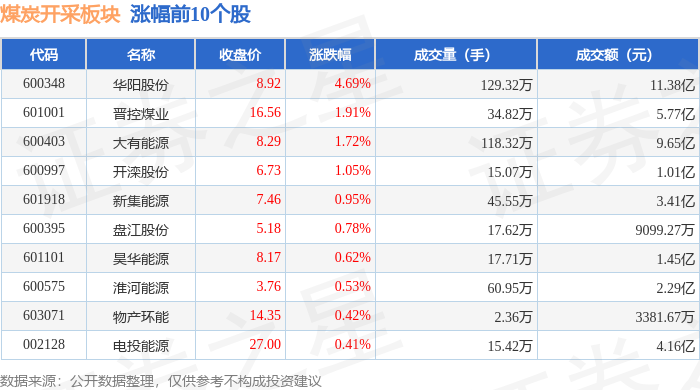
Core Insights - The coal mining sector experienced a decline of 0.24% on November 7, with Zhengzhou Coal Power leading the drop [1][2] - The Shanghai Composite Index closed at 3997.56, down 0.25%, while the Shenzhen Component Index closed at 13404.06, down 0.36% [1] Stock Performance - The top-performing stocks in the coal mining sector included: - Biyang Co. (600348) with a closing price of 8.92, up 4.69% and a trading volume of 1.2932 million shares, totaling 1.138 billion yuan [1] - Jinko Coal Industry (601001) closed at 16.56, up 1.91% with a trading volume of 348,200 shares, totaling 577 million yuan [1] - Conversely, Zhengzhou Coal Power (600121) saw a significant decline, closing at 5.48, down 2.66% with a trading volume of 1.2162 million shares, totaling 676 million yuan [2] Capital Flow - The coal mining sector experienced a net outflow of 562 million yuan from major funds, while retail investors contributed a net inflow of 553 million yuan [2][3] - Notable capital flows included: - China Shenhua (601088) with a net inflow of 35.4985 million yuan from major funds, but a net outflow of 28.0975 million yuan from speculative funds [3] - Biyang Co. (600348) had a net inflow of 18.1573 million yuan from major funds, while speculative funds saw a net outflow of 48.245 million yuan [3]