天弘基金

Search documents
2025年公募基金排名战:一场主动与被动的“双轨竞速”
2 1 Shi Ji Jing Ji Bao Dao· 2025-12-23 13:28
Core Insights - The 2025 public fund ranking highlights a dual-path competition between active and passive funds, with significant returns achieved through different strategies [1][3] - Active funds, led by Yongying Technology Smart Selection with a 231% annual return, focus on precise industry targeting and high-concentration stock selection, while passive funds, such as Guotai Communication Equipment ETF with a 125.7% increase, benefit from explosive growth in high-prosperity themes like communication and artificial intelligence [1][3] Group 1: Active Fund Performance - As of December 22, 2025, 93.44% of the 13,530 public funds reported positive returns, contrasting sharply with the previous three years of market downturns [2] - Active equity funds achieved an average return of 29.38%, with 95.75% of these funds posting positive returns, and 66 funds exceeding 100% returns [2][3] - The top ten active funds for the year were all technology and growth-oriented, with the top performer, Yongying Technology Smart Selection A, achieving a net value growth rate of 231.72% [3][4] Group 2: Passive Fund Performance - Passive index funds also showed strong performance, with an average return of 23.68% across 2,362 funds, and 91.41% of these funds achieving positive returns [2][3] - The Guotai CSI Communication Equipment ETF led the passive fund rankings with a 125.70% annual increase, outperforming many actively managed products [6][7] Group 3: Investment Trends and Strategies - The competition between active and passive funds is characterized by a clear divide, with active funds generating alpha through deep research and concentrated holdings, while passive funds capture beta returns through strategic industry trend positioning [3][4] - The 2025 market saw a significant shift towards thematic investments, particularly in technology sectors, with a notable focus on AI and communication industries [5][6] - The total scale of ETFs surged from approximately 3.73 trillion yuan to about 5.88 trillion yuan, marking a 58% growth rate, indicating a historic moment for passive investment [7] Group 4: Industry Changes and Future Outlook - New regulations in the fund industry are expected to enhance transparency and standardization, impacting how fund managers approach performance and rankings [7] - Fund managers are increasingly adjusting their investment frameworks to align with emerging industry trends, reflecting a shift towards more flexible and responsive investment strategies [7][8] - Investors are diversifying their choices, with some favoring high-risk, high-reward active funds while others opt for ETFs to spread risk across the technology sector [10]
“破1”潮下规模逆势增超万亿!货基靠什么“圈粉”?
Di Yi Cai Jing· 2025-12-23 12:03
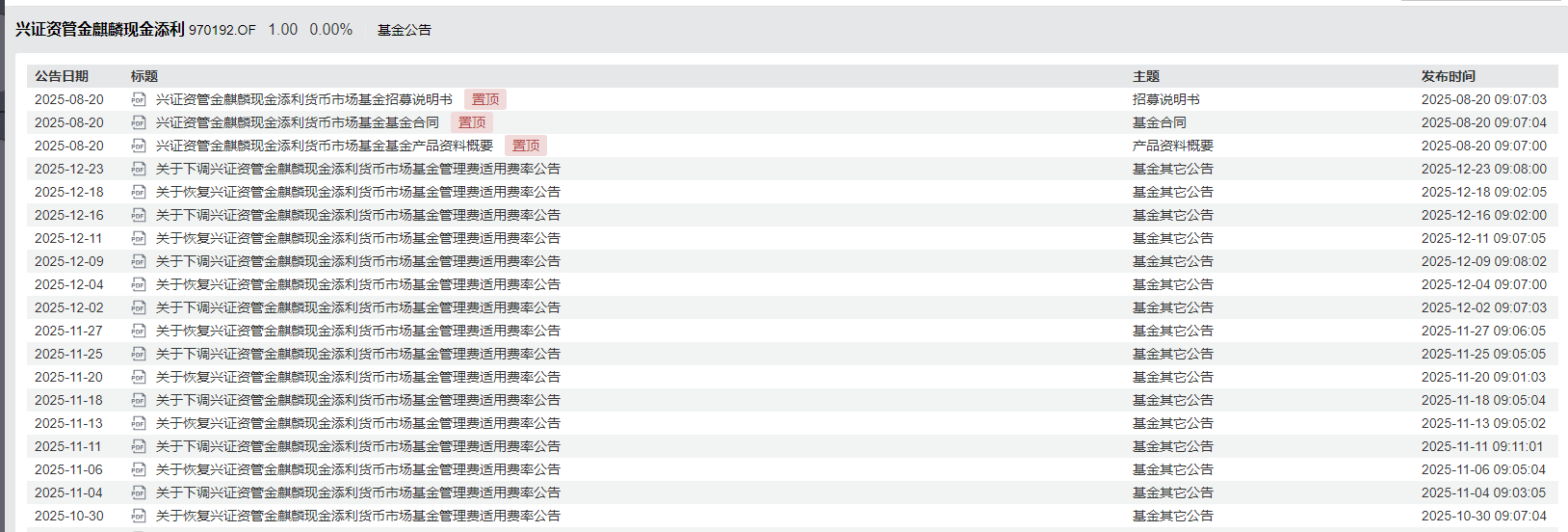
Core Viewpoint - The decline in average 7-day annualized yield of money market funds (MMFs) to 1.24% has raised questions among investors about the value of investing in these funds, especially as nearly 100 products yield below 1% [1][7] - Despite the low yields, the total scale of MMFs has increased, surpassing 15 trillion yuan, indicating a continued demand for these funds as cash management tools [1][7] Group 1: Yield Trends - The average 7-day annualized yield for MMFs has decreased significantly from 1.6% last year to 1.24%, marking a decline of 0.36 percentage points [1][2] - No MMFs currently yield over 2%, with the highest yield being 1.86%, compared to 57 funds yielding over 2% last year [2] - A significant number of funds, 93, now have yields below 1%, a 2.4 times increase year-on-year [2] Group 2: Fund Size and Investor Behavior - The total scale of MMFs has grown by over 1 trillion yuan since the beginning of the year, reaching 15.05 trillion yuan, which constitutes 40.73% of the total market [7] - The number of accounts holding MMFs has exceeded 2 billion, with an increase of nearly 7 million accounts in the first half of the year [8] - The growth in MMF size is attributed to funds being redirected from bond funds and the inclusion of MMFs in some wealth management products [8] Group 3: Fee Adjustments and Management - Several MMFs have adjusted their management fees in response to declining yields, with some lowering fees to 0.3% when yields fall below certain thresholds [3][5] - A trend of passive fee reductions has been observed, with 17 funds making similar adjustments in the past month [4][5] - High management fees are prevalent in some MMFs, particularly those designed for institutional clients, which may not align with the general market fee levels [6] Group 4: Value Proposition of MMFs - Industry experts assert that despite declining yields, MMFs retain their core value as essential cash management tools, particularly in a low-interest-rate environment [1][9] - MMFs are viewed as suitable for risk-averse investors and as foundational assets for more sophisticated investors, providing liquidity and flexibility [9][10] - The integration of MMFs with consumer payment scenarios has solidified their role as a fundamental financial infrastructure, making them less replaceable [9][10]

ETF及指数产品网格策略周报-20251223
HWABAO SECURITIES· 2025-12-23 11:34
Group 1 - The report outlines a grid trading strategy that capitalizes on price fluctuations rather than predicting market trends, making it suitable for volatile markets [4][13] - Characteristics of suitable grid trading targets include being exchange-traded, having stable long-term trends, low transaction costs, good liquidity, and high volatility, with equity ETFs being particularly appropriate [4][13] Group 2 - The report highlights key ETFs for grid trading, including the Robot ETF (159770.SZ), which is expected to benefit from a confluence of policy support, technological advancements, and increasing demand, projecting a significant growth year in 2025 [4][14] - The Central Enterprise Technology ETF (560170.SH) focuses on state-owned enterprises in core technology sectors, aligning with national strategies for technological self-reliance and modernization [5][17] - The Securities ETF Leader (159993.SZ) indicates growth potential for leading brokerage firms, supported by improved market conditions and ongoing capital market reforms, with a reported 62.48% year-on-year increase in net profit for the sector [6][20] - The Hong Kong Central Enterprise Dividend ETF (513910.SH) emphasizes high dividend yields, which are expected to gain traction in a low-interest-rate environment, supported by government policies promoting shareholder returns [7][23]
昔日“牛基”今何在?
Zheng Quan Shi Bao Wang· 2025-12-23 09:20
Core Viewpoint - The article discusses the performance of actively managed equity funds in the Chinese stock market, highlighting the emergence of new "bull funds" and the fading glory of past top-performing funds, emphasizing the need for a shift towards long-term investment strategies and stable fund management practices [1][9]. Group 1: Performance of Active Equity Funds - As of December 22, the Shanghai Composite Index has increased by 12.67% in 2024, with an additional 16.87% rise for the year, indicating a likely two consecutive years of gains [1]. - Nearly 40 actively managed equity funds have doubled their annual returns, with Yongying Technology Smart Selection A achieving approximately 219% annual return, marking it as the first "double fund" since 2008 [1]. - Historical analysis shows that only 5 out of 30 top-performing funds from previous bull markets have maintained strong performance, while the majority have returned to mediocre status [2]. Group 2: Reasons for Declining Performance of Past "Bull Funds" - Many former "bull funds" have lost their luster due to excessive growth in fund size, which hampers investment flexibility and increases transaction costs [4]. - Over-reliance on a single star fund manager has led to significant performance declines when key personnel leave or fail to adapt to market changes [5]. - Short holding periods and frequent style shifts have also contributed to the underperformance of many funds, as they chase short-term trends without a stable investment framework [6]. Group 3: Structural Changes in the Fund Industry - The public fund industry is undergoing a structural transformation, moving from a short-term ranking focus to a value investment approach aimed at achieving stable returns [7]. - Successful long-term funds are characterized by stable research teams, strong risk control capabilities, and robust company support systems [8]. - The industry is exploring new active investment models, integrating industrialized concepts into research processes to enhance efficiency [8]. Group 4: Long-Term Investment Philosophy - The fate of past "bull funds" reflects the evolution of the A-share market and the industry's changing development philosophy, emphasizing the importance of long-term investment strategies [9]. - Investors are encouraged to focus on funds with clear investment philosophies, stable teams, and proven cross-cycle capabilities rather than chasing annual performance champions [10]. - Funds that may not shine in a single bull market can still create value through solid strategies, rigorous research, and strict risk control [11].
昔日“牛基”今何在?
券商中国· 2025-12-23 09:03
Core Viewpoint - The article discusses the performance of actively managed equity funds in the context of the A-share market, highlighting the emergence of new "bull funds" and the fading glory of past top-performing funds, emphasizing the need for a shift from short-term performance to long-term investment strategies [1][11]. Group 1: Performance of Active Equity Funds - As of December 22, the Shanghai Composite Index has increased by 12.67% in 2024, with an annual increase of 16.87%, indicating a likely two-year consecutive rise in annual K-line [1]. - Nearly 40 actively managed equity funds have doubled their annual returns, with Yongying Technology Smart Selection A achieving approximately 219% annual return, marking it as the first "double fund" since 2008 [1]. - Historical analysis shows that only 5 out of 30 top-performing funds from previous bull markets have maintained strong performance, while 25 have returned to mediocre status [2]. Group 2: Reasons for Declining Performance of Former "Bull Funds" - Many former "bull funds" have lost their luster due to excessive scale growth, which reduces investment flexibility and increases transaction costs, making it harder to achieve excess returns [5][6]. - Over-reliance on a single star fund manager has led to significant performance drops when key personnel leave or fail to adapt to market changes [6]. - Short holding periods and frequent style shifts have hindered many funds from accumulating long-term returns, as they chase short-term trends without a stable investment framework [7]. Group 3: Structural Changes in the Fund Industry - The public fund industry is undergoing a structural transformation, moving from a "star-making" model focused on short-term rankings to a "systematic approach" that emphasizes value investing and stable returns [8][12]. - Successful long-term funds often have stable research teams and strong risk control capabilities, which help them navigate market downturns effectively [8][9]. - Companies are increasingly adopting innovative investment models and enhancing their research capabilities to adapt to market changes, indicating a shift towards a more collaborative and systematic investment approach [9]. Group 4: Long-term Investment Philosophy - The fate of past "bull funds" reflects the evolution of the A-share market and the investment philosophy of the industry, highlighting the importance of a stable investment strategy over reliance on individual fund managers [11]. - Investors are encouraged to focus on funds with clear investment philosophies, stable teams, and proven cross-cycle capabilities, rather than chasing annual performance champions [12].

港股通央企红利ETF天弘(159281)涨0.40%,成交额3407.89万元
Xin Lang Cai Jing· 2025-12-23 07:12
Group 1 - The Tianhong CSI Hong Kong Stock Connect Central State-Owned Enterprises Dividend ETF (159281) closed at a 0.40% increase with a trading volume of 34.08 million yuan on December 23 [1] - The fund was established on August 20, 2025, with an annual management fee of 0.50% and a custody fee of 0.10% [1] - As of December 22, the fund's latest share count was 341 million shares, with a total size of 340 million yuan [1] Group 2 - The fund's recent trading activity shows a cumulative trading amount of 615 million yuan over the last 20 trading days, with an average daily trading amount of 30.75 million yuan [1] - The current fund manager is He Yuxuan, who has managed the fund since its inception, with a return of -0.22% during the management period [1] Group 3 - The top holdings of the fund include COSCO Shipping Holdings, Orient Overseas International, China National Foreign Trade Transportation Group, PetroChina, CITIC Bank, CNOOC, China Shenhua Energy, People's Insurance Company of China, China Unicom, and Agricultural Bank of China, with respective holding percentages [2] - The largest holding is COSCO Shipping Holdings at 0.85%, followed by Orient Overseas International at 0.40% and China National Foreign Trade Transportation Group at 0.33% [2]


深耕零售客群、布局科技创新,天弘基金诠释公募差异化发展新范式
Sou Hu Cai Jing· 2025-12-23 07:06
Core Viewpoint - The speech by the Chairman of the China Securities Regulatory Commission emphasizes that high-quality development in the investment banking sector is not exclusive to top institutions, but also achievable by smaller firms through specialization and resource concentration in niche areas [1] Group 1: Differentiation Strategy - Tianhong Fund exemplifies a differentiated development model by focusing on retail clients and the technology innovation sector, aligning with the future direction outlined in the Chairman's speech [1][2] - The company has built a robust retail client base through its early investment in inclusive finance and internet channels, which it considers a core foundation for its growth [2] Group 2: Channel Development - Tianhong Fund actively collaborates with major internet platforms like Ant Group and JD Finance to reach a broader online user base, enhancing its retail service ecosystem [3] - The launch of investment tools such as the "Institutional Express" has shown significant performance, with a back-tested return of 48.18% over the past year, outperforming the CSI 300 Index by 32 percentage points [3] Group 3: Product Strategy - Index products are central to Tianhong Fund's strategy for serving retail investors, characterized by low thresholds, low costs, and transparency [5] - As of mid-2025, Tianhong Fund leads the market with 12.84 million holders of index funds, holding 14 positions among the top 100 index products in terms of holder numbers [5] - The company has reduced fees for 14 funds in response to calls for cost reduction, with management fees for passive index funds dropping to below 0.5% [5] Group 4: Investor Education - Tianhong Fund enhances user engagement through investor education initiatives, conducting extensive user research to understand their needs and preferences [7] - The company has organized over 20 investor education events since 2024, reaching more than 5,000 participants and focusing on long-term investment strategies [7] Group 5: Support for Innovation - Tianhong Fund is committed to supporting the real economy and national strategies, particularly in the technology innovation sector, by developing a range of index products targeting high-growth industries [8] - The company has launched unique index funds that track specific sectors aligned with national strategic directions, such as electric vehicles and biotechnology [8] Group 6: Fixed Income Innovations - Tianhong Fund is exploring innovations in fixed income by investing in "innovation bonds," which address the financing challenges faced by technology companies [9] - The market for innovation bonds has seen significant growth, with 1,428 bonds issued in the first three quarters of the year, totaling 1.58 trillion yuan, reflecting a 43.95% increase in quantity and a 74.94% increase in total issuance compared to the previous year [9] Group 7: Conclusion - Tianhong Fund's approach illustrates that the key to avoiding homogenization in the investment sector lies in focusing on core client groups and specialized sectors, thereby contributing to a multi-layered and diversified ecosystem in the public fund industry [10]
现货黄金再度刷新历史高点,黄金ETF、上海金ETF上涨,年内涨幅超62%
Ge Long Hui· 2025-12-23 03:14
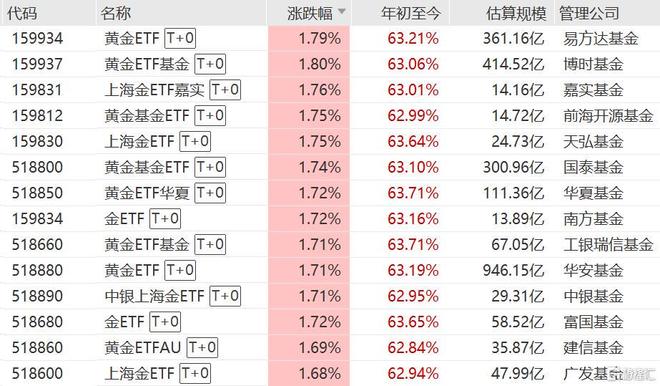
Group 1 - Spot gold has reached a new historical high, with London gold prices surpassing $4,490 per ounce, marking a year-to-date increase of 70.87%, nearing the largest annual increase since 1979 [1] - Gold ETFs, including various funds, have also seen significant gains, with year-to-date increases exceeding 62% [1] Group 2 - International gold and silver futures prices have reached historical highs, influenced by geopolitical tensions, particularly the U.S. seizure of a Venezuelan oil tanker, adding uncertainty to the market [3] - Analysts from UBS noted that gold prices rebounded quickly from a drop at the end of October, solidifying its position as one of the strongest assets this year, driven by geopolitical unrest and changes in the U.S. interest rate environment [3] - Central banks and investors continue to show strong demand for gold, with global central bank purchases expected to reach between 900 to 950 metric tons this year [3] Group 3 - Wall Street is optimistic about gold prices in the coming year, with target ranges between $4,800 and $5,000, driven by strong central bank purchases and ongoing fiscal concerns in the U.S. [4] - HSBC's report emphasizes that the U.S. fiscal deficit is a significant factor driving gold demand, as investors increasingly view gold as a hedge against debt sustainability risks and potential dollar weakness [4] Group 4 - The Federal Reserve's recent decision to lower interest rates is seen as dovish, which is favorable for gold, with expectations of further rate cuts increasing [5] - Long-term factors indicate a continued decline in global dollar reserves and rising U.S. fiscal deficits, which are beneficial for gold's monetary attributes [5] - Concerns about domestic physical gold demand due to new tax policies and potential declines in jewelry demand by 2026 highlight the importance of central bank purchases and investment demand to offset these declines [5]
大部分基金公司都是陪跑
Xin Lang Cai Jing· 2025-12-23 01:44
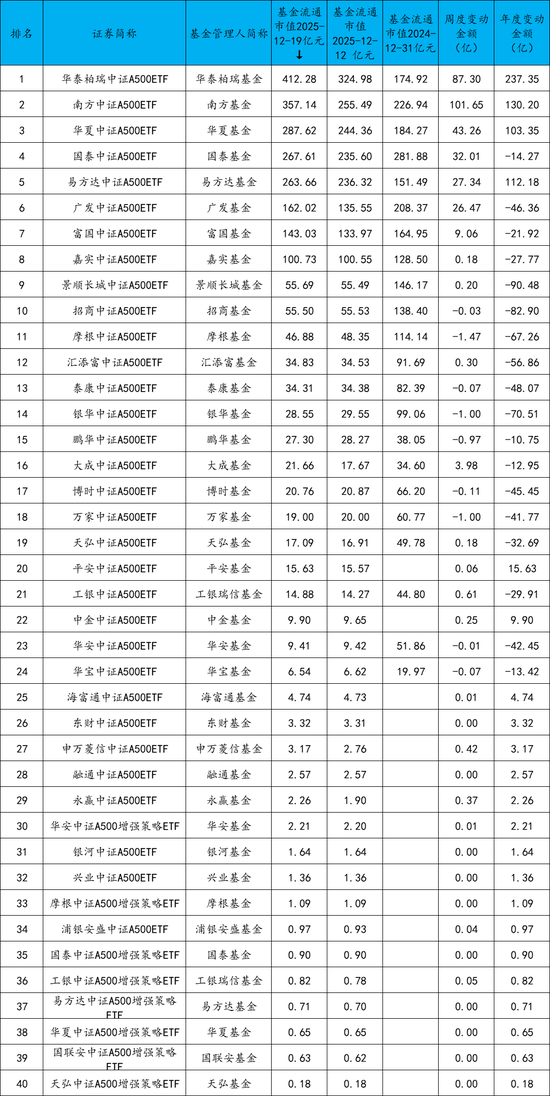
Core Viewpoint - The launch of the CSI A500 index has created a competitive landscape in the ETF market, where only a few major players dominate, while many smaller firms end up as "also-rans" [1][2][10]. Group 1: Market Dynamics - The CSI A500 index was launched in September 2024 and is considered a significant opportunity for public funds, leading to a rush of product submissions from various fund companies [2][17]. - By mid-December 2025, the total market size of A500 ETFs approached 250 billion yuan, indicating a rapid growth in this segment [2][17]. - The market has shown a clear "head effect," where a few leading funds capture the majority of the assets, leaving smaller firms struggling to compete [3][18]. Group 2: Fund Performance - The top five A500 ETFs, including Huatai-PB, Southern, and Huaxia, have assets ranging from 260 billion to 412 billion yuan, collectively dominating the market with nearly 1.6 trillion yuan [6][22]. - Recent inflows have been substantial, with Huatai-PB and Southern ETFs attracting 87.30 billion and 101.65 billion yuan, respectively, in just one week [7][22]. - The performance of smaller funds has been lackluster, with many experiencing significant redemptions and struggling to maintain their market presence [7][22]. Group 3: Challenges for Smaller Firms - Smaller public funds face significant challenges due to resource constraints, making it difficult to compete with larger firms that have established marketing and distribution channels [11][12]. - The cost of marketing and maintaining sales channels is high, with management fees for A500 ETFs around 0.15%, making it hard for smaller firms to achieve profitability without substantial scale [11][12]. - Some smaller firms have opted to withdraw from the competition, adopting a strategy of waiting rather than engaging in a costly race for market share [12][13]. Group 4: Future Outlook - The competitive landscape suggests that the development of index funds should be gradual, focusing on building differentiated competitive advantages rather than following trends blindly [13]. - Smaller firms may need to explore niche markets such as thematic, strategy-based, QDII, bond, or actively managed ETFs to find sustainable growth opportunities [13]. - The prevailing trend indicates that a few giants will continue to dominate the market, while many participants may remain on the sidelines [14].
年内ETF发行创新高,QDII型超募4倍
Guo Ji Jin Rong Bao· 2025-12-22 14:14
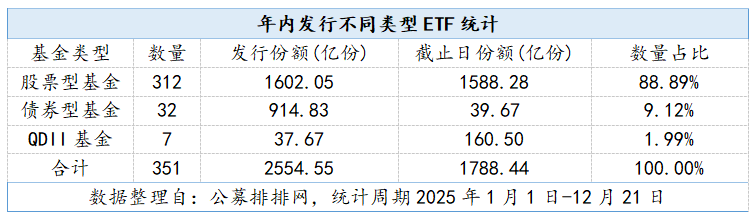
Core Insights - The ETF market is experiencing explosive growth in 2025, with a record issuance of 351 products and a total issuance volume of 2,554.55 billion shares, surpassing the total issuance of the previous two years [1][2]. Group 1: ETF Market Overview - The total number of ETFs issued in 2025 reached 351, with a total issuance volume of 2,554.55 billion shares, marking a historical high [1]. - The issuance of stock ETFs is the primary driver, with 312 products issued, accounting for 88.89% of the total number of ETFs and 62.71% of the total issuance volume [2]. - Bond ETFs also saw significant growth, with 32 new products issued and a total issuance volume of 914.83 billion shares, exceeding historical totals [3]. Group 2: Performance of Different ETF Types - The total shares of bond ETFs reached 39.67 billion, marking a new high, and representing over three times the total from the past four years [3]. - QDII ETFs, although fewer in number with only 7 products issued, experienced substantial growth in issuance volume, reaching 37.67 billion shares, with a final share count of 160.50 billion, indicating strong demand for global asset allocation [3]. Group 3: Issuing Institutions - A total of 47 public fund institutions participated in ETF issuance, with 31 institutions issuing at least 2 products and 15 institutions issuing more than 10 products [3]. - E Fund led the market with 31 products and an issuance volume of 172.41 billion shares, followed by Fuguo Fund with 26 products and 160.12 billion shares [4]. Group 4: Market Dynamics and Trends - The market is characterized by a significant over-subscription phenomenon, with 6 institutions experiencing notable over-subscription, reflecting strong market recognition of quality ETF products [4]. - Factors such as policy support, expedited approval processes, and the popularity of index investing have contributed to the dual breakthroughs in issuance scale and product quantity in 2025 [4]. - The core advantages of ETFs, including low fees, risk diversification, and high transparency, continue to attract both institutional and individual investors [4].