
拓普集团

Search documents
农机——冉冉升起的中国出口新星
2025-12-15 01:55
Summary of Key Points from the Conference Call on China's Agricultural Machinery Industry Industry Overview - The agricultural machinery industry in China is experiencing significant growth, particularly in exports, driven by the withdrawal of Western brands from the Russian market due to the Russia-Ukraine conflict. This has allowed Chinese companies to fill the gap left behind [1][2][3]. - Despite a forecasted slowdown in export growth due to Russia's new agricultural machinery scrappage tax policy, the overall export value and volume for 2025 are expected to remain strong, with monthly export growth projected at 30%-35% [1][2]. Core Insights and Arguments - The growth of Chinese agricultural machinery exports is notable against a backdrop of declining agricultural machinery revenues in other regions, such as the U.S., Europe, Latin America, and Asia, where factors like falling grain prices, high interest rates, and high inventory levels are impacting sales [2][3]. - Leading companies in the sector, such as YTO and Lovol, are expected to see export growth rates between 25%-50% in 2025, indicating resilience in the face of global demand challenges [1][3]. - Emerging markets in Africa, Central Asia, and Southeast Asia are identified as having strong growth potential for agricultural machinery, with their mechanization levels comparable to those of China several decades ago. Chinese companies are well-positioned to compete in these markets due to their cost advantages [1][4]. Strategic Adjustments - Chinese agricultural machinery companies are shifting their strategies from focusing on high-horsepower products to low-horsepower products to better meet local market demands. This includes establishing parts bases and after-sales service systems to enhance competitiveness [1][4][5]. - Companies are increasingly recognizing the need to expand overseas as a solution to domestic market saturation, leading to greater resource allocation for international expansion [4][5]. Future Outlook - The agricultural machinery industry in China is expected to see continued optimistic export prospects in the coming years, with significant underestimation of demand growth in emerging markets [4][5]. - The anticipated global economic recovery, alongside favorable conditions such as potential interest rate cuts by the Federal Reserve and a rebound in commodity prices, is expected to create new development opportunities for the industry [5][8]. - The domestic market for agricultural machinery remains stable, with recent increases in corn prices due to adverse weather conditions and reduced import quotas, which are likely to stimulate demand in the upcoming quarters [9][10]. Conclusion - The transition of the Chinese agricultural machinery sector from a domestic demand-driven model to an export-driven one is expected to enhance competitiveness and profitability, positioning Chinese companies favorably in the global agricultural machinery market [10].
信达证券:汽车行业向高端化、智能化、全球化高质量发展 人形机器人市场前景广阔
Zhi Tong Cai Jing· 2025-12-15 01:53
智能驾驶:法规逐步完善,L3与高阶智驾逐步落地 当前国内关于智能网联汽车的法规持续完善,行业发展环境逐步规范化。同时自主品牌加快智驾技术研 发,行业智驾渗透率持续提升,2025年1-9月L2++及以上车型销量达364.3万辆,占比为38.65%,其中自 主品牌在L2级及以上辅助驾驶渗透率提升最快。在高阶自动驾驶层面,Robo-X持续落地:Robotaxi2030 年市场规模有望达到2700亿元,且无人物流车逐步落地,2030年中国无人驾驶物流车产业产值增量有望 升至5948亿元。 机器人:产业快速迭代,行业空间广阔 信达证券(601059)发布研报称,汽车行业向高端化、智能化、全球化高质量发展。2025年汽车销量有 望突破3400万辆,自主品牌与新能源占比显著提升。智能驾驶领域法规完善,L3与高阶智驾加速落 地,相关市场规模潜力巨大。机器人产业快速迭代,特斯拉加速量产,国内政策扶持力度大,人形机器 人市场前景广阔,并有望带动汽车零部件产业发展。 信达证券主要观点如下: 高端化、智能化、全球化,行业迎来高质量发展 政策扶持+新能源、出口发力,2025年全年汽车销量有望突破3400万辆,同时自主品牌、新能源车型占 ...

富森美押中宏明电子IPO成功过会 近五年投资收益达4.39亿元
Zheng Quan Shi Bao Wang· 2025-12-14 12:45
Core Viewpoint - Chengdu Hongming Electronics Co., Ltd. successfully passed the IPO review, highlighting the investment opportunities for Fusenmei in the capital market [1] Group 1: Investment Strategy - Fusenmei has been actively participating in the establishment of equity investment funds and direct investments, focusing on emerging industries such as new energy and artificial intelligence [2] - The investment in Hongming Electronics dates back to the end of 2019, when Fusenmei contributed 200 million yuan to the Chengdu Chuanjing Longchu No. 1 Equity Investment Fund, which has a total target subscription of 1.2 billion yuan [2] - Fusenmei has established multiple equity investment funds with various professional investment institutions, indirectly investing in high-quality companies in sectors like photovoltaic equipment and AI chips [2] Group 2: Company Performance - Hongming Electronics is a well-established manufacturer of electronic components, primarily engaged in the R&D, production, and sales of new electronic components, with applications in consumer electronics and new energy sectors [2] - Fusenmei's investment in Hongming Electronics represents a significant milestone, allowing the company to diversify from its traditional home furnishing business and tap into the high-value electronic manufacturing sector [4] Group 3: Financial Performance - From 2020 to 2024, Fusenmei's investment income totaled 43.9 million yuan, with annual returns showing a positive trend [6] - In the first three quarters of the current year, Fusenmei achieved an operating income of 924 million yuan and a net profit of 477 million yuan, indicating stable overall performance despite economic pressures [7] - Compared to competitors like Meikailong and Juran Home, which reported significant losses, Fusenmei stands out as a bright spot in the home furnishing industry [8]

汽车行业2026年度投资策略:破局与新生:整车出海、AI应用汽零,迎接优质公司价值重估
Orient Securities· 2025-12-14 06:32
Core Insights - The report emphasizes the importance of overseas expansion and AI applications in the automotive industry, particularly for vehicle manufacturers and parts suppliers, as a means to achieve growth and value reassessment by 2026 [2][9][14]. Group 1: Automotive Industry Overview - In 2025, the domestic automotive market experienced significant growth due to policies promoting vehicle replacement and increasing exports, with a notable rise in sales of new energy vehicles (NEVs) [14][19]. - The outlook for 2026 indicates potential growth pressures in the domestic market due to tightening policies and the phasing out of tax exemptions for NEVs, while exports are expected to remain a key growth driver [15][20]. Group 2: Vehicle Segment Analysis - The report forecasts that the domestic passenger vehicle market will see stable sales, with an estimated total of 30.37 million units in 2026, reflecting a 1.1% year-on-year increase, driven by export growth [29][39]. - The export volume of passenger vehicles is projected to reach approximately 6.56 million units in 2026, representing a 14% year-on-year increase, as domestic brands enhance their overseas presence [39][40]. Group 3: New Energy Vehicles (NEVs) - The penetration rate of NEVs is expected to continue rising, with sales projected at around 17.41 million units in 2026, marking a 12% year-on-year increase [9][30]. - The report highlights a shift from a "price war" to a "value war" among NEV manufacturers, indicating a competitive landscape focused on quality and technology [9][16]. Group 4: Auto Parts Industry - The report identifies overseas business as a crucial growth point for auto parts companies, with expectations of improved profitability from international operations as companies expand their global footprint [9][16]. - AI applications in areas such as humanoid robots, AI liquid cooling, and intelligent driving are anticipated to create new growth opportunities for parts suppliers, with significant advancements expected in 2026 [9][16][19]. Group 5: Investment Recommendations - The report recommends focusing on mid-cap blue-chip companies in the auto parts sector, as their overseas business is expected to contribute significantly to profitability in the coming years [3][9]. - Key investment targets include companies like Yinchuan, New Spring, Top Group, and others that are well-positioned to benefit from the trends in overseas expansion and AI integration [3].





人形机器人行业周报:人形机器人公司融资加速,浙江荣泰泰国基地扩产机器人部件-20251214
Guohai Securities· 2025-12-14 05:01
Investment Rating - The report maintains a "Recommended" rating for the humanoid robot industry, indicating a positive outlook for the sector [10]. Core Insights - The humanoid robot industry is experiencing accelerated financing activities, with companies like Zhongqing Robotics and Yunshe Technology successfully completing multiple funding rounds to enhance R&D and commercialize products [1][2][6]. - The report highlights the potential for humanoid robots to create a market space broader than that of automobiles, marking a significant investment opportunity as the industry transitions from 0 to 1 [10]. - The report emphasizes the importance of companies with core component capabilities and active involvement in humanoid robotics, suggesting a focus on specific stocks within this sector [10]. Summary by Sections Recent Developments - Zhongqing Robotics completed A1+ and A2 funding rounds, attracting investments from various institutional investors [1]. - Yunshe Technology announced over 500 million RMB in C round financing, aimed at enhancing R&D for humanoid and quadruped robots [2]. - Luming Robotics secured Pre-A1 and Pre-A2 funding rounds, focusing on investments in intelligent data and hardware [2]. - Yuanzhi Intelligent was recognized in the national AI medical device initiative, showcasing its advancements in surgical robotics [3]. Industry Performance - The humanoid robot industry is positioned to benefit from the ongoing electrification and intelligence trends, with significant product iterations and business collaborations underway [10]. - The report notes that the humanoid robot sector may be on the verge of a transformative moment akin to the "ChatGPT moment" [10]. Key Companies to Watch - The report suggests monitoring companies with established core components and active engagement in humanoid robotics, including Sanhua Intelligent Controls, Top Group, and Zhejiang Rongtai, among others [10].

人形机器人细分龙头年内涨超300% 梳理产业链成本占比居前A股名单
Xin Lang Cai Jing· 2025-12-13 11:53
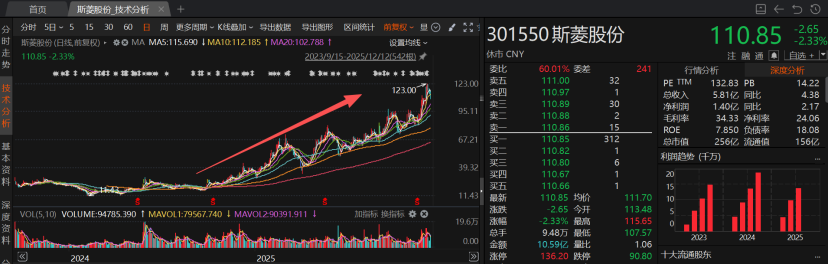
Industry Overview - The humanoid robot industry is accelerating mass production by 2025, with companies like Zhiyuan achieving deliveries in the thousands and a significant increase in the localization rate of core components [1] - Continuous support from domestic and international policies is driving both market enthusiasm and the commercialization process [1] - The industry trend is expected to provide dual drivers for performance and valuation in the sector, according to a report from CITIC Securities [1] Market Performance - Siling Co., Ltd. has seen a maximum stock price increase of 329% year-to-date, while Haoshi Electromechanical has experienced a 134% increase [1] Component Cost Analysis - In the humanoid robot supply chain, the cost breakdown for various components includes: - Actuators: 1% cost share, with companies like Sanhua Intelligent Control and Top Group involved [2][3] - Frameless torque motors: 4% cost share, with companies such as Buke Co., Haoshi Electromechanical, and Leisai Intelligent [2][3] - Harmonic reducers: 5% cost share, with companies like Green Harmonic, Hanyu Group, Siling Co., and Fengli Intelligent [2][3] - Encoders: 2.7% cost share, with companies including Inovance Technology and Aopu Optoelectronics [2][3] - Bearings: 1.2% cost share, with companies like Lixing Co., Southern Precision, and Guoji Precision [2][3] Company Highlights - Haoshi Electromechanical is focusing on building a second growth curve through its robotics business, which includes a robust "N+1+3" business system [4] - The company has achieved significant improvements in transmission precision and reduced noise levels in its products, positioning itself competitively in the market [4] - Buke Co. is recognized as a domestic leader in frameless torque motors, with projected sales of approximately 24,000 units in 2024 [5] - Siling Co. is a leading domestic company in harmonic reducers, with a focus on applications in industrial and humanoid robots [5] - Green Harmonic holds a 26% market share in the domestic harmonic reducer market, with robot-related revenue constituting over 80% of its total income [6]


拓普集团(601689) - 拓普集团关于闲置募集资金现金管理到期赎回的公告
2025-12-12 09:46
二、公司最近十二个月使用募集资金委托理财的情况 证券代码:601689 证券简称:拓普集团 公告编号:2025-085 截至 2025 年 12 月 12 日,公司最近十二个月使用募集资金委托理财的情况 如下表: 宁波拓普集团股份有限公司 关于闲置募集资金现金管理到期赎回的公告 本公司董事会及全体董事保证本公告内容不存在任何虚假记载、误导性陈述 或者重大遗漏,并对其内容的真实性、准确性和完整性承担个别及连带责任。 宁波拓普集团股份有限公司(以下简称"公司")分别于 2025 年 4 月 22 日 召开第五届董事会第二十一次会议及第五届监事会第十七次会议、2025 年 5 月 14 日召开 2024 年年度股东大会,审议通过了《关于使用部分暂时闲置募集资金 委托理财的议案》,授权公司(含全资子公司)使用最高额度不超过人民币 24 亿元的暂时闲置募集资金委托理财,用于结构性存款或购买保本型理财产品,授 权期限自 2025 年 7 月 1 日起至 2026 年 6 月 30 日止,额度内资金可以循环滚动 使用。详情请见公司于 2025 年 4 月 24 日在上海证券交易所网站披露的《拓普集 团关于使用部分暂时闲置募 ...
走访上市公司 推动上市公司高质量发展系列(三十)
证监会发布· 2025-12-12 08:49
丨 来源:每日经济新闻 2025-12-05 一家运输行业公司负责人表示,针对公司提出的在持续改善资本结构、拓展国内外业务、 提升服务水平等工作中遇到的问题,深交所研究提出具体举措,持续加强日常沟通、规则解答 和培训交流,积极做好支持服务,帮助公司更好解决难题、积极应对风险与挑战。接下来,公 司将依法依规高质量做好信息披露工作,主动维护投资者关系,积极参与投资者交流活动,促 进形成正向循环,努力提升投资者回报。 已办理落实400多项上市公司诉求建议 深交所高度重视上市公司高质量发展。本轮走访活动开展以来,主要负责同志多次带队深 入公司一线,累计走访调研140余家次上市公司,专题调研产业链协同、海外布局配套、资金 保障等难点问题。为积极回应公司诉求,深交所组建工作专班,加强动态跟踪,强化分类施 策,切实推进解决调研中反映的实际问题。 截至目前,深交所已办理落实400多项诉求建议,涉及信息披露、并购重组、再融资、股 权激励、培训与行业交流等方面,为公司提供更精准的服务支持。同时,深交所重视反馈闭 环,通过走访现场答复、书面答复、回访等方式,切实回应公司每一项诉求建议,实现"件件 有着落、事事有回音"。 提高上市公 ...

电动化拖垮百年老店,中国供应链扛起时代大旗
3 6 Ke· 2025-12-11 02:27
Core Insights - The Chinese automotive industry is experiencing a significant transformation, with high-end models like the Huawei's Zun Jie S800 driving advancements in domestic technology and supply chains [1] - The global automotive parts industry is facing a stark contrast in performance, with European and American giants struggling while Chinese suppliers thrive [3][4] Group 1: Performance of Global Automotive Parts Industry - European and American automotive parts companies are facing ongoing challenges, including significant profit declines and restructuring efforts [5][9] - Major companies like Schaeffler and Continental are reporting substantial losses, with Schaeffler's net profit down 45.9% and Continental's net loss exceeding 700 million euros [6][9] - In contrast, Japanese and Korean companies are benefiting from favorable exchange rates and government subsidies, leading to stable revenue growth [12][13] Group 2: Rise of Chinese Automotive Parts Suppliers - Chinese automotive parts suppliers are rapidly rising, with 15 companies making it to the top 100 global suppliers list, showcasing their growth potential [14][15] - The Chinese automotive market is booming, with production and sales figures showing double-digit growth, particularly in the electric vehicle sector [16] - Leading companies like CATL and Yanfeng are reporting impressive revenue growth, with CATL's revenue reaching 1041.86 billion yuan, a 41.21% increase year-on-year [18] Group 3: Challenges and Opportunities - Despite the growth, over 60 automotive parts companies in China are facing the "increased revenue without increased profit" dilemma, indicating a growing industry divide [20] - International companies are increasingly focusing on the Chinese market, with Magna and Denso expanding their investments and partnerships in the region [21][23] - The ongoing transition to electric and smart vehicles is reshaping the global automotive supply chain, with Chinese companies positioned to play a central role in this transformation [23]






2025年汽车悬架行业词条报告
Tou Bao Yan Jiu Yuan· 2025-12-10 12:13
Investment Rating - The report does not explicitly state an investment rating for the automotive suspension industry Core Insights - The automotive suspension industry is undergoing a profound transformation driven by electrification and intelligence, shifting the competitive focus from traditional mechanical hardware to a comprehensive system capability defined by software [4] - The demand for lightweight structural components and high-performance suspensions is increasing due to electrification, while intelligence is pushing the evolution of suspensions from passive adaptation to active prediction [4] - The value distribution across the entire industry chain will be redefined in this technological revolution, with investment opportunities focusing on leading domestic component manufacturers, system integrators with advantages in electric control suspensions, and suppliers providing key enabling technologies for intelligent suspensions [4] Summary by Sections Industry Overview - The automotive suspension system connects the vehicle body to the wheels, playing a crucial role in cushioning road impacts and ensuring good contact between the wheels and the ground [5] - The industry can be categorized into passive, semi-active, and active suspensions based on their working principles and application scenarios [5][6] Industry Characteristics - High-end market core technology barriers are significant, with foreign companies having established a "patent moat" in core suspension technologies [8] - Electrification is driving technological iterations, with new energy vehicles imposing stricter requirements on suspension systems [9] - Intelligent technology is enabling the transition of suspension systems from mechanical passive modes to electronically controlled active modes [10] Development History - The automotive suspension system has evolved from passive systems in the 1930s to semi-active systems in the 1970s, and to active systems gaining traction in the 1990s [11][12][13][14][15] Industry Chain Analysis - The automotive suspension industry chain consists of upstream (core materials and components), midstream (system design and assembly), and downstream (vehicle application and aftermarket services) [16] - The upstream component supply segment is highly concentrated, dominated by international suppliers like ZF and Continental [17][22] - Midstream, system integrators are increasingly investing in R&D to enhance differentiation and supply chain security [18][19] Market Size and Growth - The automotive suspension market size is projected to grow from 67.25 billion RMB in 2019 to 83.42 billion RMB in 2024, with a compound annual growth rate (CAGR) of 4.40% [29] - The market is expected to further expand to 111.45 billion RMB by 2029, with a CAGR of 6.10% [29] Future Trends - The demand for high-performance suspension systems is increasing, with technology being downscaled to mid-range markets [32] - The rise of line-controlled suspension systems is anticipated to support the development of automotive intelligence [33] Competitive Landscape - The competitive landscape is characterized by a "global leaders and Chinese tiered catch-up" scenario, with high market concentration [39] - Chinese manufacturers are rapidly closing the technology gap with international giants, driven by the growth of the new energy vehicle market [43][44]



