
新凤鸣

Search documents
化纤行业“反内卷”实录
市值风云· 2026-02-14 10:09
Group 1 - The core viewpoint of the article highlights the significant performance of six leading companies in the chemical fiber industry, with stock prices increasing by over 30% since mid-December 2025 [3][4] - The six leading companies include Tongkun Co., Ltd. (601233.SH), Hengyi Petrochemical (000703.SZ), Dongfang Shenghong (000301.SZ), Hengli Petrochemical (600346.SH), Rongsheng Petrochemical (002493.SZ), and Xin Fengming (603225.SH) [3] - The article notes that the performance of the chemical fiber industry, particularly polyester filament, has shown significant differentiation over the past five years, with ordinary polyester industrial yarn experiencing the most price volatility [4][6] Group 2 - Among the six leading companies, Hengli Petrochemical achieved a net profit of 15.5 billion in 2021, while in the downturn of 2024, Dongfang Shenghong reported a loss of nearly 2.3 billion [6]



化工行业2026年投资策略:周期破晓,材料乘风
Southwest Securities· 2026-02-13 23:30
Core Insights - The chemical industry is at the beginning of a new prosperity cycle globally, with Chinese chemical companies showing stronger profit foundations and elasticity due to past expansions and capital expenditures [5][11][29] - Focus on cyclical chemical products, particularly those with resource attributes and potential in the real estate chain [4][5] - The demand from major economies like China and the US is expected to improve, with China's GDP projected to exceed 140 trillion yuan, growing at 5.0% year-on-year [5][22] Group 1: Global and Domestic Chemical Landscape - The global chemical landscape is improving, with China's chemical sector becoming more resilient [9][12] - China's share of the global chemical market has significantly increased from 13% in 2004 to 47% in 2024, indicating its growing importance in the global chemical industry [14][29] - The capital expenditure in the global chemical sector has paused, with many overseas chemical companies reducing production, which may benefit Chinese companies [14][16] Group 2: Resource Attributes in Chemical Products - Three main resource directions are emphasized: mineral resources (like phosphate and potash), indicator resources (such as pesticides and refrigerants), and channel resources (like compound fertilizers) [5][33] - China's phosphate reserves rank second globally, with a steady increase in demand driven by both traditional fertilizer needs and emerging sectors like lithium iron phosphate for batteries [33][36] - The supply of fertilizers is expected to contract in 2025, with production of monoammonium phosphate and diammonium phosphate projected to decrease by 6.73% and 6.86% respectively [39] Group 3: Real Estate Chain Chemical Products - The market currently has low expectations for the recovery of demand in the real estate chain, but there is potential for significant improvement due to government stimulus policies [5][22] - The supply concentration of chemical products related to the real estate chain is gradually increasing, which may lead to faster and easier supply-demand improvements [5] Group 4: New Materials and Domestic Substitution - The report highlights the importance of domestic substitution and the development of new materials in line with China's strategic plans for emerging industries [7][8] - Key areas of focus include lubricating oil additives, semiconductor materials, and bio-based materials [7] Group 5: Investment Recommendations - Suggested companies for investment include Hualu Chemical, Xin Fengming, Yuntianhua, and others, focusing on those with strong market positions and innovative capabilities [7][8]




2026年化工行业有望迎来周期复苏与产业升级双重机遇,化工ETF嘉实(159129)获资金持续关注
Xin Lang Cai Jing· 2026-02-13 03:15
Group 1 - The chemical raw materials sector is experiencing a correction, with the CSI sub-industry index down by 0.82% as of 10:28 on February 13, 2026, despite some stocks like Enjie and Tianci Materials showing gains of 4.65% and 3.10% respectively [1] - Sub-sectors such as dyes, PVA, and vitamins are seeing an upward trend, with leading dye companies raising prices due to tight supply of core intermediates, and PVA prices increasing due to extreme weather affecting overseas facilities [1] - The chemical industry is expected to benefit from a dual opportunity of cyclical recovery and industrial upgrading in 2026, with traditional demand anticipated to recover moderately as domestic growth policies are expected to take effect [1] Group 2 - As of January 30, 2026, the top ten weighted stocks in the CSI sub-industry chemical index account for 44.82% of the index, including companies like Wanhua Chemical and Yalv Co [2] - The chemical ETF managed by Harvest (159129) closely tracks the CSI sub-industry chemical index, focusing on the new round of prosperity cycle under the "anti-involution" backdrop [2] - Investors can also consider the chemical ETF linked fund (013527) to explore investment opportunities in the chemical sector [3]
未知机构:国投证券化工重视聚酯链投资机遇PTA-20260213
未知机构· 2026-02-13 03:00
Summary of Conference Call Notes Industry Overview - The focus is on the PTA (Purified Terephthalic Acid) industry and its supply-demand dynamics for 2026, which is recognized as a consensus within the industry [1][2] - The high expansion cycle of the PTA industry is officially ending, with no new capacity expected in 2026 due to the completion of several major projects in 2025 [1][2] Key Points on Supply and Demand - The downstream polyester sector (including filament, staple fiber, and bottle-grade) is expected to expand by 3-4 million tons, which will drive demand for PTA [1][2] - There is a clear mismatch in supply and demand, leading to an improvement in the market structure [2][3] Corporate Strategies and Market Dynamics - The PTA industry faced significant losses in October 2025, with losses exceeding 200 RMB per ton, creating immense operational pressure on producers [3] - Companies like Xinfonming, Yisheng, Sanfangxiang, and Dongfang Shenghong have begun to reduce or halt production, signaling a positive shift towards industry collaboration and improved profitability [3] - Three major polyester filament manufacturers have implemented successive production cuts to align inventory with downstream demand, particularly ahead of the Chinese New Year [3] Price Trends and Market Conditions - Oil prices have been in a downward trend in 2024 and 2025, affecting the pricing dynamics of polyester filaments [4] - Current oil prices are at a low point, suggesting limited downside potential, which may facilitate price increases for polyester filaments [5] Demand Drivers - Two marginally positive factors are identified: 1. Rising cotton prices may lead to increased demand for polyester filaments as a cost-effective alternative [6] 2. The reduction of tariffs on Chinese textile and apparel products by the U.S. could stimulate demand for domestic filament products [7] Profitability Expectations - Companies anticipate a profit increase of 100-200 RMB per ton compared to the previous year, supported by the favorable market conditions [7] Investment Recommendations - Suggested companies to watch include Hengli Petrochemical, Rongsheng Petrochemical, Hengyi Petrochemical, Tongkun Co., Xinfonming, Dongfang Shenghong, and Sanfangxiang [8]

大宗-强供给逻辑下的底部反转机会
2026-02-13 02:17
Summary of Key Points from Conference Call Industry Overview - **Electronic Fabric Market**: The electronic fabric market is experiencing a supply-demand imbalance due to a shortage of weaving machines, leading to price increases for LCT and second-generation fabrics expected in 2025-2026. Ordinary electronic fabrics also face supply constraints, with a projected shortage lasting until 2027, potentially driving prices significantly higher. China National Glass's market value could reach 140 billion [2][4]. - **Consumer Building Materials**: The consumer building materials sector has seen a decline since 2021, but leading companies like Oriental Yuhong and Sankeshu have significantly increased their market share, indicating a potential turning point. With supportive real estate policies, it is recommended to increase allocations to quality leading companies such as Sankeshu, Henkel Group, Yuhong, and Tubao [2][4]. - **Electricity Market Reform**: The reform in the electricity market is promoting green electricity consumption, with the State Council emphasizing the green certificate system. High-energy-consuming industries may face mandatory assessments of green certificate ratios. Clean energy operators like Longyuan Power and New天绿色能源 are worth monitoring [2][6]. - **Global Metal Resource Pricing**: The pricing model for global metal resources has shifted from a just-in-time supply chain to a stockpiling approach, leading to a tighter supply of strategic metals and increased price volatility. Copper inventories are moving from Asia to North America, complicating price stability due to geopolitical tensions [2][7]. Core Insights and Arguments - **Supply Situation in 2026**: The supply situation in the building materials industry, particularly in electronic fabrics and consumer building materials, is expected to be tight. The electronic fabric sector, especially AI electronic fabrics, is facing significant shortages due to machine supply constraints. Even with new capacities from China National Glass and Jianfa, the existing gap is unlikely to be filled [3][4]. - **Chemical Industry Pricing Logic**: Future price increases in the chemical industry are expected to be driven by changes in competitive dynamics and carbon emission restrictions. Products in the textile chain, such as nylon and organic silicon, are likely to see price increases through self-regulation [3][17]. - **Coal Industry Trends**: After four years of decline, the coal industry is expected to see a supply contraction due to policy shifts towards price stabilization and external factors like the U.S. coal revival plan. Companies with stable earnings, such as Yancoal and Power Development, are recommended for investment [3][25]. Additional Important Insights - **Investment Strategies in Power Sources**: Different power sources exhibit significant differences in stability and cleanliness, which will influence future investment strategies. The emphasis on green energy and carbon reduction will be crucial [5][6]. - **Impact of U.S. Midterm Elections**: The U.S. midterm elections are expected to significantly impact economic data, which in turn will affect metal prices. Key economic indicators will be closely monitored during this period [12]. - **Challenges for China's Export and Domestic Demand**: In 2026, China's export and domestic demand chains may face challenges due to rising raw material prices and currency appreciation, potentially leading to a shift back to domestic demand chains [13]. - **Future of the Dye Industry**: The dye industry is seeing a shift towards self-regulation among leading companies to avoid destructive competition, with expectations of price increases continuing into peak seasons [18]. - **PVC Industry Changes**: Recent price increases in the PVC market are attributed to the cancellation of export tax rebates, with long-term supply constraints expected due to environmental regulations [20][21]. - **Outlook for Refrigerants and Potash Fertilizers**: The refrigerant market is expected to see price increases due to seasonal demand, while potash fertilizers are projected to remain stable with growth potential [22]. - **Opportunities in Petrochemical and Oil & Gas Sectors**: The petrochemical sector is poised for growth due to reduced competition and favorable market conditions, while the oil and gas sector is expected to benefit from rising oil prices [23][24]. - **Coal Supply and Price Expectations**: Domestic coal supply is expected to decrease in 2026, leading to potential price increases due to reduced imports from Indonesia and domestic production cuts [26][27]. - **Geopolitical Impact on Oil Transportation**: U.S. geopolitical actions may boost oil transportation demand, particularly in light of sanctions against countries like Venezuela and Iran [16]. - **Investment Recommendations**: Companies with stable earnings and growth potential in the coal sector are recommended for investment, particularly those with reasonable valuations at higher price levels [30].
对二甲苯:单边震荡市,节前注意仓位控制PTA:区间震荡市,节前注意仓位控制MEG:区间操作,节前注意仓位控制
Guo Tai Jun An Qi Huo· 2026-02-13 01:37
Report Industry Investment Rating - Not provided in the content Core Viewpoints - PX is in a pre - holiday range - bound market with support at the bottom, and the monthly spread is in a reverse arbitrage. The geopolitical disturbance risk during the Spring Festival still exists, and the PX valuation is upward - revised. The fundamentals weaken in February, but the unilateral price is supported and runs relatively strongly. Investors should pay attention to position management [5]. - The downside space of PTA may be limited, and the monthly spread is bearish. Short PTA when the processing fee is above 450. The terminal demand has different situations in domestic and foreign markets. The polyester start - up rate is expected to be 80.5% in February and recover to 91% in March. The current polyester inventory is moderately low, and the post - holiday pressure is less than in previous years. Multiple PTA device maintenance plans boost the monthly spread. Unilateral attention should be paid to the support at 5100 yuan/ton. Investors should pay attention to position management [6]. - The inventory of MEG continues to rise, and the supply pressure is still large. Conduct reverse arbitrage operations on the basis spread and monthly spread. The ethylene glycol start - up rate remains stable, but due to the large - scale shutdown of polyester on the demand side, the inventory accumulation pressure in February is large, and it is difficult to digest the inventory after the festival. The basis spread and monthly spread trends are still weak. Investors should pay attention to position management [6]. Summary by Related Catalogs Futures Market - The closing prices of PX, PTA, MEG, PF, and SC yesterday were 7312, 5220, 3723, 6622, and 476.8 respectively. The price changes were - 66, - 40, - 41, - 32, and 0, with price change rates of - 0.89%, - 0.76%, - 1.09%, - 0.48%, and 0.00% respectively. The monthly spreads of PX5 - 9, PTA5 - 9, MEG5 - 9, PF3 - 4, and SC2 - 3 had price changes of 4, - 2, 3, - 2, and - 1.3 respectively [2]. Spot Market - The spot prices of PX CFR China, PTA in East China, MEG, naphtha MOPJ, and Dated Brent yesterday were 910.33 dollars/ton, 5200 yuan/ton, 3630 yuan/ton, 612.12 dollars/ton, and 70.88 dollars/barrel respectively. The price changes were - 7, 20, - 33, - 5, and - 2.25 respectively [2]. Spot Processing Fees - The spot processing fees of PX - naphtha spread, PTA processing fee, short - fiber processing fee, bottle - chip processing fee, and MOPJ naphtha - Dubai crude oil spread yesterday were 294.05, 378.86, 71.28, 294.17, and - 4.34 respectively. The price changes were 5.96, - 49.15, 29.19, 70.13, and 0 respectively [2]. Fundamental Data - For PX, a March Asian spot was traded at 909, and an April Asian spot was traded at 910. The PX valuation was 910 dollars/ton, down 7 dollars [3]. - For PTA, the 250 - ton PTA device of Dushan Energy was shut down, and the PTA load on Thursday was 74.8% [3]. - For MEG, as of February 12, the overall ethylene glycol start - up load in the Chinese mainland was 76.81% (a 0.58% increase from the previous period), and the start - up load of ethylene glycol produced by oxalic acid catalytic hydrogenation (syngas) was 78.59% (a 1.82% increase from the previous period) [3]. - For polyester, a 50 - ton bottle - chip device was restarted, and 5 new polyester factories carried out device maintenance, mainly involving short - fiber and chips. The comprehensive polyester load continued to decline. As of Thursday, the polyester load in the Chinese mainland was around 77.7%. The start - up load of large - scale polyester industrial yarn manufacturers mostly remained stable, with a slight reduction in some areas, so the overall start - up load decreased slightly. As of now, the overall theoretical start - up load of domestic polyester industrial yarn is about 64% (since January 2026, the production capacity base of polyester industrial yarn is 328.6 tons) [3]. Trend Intensity - The trend intensities of PX, PTA, and MEG are all 1, with the range of trend intensity being integers in the [- 2,2] interval [5].
对二甲苯:单边震荡市,节前注意仓位控制,PTA:区间震荡市,节前注意仓位控制,MEG:区间操作,节前注意仓位控制
Guo Tai Jun An Qi Huo· 2026-02-12 03:20
Report Industry Investment Rating - Not provided Core Viewpoints - PX is in a pre - holiday range - bound market with support at the bottom, and a reverse spread for the monthly spread is recommended. Investors should pay attention to position management during the long Spring Festival holiday [5]. - PTA has limited downside space, and the monthly spread is bearish. Short PTA when the processing fee is above 450. Pay attention to the support at 5100 yuan/ton. Position management is necessary during the Spring Festival [6]. - MEG's inventory continues to rise, with large supply pressure. A reverse spread operation for the basis and monthly spread is suggested. The basis and monthly spread trends remain weak, and investors should manage positions during the Spring Festival [6]. Summary by Related Catalogs Futures Market - **PX**: The closing price of the PX main contract was 7378, up 70 (0.96%) from the previous day. The PX5 - 9 monthly spread was 22, up 14 from the previous day [2]. - **PTA**: The closing price of the PTA main contract was 5260, up 30 (0.57%) from the previous day. The PTA5 - 9 monthly spread was 24, down 4 from the previous day [2]. - **MEG**: The closing price of the MEG main contract was 3764, up 31 (0.83%) from the previous day. The MEG5 - 9 monthly spread was - 110, down 2 from the previous day [2]. - **PF**: The closing price of the PF main contract was 6654, up 28 (0.42%) from the previous day. The PF3 - 4 monthly spread was - 66, up 8 from the previous day [2]. - **SC**: The closing price of the SC main contract was 476.8, up 0.7 (0.15%) from the previous day. The SC2 - 3 monthly spread was 1, up 3.7 from the previous day [2]. Spot Market - **PX**: The PX CFR China price was 917.33 dollars/ton, up 8.33 dollars/ton from the previous day. The PX - naphtha spread was 294.05 dollars/ton, up 5.96 dollars/ton from the previous day [2]. - **PTA**: The PTA price in East China was 5180 yuan/ton, up 35 yuan/ton from the previous day. The PTA processing fee was 378.86 yuan/ton, down 49.15 yuan/ton from the previous day [2]. - **MEG**: The MEG spot price was 3663 yuan/ton, up 38 yuan/ton from the previous day [2]. Market News - **PX**: On February 11, PX prices rose. The Platts - assessed Asian p - xylene CFR Unv1/China and FOB Korea indicators both rose 8.33 dollars/ton. The futures market rise was due to short - covering rather than fundamental changes in the physical market [3][4]. - **MEG**: A 400,000 - ton/year syngas - to - ethylene glycol unit in Xinjiang restarted one line and plans to restart another line around this Friday. A 900,000 - ton/year ethylene glycol unit in Lianyungang has stopped production for conversion, with an initial plan of at least 2 - 3 months [4]. - **Polyester**: On February 11, the sales of polyester yarn in Jiangsu and Zhejiang increased individually but remained weak overall, with an average sales rate of over 40% by 4:30 pm. The average sales rate of direct - spun polyester staple fiber factories was 29% by 3:00 pm [4][5].
PTA 重新步入累库阶段
Qi Huo Ri Bao· 2026-02-12 01:30
Core Viewpoint - The PTA industry is experiencing a recovery in processing fees, leading to increased production activity and rising operating rates, which in turn is creating supply pressure [2][3][4] Group 1: Industry Supply and Demand Dynamics - PTA processing fees have rebounded to a normal level of 400 yuan/ton after hitting a historical low of 80 yuan/ton, prompting a recovery in production and a potential increase in operating rates [2] - Domestic PTA operating rates are currently at a three-year low, down 6.04 percentage points year-on-year, but the weekly production has reached 1.46 million tons due to increased capacity [2] - As of February 5, domestic PTA social inventory rose to 3.25 million tons, an increase of 3.55% from the previous week, indicating a return to a phase of inventory accumulation [3] Group 2: Impact on Downstream Industries - The polyester sector, particularly polyester filament and bottle-grade polyester, has seen some profit improvement due to the recent profit redistribution in the chemical fiber industry [4] - Despite the profit recovery, downstream polyester production rates are declining, with polyester enterprises operating at 77.93%, down 5 percentage points year-on-year, and weaving industry operating rates at 27%, down 22 percentage points year-on-year [3][4] - High inventory levels in polyester filament products compared to the previous year are creating de-inventory pressure, which may affect the pace of enterprise resumption after the Spring Festival [4] Group 3: Market Outlook - The PTA market remains in a state of oversupply, with price increases viewed as a rebound rather than a sustainable trend, as the underlying issue of supply exceeding demand persists [4] - The combination of profit recovery and raw material support has led to a rebound in PTA futures prices since November, but the accumulation of inventory alongside increased operating rates suggests a return to a weaker market position [4]
反内卷+地产复苏双主线!138亿主力资金杀入,化工ETF(516020)上探3.02%!“春季攻势”启动?
Xin Lang Cai Jing· 2026-02-11 11:46
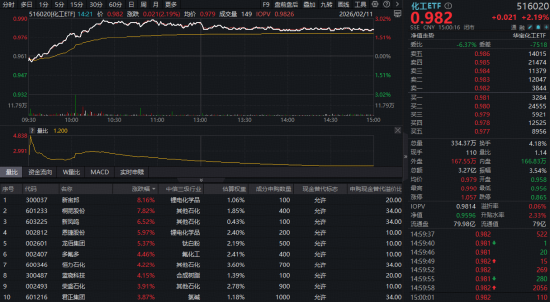
化工板块今日(2月11日)继续猛攻!反映化工板块整体走势的化工ETF(516020)开盘后直线拉升, 盘中场内价格涨幅一度达到3.02%,而后持续高位震荡,截至收盘,涨2.19%。 成份股方面,锂电、石化、钛白粉等板块部分个股涨幅居前。截至收盘,新宙邦飙涨8.16%,桐昆股份 大涨7.82%,新凤鸣、恩捷股份、龙佰集团等亦涨幅居前。 | | | 分时 部日 1分 5分 15分 30分 60分 日 周 月 霞多 | | | | | | F9 盘萌像层 露加 九线 面线 工具 @ (2) > | | | 化工ETF (D | | 516020 | | --- | --- | --- | --- | --- | --- | --- | --- | --- | --- | --- | --- | --- | --- | | 0.00 | | | | 516020(RZIFF) 14:21 拾 0.962 盈跌 0.021(2.19%) 均价 0.979 股交量 149 IOPV 0.9826 | | | | | 2026/02/11 | | 0.982 | | +0.021 +2.199 | | | | | | wa ...
“涨价”主线强势回归!有色ETF、化工ETF双双放量涨超2%!港股持续回暖,基金经理解读来了!
Xin Lang Cai Jing· 2026-02-11 11:35
Market Overview - A-shares experienced narrow range consolidation with mixed performance across the three major indices, as the trading volume in the Shanghai and Shenzhen markets fell below 2 trillion yuan for the first time in 31 trading days, with over 3,200 stocks declining [1][19] - The market saw a return of funds to "price increase" themes, with prices of rare earths, tungsten, molybdenum, tin, and antimony rising [1][23] Sector Performance Non-ferrous Metals - The non-ferrous ETF Huabao (159876) rose by 2.29%, with a trading volume of 89.8 million yuan, marking an 80% increase in trading activity [1][20] - Significant inflows into the non-ferrous metals sector, with over 13.7 billion yuan in main funds entering, making it the top sector in terms of capital inflow [22] - Key stocks in the small metals sector, such as Xiamen Tungsten and Jinchuan Group, saw gains exceeding 7% [22] Chemical Sector - The chemical ETF (516020) surged by 2.19%, with a peak increase of 3.02% during the trading session, reflecting strong market momentum [8][26] - The chemical sector attracted 13.8 billion yuan in main funds, ranking second among all sectors [11] - Notable stock performances included New Zhonbang, which surged by 8.16%, and Tongkun Co., which rose by 7.82% [9][26] Hong Kong Market - The Hong Kong market showed signs of recovery, with the Hong Kong Stock Connect Automotive ETF Huabao (520780) gaining 1.6% for four consecutive days [1][21] - The Hong Kong Internet ETF (513770) rose nearly 1%, driven by the performance of major internet companies [1][21] Investment Insights - Analysts suggest that the recent adjustments have released certain risks, and upcoming events and the "Spring Festival effect" may create a favorable environment for market recovery [1][20] - Key investment themes include TMT (Technology, Media, and Telecommunications), high-end manufacturing, and price increase chains [1][20] - The Hong Kong Internet ETF is expected to highlight the value of AI core assets as new AI-related companies enter the market [2][21]


