小米

Search documents
全球车企市值“大洗牌”
财联社· 2026-01-05 14:08
汽车产业深度变革背景下,全球车企市值排名的更新既是中国、外资车企行业地位与竞争格局的直观体现,亦为市场对汽车企业全产业链价值的综 合判断。 "一家企业的市值表现与很多因素有关,如盈利与现金流能力、成长潜力与战略布局以及企业抗风险能力等。"有业内人士分析称,小米的市 值排在比亚迪之前,本质是估值逻辑的胜利,两家企业在资本眼中的定位差异十分明显。"尽管小米在过去一年经历了诸多风波,但其'生态 溢价'能力依旧十分可观,尤其是相对于偏向传统制造的比亚迪而言。" 与华为深度绑定的赛力斯,是除小米、比亚迪外排名第三的中国车企,反超上汽集团的同时整体排名上升一位,至第18位。业界普遍认为, 爆款车型终端热度不减、登陆港股两地上市等因素,是其被市场认可的主要原因。 | | | | 2025年中国上市车企市值排名(截至2025年12月31日) | | | | | --- | --- | --- | --- | --- | --- | --- | | 2025排名 | 较2024排名 | 公司 | 2025年市值 | 2024年市值 | 市值变化 | 色注 | | | | | (亿美元) | (亿美元) | (亿,美元) | | ...



雷军恐惧流言日
36氪· 2026-01-05 13:35
Core Viewpoint - The article discusses Xiaomi's recent live stream led by Lei Jun, where he addressed various controversies and criticisms surrounding the company, particularly focusing on the impact of "black water armies" (organized online attacks) on his public persona and the company's reputation [4][5][30]. Group 1: Controversies and Responses - Lei Jun expressed his frustration over the negative impact of online attacks, stating that they have caused him significant psychological distress and made him cautious about his public statements [5][8]. - The live stream served as a platform for Lei Jun and the new PR head, Xu Jieyun, to clarify misconceptions, including the misinterpretation of the vehicle's performance claims and the company's policies [14][15]. - Lei Jun highlighted the organized nature of the online attacks, mentioning that a few individuals manipulate thousands of accounts to spread false information about Xiaomi [14][30]. Group 2: Product Performance and Sales - In 2025, Xiaomi delivered 410,000 vehicles, exceeding the initial target of 350,000, indicating strong sales performance despite the controversies [34]. - The Xiaomi YU7 has seen high demand, but the delivery timeline remains long, with reports of up to seven to eight months for customers [32]. - The SU7 Ultra faced a significant drop in monthly sales from thousands to below 100 units due to previous controversies, reflecting the potential long-term impact of negative publicity on sales [31]. Group 3: Future Goals and Strategies - Lei Jun set ambitious goals for 2026, aiming for 550,000 vehicle deliveries, which he considers a challenging yet achievable target [34]. - The company plans to address the issue of "small font marketing" practices, which have drawn criticism, by committing to changes in their marketing strategies [20]. - Xiaomi's management is focused on combating the influence of "black water armies" while also addressing deeper issues within the company to restore its public image [30].

铜价狂飙36%,格力回应空调涨价问题
Xin Lang Cai Jing· 2026-01-05 12:57
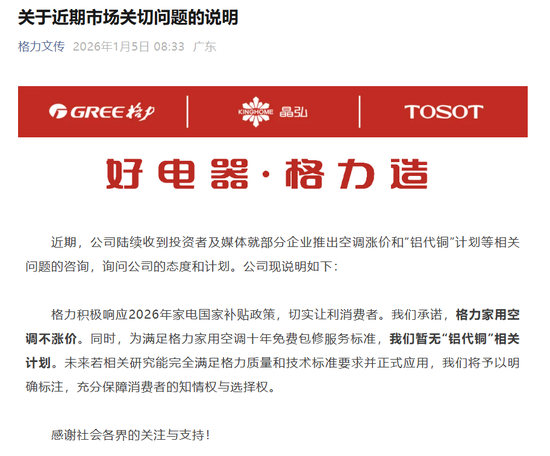
炒股就看金麒麟分析师研报,权威,专业,及时,全面,助您挖掘潜力主题机会! 记者丨翁榕涛 编辑丨骆一帆 近期,格力电器(000651.SZ)陆续收到投资者及媒体就部分企业推出空调涨价和"铝代铜"计划等相关 问题的咨询,询问公司的态度和计划。 1月5日,格力电器官方微信号发布通知表示,格力家用空调不涨价。同时,为满足格力家用空调十年免 费包修服务标准,暂无"铝代铜"相关计划。未来若相关研究能完全满足格力质量和技术标准要求并正式 应用,格力将予以明确标注,充分保障消费者的知情权与选择权。 2025年12月23日,格力电器也曾于投资者互动平台表示,铜是空调的核心原材料,占空调成本的20%左 右,尽管同等情况下,铝材成本约为铜材的1/12(价格约为1/4,密度约为1/3),但其在熔点、热传导 系数、电阻率、耐腐蚀等参数以及长期可靠性等方面,与铜存在较大差距,在其性能、质量和可靠性不 能完全保证的情况下,公司暂时没有"铝代铜"计划。公司重视"铝代铜"技术研究,并将持续关注行业动 态。 Wind数据显示,铜价在近日首次突破10万元关口,2026年1月5日,现货铜价报100620元/吨,这一价格 较2025年初的73830元 ...

铜价狂飙36%,格力回应空调涨价问题
21世纪经济报道· 2026-01-05 12:52
Core Viewpoint - Gree Electric Appliances has decided not to raise prices for its home air conditioners despite rising copper prices, emphasizing its commitment to consumer rights and maintaining the benefits of national subsidies [1][5]. Group 1: Price Strategy and Market Position - Gree Electric announced that it will not increase the price of its home air conditioners, aiming to ensure that the benefits of national subsidies reach consumers fully [1][5]. - The company highlighted that copper constitutes about 20% of the cost of air conditioners, and the recent surge in copper prices has led to a cost increase of approximately 7.26% per unit [4]. - Gree's market director stated that transferring cost pressures to consumers undermines the effectiveness of national subsidy policies [5]. Group 2: Aluminum vs. Copper Debate - Gree Electric has no current plans to adopt "aluminum instead of copper" technology, citing significant performance and reliability differences between the two materials [4][6]. - The company has been actively researching aluminum technology but insists that it will only switch to aluminum when it meets the same technical standards as copper [6]. - Other companies in the industry, such as Midea and Haier, have signed a self-regulatory agreement to accelerate the adoption of aluminum, while Gree has opted out of this initiative [6][7]. Group 3: Industry Trends and Future Outlook - The air conditioning industry is seeing a push towards aluminum use, with expectations that aluminum replacement rates could reach 60% for heat exchangers and 90% for connecting pipes by 2030 [7]. - Analysts predict that the air conditioning sector, due to its high copper intensity and cost sensitivity, will be a leading area for aluminum adoption, potentially increasing annual aluminum demand by 200,000 to 500,000 tons [7].
【港股收盘快报】港股恒指涨0.03% 科指涨0.09% 石油股走弱 生物医药股走强 快手涨幅超...
Xin Lang Cai Jing· 2026-01-05 12:14
来源:青岛财经日报 盘面上,科网股涨跌不一,快手涨幅超过11%,哔哩哔哩涨幅超过4%,阿里巴巴涨幅超过2%,网易、 小米跌幅超过2%;生物医药股涨幅居前,荣昌生物涨幅超过7%;内房股走强,融信中国涨幅超过6%; 脑机接口概念大涨,南京熊猫电子股份涨幅超过39%;石油股走弱,中石油跌幅超过3%;汽车股跌幅 居前,长城汽车跌幅超过6%。 2026年1月5日,港股三大指数涨跌不一。截至收盘,恒生指数涨0.03%,报26347.24点,恒生科技指数 涨0.09%,国企指数跌0.22%。 ...

铜价一年涨超36%!格力坚持空调不涨价,不用“铝代铜”
2 1 Shi Ji Jing Ji Bao Dao· 2026-01-05 12:00
2025年12月23日,格力电器也曾于投资者互动平台表示,铜是空调的核心原材料,占空调成本的20%左 右,尽管同等情况下,铝材成本约为铜材的1/12(价格约为1/4,密度约为1/3),但其在熔点、热传导 系数、电阻率、耐腐蚀等参数以及长期可靠性等方面,与铜存在较大差距,在其性能、质量和可靠性不 能完全保证的情况下,公司暂时没有"铝代铜"计划。公司重视"铝代铜"技术研究,并将持续关注行业动 态。 近期,格力电器(000651)(000651.SZ)陆续收到投资者及媒体就部分企业推出空调涨价和"铝代 铜"计划等相关问题的咨询,询问公司的态度和计划。 1月5日,格力电器官方微信号发布通知表示,格力家用空调不涨价。同时,为满足格力家用空调十年免 费包修服务标准,暂无"铝代铜"相关计划。未来若相关研究能完全满足格力质量和技术标准要求并正式 应用,格力将予以明确标注,充分保障消费者的知情权与选择权。 数据显示,铜价在近日首次突破10万元关口,2026年1月5日,现货铜价报100620元/吨,这一价格较 2025年初的73830元/吨上涨36.28%,较2015年的周期低点涨幅接近2倍。 若以铜原材料占据空调成本的20%计 ...
德系豪华车新年搞“突袭”?宝马开年官降最高30万
Zhong Guo Jing Ji Wang· 2026-01-05 11:49
Core Viewpoint - BMW has initiated a significant price reduction across 31 key models, with discounts reaching up to 300,000 yuan, marking a departure from its previous stance against price wars in the luxury car market [1][4]. Group 1: Price Reduction Details - The price cuts affect a wide range of models, with reductions generally exceeding 10%, and 24 models seeing cuts over 10%, while 5 models have reductions over 20% [2]. - The model with the largest price drop is the BMW i7 M70L, which saw a reduction from 1.899 million yuan to 1.598 million yuan, a decrease of 301,000 yuan [3][4]. - The entry-level BMW 225L M Sport model's price was reduced from 259,900 yuan to 208,000 yuan, lowering the entry barrier for consumers [2]. Group 2: Market Context and Strategy - BMW's price reduction is framed as a "value upgrade" rather than a price war, indicating a strategic response to market dynamics [4]. - The luxury car market in China is undergoing rapid restructuring, with traditional German brands like BMW, Mercedes-Benz, and Audi facing declining sales, as evidenced by a 14.7% drop in BMW's sales from January to November 2025 [6]. - The rise of Chinese brands, which have seen significant sales growth, poses a challenge to established luxury brands, with companies like Hongmeng Zhixing and Zeekr achieving sales of 589,000 and 575,000 units respectively in 2025 [7][8]. Group 3: Regulatory Environment and Implications - The Chinese government has been actively regulating price wars in the automotive sector, emphasizing compliance with pricing guidelines to promote healthy market development [9]. - BMW's decision to lower prices may attract consumer interest in the short term but could undermine its brand's pricing integrity and consumer perception in the long run [9]. - The competitive landscape may prompt other luxury brands like Mercedes-Benz and Audi to reconsider their pricing strategies in response to BMW's actions, potentially reshaping the market dynamics further [10].
空调“铝代铜”,这次董明珠和雷军终于一致了
Xin Lang Cai Jing· 2026-01-05 11:45
Core Viewpoint - The rising copper prices have led to discussions about the potential for aluminum to replace copper in air conditioning units, with major manufacturers like Gree and Midea currently not planning to adopt aluminum alternatives [1][2][3] Group 1: Copper Price Impact - Copper prices have reached historical highs, with LME copper exceeding $11,870 per ton and domestic prices surpassing 90,000 and 100,000 yuan per ton [2][7] - The air conditioning industry is feeling pressure to raise prices due to high copper costs, but the 2026 appliance replacement subsidy policy may mitigate this pressure [2][7] - Gree Electric has committed to not raising prices for household air conditioners to align with the 2026 subsidy policy, aiming to boost consumer spending [2][7] Group 2: Market Reactions - There were rumors of Midea increasing prices by over 6%, but these were clarified as misinterpretations, with only minor adjustments to specific models [3][8] - Gree's decision to maintain prices reflects its strategy of emphasizing quality and brand value, while Midea's approach shows flexibility in response to cost pressures [3][8] - Gree's air conditioning units reportedly have a gross margin that is over 5 percentage points higher than Midea's, which may explain its ability to avoid price increases [3][8] Group 3: Aluminum as a Substitute - The air conditioning sector is highly sensitive to copper prices, with approximately 85,000 tons of copper consumed annually, accounting for 21% of national demand [4][9] - Some manufacturers, like Wanbao, are exploring aluminum alternatives, with their new series priced significantly lower than traditional models after subsidies [4][9] - Cost savings from switching to aluminum can range from 70 to 80 yuan per unit for evaporators, and up to 300 to 500 yuan for comprehensive replacements [5][9] Group 4: Future Price Trends - The introduction of aluminum may not necessarily lead to lower retail prices, as the market dynamics could result in stable high-end prices and increased competition in the mid-range segment [10][11] - Analysts suggest that if raw material prices do not continue to rise and considering the impact of subsidies, air conditioning prices may remain low in 2026 [11]

不止拆了一辆车,雷军真正想拆的是人心中的偏见墙
Sou Hu Cai Jing· 2026-01-05 10:59
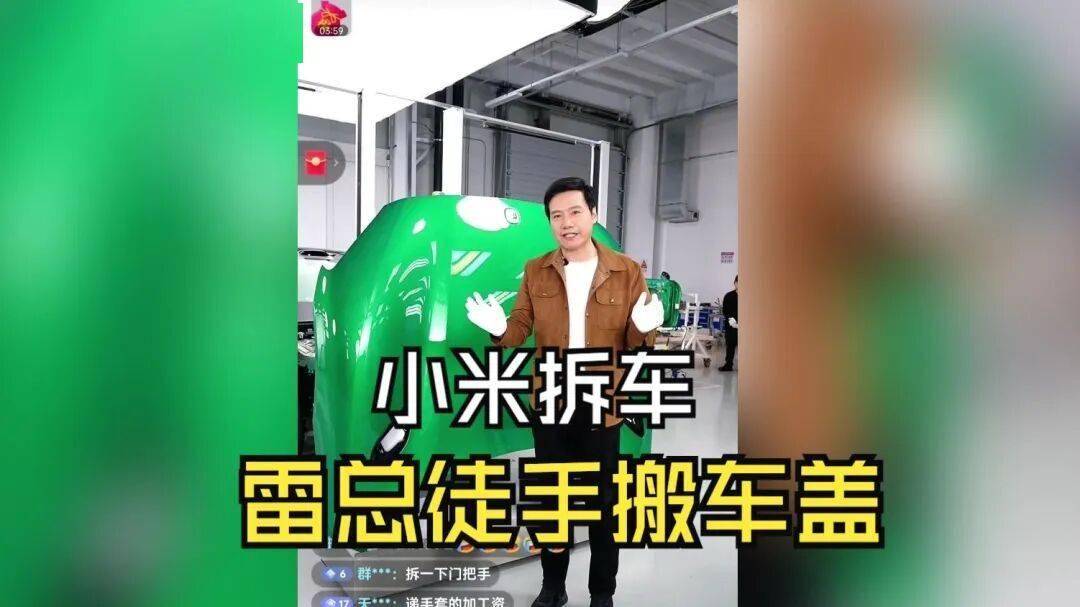
四个半小时的直播,雷军用螺丝刀和工程师的耐心,完成了一场商业史上最坦诚的信任重建实验。 "以前我们怕没人知道小米造车;现在,我们怕大家信错了谣言。" 雷军在直播中的这句开场白,几乎道破了当下所有商业与个人关系的窘境。2025年最后一天晚上8点,雷军开启了一场前所未有的跨年直播——现场拆解 一辆小米YU7,从电池包到门锁结构,从电机到车架,在数百万观众注视下,把一辆完整的车拆成了白车身。 (图源网络,侵删) 这四小时,表面上是一场技术秀,实际上是一场关于信任的公开手术。 01 直播自证,信任崩塌后的笨办法 过去半年,小米汽车被贴上了各种标签:"绿化带战神"、"小字吹牛"、"不让农民卖小米"……最刺痛的是针对安全性能的质疑。雷军在镜头前摊开一叠手 写"小抄",苦笑着说:"我现在讲每句话都得想了又想、看了又看。" 信任一旦破碎,华丽的参数表和公关声明都显得苍白无力。 雷军选择的路径近乎笨拙却极致坦诚——用最原始的物理呈现取代任何话术。工程师现场切断车辆主副电源,仅靠备份电池和机械拉线把车门硬生生拉 开,用最基本的机械原理回应"车门打不开"的传言。 (图源网络,侵删) 市场给出了复杂反馈:2025年小米汽车交付超41 ...
五年后惊呆自己?数据揭示巨变真相,结果让所有人意外!
Sou Hu Cai Jing· 2026-01-05 09:46
Group 1: Internet Industry Transformation - The internet landscape has been reshaped significantly over the past five years, with companies like Pinduoduo and ByteDance altering market boundaries and user engagement [3][5] - Pinduoduo has steadily closed the gap with Taobao by focusing on retail, while ByteDance has expanded into various fields with high success rates [3][5] - The competition in the internet sector remains fierce, with major platforms continuing to grow and integrate deeply into daily life, impacting the flow of information and goods [5] Group 2: AI Development in China - AI gained traction in China around 2025, marked by significant events such as the first major AI application acquisition for $2 billion by Meta [5][7] - Chinese AI companies face different challenges compared to their Silicon Valley counterparts, particularly in terms of computing power and user payment willingness [7] - The development strategies of Chinese AI firms are pragmatic, focusing on mature product offerings to meet local market demands [7] Group 3: New Energy Vehicle (NEV) Industry - The NEV sector in China has evolved rapidly, with the share of pure fuel vehicles expected to drop to 50% by 2025, showcasing a complete cycle from explosion to intense competition [9][11] - Major players like Geely and BYD are adjusting strategies to enhance competitiveness, while newer entrants like Xiaomi are avoiding early pitfalls [11] - The NEV industry's growth has positioned China as a global leader, demonstrating resilience and adaptability in a challenging market environment [11][13] Group 4: Market Trends and Future Outlook - The period from 2021 to 2025 has highlighted the transformative power of time, with significant advancements in internet, AI, and NEV sectors [13][14] - The investment landscape has seen indices in A-shares and Hong Kong stocks return to and exceed 2021 peaks, indicating a robust recovery [13] - The next five years are expected to bring further unexpected changes, with a focus on maintaining a proactive and innovative approach to ensure quality development in China's industries [14]