
东风股份

Search documents
2025车市分水岭:淘汰内卷,狂卷效率
汽车商业评论· 2026-01-01 22:57
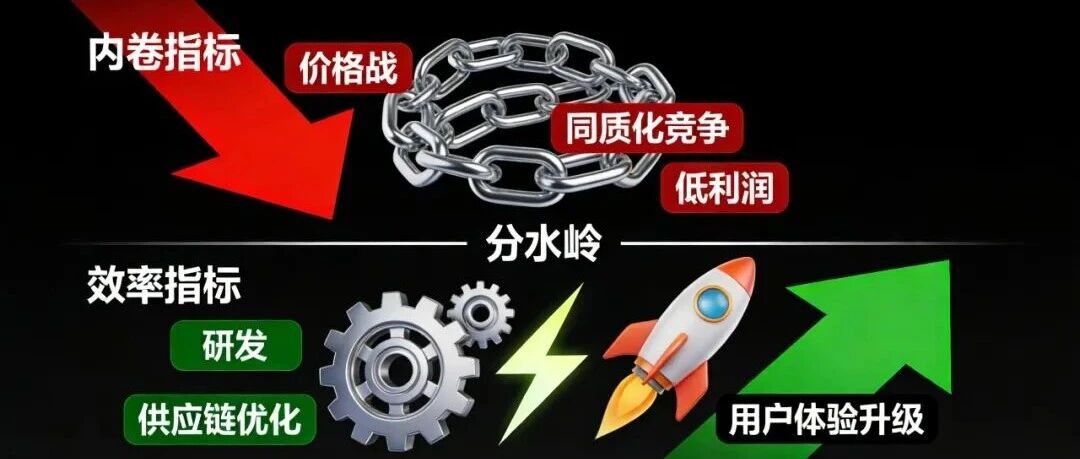
设计 | 甄 尤 美 撰文 | 吴 静 编辑 | 黄 大 路 回望十余年前,中国汽车市场那段高增长的草莽岁月,总 是会被人怀念。 那是 一个 供需彻底失衡、规则尚显粗放、红利俯拾皆是的年代, " 躺着赚钱 "并不是神话, 对于亲历者而言 , 那无疑是 一段名副其实的 "黄金 岁月"。 如今,中国汽车行业正在 "上演"相反的剧本:市场从"水大鱼大"的增量蓝海,急转直入"刺刀见红"的存量血海。曾经躺着赚钱的日子一去不返, 在极致内卷下,中国汽车人每天面对的都是关于生死存亡的考题。 过去一年,在行业增收不增利的大背景下,销量目标成功达成的车企屈指可数。 倘若多年后回顾中国汽车市场, 2025 年一定会是一个重要的分水岭。 共探新营销,共创新可能 这一年,中国汽车行业躲不过的关键词之一就是效率。在新能源市场竞争加剧、亏损式增长难以为继的背景下,车企纷纷整合品牌向行业清晰传 递了其从 "拼规模"向"拼效率"的重大转变。更重要的是,未来汽车行业的竞争将更加依赖核心技术、供应链效率与品牌协同,而非盲目扩张。 它标志着中国汽车产业告别野蛮生长的 "上半场",开启了以体系化能力、全球化视野和可可持续盈利为核心的高质量发展"下半 ...

每周股票复盘:东风股份(600006)获1000万政府补助影响2025利润
Sou Hu Cai Jing· 2026-01-01 18:42
Group 1 - The core stock price of Dongfeng Motor Co., Ltd. (600006) closed at 7.2 yuan on December 26, 2025, down 0.28% from the previous week's 7.22 yuan [1] - The highest intraday price for the stock was 7.41 yuan on December 22, 2025, while the lowest was 7.16 yuan on December 23, 2025 [1] - The current total market capitalization of Dongfeng Motor is 14.36 billion yuan, ranking 8th out of 13 in the commercial vehicle sector and 1354th out of 5181 in the A-share market [1] Group 2 - The company received a government subsidy of 10 million yuan related to revenue, which accounts for 34.29% of the audited net profit attributable to shareholders for the fiscal year 2024 [2] - This subsidy is related to the company's daily operations but is not sustainable [2] - The subsidy is expected to have a positive impact on the company's profit for the fiscal year 2025, with specific accounting treatment and profit impact to be confirmed by the annual audit [2]

造车新势力,仅3家完成年度目标
第一财经· 2026-01-01 14:49
Core Viewpoint - The article discusses the annual performance of new energy vehicle manufacturers in 2025, highlighting the successes and challenges faced by various brands in achieving their sales targets [3][5]. Group 1: Sales Performance - Li Auto sold 406,343 vehicles in 2025, achieving only 58.05% of its target of 700,000 units, marking an 18.81% decline year-on-year [4][5]. - NIO delivered 326,028 vehicles, with a completion rate of 74.10% against a target of 440,000 units, while its main brand saw a decline in sales [5][6]. - Leap Motor emerged as the top performer with nearly 600,000 units sold, exceeding its target by 19.31% [4][5]. - Xiaomi and Xpeng also met their sales targets, with Xpeng achieving 429,445 units sold, a 125.94% increase year-on-year [4][5]. Group 2: Market Dynamics - The article notes a divergence among previously leading brands, with some experiencing significant growth while others face challenges in scaling [4][5]. - The new energy vehicle market is expected to be influenced by upcoming subsidy policies, which may impact sales in 2026 [7]. Group 3: Company Developments - Deep Blue Automotive adjusted its sales target from 500,000 to 360,000 units, ultimately selling 333,117 vehicles, achieving 92.53% of its revised goal [6][7]. - Avita's sales remained low at 128,772 units, completing only 58.53% of its target, indicating challenges in scaling operations [6][7]. - The article mentions that Deep Blue Automotive has made significant moves in technology and financing, which may enhance its market position in 2026 [6][7].



“新汽车”放榜2025:“华系”品牌集体创新高 小米120%完成年度KPI
Xin Lang Cai Jing· 2026-01-01 14:13
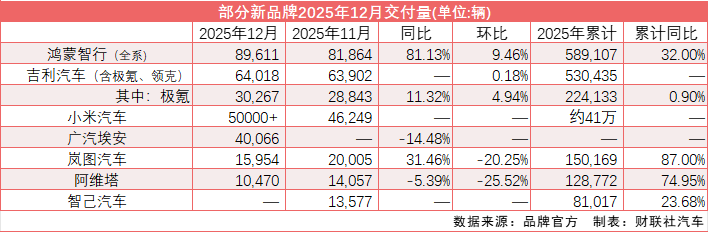
Group 1 - Xiaomi Auto reported a monthly delivery of over 50,000 units in December 2025, achieving an annual cumulative sales of approximately 410,000 units, exceeding the annual sales KPI by about 20% [1] - Xiaomi Auto introduced a new "3 years 0 interest" installment plan for the YU7 model, with a down payment starting at 74,900 yuan and monthly payments as low as 4,961 yuan [1] - Xiaomi Auto expanded its channel network by adding 36 new stores in December, bringing the total to 477 stores across 138 cities, with plans to add 9 more stores in January 2026 [1] Group 2 - Huawei's HarmonyOS vehicle brand, Hongmeng Zhixing, delivered 89,611 units in December, marking a historical high for four consecutive months, with a total annual delivery of 589,107 units, a year-on-year increase of 32% [2] - The sales of Dongfeng Mengshi reached 3,002 units in December, with an annual total of 10,228 units, reflecting a year-on-year growth of 387% [2] - Geely Auto's sales exceeded 60,000 units in December, with the Zeekr brand selling 30,267 units and Lynk & Co selling 33,751 units, while setting a 2026 sales target of 3.45 million units, a 14% increase from 2025 [2] Group 3 - Zhiji Auto achieved a total sales of 81,017 units in 2025, marking a historical high, and reported its first full-cost profitability in December [3] - The Ministry of Commerce announced that the "old-for-new" program in 2025 generated sales exceeding 2.6 trillion yuan, benefiting over 360 million people, with over 11.5 million vehicles involved [3] - The 2026 automotive "two new" policy is expected to stabilize market growth and promote new vehicle consumption, with an estimated 12 million vehicles expected to benefit from the "old-for-new" policy [4]
透过岚图,看中国汽车高端化的“十四五”答卷
Zhong Guo Qi Che Bao Wang· 2026-01-01 08:34
Core Viewpoint - By 2025, China's automotive industry has transitioned from "following" to "leading," with a focus on product and technological innovation, exemplified by Dongfeng Motor's high-end smart new energy brand, Lantu Auto, which has become a flagship for high-end Chinese brands [1][3]. Group 1: Market Performance - In 2025, Lantu Auto achieved cumulative deliveries of 150,169 vehicles, marking an 87% year-on-year increase, solidifying its position as the leading high-end new energy brand among state-owned enterprises [1]. - Lantu Auto has established a comprehensive product matrix with three flagship models: Lantu Dreamer, Lantu Taishan, and Lantu Pursuit L, becoming the first high-end new energy brand in China to mass-produce SUVs, MPVs, and sedans [5][11]. Group 2: Product Innovation - The Lantu Dreamer has consistently ranked as the top-selling high-end MPV, with an average selling price exceeding 400,000 yuan, indicating strong market penetration [5]. - Lantu Taishan achieved over 5,000 deliveries within 26 days of its nationwide launch, demonstrating high market recognition and establishing itself as a benchmark in the high-end new energy SUV market [7]. - The Lantu Pursuit L, launched on December 10, 2025, completes Lantu's flagship lineup and features advanced technologies such as Huawei's intelligent driving and smart cockpit systems [9]. Group 3: Technological Development - Lantu Auto emphasizes self-research and collaboration to build a technological "moat," with nearly 5,400 patents, of which 85% are invention patents, leading the new energy vehicle sector in patent growth [12][14]. - The company has developed a fully autonomous intelligent electric architecture (ESSA) and a new generation of intelligent multi-mode hybrid technology, showcasing its commitment to innovation and high-quality development [14]. Group 4: International Expansion - Lantu Auto has entered over 40 countries and regions, including key markets in Europe, the Middle East, and Central Asia, reflecting its global strategy and alignment with national initiatives [15][16]. - The brand has successfully launched in the Middle East, with product and cultural exports, demonstrating confidence in Chinese culture and innovation [18].

五维度看2025中国乘用车发展之“术”
Xin Lang Cai Jing· 2025-12-31 16:01
Core Insights - The Chinese passenger car market is experiencing unprecedented vitality and resilience due to various transformative forces, with a focus on the industry's ability to identify and solve problems [1][2]. Group 1: New Energy Vehicle Market - The penetration rate of new energy vehicles (NEVs) in China reached 53.6% in the first 11 months of 2025, indicating a shift from policy-driven to market-driven growth [4]. - The number of new car models launched in 2025 exceeded 200, showcasing the industry's strength and providing diverse options for consumers [5]. - Major NEV manufacturers have established comprehensive product platforms, enabling rapid iteration and performance enhancement across various models [6]. Group 2: Technological Advancements - Significant advancements in foundational technologies, such as intelligent chassis systems, are enhancing the overall level of the NEV industry [7]. - The performance of pure electric vehicles has improved, with extended driving ranges and enhanced safety features, addressing consumer concerns [8]. - Range-extended vehicles have also seen performance improvements, with some models achieving over 1000 kilometers of range [9]. Group 3: Autonomous Driving and AI Integration - The first batch of Level 3 conditional autonomous driving vehicle licenses was issued, marking a new phase in the commercialization of autonomous driving in China [10]. - AI technology is being integrated into smart cockpit systems, enhancing user interaction and experience [11]. - The automotive industry is witnessing a shift towards cognitive intelligence, allowing vehicles to understand and respond to complex commands [23]. Group 4: Domestic Brand Performance - Domestic brands captured a market share of 69.6% in the first 11 months of 2025, reflecting their growing competitiveness [13]. - High-end NEV sales have been dominated by domestic brands, indicating their increasing strength in the premium segment [14]. - Domestic brands are expanding internationally, with significant export growth and market penetration in Europe and Southeast Asia [15]. Group 5: Brand Image and Communication - Automotive leaders are increasingly engaging with consumers through relatable narratives, moving away from traditional high-end marketing [39]. - The industry is addressing issues of "involution" and promoting high-quality development to avoid harmful price competition [40][41]. - Companies are adopting transparent communication strategies to build trust and address safety concerns following incidents involving autonomous driving technologies [44][46].

中国电泳漆市场现状研究分析与发展前景预测报告
QYResearch· 2025-12-31 09:24
Core Viewpoint - The electrophoretic paint market in China is characterized by moderate scale, technical intensity, and stable growth, driven by both domestic demand and global industry trends. The market is expected to grow from $1,504.1 million in 2024 to $1,855.5 million by 2031, with a CAGR of 2.80% from 2025 to 2031 [3][9]. Market Size and Growth Trends - The Chinese electrophoretic paint market is projected to reach $1,504.1 million in sales revenue by 2024 and $1,855.5 million by 2031, indicating a stable growth trend with a CAGR of 2.80% from 2025 to 2031 [3]. Demand Analysis - The automotive and home appliance sectors are the primary consumers of electrophoretic paint, with automotive applications requiring high corrosion resistance and compatibility with subsequent coatings. The demand from the home appliance sector is characterized by large-scale, standardized needs [9]. Competitive Landscape - The market features a mix of international giants and local specialized manufacturers. Multinational companies dominate the high-end market due to their advanced formulation technologies and relationships with major automotive manufacturers, while local firms excel in the mid-to-low-end market segments [10][13]. Key Players - Major players in the Chinese market include PPG Industries, BASF, Haolisen, Xiangjiang Kansai, Axalta, Nippon Paint, and Jinlitai, with the top three companies holding approximately 38.63% of the market share in 2024 [13]. Industry Chain Analysis - Upstream - Key raw materials for electrophoretic paint include resins, solvents, additives, and pigments, with the chemical industry being the primary upstream sector. The market is competitive, and product costs are closely linked to fluctuations in crude oil prices [16]. Industry Chain Analysis - Midstream - Foreign brands hold a strong position in the automotive OEM paint sector, with six major companies controlling about 90% of the market share in automotive coatings. Domestic companies are gradually gaining market share in non-passenger vehicle segments [17]. Industry Chain Analysis - Downstream - The downstream industries include automotive manufacturing and other sectors such as engineering machinery, motorcycles, hardware, and home appliances, which are closely tied to macroeconomic conditions and exhibit cyclical characteristics [18]. Development Drivers - Key drivers for the industry include government support for environmentally friendly coatings, advancements in technology leading to diverse and functional products, and stable growth in downstream industries such as automotive and home appliances [21]. Development Constraints - The industry faces challenges such as risks from macroeconomic fluctuations, volatility in raw material prices, and intense competition, particularly from foreign brands in the high-end market [21].
中保研汽车技术研究院发布第19期和第20期汽车零整比研究结果
Zhong Guo Qi Che Bao Wang· 2025-12-31 07:22
Core Insights - The automotive zero-to-whole ratio is a key actuarial indicator for insurance premium pricing and is essential for optimizing after-sales maintenance costs for automotive companies, thereby protecting consumer rights in the long term [1] Group 1: Automotive Zero-to-Whole Ratio Indicators - The 20th period's "Automotive Zero-to-Whole Ratio 100 Index" for fuel vehicles is 391.07%, an increase of 2.00 percentage points from the 19th period, reflecting a growth rate of 0.51% [2] - The average zero-to-whole ratio coefficient for 10 new fuel vehicle models is 545.11%, which significantly contributed to the rise in the 20th period's index [2] - The "Repair Burden 100 Index" for fuel vehicles is 20.86, up by 0.10 from the 19th period, indicating a 0.47% increase, which highlights the rising repair costs and insurance payout pressures for traditional vehicle users [2] Group 2: Component-Specific Zero-to-Whole Ratios - Among 18 commonly used components in fuel vehicles, 11 saw an increase in their average single-component zero-to-whole ratios, with the rearview mirror assembly experiencing the highest increase of 4.82% [4] - The average price of 12 commonly used components also rose, with the rearview mirror assembly showing the highest price increase of 7.82% [4] - The average single-component zero-to-whole ratio for front headlights is 3.20%, an increase of 0.02 percentage points, with the highest ratio recorded for the Audi A6L at 10.40% [5] Group 3: New Energy Vehicle Indicators - The 20th period's "Automotive Zero-to-Whole Ratio 100 Index" for new energy vehicles is 312.24%, an increase of 3.30 percentage points from the 19th period, reflecting a growth rate of 1.07% [6] - The "Repair Burden 100 Index" for new energy vehicles is 27.66, up by 0.55 from the 19th period, indicating a 2.03% increase, which reflects the rising repair costs and insurance payout pressures for new energy vehicle users [6] - Among 18 commonly used components in new energy vehicles, 16 saw an increase in their average single-component zero-to-whole ratios, with the outer tail light showing the highest increase of 11.59% [8] Group 4: Battery Component Insights - The average single-component zero-to-whole ratio for power batteries in new energy vehicles is 49.59%, a decrease of 0.38 percentage points from the 19th period [11] - The average unit energy price for power batteries is 1538.83 yuan/kWh, reflecting a decrease of 2.23%, indicating improved cost-effectiveness [12] - The research results aim to enhance transparency in the automotive aftermarket and support the insurance industry in refining premium rates and risk assessment models [12]

“小众破局”实验:猛士汽车如何进军大众市场?
2 1 Shi Ji Jing Ji Bao Dao· 2025-12-31 06:16
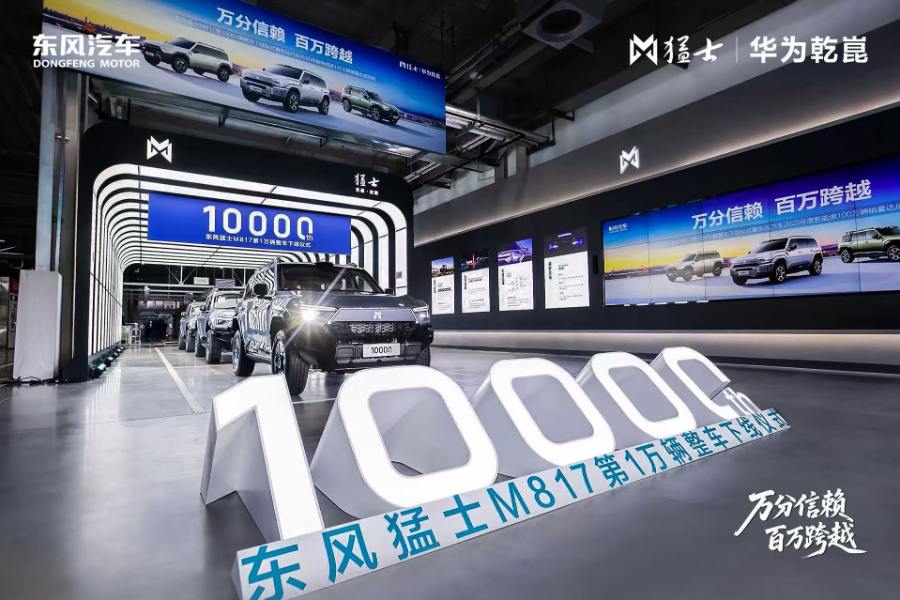
Core Insights - The Dongfeng Warrior M817 has officially rolled off the production line, marking a significant milestone with the 10,000th unit. The company aims to transition from military off-road vehicles to smart electric off-road vehicles, targeting the high-end electric vehicle market in China with a focus on "smart off-road" as a differentiating factor [2][3] Strategic Transformation - The company has launched a systematic transformation plan named "Climbing Action," which encompasses four dimensions: organization, product, technology, and ecosystem. This initiative is not merely a market choice but a mission to redefine its role in the automotive industry [3][4] - The organizational strategy includes creating an agile system that directly connects with users, implementing a "3-1" response mechanism to enhance customer service [3][4] Product Development - The product lineup consists of three series: the 917 series as the flagship, the M series targeting off-road enthusiasts, and a new series focused on "light off-road" experiences set to launch in late 2026 [4][5] - The company emphasizes the integration of smart technology with off-road capabilities, aiming to enhance safety and comfort while addressing reliability concerns associated with electric off-road vehicles [5][6] Technological Integration - The core technology strategy involves deepening the fusion of "smart" and "off-road," utilizing advanced sensors and computing power to improve vehicle performance and user experience [4][5] - The partnership with Huawei is pivotal, with the M817 featuring comprehensive Huawei technology, indicating a long-term strategic collaboration that extends beyond hardware to include ecosystem development [5][6] Market Positioning - The company is attempting to shift the perception of off-roading from a niche activity to a mainstream lifestyle through technological empowerment and accessibility [6][7] - Initial market feedback has been positive, with the M817 achieving significant sales growth since its launch, although the company remains cautious about its future targets [6][7] Competitive Landscape - The company faces challenges in educating the market about the reliability of electric off-road vehicles and competing against traditional off-road brands and new entrants in the market [7] - The strategic focus on leveraging military heritage, deep integration of smart technology, and a planned product series approach aims to expand its market base while navigating the competitive landscape [6][7]
降本增效提速“出海” ,“车谷造”汽车全年出口达20万辆
Chang Jiang Ri Bao· 2025-12-31 00:38
2025年初,武汉港汉南港区国家一类口岸获批临时对外开放,通过江海联运,"车谷 造"汽车可直接在本地办理海关手续,单车出口成本降低超千元。 12月30日,汉南区第十届人民代表大会第五次会议开幕。记者从会上获悉,2025 年,"车谷造"汽车出海20万辆,增长70%。 武汉经开区作为"武襄十随"汽车产业集群核心,已集聚10家整车企业、14座整车工厂、 1200余家零部件厂商。近年来,全区持续构建"自贸+综保+口岸+通道"全链条出海服务体 系,对外开放水平全面提升。 3月,武汉"经开港—太仓港"直达航线正式启航,物流时效从过去的5-6天缩短至3天, 成本降低20%—30%,成为汽车出海"水陆联动"的关键;7月,首条直达日韩的近洋航线从 经开港启航,为车谷企业对接东亚市场开辟了新通道。 当前,武汉经开区正加速从"中国车谷"迈向"世界车谷"。记者从会上获悉,2026年,武 汉经开区将加快建设自贸区联动创新发展区,启动港产城一体化发展规划建设,打造长江中 游汽车(出口)集散中心,持续拓展近洋航线,力争全年汽车出海达到25万辆。 编辑:熊展平 今年以来,"车谷号"滚装船专线实现稳定运营,依托长江黄金水道将汽车高效运抵沿海 ...