欣旺达

Search documents
极氪美股退市仅3天即发起23亿天价索赔 吉利实施私有化前是否刻意隐瞒重大信息?
Xin Lang Cai Jing· 2025-12-30 07:33
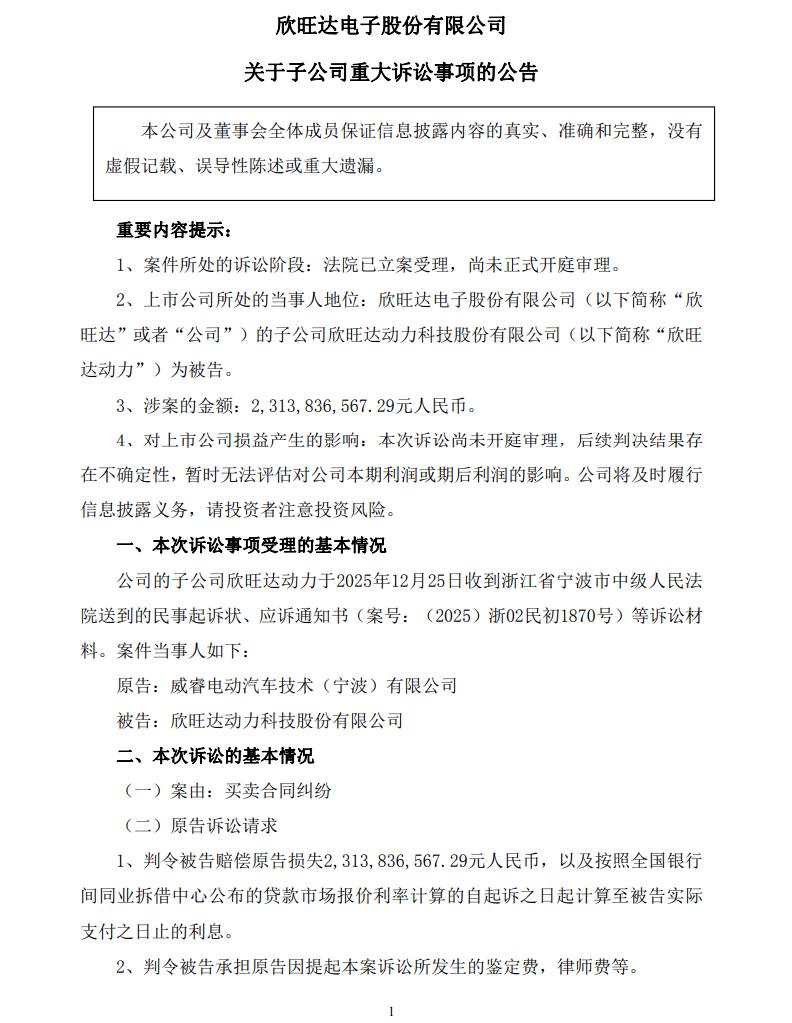
Core Viewpoint - Geely's subsidiary Zeekr has filed a lawsuit against battery supplier Sunwoda, claiming damages of 2.314 billion yuan due to quality issues with battery cells supplied over a period of two years, raising questions about the timing and motivations behind the lawsuit following Zeekr's recent privatization and delisting from the U.S. stock market [1][2][11]. Group 1: Lawsuit Details - The lawsuit was filed by Weir Electric Vehicle Technology, a key subsidiary of Zeekr, which has been involved in the development and manufacturing of core components for electric vehicles since its establishment in 2017 [2]. - Weir Electric claims that the battery cells delivered by Sunwoda from June 2021 to December 2023 had quality issues, leading to significant financial losses, including the principal claim of 2.314 billion yuan plus interest and legal costs [2][3]. - The relationship between Weir Electric and Sunwoda began in April 2021, with the first Zeekr model equipped with Sunwoda cells delivered in October 2021 [2]. Group 2: Market Impact and Financial Losses - Zeekr's rapid delisting from the U.S. market occurred just 19 months after its IPO, resulting in a direct loss of approximately 3.5 billion yuan for Geely, which raised concerns about the company's financial health and strategic decisions [7][8]. - The IPO raised a total of 3.62 billion yuan, but after accounting for underwriting fees and other costs, the net external funding was only about 1.496 billion yuan [8]. - Geely's total cash outlay for the privatization was around 24 billion yuan, with a significant portion of shareholders opting for cash payouts, leading to a direct cash loss of about 5 billion yuan [8]. Group 3: Quality Issues and Customer Feedback - The battery cells in question were primarily used in the Zeekr 001 WE86 model, which saw over 70,000 units sold in 2022, with more than 60% of those being the WE86 version [3]. - Customers reported issues such as slow charging speeds and discrepancies in advertised range, with complaints escalating in 2023 regarding battery performance and safety concerns [3][4]. - By the end of 2023, Weir Electric began reducing purchases from Sunwoda, shifting to products from CATL and Geely's own battery company [4]. Group 4: Strategic Implications of the Lawsuit - If Zeekr wins the lawsuit, the compensation could significantly improve its financial metrics, including net profit and cash flow, as the claimed amount exceeds its losses for the first three quarters of 2025 [9]. - The lawsuit could also help restore Zeekr's brand reputation by establishing supplier accountability for quality issues, potentially enhancing its negotiating power in future supply chain discussions [10]. - The timing of the lawsuit, following the delisting, raises questions about whether Geely aimed to avoid disclosure obligations under U.S. regulations, allowing for a more strategic approach to litigation [11][12].


锂电行业跟踪:动力和储能电池需求旺盛,储能电芯和系统均价上涨
Shanghai Aijian Securities· 2025-12-30 06:41
Investment Rating - The industry is rated as "Outperform" compared to the market [3]. Core Insights - The demand for power and energy storage batteries is strong, with an increase in average prices for storage cells and systems [3][4]. - In November 2025, domestic battery production reached 176.3 GWh, a year-on-year increase of 49.66% and a month-on-month increase of 3.34% [3]. - The production of lithium iron phosphate (LFP) cathode materials in November 2025 was 268,900 tons, up 29.43% year-on-year and 0.75% month-on-month, with a capacity utilization rate of 62.53% [3]. - The price of industrial-grade lithium carbonate rose to 116,000 CNY/ton as of December 26, 2025, with a weekly increase of 14.85% [3]. - The average price of LFP (power type) reached 45,100 CNY/ton, increasing over 15% since December 19, 2025 [3]. - The average price of square LFP energy storage cells remained stable, with slight increases noted in December 2025 [3]. - In November 2025, the monthly loading volume of LFP batteries was 75.3 GWh, a year-on-year increase of 43.62% and a month-on-month increase of 11.56% [3]. - The export volume of Chinese power batteries in November 2025 was 21.2 GWh, a year-on-year increase of 69.60% [3]. Summary by Sections Production - In November 2025, the production of LFP cathode materials and batteries showed significant growth compared to the same period in 2024 [3][4]. Prices - Prices for key materials such as lithium carbonate and LFP have seen substantial increases, indicating a tightening supply [3][4]. Domestic Demand - The domestic demand for batteries is robust, with record loading volumes and increased tender capacities for new energy storage projects [3][4]. Overseas Demand - The export market for Chinese power batteries is expanding, with notable year-on-year growth in November 2025 [3][4].





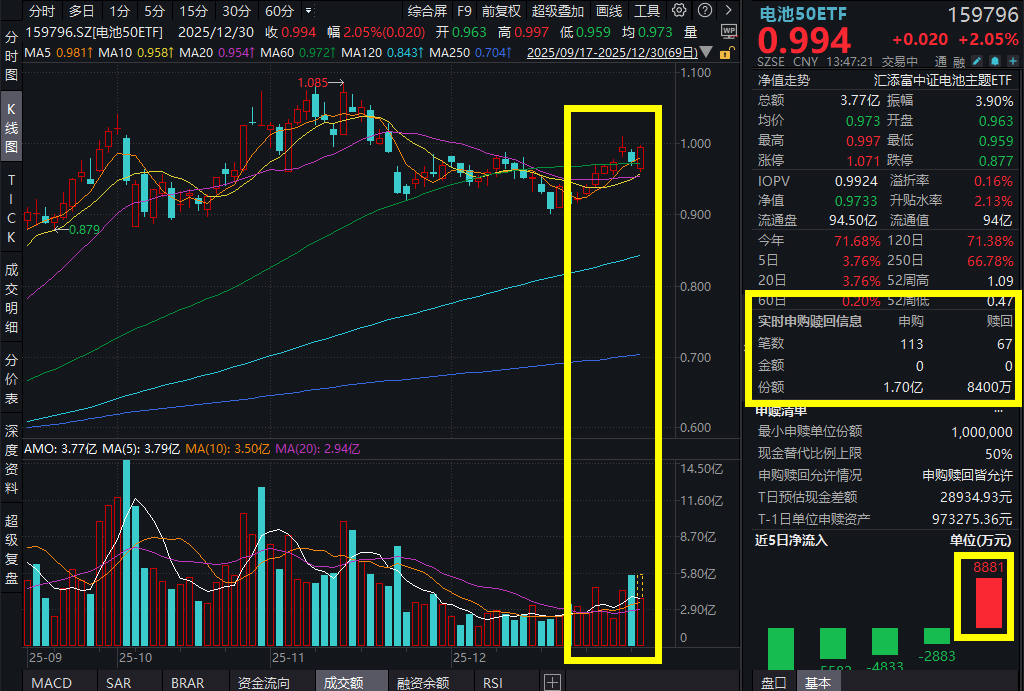
电池午后狂飙,三花智控涨停,电池50ETF(159796)大涨超2%,大举揽金8500万元!全球储能需求共振,电池后市怎么看?
Xin Lang Cai Jing· 2025-12-30 06:40
Core Viewpoint - The battery sector, particularly the battery 50 ETF (159796), has experienced a significant surge due to strong capital inflow and a rebound in component stocks, driven by the booming demand for energy storage solutions [1][3][5]. Group 1: Market Performance - As of December 30, the battery 50 ETF (159796) rose over 2%, recovering from previous declines with more than 85 million yuan in capital inflow [1]. - Key component stocks such as Sanhua Intelligent Control and Tianci Materials saw substantial gains, with Sanhua hitting the daily limit and Tianci rising over 3% [3][4]. Group 2: Industry Dynamics - The energy storage sector is experiencing a transformative shift, driven by the global energy transition and advancements in AI, leading to a significant increase in electricity demand [7]. - Domestic policies are evolving from mandatory energy storage to independent energy storage, enhancing the economic viability of storage projects [7]. - The demand for energy storage in China is projected to grow significantly, with a 118% year-on-year increase in project bidding data for the first ten months of 2025 [8]. Group 3: Future Projections - Global energy storage installations are expected to grow by over 60% next year, with a compound annual growth rate of 30-50% over the next three years [10]. - By 2025, the domestic energy storage installation capacity is anticipated to reach over 180 million kilowatts, nearly doubling within two and a half years [8]. Group 4: Investment Opportunities - The battery 50 ETF (159796) has a high concentration in the energy storage sector, with 27% of its index comprising energy storage components, positioning it well to benefit from the sector's growth [15]. - The ETF also includes a significant portion of solid-state battery technology, which is expected to see substantial advancements and market potential [15][17].




欣旺达涨2.05%,成交额15.89亿元,主力资金净流出2.32亿元
Xin Lang Cai Jing· 2025-12-30 05:33
Core Viewpoint - The stock of Xinwanda has shown a significant increase of 21.71% this year, but has recently experienced a decline in the last five trading days by 9.85% [1] Group 1: Stock Performance - As of December 30, Xinwanda's stock price rose by 2.05% to 26.90 CNY per share, with a trading volume of 1.589 billion CNY and a turnover rate of 3.49%, resulting in a total market capitalization of 49.697 billion CNY [1] - The net outflow of main funds was 232 million CNY, with large orders buying 301 million CNY (18.94%) and selling 449 million CNY (28.28%) [1] - The stock has seen a decline of 21.98% over the past 60 days [1] Group 2: Financial Performance - For the period from January to September 2025, Xinwanda achieved a revenue of 43.534 billion CNY, representing a year-on-year growth of 13.73%, and a net profit attributable to shareholders of 1.405 billion CNY, up by 15.94% [2] - Since its A-share listing, Xinwanda has distributed a total of 1.772 billion CNY in dividends, with 755 million CNY distributed in the last three years [3] Group 3: Shareholder Information - As of September 30, 2025, the number of shareholders of Xinwanda increased by 18.08% to 135,300, while the average circulating shares per person decreased by 15.23% to 12,669 shares [2] - The second-largest circulating shareholder is Hong Kong Central Clearing Limited, holding 69.279 million shares, a decrease of 21.416 million shares from the previous period [3] - New entrants among the top ten circulating shareholders include Guangfa National Standard New Energy Vehicle Battery ETF, holding 14.901 million shares, and E Fund Ke Rong Mixed Fund, holding 11.1296 million shares [3]
光大期货金融期货日报-20251230
Guang Da Qi Huo· 2025-12-30 05:31
1. Report Industry Investment Rating - No industry investment rating is provided in the report. 2. Core Viewpoints of the Report - **Stock Index**: The stock index futures market has been oscillating along the lower edge of the central range since October, with limited differentiation between large - and small - cap indexes, frequent sector rotations, and relatively mild market sentiment. Important meetings have a long - term positive impact on the stock index, but in the short term, it will mainly oscillate. The expected GDP growth target of 5% in 2026 will not change, and policies will focus on "stabilizing domestic demand" and "promoting the rapid development of new - quality productivity." Fiscal and monetary policies will continue to work together, and the scale may increase slightly compared to this year. Overseas, there is a divergence in the 2026 interest - rate cut expectations, and the Japanese central bank's interest - rate decision may affect carry - trade funds [1]. - **Treasury Bonds**: The central economic work conference has set the tone for a moderately loose monetary policy in 2026, but interest - rate cuts will be cautious. In the short term, the capital market is loose under the care of monetary policy, but the overall economy remains resilient, and prices are warming up. Therefore, the bond market's oscillating pattern is difficult to change [2]. 3. Summary by Relevant Catalogs 3.1 Research Views - **Stock Index**: The Shanghai Composite Index rose 0.04% on Monday after a day of rising and then falling, the Shenzhen Component Index fell 0.49%, and the ChiNext Index fell 0.66% in the afternoon. More than 3,300 stocks in the Shanghai, Shenzhen, and Beijing markets declined, with a trading volume of over 2.15 trillion. The short - term impact of policies on the market is expected to increase. The expected GDP growth rate of 5% in 2026 will not change, and policies will focus on "stabilizing domestic demand" and "promoting the rapid development of new - quality productivity." Overseas, the Fed cut interest rates by 25bp and restarted the balance - sheet expansion plan, but there is a divergence in the 2026 interest - rate cut expectations, and the Japanese central bank's interest - rate decision may affect carry - trade funds. The short - term trend is oscillating [1]. - **Treasury Bonds**: The 30 - year, 10 - year, 5 - year, and 2 - year treasury bond futures contracts fell by 0.91%, 0.28%, 0.18%, and 0.07% respectively at the close. The central bank conducted 482.3 billion yuan of 7 - day reverse repurchases on December 29, with a net injection of 415 billion yuan. DR001 fell 1.3BP to 1.24%, and DR007 rose 7BP to 1.59%. The short - term trend is relatively strong, but the bond market's oscillating pattern is difficult to change [1][2]. 3.2 Daily Price Changes - **Stock Index Futures**: From December 26 to December 29, IH fell 0.44% (from 3,051.4 to 3,038.0), IF fell 0.61% (from 4,638.4 to 4,610.2), IC fell 0.70% (from 7,388.0 to 7,336.6), and IM fell 0.45% (from 7,472.4 to 7,439.0) [3]. - **Stock Indexes**: The Shanghai 50 Index fell 0.35% (from 3,045.4 to 3,034.6), the CSI 300 Index fell 0.38% (from 4,657.2 to 4,639.4), the CSI 500 Index fell 0.38% (from 7,458.8 to 7,430.6), and the CSI 1000 Index fell 0.15% (from 7,605.5 to 7,594.2) [3]. - **Treasury Bond Futures**: TS fell 0.07% (from 102.55 to 102.48), TF fell 0.20% (from 106.05 to 105.84), T fell 0.30% (from 108.30 to 107.98), and TL fell 1.01% (from 112.96 to 111.82) [3]. 3.3 Market News - **Overall Trend**: The Shanghai Composite Index rose and then fell, with the ChiNext Index falling more than 1% in the afternoon. More than 3,300 stocks declined, and the trading volume exceeded 2.15 trillion. The Shanghai Composite Index rose 0.04%, the Shenzhen Component Index fell 0.49%, and the ChiNext Index fell 0.66% [5]. - **Industry Sectors**: The carbon fiber concept strengthened, with stocks like Heshun Technology and Jilin Chemical Fiber hitting the daily limit. The digital currency concept rose, with stocks like Yuyin Co., Ltd. and Cuiwei Co., Ltd. hitting the daily limit. The large - consumption and lithium - battery sectors declined, with stocks like Anji Food and Baida Group hitting the daily limit down and stocks like Sunwoda and Hongyuan Pharmaceutical falling more than 10% [5]. - **Popular Concepts**: Robot concept stocks remained active, with stocks like Shangwei New Materials and Buke Co., Ltd. hitting the daily limit and reaching new highs. The commercial aerospace concept continued to be strong, with stocks like China Satellite and Shenjian Co., Ltd. hitting the daily limit [5]. 3.4 Chart Analysis - **Stock Index Futures**: The report provides the historical price trends and basis trends of IH, IF, IM, and IC main contracts, as well as the Shanghai 50, CSI 300, CSI 500, and CSI 1000 stock index futures [7][9][11]. - **Treasury Bond Futures**: The report presents the historical price trends, spot - bond yields, basis, inter - period spreads, cross - variety spreads, and capital - interest rate trends of treasury bond futures main contracts [14][16][20]. - **Exchange Rates**: The report shows the historical trends of the central parity rates of the US dollar, euro, pound, and Japanese yen against the RMB, as well as the forward exchange rates and currency - pair exchange rates [24][28][30][32].
恒生指数早盘涨0.44% 6只新股挂牌首日涨跌不一
Zhi Tong Cai Jing· 2025-12-30 04:25
Market Overview - The Hang Seng Index rose by 0.44%, gaining 113 points to close at 25,749 points, while the Hang Seng Tech Index increased by 1.04%. The morning trading volume reached 96.5 billion HKD [1]. New Listings - Six new stocks were listed on the Hong Kong Stock Exchange with mixed performance: - Inspur Intelligent (03696) surged over 34% - Meilian Holdings (02671) rose by 30% - Xunce (03317) briefly fell below issue price, down 0.08% - Woan Robotics (06600) remained unchanged - Linqingxuan (02657) increased by over 14% - Wuyi Vision (06651) gained over 18% [1]. Notable Stocks - Baidu Group-SW (09888) led blue-chip stocks with a 6.8% increase, driven by its expansion into the UK with autonomous vehicles and the anticipated ramp-up of its self-developed AI chip, Kunlun [1]. - Liqin Resources (02245) also saw a rise of over 6%, influenced by policy disruptions in the nickel market in Indonesia, with its pyrometallurgical project expected to be fully operational by 2026 [1]. Collaborations and Innovations - Maifushi (02556) experienced a surge of over 10% due to deep collaborations with Baidu and other tech companies, marking a potential turning point for AI Agent adoption [2]. - InnoScience (02577) rose by over 9%, with its gallium nitride products meeting core demands across multiple sectors [3]. - Zhongwei New Materials (02579) increased by nearly 7% after signing a strategic cooperation framework agreement with Xinwanda (300207) to jointly develop new precursor materials for solid-state batteries [3]. - Asia Pacific Satellite (01045) rose by 5%, operating multiple satellites including Asia Pacific 5C as a subsidiary of China Satcom (601698) [3]. Clinical Developments - Tongyuan Kang Pharmaceutical-B (02410) saw an increase of over 2% as it initiated Phase I/II clinical trials for the TYK-01054 capsule, targeting advanced solid tumors [4]. Shareholder Actions - Zhaoyan New Drug (603127) (06127) fell by over 6% as its controlling shareholder plans to reduce holdings by up to 14.98 million A-shares [5].
港股异动 | 中伟新材(02579)涨超5% 与欣旺达签署固态电池战略合作框架协议 联合开发新型正极材料前驱体
智通财经网· 2025-12-30 03:06
Core Viewpoint - Zhongwei New Materials (02579) has seen a stock increase of over 5%, currently trading at 31.24 HKD, with a transaction volume of 24.25 million HKD, following the announcement of a strategic cooperation framework agreement with Xinwanda for solid-state battery development [1] Group 1: Strategic Partnership - The company signed a strategic cooperation framework agreement with Xinwanda on December 25, 2025, focusing on the joint development of new cathode material precursors [1] - This collaboration aims to address core technical challenges in solid-state batteries, including energy density, safety, and cycle life [1] Group 2: Technological Advancements - The partnership is expected to enhance the company's technological reserves and innovation capabilities by closely aligning material research with end-product requirements [1] - It aims to tackle critical issues such as the compatibility of cathode/electrolyte interfaces, thereby accelerating the development process [1] Group 3: Market Positioning - The collaboration establishes a synergistic path from "material development - performance validation - industrialization," providing stable application outlets for the company's products [1] - This initiative is anticipated to help the company strategically position itself in emerging markets related to artificial intelligence, autonomous driving, robotics, and low-altitude economy, while enhancing its industry status and market influence in the global new energy materials sector [1]
中伟新材涨超5% 与欣旺达签署固态电池战略合作框架协议 联合开发新型正极材料前驱体
Zhi Tong Cai Jing· 2025-12-30 03:04
中伟新材(02579)涨超5%,截至发稿,涨4.83%,报31.24港元,成交额2425.36万港元。 此外,本次合作构建了从"材料开发-性能验证-产业化"的协同路径,为公司产品提供了稳定的应用出 口。这不仅有助于公司抢先布局人工智能、无人驾驶、机器人、低空经济等相关新兴市场,更能共同提 升公司在全球新能源材料领域的行业地位与市场话语权。 消息面上,中伟新材发布公告,公司与欣旺达(300207)于2025年12月25日签署《固态电池战略合作框 架协议》。本次合作通过联合开发新型正极材料前驱体,直接应对固态电池在能量密度、安全性和循环 寿命方面的核心技术挑战。与产业链的深度绑定,使材料研发能精准匹配终端产品需求,加速攻克如正 极/电解质界面相容性等关键难题,从而显著增强公司的技术储备与创新能力。 ...
化工ETF(159870)红盘向上,PX盈利情况率先好转,PTA反内卷可期,聚酯产业链景气度持续上行
Xin Lang Cai Jing· 2025-12-30 02:40
Group 1: Polyester Industry Chain Price Trends - The prices of polyester industry chain products have increased as of December 25, with PX at 7318, PTA at 5040, polyester filament at 6450, polyester bottle chips at 5990, and BOPET at 7475 yuan/ton, reflecting increases of +7.88%, +8.39%, +2.79%, +5.27%, and +1.15% respectively compared to the previous week [1] Group 2: Production Capacity Insights - PX production is currently at 89% capacity, with no new capacity expected before Q4 2024. PTA has a 74% operating rate with significant pressure from 2025, and no new capacity is anticipated for 2026. Polyester filament is stable with a 90% operating rate and an annual expansion of 3-4% [1] Group 3: Demand and Consumption Forecast - From January to November this year, the apparent demand for polyester filament has only increased by 3.5%. Following a proactive inventory accumulation cycle in 2024, a destocking cycle is expected to begin in early 2025. By 2026, a return to an inventory accumulation cycle is anticipated, with consumption growth expected to return to the 5-10% range [1] Group 4: Profitability Analysis - Recent profitability trends show PX recovering from zero to 700 yuan/ton, PTA moving from cash flow losses to break-even, and polyester entering a state of slight losses. By 2026, PX profits are expected to expand further, while PTA is likely to maintain break-even, and polyester is projected to recover to a profit range of 100-200 yuan [1] Group 5: Lithium Battery Materials Sector - The lithium battery materials sector has seen a decline due to rumors of a 15% production cut by CATL in Q1 and speculation about 6F prices dropping below 110,000 yuan. However, ongoing negotiations indicate that pricing discussions are progressing as planned, and CATL's suppliers have stated that a 15% reduction is not feasible without losing market share [2] Group 6: Chemical ETF Performance - As of December 30, 2025, the CSI Sub-Industry Chemical Theme Index (000813) rose by 0.37%, with notable increases in constituent stocks such as Hengyi Petrochemical (000703) up by 5.21% and Hengli Petrochemical (600346) up by 2.95% [2]
被索赔23亿,欣旺达动力遭“秋后算账”
3 6 Ke· 2025-12-30 02:08
Core Viewpoint - The lithium battery manufacturer, Xinwanda, faces a lawsuit from its subsidiary Xinwanda Power, filed by Geely's subsidiary Weirui Electric Vehicle Technology, claiming damages of 2.314 billion yuan due to quality issues with battery cells supplied between June 2021 and December 2023, leading to a significant drop in Xinwanda's stock price and market capitalization [1][4][14]. Group 1: Lawsuit and Financial Impact - Weirui's claim of 2.314 billion yuan is equivalent to Xinwanda's net profit for a year and a half [4][14]. - The lawsuit stems from quality problems with battery cells that caused losses for Weirui, which is backed by Geely and Zeekr [4][12]. - Following the lawsuit announcement, Xinwanda's stock fell by 11.39%, resulting in a market value loss of over 6 billion yuan [1][4]. Group 2: Relationship with Geely - The relationship between Xinwanda and Geely has deteriorated from close collaboration to legal disputes in less than five years [5][7]. - Geely was one of the first major customers for Xinwanda's automotive battery market, with a joint venture established in 2021 [7][9]. - The partnership included plans for an 80,000-unit hybrid battery production project, which has seen limited updates since its inception [7][9]. Group 3: Market Position and Competition - Xinwanda is among the top ten global suppliers of power batteries, with a significant market presence in the competitive landscape dominated by CATL and BYD [15][16]. - The company has seen a rise in its market share, reaching approximately 3.25% in the first eleven months of the year [15]. - Xinwanda's battery products have been supplied to major automotive manufacturers, including Li Auto, Xpeng, and others, indicating a broad customer base despite the current challenges [16][17]. Group 4: IPO Plans and Financial Pressure - Xinwanda Power was planning to split and list on the ChiNext board, with intentions for a dual listing in Hong Kong, but the lawsuit poses a significant threat to these plans [5][18]. - The company has faced increasing financial pressure due to high debt levels and competitive pricing strategies, which have affected profitability [18]. - As of the end of 2024, Xinwanda's debt-to-asset ratio is projected to reach 63.43%, highlighting the urgent need for capital influx through an IPO [18].