
OPPO

Search documents
200亿上海手机代工巨头冲刺港股IPO,最大客户小米持股4.94%
量子位· 2026-01-12 04:13
Core Viewpoint - Shanghai Longqi Technology is on the verge of becoming the first consumer electronics ODM listed on the Hong Kong Stock Exchange, having successfully passed the hearing process [2][50]. Group 1: Company Overview - Longqi Technology, established in 2004, is the world's largest smartphone ODM, holding a 32.6% market share in the smartphone ODM sector [19][4]. - The company has a diverse product portfolio, including smartphones, AI PCs, automotive electronics, tablets, smartwatches, and smart glasses, structured under a "1+2+X" framework [5][10]. - Longqi's main business driver is its smartphone segment, which provides comprehensive R&D services from concept design to mass production [7][8]. Group 2: Financial Performance - The company's revenue for 2022, 2023, and 2024 is reported at 29.34 billion, 27.19 billion, and 46.38 billion RMB, respectively [20]. - In the first nine months of 2024, revenue reached 31.33 billion RMB, reflecting a 10.3% year-on-year decline [21]. - The smartphone segment remains the primary revenue source, contributing 82.7%, 80.3%, 77.9%, and 69.3% of total revenue from 2022 to 2024 [24]. Group 3: Client Base and Market Position - Longqi collaborates with major brands such as Xiaomi, Samsung, Lenovo, Honor, OPPO, and vivo, with Xiaomi being the largest client [15][26]. - The top five clients accounted for 82.2% of total revenue in 2024, indicating a concentrated client base [25]. Group 4: Profitability and Margins - The gross profit margins for 2022, 2023, and 2024 were 8.1%, 9.5%, and 5.8%, with a recovery to 8.3% in the first nine months of 2025 [28][30]. - The decline in gross margin in 2024 was attributed to increased raw material costs and strategic market expansion [29]. Group 5: Research and Development - Longqi places significant emphasis on R&D, with expenditures of 1.5 billion, 1.69 billion, 2.08 billion, and 1.95 billion RMB from 2022 to the first nine months of 2024, representing 5.1%, 6.2%, 4.5%, and 6.2% of total revenue, respectively [35]. Group 6: Future Outlook - The company aims to expand production capacity and enhance core technology innovation, particularly in AI-related technologies, as part of its strategy for the upcoming IPO [54].



为什么深圳硬件圈都在谈论千问?
雷峰网· 2026-01-12 03:34
Core Viewpoint - The article emphasizes that AI has transitioned from being a mere functional plugin to a fundamental system capability, marking a significant shift in the hardware innovation landscape as large models become the default capability in smart devices [2][9]. Group 1: AI Hardware Landscape - The AI hardware landscape is witnessing a resurgence, with over 200 mainstream hardware manufacturers participating in events like the Alibaba Cloud Tongyi Intelligent Hardware Expo and CES, showcasing a variety of AI applications [3][4]. - The integration of large models, such as Qianwen, into over 1,000 smart devices across 76 categories indicates a strong industry signal that AI is moving beyond screens into the physical world [4][12]. Group 2: Historical Challenges - The AI hardware sector has faced significant challenges over the past decade, including uncontrollable model capabilities, difficult commercial logic, and high engineering complexity, which have hindered the successful implementation of AI in hardware [8][9]. Group 3: Turning Point in AI Hardware - Recent exhibitions signal a turning point for AI hardware, shifting the focus from showcasing model capabilities to system engineering, indicating that AI is now a reliable and efficient foundational capability [9][10]. - Alibaba Cloud's development of a multimodal interaction development kit allows manufacturers to integrate core model capabilities with various interaction technologies, significantly lowering the barriers for hardware selection and adaptation [10][11]. Group 4: Qianwen as a Universal Foundation - Qianwen has emerged as a universal foundation for AI hardware, with Alibaba Cloud collaborating with all AI hardware categories, indicating a shift from single-function AI to comprehensive system capabilities [14][15]. - The comprehensive AI capabilities provided by Qianwen address key pain points in AI hardware implementation, creating a complete ecosystem from models to tools and platforms [16][21]. Group 5: Market Impact and Future Outlook - The AI hardware market in China has surpassed 1.1 trillion yuan, marking a transition from conceptual exploration to large-scale implementation [12]. - The integration of over 1,000 smart devices with Qianwen signifies a clear signal that AI is deeply connecting with the physical world, transforming hardware into intelligent systems that continuously learn and evolve [23][24].

多品牌集体涨价!“下午刚报价,晚上就调价”,“后面还要涨”,消费者傻眼:预算不够了
Xin Lang Cai Jing· 2026-01-12 03:34
Core Insights - The rapid development of AI has led to significant price increases in memory, hard drives, and graphics cards, impacting hardware prices across various brands [1] - Major PC manufacturers are responding to rising costs by increasing product prices, with some models seeing price hikes of 10%-30% [3] Price Increases in Hardware - Global PC manufacturers are experiencing price adjustments due to rising memory costs, with examples including Lenovo's Y7000 model increasing from 6980 CNY to 7400 CNY within days [2] - The price of a 16GB memory module has surged from around 800-900 CNY to over 2700 CNY on major e-commerce platforms, while solid-state drive prices have nearly doubled [2] Manufacturer Responses - HP, Acer, and Asus have all indicated that they will raise prices due to ongoing memory shortages and cost increases, with Dell raising commercial computer prices by 10%-30% [3] - Lenovo has adjusted prices for several mid-to-high-end models, increasing prices by 500 to 1500 CNY [3] Impact on Consumer Behavior - The price increases have led to a decline in consumer enthusiasm, with market research indicating a downward revision in global laptop and smartphone shipment forecasts for 2026 [4] - Consumers are postponing purchases due to higher prices, with many opting to wait for better deals despite government subsidies [4][5] Market Trends - The memory semiconductor's share of smartphone material costs has risen from 10%-15% to over 20%, becoming a key driver of smartphone price increases [3] - Some consumers are engaging in "downgrade" strategies, selling high-value memory components in the second-hand market and opting for lower-cost alternatives [5]

豆包 AI 手机的崛起正挑战既有 App 生态体系
Counterpoint Research· 2026-01-12 02:45
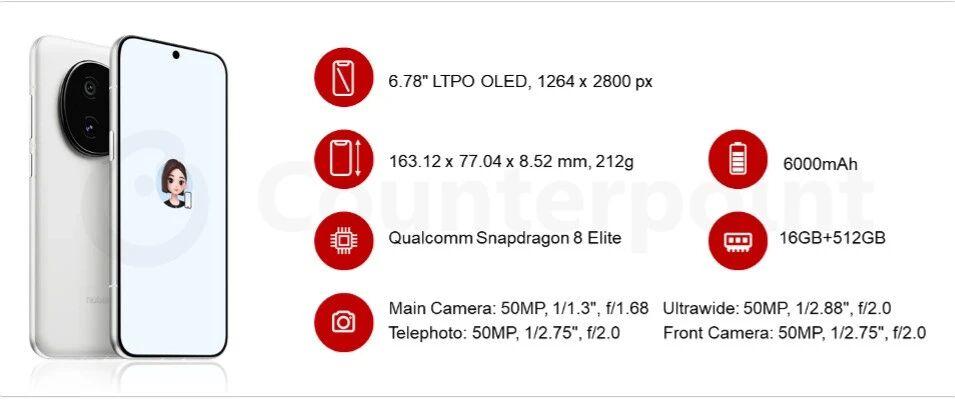
Core Insights - The article discusses the launch of the Nubia M153, the first native AI smartphone developed by ByteDance and ZTE, which was released as a "technology preview" on December 1, 2025, and sold out quickly, indicating strong market interest [4] - According to Counterpoint's "AI 360" report, the global smartphone shipment share supporting GenAI is expected to exceed 30% in 2025, up from 20% in 2024, and reach 57% by 2029, highlighting the growing importance of AI in high-end smartphones [5] - The article emphasizes the competitive landscape between smartphone brands and internet giants, focusing on user engagement, service entry control, and high-value data acquisition [8][10] Market Trends - The Nubia M153 is equipped with a Snapdragon 8 Elite platform, and future iterations are expected to enhance NPU performance to 80-100 TOPS, raising hardware requirements for smartphones [5] - AI functionalities are increasing the demand for RAM and ROM, as well as high-bandwidth memory, while also raising power consumption by approximately 8%-12%, posing challenges for battery technology [5] AI Capabilities - The core advantage of the Doubao AI smartphone lies in its ability to understand user intent and execute tasks across multiple apps, although it still faces challenges in complex, multi-app scenarios [6][8] - The high-privilege simulation operations of Doubao AI are causing friction with existing app ecosystems, triggering security mechanisms in major applications like WeChat and Alipay [6][8] Strategic Partnerships - The collaboration between ByteDance and ZTE mirrors the division of labor seen in other tech partnerships, with Doubao providing AI capabilities and Nubia handling hardware design [10] - The article suggests that smartphone brands with established ecosystems may not adopt the same division of labor, instead exploring open and collaborative app frameworks [10] Future Outlook - The article anticipates that smartphone brands and leading apps will gradually reach a consensus on standardized ecological interfaces, allowing system-level AI to act as a unified scheduling hub [10] - The control of high-value data and data security will remain central issues in ongoing negotiations between smartphone manufacturers and app developers [10]

马斯克宣布开源X推荐算法;印尼暂时封禁马斯克旗下AI聊天机器人
Sou Hu Cai Jing· 2026-01-12 02:16
Group 1: AI Developments - Elon Musk announced the open-sourcing of the X platform's content recommendation algorithm, which will cover all code used to recommend natural and advertising content, with updates every four weeks [2] - Indonesia has temporarily banned Musk's AI chatbot "Grok" due to concerns over potential generation of inappropriate content, marking the first country to restrict access to this AI tool [2] - DeepSeek is set to release its next-generation AI model, DeepSeek V4, in February, which is reported to outperform existing models in code generation capabilities [3] Group 2: Investments and Financing - OpenAI and SoftBank have jointly invested $1 billion in SB Energy to support the construction of AI data centers in the U.S., with each contributing $500 million [3] - Forvia Hydrogen has completed a strategic financing round of 300 million yuan, backed by Sinopec Capital, focusing on hydrogen storage solutions [4] - Turing Quantum has secured several hundred million yuan in strategic financing, aimed at advancing research and commercialization in optical quantum computing [5] - The industrial intelligence company Zhi You Wu Jie has completed a seed round financing of several million yuan, with plans to enhance product development and team expansion [6] Group 3: Mergers and Acquisitions - Mobileye has announced the acquisition of humanoid robotics company Mentee Robotics for approximately $900 million, which includes cash and stock components [7] Group 4: Technological Innovations - The "Tianma-1000" unmanned transport aircraft successfully completed its first flight test, designed for logistics, emergency rescue, and material delivery [8] - The upcoming Xiaomi 17 Max smartphone is expected to be released in March, featuring a large battery and screen, alongside other new models from various brands [8] - The Zhijie V9, a new luxury MPV from Huawei, is set to launch in Spring 2026, targeting the high-end market with advanced features and a long range [8]

2025 年底新旗舰单品激活百万机型曝光,含小米 17 Pro 系列、华为 Mate 80
Xin Lang Cai Jing· 2026-01-12 01:23
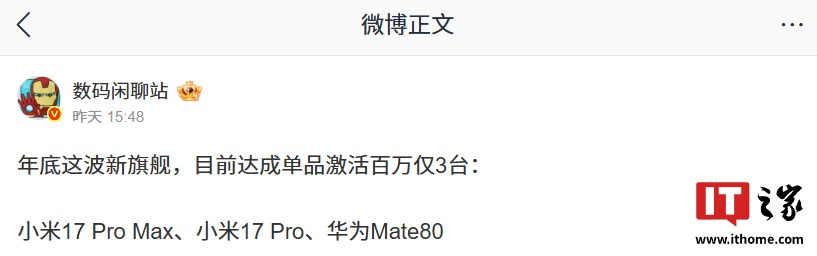
IT之家 1 月 11 日消息,博主 @数码闲聊站 昨日发文透露,年底这波新旗舰,目前达成单品激活百万仅 3 台,包括小米 17 Pro Max、小米 17 Pro 和华为 Mate 80。 IT之家注:小米 17 系列(不含 Ultra)发布于 2025 年 9 月 26 日,首发搭载第五代骁龙 8 至尊版移动平台,售价 4499 元起,系列手机开售仅 5 天销量破 100 万台;华为 Mate 80 系列手机发布于 2025 年 11 月 25 日,首发麒麟 9030 / Pro 处理器(标准版为麒麟 9020 处理器),售价 4699 元起。 蓝厂(预计指 vivo) 粮厂(预计指小米) 果厂(预计指苹果) 绿厂(预计指 OPPO) 菊厂(预计指华为) IT之家 1 月 11 日消息,博主 @数码闲聊站 昨日发文透露,年底这波新旗舰,目前达成单品激活百万仅 3 台,包括小米 17 Pro Max、小米 17 Pro 和华为 Mate 80。 ▲ IT之家开箱:小米 17 Pro / Pro Max 手机图赏 据IT之家此前报道,消息称真我回归 OPPO 后,2025 国内激活量 TOP5 排名如下(TO ...
“死了么”APP一夜估值千万,最新回应;佐香园与闫学晶解约;鸿蒙智行首款MPV定档,定位50万级豪华市场丨邦早报
创业邦· 2026-01-12 00:13
Group 1 - The "Did You Die?" app has gained significant popularity, ranking first in Apple's paid tools category, and is designed as a safety tool for individuals living alone, requiring users to check in regularly [3] - The app's creator revealed that it was developed in less than a month with an initial investment of only over 1,000 yuan, and it has already become profitable with a download increase of over 100 times in recent days [3] - The app's valuation is estimated at 10 million yuan based on a proposed sale of 10% equity for 1 million yuan [3] Group 2 - Elon Musk announced that the X platform will open-source its content recommendation algorithm within a week, covering all code used for recommending content and ads [4] - Musk stated that this process will be repeated every four weeks, providing developers with explanations and updates on algorithm changes [4] Group 3 - BYD has launched a new automotive brand called Linghui, which includes four new models, three of which are pure electric sedans and one is a plug-in hybrid MPV [8] - The Linghui brand aims to cater to B-end market demands and is part of BYD's strategy to differentiate between B-end and C-end market vehicles [8] Group 4 - SanDisk is reportedly planning to increase prices by over 100% and has introduced a strict payment policy requiring 100% cash prepayment for future storage chip allocations [10] - This unprecedented move challenges traditional payment practices in the semiconductor supply chain, driven by strong demand for storage devices in AI infrastructure [10] Group 5 - CATL's service brand, NING Service, has opened the largest new energy after-market experience center in the Middle East, providing comprehensive lifecycle services for various battery types [10] - The center aims to support the growing demand for electric vehicle maintenance and battery recycling in the region [10] Group 6 - The Beijing-Tianjin-Hebei region has emerged as a leader in the production of new energy vehicles, with a total automotive output of 285,000 units in 2024, marking an 11.8% year-on-year increase [23] - The production of new energy vehicles in the region surged by 154% year-on-year, highlighting the area's strong industrial growth and leadership in the sector [23]

晶丰明源推32.83亿收购完善布局 经营企稳单季归母净利增131.8%
Chang Jiang Shang Bao· 2026-01-11 23:31
Core Viewpoint - Jiangfeng Mingyuan (688368.SH) is acquiring 100% equity of Yichong Technology for a total price of 3.283 billion yuan, aiming to enhance its power management chip layout and accelerate its transformation into a platform semiconductor enterprise [1][2]. Group 1: Acquisition Details - The acquisition involves a combination of shares and cash, with 1.249 billion yuan in cash (38.05%) and 2.033 billion yuan in shares (61.95%), corresponding to an issuance price of 50.39 yuan per share, with approximately 40.35 million shares expected to be issued [2]. - To ensure funding for the transaction, Jiangfeng Mingyuan plans to raise up to 1.8 billion yuan through a private placement to no more than 35 specific investors, which will be used for cash payments, working capital, and intermediary fees [2]. Group 2: Valuation and Market Position - The transaction price of 3.283 billion yuan is supported by a professional assessment valuing Yichong Technology at 3.56 billion yuan, indicating a reasonable discount that protects the interests of the listed company and minority shareholders [3]. - Yichong Technology specializes in high-performance analog and mixed-signal chips, covering key areas such as wireless charging and automotive power management, which aligns with Jiangfeng Mingyuan's strategic goals [4]. Group 3: Financial Performance and Synergy - Jiangfeng Mingyuan reported a revenue of 1.117 billion yuan for the first three quarters of 2025, a year-on-year increase of 2.67%, and a net profit of 23.33 million yuan, marking a turnaround from losses [5]. - The merger is expected to create strong synergies, enhancing Jiangfeng Mingyuan's market position and potentially placing it among the top five in the industry [5].

首店经济“首”发力
Xin Lang Cai Jing· 2026-01-11 21:21
Core Insights - The Peace District is actively promoting the "first store economy" as a strategy for high-quality development, with a focus on attracting flagship and concept stores to reshape the consumer landscape [1][2][5] Group 1: Economic Development - In 2024, the Peace District plans to introduce 82 various first stores, flagship stores, and concept stores, with notable brands like UH Youhe and B&C set to open in 2025 [1] - The district has implemented a "2.0 version" of its first store support policy, which was developed through consultations with over 30 businesses and 20 local departments to create a more effective support system [2] Group 2: Government Support - The Peace District's government has established a proactive service model that includes dedicated personnel for businesses, ensuring smooth communication and support throughout the project lifecycle [2][3] - Innovative government services, such as the "Peace First Store" column, aim to enhance visibility for new stores and facilitate customer engagement, transitioning from basic support to active empowerment [4] Group 3: Business Performance - The "Supply and Marketing Forward Milk Bread" first store achieved sales exceeding 5.5 million yuan within its first year, demonstrating the potential for sustained business success beyond initial popularity [5] - The ONE MOMENT first store in Peace Grand Joy City generated over 1 million yuan in sales within its first three days, indicating strong consumer interest and engagement [6] Group 4: Long-term Strategy - The Peace District aims to create a virtuous cycle of "introduction—growth—radiation" for first stores, focusing on optimizing the types of stores introduced and integrating them with urban renewal and cultural tourism [6]
AI周观察:数据软件行业积极并购,谷歌邮件集成Gemini
SINOLINK SECURITIES· 2026-01-11 13:35
摘要 风险提示 芯片制程发展与良率不及预期 中美科技领域政策恶化 智能手机销量不及预期 敬请参阅最后一页特别声明 1 - 本周,受节假日因素影响,聊天助手类应用活跃度普遍回落,其中 Kimi 降幅较为显著。行业动态方面,数据与 生态整合加速,微软收购 Osmos 优化 Fabric 平台数据流程,Snowflake 以 10 亿美元收购 Observe 布局 AI 可观 测性;谷歌 Gmail 全面集成 Gemini3 模型重塑邮件体验;阿里高德发布世界模型 FantasyWorld,登顶 WorldScore 榜单并落地低成本 3D 街景生成功能。 - 2025 年 11 月,中国智能手机销量达到约 2600 万台,同比上升约 10%。苹果、小米、华为、荣耀、OPPO 以约 23%、15%、14%、13%、12%的份额排名前五。具体型号方面,苹果 iPhone 17 Pro Max 销量排名第一,iPhone 17、iPhone 17 Pro 排名第二、第三。11 月国内 PC 市场销量有所回暖,台式机销量约为 152 万台,同比上升约 7%。笔电销量约为 195 万台,同比上升约 4%。 | 海外市场行情 ...