
淘宝

Search documents
【钛晨报】外资利好!境外投资者以分配利润直接投资可享税收抵免;华为、百度同日宣布开源新动作;《哪吒2》下映,全球总票房超159亿元
Sou Hu Cai Jing· 2025-06-30 23:55
Tax Policy Changes - The Chinese government announced a tax credit policy for foreign investors, allowing a 10% tax credit on profits reinvested in domestic direct investments from January 1, 2025, to December 31, 2028 [1][2] - Conditions for enjoying the tax credit include the nature of the profits, the type of investment, the industry involved, the holding period, and the payment method [1][2] Investment and Economic Trends - China's chip production accounts for approximately 30% of global output, with annual exports reaching several hundred billion USD, despite current limitations in high-end chip capabilities [3] - The domestic automotive sector is set to see new product launches from Ora, with a sales target of 50,000 units by 2025 and an expansion of sales channels [7] - Gree Electric's chairman emphasized the company's financial stability and called for patience from investors regarding future returns [7] Financial Market Developments - The Shenzhen Stock Exchange released guidelines for identifying "light asset, high R&D investment" companies, detailing standards for eligibility and disclosure requirements [11][12] - The A-share market saw significant growth in the first half of the year, with major indices rising, particularly the North Star 50 Index, which surged by 39.45% [13] International Business and Regulatory Environment - Alphabet's agreement with Commonwealth Fusion Systems marks a significant step towards commercializing nuclear fusion energy [8] - The Canadian government's decision to halt operations of Hikvision due to national security concerns has drawn strong opposition from the Chinese government, highlighting tensions in international trade [15]


中国最容易转行的大学专业,谁读谁后悔
36氪· 2025-06-29 23:55
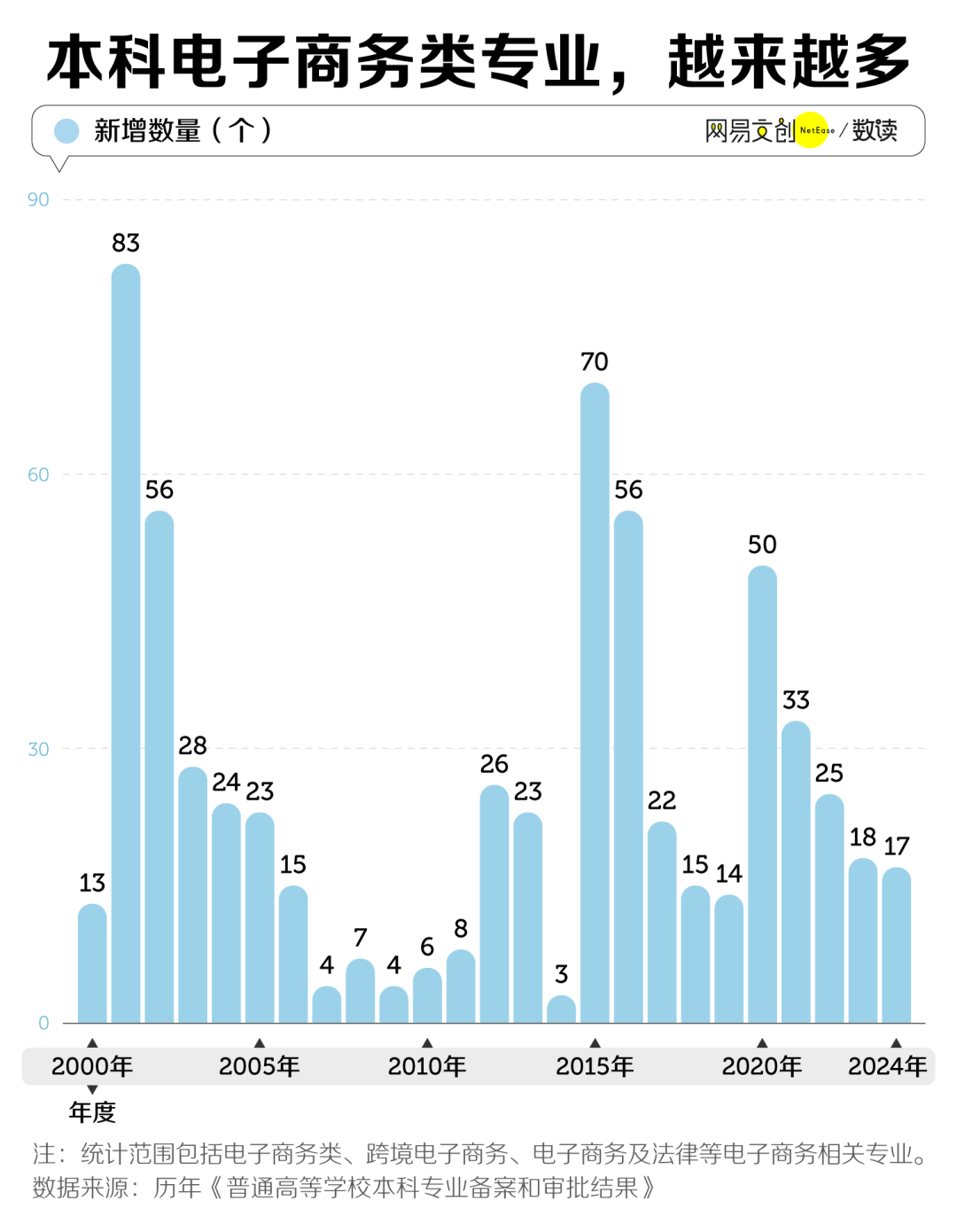
Core Viewpoint - The article discusses the challenges and realities faced by graduates of e-commerce programs in China, highlighting the disparity between the perceived opportunities in the industry and the actual job market conditions [4][6][21]. Group 1: E-commerce Education Landscape - E-commerce has become a popular field of study, with over 600 universities offering related programs, indicating a promising outlook for the industry [5][15]. - The initial enthusiasm for e-commerce programs has waned, with many graduates struggling to find relevant jobs, leading to a significant drop in the number of new programs being established [11][15]. - In 2004, the employment rate for e-commerce graduates was reported to be as low as 20%, reflecting the difficulties in securing relevant positions [13][14]. Group 2: Job Market and Employment Challenges - Despite a high demand for e-commerce positions, with projections of 1.627 million job openings by 2025, graduates still face significant challenges in finding suitable roles [21][28]. - Many graduates report that the most accessible positions are low-paying customer service roles, leading to feelings of frustration and inadequacy [22][32]. - The e-commerce industry places a strong emphasis on practical experience, which many graduates lack, resulting in a gap between education and job readiness [24][39]. Group 3: Work Conditions in E-commerce - E-commerce jobs are characterized by high workloads and long hours, with many employees experiencing burnout due to the demanding nature of the work [29][31]. - The average salary for e-commerce specialists is low, with nearly 70% of employees earning less than 10,000 yuan per month, and some even earning below 5,000 yuan [32][33]. - Many employees find themselves performing multiple roles within the industry, leading to a sense of being overworked and underappreciated [30][31]. Group 4: Career Transition and Future Prospects - A significant number of e-commerce professionals are considering career changes due to the challenging work environment and limited growth opportunities [34][36]. - Those with skills in video production and design find it easier to transition to related fields, while others may struggle to find relevant opportunities outside of e-commerce [36][37]. - The perception that a degree in e-commerce is essential for success in the industry is challenged, as practical skills and adaptability are often more valuable [39].


中国创业者的信心从哪里来?首先是9亿人的刚需升级机会
创业家· 2025-06-29 10:09
Core Viewpoint - The article emphasizes the structural opportunities in China's consumer market, particularly focusing on the 900 million people in lower-tier cities as the main consumer base for future growth [5][12]. Group 1: Market Dynamics - The consumer landscape in China has shifted, with the previous focus on high-end brands in first-tier cities evolving to include a broader range of products catering to lower-tier markets [5][6]. - The connection between high-tier and low-tier markets has been established, allowing for a more integrated consumer experience [7]. - The article highlights the emergence of new business models based on China's new infrastructure and production relationships, which enhance efficiency in information flow and supply chains [11][12]. Group 2: Consumer Segmentation - The consumer market is segmented into three layers: the affluent class, the middle class under economic pressure, and the 900 million people in lower-tier cities who represent the main market [9]. - The affluent class consumes globally, while the middle class faces challenges due to economic adjustments, and the lower-tier market shows potential for growth as purchasing power is released [9][12]. Group 3: Investment Opportunities - The article identifies two structural opportunities in the consumer market: the rise of new national brands and the development of new nationwide chains [13]. - The "启承消费时钟" (Qicheng Consumption Clock) is introduced, categorizing consumer goods into four phases: essential needs, optional purchases, alternatives, and upgrades, reflecting the changing economic conditions [12][13]. - The growth of discount brands and alternative products is noted, with examples such as "鸣鸣很忙" in the snack sector, indicating a shift towards more affordable options [13].



华映资本管理合伙人王维玮:消费投资“热”了,估值尚未明显变化
Jing Ji Guan Cha Wang· 2025-06-29 08:11
Core Insights - The article discusses the evolution of Pop Mart's business model and the broader changes in consumer investment trends, emphasizing the importance of long-term perspectives in investment decisions [2] Group 1: Business Model Evolution - Pop Mart's initial business model was a "store within a store" concept focused on creative products, which has evolved through multiple iterations to its current form [2] - The management partner of Huaying Capital, Wang Weiwei, highlights that investment should not only focus on the present but also consider long-term cycles [2] Group 2: Consumer Investment Trends - After a surge in consumer investment from 2021 to 2022, the sector is expected to face a downturn in 2024, with a potential recovery in 2025 as leading Hong Kong consumer stocks see significant valuation increases [2] - Huaying Capital has accelerated its investment pace this year, with total investments reaching three times that of the previous year, focusing on efficiency-driven companies and emotional consumption sectors [2] Group 3: Market Dynamics - The consumer industry faces inherent efficiency bottlenecks, with offline consumption limited by geographical constraints, creating opportunities for small and medium enterprises [3] - Wang Weiwei notes that the competitive landscape in the consumer sector is intense, requiring companies to excel in product, brand, channel, and capital operations [3] Group 4: Investment Strategy and Valuation - The valuation logic in consumer investment has shifted from price-to-sales (PS) to price-to-earnings (PE) methods, with a general cap of 10 times PE expected in 2024 [4] - Despite the changing landscape, the overall valuations of consumer projects have not shown significant changes this year [4] Group 5: Exit Strategies and M&A Opportunities - Huaying Capital is increasingly favoring Hong Kong listings for exits, as the market offers high certainty and low opportunity costs, especially with the recovery of consumer sector valuations [4] - The next five years are anticipated to witness a wave of industry consolidation, with five key M&A opportunities identified, including the scaling of small enterprises and the modernization of family business governance [5]

食品饮料行业周报:周观点:啤酒饮料正当旺季,持续关注渠道变化-20250629
GOLDEN SUN SECURITIES· 2025-06-29 07:31
Investment Rating - The report maintains an "Increase" rating for the food and beverage industry, indicating a positive outlook for the sector [4]. Core Insights - The beer and beverage sector is entering a peak season, with a focus on channel changes and growth opportunities. The report highlights three main investment lines for the liquor segment: leading brands, high-certainty regional brands, and elastic stocks benefiting from recovery and increased risk appetite [1][2]. - The white liquor industry is gradually bottoming out, with leading companies like Kweichow Moutai and Wuliangye showing low valuations and dividend value. The report emphasizes the importance of adapting to younger consumer preferences and enhancing brand quality [2]. - The beverage segment is characterized by high growth potential, with companies like Yanjing Beer and Zhujiang Beer being highlighted for their strong performance. The report also notes the introduction of new products by Xiangpiaopiao and the competitive landscape in the beverage market [3][6]. Summary by Sections White Liquor - Demand-side strategies focus on solidifying sales foundations, with companies actively managing supply and pricing to maintain strong sales [2]. - Supply-side initiatives include marketing transformations and product innovations aimed at younger consumers, such as low-alcohol and flavored products [2]. - The report indicates that the valuation of white liquor stocks has reached low levels, with current PE ratios around 17.7x, which is approximately 10% lower than the A-share market [2]. Beer and Beverage - The report notes the resignation of the chairman of China Resources Beer, which may present a buying opportunity post-adjustment [3][6]. - The beverage sector is experiencing intense competition, with new product launches and a focus on high-growth potential companies [6][7]. - The report highlights the ongoing transformation in retail, with companies like Sam's Club and Walmart leading in sales growth, indicating a shift in consumer purchasing behavior [7].
中国最容易转行的大学专业,谁读谁后悔
虎嗅APP· 2025-06-26 13:19
Core Viewpoint - The article discusses the challenges and realities faced by graduates of e-commerce programs in China, highlighting the disparity between the perceived opportunities in the industry and the actual job market conditions [4][5][12]. Group 1: E-commerce Education and Job Market - E-commerce has become a popular field of study, with over 600 universities offering related programs, indicating a promising outlook [4][8]. - Despite the initial enthusiasm, many graduates face difficulties in finding relevant jobs, leading to a decline in the number of new e-commerce programs being established [9][12]. - In 2004, the employment rate for e-commerce graduates was reported to be only 20%, reflecting the challenges in securing jobs in the field [12][13]. Group 2: Industry Demand and Graduate Experiences - From 2014 to 2022, the number of people employed in e-commerce grew to nearly 70 million, increasing the demand for e-commerce professionals [15]. - Despite the high number of job openings in the e-commerce sector, many graduates report difficulties in finding suitable positions, often ending up in unrelated fields [20][21]. - A significant portion of e-commerce job postings (38.3%) do not require a specific educational background, making it easier for individuals to enter the industry, albeit with low pay and high demands [28][29]. Group 3: Work Conditions and Career Progression - E-commerce jobs are characterized by long hours and high workloads, with many employees feeling overburdened by their responsibilities [30][32]. - The average salary for e-commerce specialists is relatively low, with nearly 70% of employees with over four years of experience earning less than 10,000 yuan per month [35]. - Many e-commerce workers consider transitioning to other fields due to the demanding nature of their jobs and the lack of growth opportunities [37][39].

低价陷阱里的即时零售:越卷越亏,出路究竟在哪?
3 6 Ke· 2025-06-25 09:55
Core Insights - The instant retail sector is experiencing rapid growth, with major platforms like Meituan, Taobao, and JD showing significant increases in daily order volumes, indicating a competitive landscape [1][2][3] - However, the industry is facing challenges due to a price war, leading to unsustainable low-price strategies that threaten long-term profitability and brand integrity [2][3][4] Group 1: Industry Growth - Meituan's non-food instant retail surpassed 18 million daily orders in Q1 2025, with core categories like 3C appliances and daily necessities growing over 200% year-on-year [1] - Taobao's flash purchase service achieved over 60 million daily orders within two months, with a year-on-year retail order growth of 179% and a punctuality rate of 96% [1] - JD's food delivery service has exceeded 25 million daily orders since its launch on March 1, with over 120,000 full-time delivery personnel [1] Group 2: Price Competition Challenges - The industry is dominated by low-price strategies, forcing merchants to lower prices to attract price-sensitive consumers, which compresses profit margins [3][4] - Platforms encourage low-price promotions to enhance competitiveness, leading to a cycle of unhealthy competition that harms long-term sustainability [3][4] - Over-reliance on low prices results in reduced product quality and brand damage, as merchants may resort to inferior goods to cut costs [3][4] Group 3: Need for Differentiation - The current low-price competition model fails to meet the evolving demands of consumers who seek quality, service, and speed [5][6] - Platforms must shift focus from low prices to high-quality offerings and services to attract discerning customers, as exemplified by Sam's Club and Costco [7][8] - A strategy of customer segmentation targeting high-end clients with premium products and services can create a competitive edge [8][9] Group 4: Strategic Recommendations - Platforms should develop robust customer analysis systems to identify high-end consumer segments based on purchasing behavior and preferences [9] - Strengthening partnerships with suppliers to ensure high-quality product offerings is essential for long-term success [9] - Building a strong brand image through quality service and products will help attract and retain high-end customers, moving away from the low-price model [9]


存量调改成风 | 2025年6月商业地产零售业态发展报告
Sou Hu Cai Jing· 2025-06-25 09:54
Core Viewpoint - The retail sector in commercial real estate is experiencing a transformation driven by consumer promotion policies and the expansion of the duty-free economy across major cities in China, leading to increased consumer spending and inbound tourism [3][5][6]. Group 1: Retail Sector Performance - Major retail operators such as CR Land, Longfor Group, and Link REIT are showing varied performance, with some projects achieving significant growth while others struggle with older assets requiring continuous investment [3][9]. - The retail property portfolio of Link REIT in mainland China reported a total revenue and net property income growth of 29.7% and 28.9% respectively, driven by strong performance from specific projects in Shanghai and Shenzhen [9][12]. Group 2: Consumer Promotion Policies - Cities like Shenzhen, Chongqing, and Chengdu have introduced consumer promotion policies aimed at boosting local economies, with initiatives such as the establishment of new retail stores and events to attract consumers [5][6]. - The focus on green consumption and the establishment of new retail formats, such as duty-free shops in urban areas, are part of a broader strategy to enhance consumer engagement and stimulate economic activity [5][8]. Group 3: Experience and Content Enhancement - Existing retail spaces are undergoing significant upgrades to enhance consumer experience, with a shift towards immersive and engaging environments to attract foot traffic [14][17]. - New entrants in the outlet market are leveraging unique themes and experiences to differentiate themselves, such as health and wellness concepts in shopping centers [13][19]. Group 4: Cross-Border E-commerce Expansion - Cross-border e-commerce platforms like TikTok Shop are expanding into new European markets, indicating a strategic move to capture a broader customer base [30][31]. - Domestic platforms are also enhancing their international competitiveness, with initiatives like JD's collaboration with Xiaohongshu to improve conversion rates and customer engagement [34]. Group 5: REITs and Investment Trends - The approval of new consumption infrastructure REITs, such as the China Green Development REIT, reflects a growing trend towards light-asset operations and the optimization of commercial assets [35][36]. - Existing REITs are showing stable operations, with a reported cash distribution rate of 4.19% for the recently restructured Huaxia First Creation Outlet REIT [36][37].

中国最容易转行的大学专业,谁读谁后悔
Hu Xiu· 2025-06-25 07:45
Group 1 - The core viewpoint of the article highlights the challenges and contradictions faced by the e-commerce industry and its related academic programs, despite the apparent growth and demand for e-commerce professionals [2][20][21] - E-commerce has become an integral part of daily life, with over 600 universities offering e-commerce programs, indicating a promising future for the field [2][6] - However, there are significant concerns regarding the employability of graduates, with historical data suggesting that only 20% of e-commerce graduates found relevant jobs in 2004 [11][12] Group 2 - The e-commerce industry has seen a surge in demand for talent, with the number of professionals in the field approaching 70 million from 2014 to 2022 [14] - Despite the high demand for e-commerce positions, graduates often struggle to find suitable roles, leading to a perception that studying e-commerce may not be worthwhile [21][22] - The job market for e-commerce roles is projected to reach 1.627 million positions by 2025, accounting for 11.9% of the national recruitment market [20] Group 3 - Many graduates express dissatisfaction with their job prospects, often finding themselves in roles that do not align with their education, such as customer service [23][30] - The e-commerce sector places a strong emphasis on practical skills, yet many academic programs fail to provide adequate hands-on experience [26][28] - The overall working conditions in e-commerce are challenging, with high workloads and low salaries, leading to a high turnover rate among employees [41][42] Group 4 - The article notes a trend of graduates seeking to transition to other fields, with many opting for careers in education or unrelated sectors due to a lack of relevant skills acquired during their studies [49][50] - The perception that e-commerce professionals do not require formal education in the field is growing, as practical experience and adaptability become more valued [53]
刘强东杀入酒旅,要夺回京东失去的五年
首席商业评论· 2025-06-25 03:47
Core Viewpoint - JD.com has experienced a significant decline over the past five years, marked by a lack of innovation and growth, as highlighted by founder Liu Qiangdong. He emphasizes the need for new projects and a return to the company's core strengths in low pricing and supply chain efficiency [3][6]. Group 1: Recent Developments and Challenges - Liu Qiangdong criticized the company for not introducing any new business models in the last five years, calling it a period of stagnation [3]. - The company has faced challenges in competing with emerging platforms like Pinduoduo and Douyin due to strategic instability and a shift away from its core competencies [6]. - JD.com has launched a high-profile entry into the food delivery market, achieving a 150% increase in daily order volume within 90 days, reaching 25 million orders per day [13][21]. Group 2: Future Growth Strategies - JD.com is exploring new growth avenues, particularly in the food delivery sector, to enhance overall GMV and user engagement [8]. - The company is also venturing into the hotel and travel market, offering a "JD Hotel PLUS Membership Plan" with incentives for hotel operators [25][39]. - JD.com aims to leverage its supply chain capabilities to reduce costs in the hotel industry, although challenges remain in transforming the fragmented market [41][43]. Group 3: Competitive Landscape - The food delivery market has seen explosive growth, with JD.com and Alibaba's combined order volume reaching approximately 85 million, rivaling Meituan's 80 million daily orders [17][18]. - Meituan has responded with increased subsidies in the flash purchase segment, indicating a competitive environment where all players are aggressively pursuing market share [22]. - JD.com’s strategy in the hotel sector involves a focus on low pricing and supply chain optimization, but it faces significant competition from established players like Ctrip [31][36].
