
嘉能可

Search documents
钴又被庄家盯上了
Hu Xiu· 2025-09-30 09:35
Core Viewpoint - The article discusses the rising cobalt prices driven by government intervention in the Democratic Republic of Congo (DRC), which is expected to benefit the DRC government and impact the global electric vehicle (EV) market significantly. Group 1: Cobalt Market Dynamics - Cobalt prices have experienced two significant cycles of volatility since 2016 due to supply-demand mismatches [2] - From May 2022 to early 2025, cobalt prices entered a downward phase due to slowing demand for EVs and increased competition from lithium iron phosphate (LFP) batteries [4] - The DRC government has intervened in the cobalt market since 2025, controlling supply to create an upward price cycle [5][6] Group 2: Government Intervention - The DRC, as the largest cobalt supplier, accounted for over 75% of global cobalt supply in 2024, with reserves of 6 million tons [6] - The DRC government imposed temporary export bans on cobalt in 2025, leading to a price rebound of over 100% from its lowest point [7] - The DRC has extended the export ban and introduced a quota system, limiting exports to 9.66 million tons in 2026 and 2027, significantly below its production capacity [8] Group 3: Price Projections - Analysts predict that cobalt prices could reach between 400,000 to 500,000 yuan per ton due to the supply constraints imposed by the DRC government [8] - The global demand for cobalt is expected to grow, with projected requirements of 248,000 tons in 2025 and 329,000 tons in 2027, indicating a widening supply-demand gap [8] Group 4: Impact on Battery Technology - The rising cobalt prices are likely to negatively impact the nickel-cobalt-manganese (NCM) battery route while benefiting LFP battery manufacturers [18] - The cost increase in cobalt could lead to a rise of over 10,000 yuan in battery costs for each EV, affecting automaker profit margins and consumer choices [18] - Companies are exploring alternative battery technologies to reduce cobalt dependency, such as high-nickel low-cobalt batteries [19][20] Group 5: Recycling and Market Opportunities - Cobalt recycling companies are expected to benefit from rising prices, with companies like Greeenme's cobalt recycling business showing improved profitability [21] - The current cobalt price crisis serves as a catalyst for industry upgrades and a lesson for the Chinese EV sector [22] Group 6: Investment Opportunities - The DRC government's intervention in the cobalt market suggests a sustained upward price trend, making cobalt price tracking crucial for investors [23] - Historical performance of cobalt producers like Huayou Cobalt during previous price cycles may provide insights for current investment strategies [23]


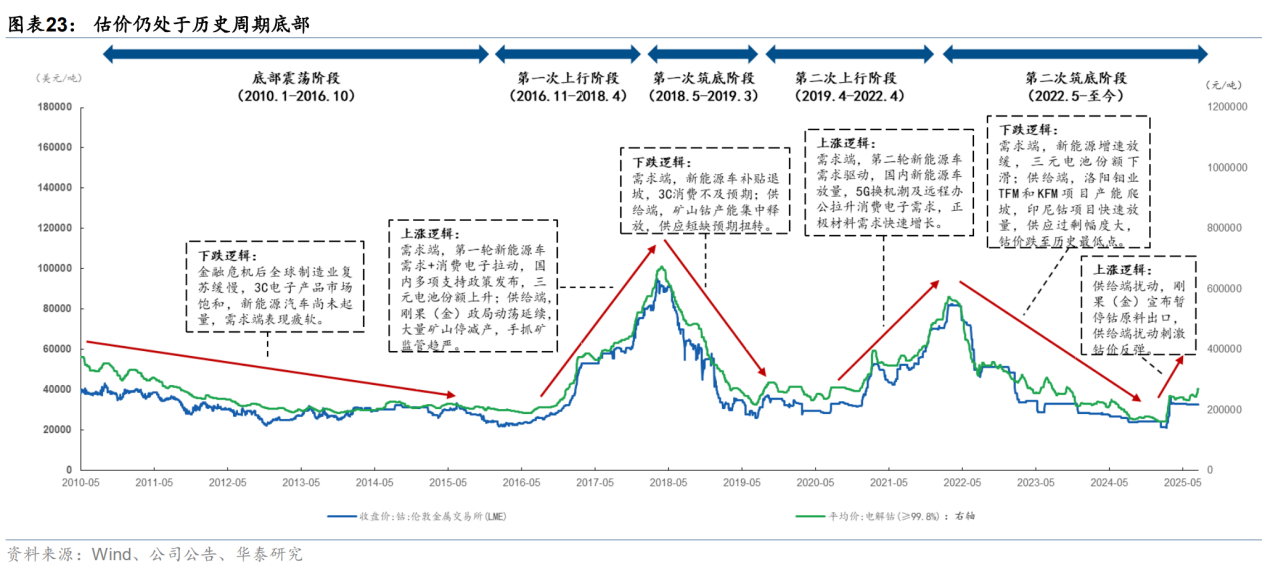
2025年第39期(总第714期):2025全球关键矿产深度报告-赛迪译丛
Sou Hu Cai Jing· 2025-09-29 23:47
Group 1: Supply and Demand Dynamics - The global supply and demand landscape for critical minerals is undergoing significant changes, with a surge in demand driven by energy transition, particularly in electric vehicles and energy storage [1][6][7] - Lithium demand is expected to increase by nearly 30% year-on-year in 2024, significantly outpacing the average annual growth rate of 10% seen in the 2010s [1][6] - By 2040, lithium, graphite, and rare earth demand is projected to grow by 4.7 times, 2.2 times, and 1.6 times respectively, with electric vehicle batteries consuming 60% of global lithium and 40% of nickel and cobalt [1][7] Group 2: Supply Concentration and Investment Trends - The supply side is characterized by increasing concentration, with China, Indonesia, and the Democratic Republic of Congo dominating the market, leading to an average market share of 86% in the refining sector for the top three producing countries [1][9] - Despite the surge in demand, global investment in critical mineral extraction is expected to slow, with growth rates dropping to 5% in 2024, half of the previous year's rate [1][10] - The International Energy Agency (IEA) warns of potential shortages, predicting a 30% gap in copper supply by 2035 and possible lithium shortages in the 2030s [1][10] Group 3: Geopolitical Influences and Market Pressures - Geopolitical tensions are reshaping resource order, with countries accelerating the establishment of mineral security frameworks, such as the U.S. simplifying licensing processes and the EU passing the Critical Raw Materials Act [2][15] - China's export controls on strategic minerals have led to significant price increases, with bismuth prices rising by 90% and cobalt prices surging by 67% following export restrictions [2][26] - The market faces structural contradictions, with rising costs and environmental pressures hindering development, as emerging producers experience higher operational costs compared to leading producers [2][8] Group 4: Policy Innovations and Technological Breakthroughs - To address these challenges, innovative policy mechanisms are needed, such as establishing certification systems for differentiated pricing and increasing public financial support for high-risk projects [3] - Technological advancements in mining, refining, and recycling are essential, including the development of new techniques to reduce energy consumption and costs in rare earth production [3][29] - The report emphasizes the importance of international cooperation and partnerships to ensure a stable supply chain for critical minerals [30][31]

Perpetua Resources in talks with mining companies for antimony processing
Yahoo Finance· 2025-09-29 11:15
Group 1 - Perpetua Resources is in discussions with several mining companies, including Glencore and Trafigura, to establish partnerships for antimony processing in the US, aiming to secure a steady supply for domestic consumers [1][5] - The company plans to issue a request for proposal (RFP) to evaluate the technical and economic viability of off-site processing facilities, focusing on production capacity, financial stability, environmental performance, and transport reliability [2] - The RFP is expected to be issued in the coming weeks, with a final decision anticipated by Q4 2025, following a due diligence review [3] Group 2 - Perpetua Resources has received conditional approval from the US Forest Service to begin developing the Stibnite Gold Project, which is contingent on financial assurance bonding [4] - Antimony is classified as a critical mineral by the US Department of the Interior, essential for national security and used in manufacturing applications such as bullets and solar panels [5]

4Q25铅观点与策略:海晏河清,时雨逢春-20250929
Dong Zheng Qi Huo· 2025-09-29 07:43
Report Industry Investment Rating - The rating for Shanghai Lead is "Volatility", with a price range of [16,500, 17,800], featuring narrow - range fluctuations and occasional small - to medium - scale market movements [3]. Core Viewpoints of the Report - In Q4 2025, the shortage of lead concentrates and waste batteries will intensify. Domestic demand is expected to improve periodically under the background of policy - boosted consumption, while export demand may continue to be under pressure. The oscillation center of Shanghai Lead may move up, and there may be small - to medium - scale upward trends as consumption improves. The volatility may increase compared to Q3, and it is safer to take long positions at low prices. Attention should be paid to the production strategies of large enterprises [3]. Summary by Relevant Catalogs 1. Q3 2025 Lead Price Review - In July, lead prices rose first and then fell. Shanghai Lead increased significantly due to anti - cut - throat competition sentiment and pre - trading of improved demand, but domestic demand was later disproven, and anti - cut - throat competition had limited impact on basic non - ferrous commodities. LME Lead was pressured by a stronger US dollar, and both domestic and overseas lead prices dropped back to pre - increase levels [6]. - In August, the 0 - 3 cash of the outer market remained deeply in contango. The domestic lead market had weak supply and demand. Falling lead prices and tight raw materials intensified the pressure on the operating rate of secondary smelters, and demand was even weaker. With low capital attention, both domestic and overseas lead prices fluctuated at low levels [6]. - In September, the bottom - building of lead prices ended. As the traditional peak season approached, the raw material and finished - product inventories of downstream battery factories continued to decline, and lead prices rose slightly in advance. With the approaching of the double - festival holiday, downstream enterprises stocked up in advance, and market transactions improved as lead prices rose. The fundamental support pushed the operating center of lead prices up from 16,800 yuan/ton to 17,000 yuan/ton [6]. 2. Lead Concentrate Supply Overseas - In Q3 2025, overseas lead concentrate production was lower than expected. Although project profits were sufficient, factors such as lower - than - expected output from sample mining enterprises, irreversible decline in mine grades, long - term impact of geological factors, time required for equipment renewal, and increased probability of La Nina led to the annual overseas lead concentrate increment dropping from 700,000 to 0 tons. There is no obvious expectation of improvement in Q4 [7][11]. Domestic - From January to August, the cumulative domestic lead concentrate output was 1.098 million tons, a year - on - year increase of 11.7%, mainly due to the output release of new projects such as Yinzhushan and Kangjiawan. The main reasons for the decline in TC were the high operating rate of primary smelters, the reflection of the supply - demand relationship of high - grade concentrates in TC, and the weak bargaining power in spot transactions due to fewer long - term contracts signed by smelters. In Q4, Huoshaoyun may release marginal increments, and the domestic mine increment in 2025 is expected to reach +1.2 million tons. The import of Red Dog lead concentrate will share tariff costs equally between domestic and foreign parties, and the import of lead concentrates may decline seasonally in Q4. With primary smelters maintaining a relatively high operating rate, TC may continue to be under pressure [20]. 3. Primary Lead Production Overseas - From January to August, the cumulative overseas primary lead output was 864,000 tons (YoY - 1.4%). Due to tight raw materials, the reduction in overseas primary lead production increased. There was a significant reduction in Kazzinc 3rd Party under Glencore, and the incremental production from restarted and ramping - up projects was not obvious [24]. Domestic - From January to August, the cumulative domestic primary lead output was 2.542 million tons (YoY + 8.2%), mainly due to the restoration of raw material supply, the widening of the price difference between refined and secondary lead, and the increase in production profits (including by - products such as small metals). The operating rate of primary lead in Q3 was generally at a high level. Overall, the domestic surplus (+193,000 tons) can still cover the overseas reduction (-13,000 tons). However, smelting profits are approaching the break - even point and declining, and with the downward pressure on TC in the future, smelting profits may be under pressure. The production of primary lead in Q4 may decline quarter - on - quarter [24]. 4. Secondary Lead Production - From January to August, the cumulative secondary refined lead output was 2.08 million tons (YoY - 3%), and the operating rate of secondary lead remained at a low level of 30%, which may drop below 25% in September. The production cuts of secondary lead smelters mostly follow the raw material consumption rhythm rather than profit changes. The scrap battery scrap volume in Q3 did not improve significantly. Although recyclers sold off stocks multiple times during the lead price decline, it had limited effect on replenishing smelters' raw material inventories. As lead prices rebounded, the profits of secondary lead smelters in October were restored, and the operating rate may increase [44]. - The operating rate of secondary lead smelters in Q4 may increase quarter - on - quarter but will still be highly volatile. The replacement demand may be stimulated by trade - in subsidies, new national standards, and consumer festivals after October, but the annual output is expected to be lower than expected, and the year - on - year growth rate is revised down to - 2%. After years of continuous losses, the cash flow of many secondary lead plants has been under pressure for two and a half years, and attention should be paid to the possible exit of secondary lead production capacity [44]. 5. Initial Demand - In Q3, lead demand was generally weak. In the battery field, the demand for new automotive batteries was neutral to weak, and the replacement demand was significantly lower than expected. The traditional peak seasons for electric two - wheelers and tricycles did not materialize. The export demand for batteries was also weakened by tariffs and anti - dumping measures, while the demand in the energy storage field continued to perform well [46]. - The participation of large enterprises in the futures market has decreased, and there is a phenomenon of buying on rising prices. The finished - product inventory of large enterprises has been transferred to dealers, and the finished - product inventory has undergone a round of destocking. The production orders of lead - carbon battery manufacturers in the energy storage field are abundant [48]. 6. Terminal Demand Electric Two - Wheelers - From January to August, the cumulative production of electric bicycles in Jiangsu and Tianjin increased by 101.5% and 14.7% year - on - year respectively, and the growth rate expanded compared to the first half of the year. The cumulative production of two - wheeled and three - wheeled motorcycles increased by 10.6% and 4.4% year - on - year respectively, and the growth rate narrowed compared to the first half of the year. The replacement demand in Q3 was weak. In Q4, the replacement demand is expected to strengthen periodically due to factors such as trade - in policies, upcoming Double Eleven promotions, and the implementation of new national standards [54]. Automobiles - From January to August, the domestic automobile production was 21.027 million vehicles (YoY + 12.6%), with new energy vehicles increasing by 37.1% and fuel vehicles decreasing by 2%. The export increased by 13.8% year - on - year, but the export growth rate may slow down in Q4. Considering the impact of lithium substitution for lead, the annual lead consumption growth rate in the automotive field is revised down to - 1.8% [59]. Energy Storage - Lead - carbon batteries are still irreplaceable in the data center energy storage field. As of the end of September, the production schedules of some energy storage manufacturers have reached March next year, and the demand for lead - carbon batteries continues to grow strongly. The lead consumption growth rate in this sector is revised up from 8% to 10% [59]. 7. Export Demand - From 2020 - 2023, the average annual compound growth rate of lead battery exports was 10%. From January to August, the export of starting - type batteries increased by 0.2% year - on - year, while the export of other types decreased by 11.5% year - on - year, and the decline further expanded. The main reasons are price ratio suppression, anti - dumping measures, and weak non - automotive demand (destocking) [64]. - There is no obvious driver for the recovery of overseas lead consumption, and the domestic secondary production cost support is still strong. The internal - external price ratio is difficult to repair significantly. With the influence of trade protectionism and battery manufacturers going global, exports may still be under pressure, and the annual export demand growth rate is revised down from flat to - 1% [64]. 8. Inventory - The LME lead inventory is still at a seasonal high even after destocking, and the 0 - 3 spot has been in deep contango for a long time [69]. - In Q3, the lead elements concentrated in the initial downstream and terminal consumption fields were slowly consumed, and the lead elements in the intermediate links of the industrial chain have decreased. However, the medium - to - long - term trend still depends on future demand. Before the double - festivals, downstream enterprises stocked up normally, and potential delivery risks should be警惕 under low inventory levels [69]. - The import window for lead ingots may open intermittently in Q4. Based on this expectation, it is recommended to pay attention to the range - trading opportunities of the internal - external price ratio [69]. 9. Supply - Demand Balance - The revised balance sheet shows that the annual shortage level has decreased. The supply of primary lead may face a marginal tightening of imported ores in Q4, and TC has downward pressure, with a possibility of limited production cuts by smelters. The replacement demand in the secondary lead sector may improve periodically in Q4, but waste batteries will still be in short supply. The operating rate of secondary lead smelters may improve quarter - on - quarter but will remain highly volatile [71]. - The annual terminal demand growth rate is expected to turn negative, mainly due to the possible over - expected lithium substitution for lead, the pressure on both domestic sales and exports of automobiles, the dependence of electric vehicle replacement demand on policy stimuli, the strong consumption in the energy storage field, and the continued pressure on exports. The demand in Q4 may improve periodically [72].
银河期货铜10月报-20250929
Yin He Qi Huo· 2025-09-29 07:17
Group 1: Report Industry Investment Rating - Not provided in the content Group 2: Core Viewpoints of the Report - The expectation of the Fed's interest rate cut has increased, and copper prices are consolidating at a high level. Supply - side disturbances have increased, and the center of copper prices has shifted upward. The copper smelting industry's "anti - involution" is expected to unfold, with bullish sentiment fermenting. Although downstream demand for high prices is insufficient and demand is marginally weakening, it will not collapse. The Grasberg accident has strengthened the bullish trend, and prices are expected to continue to be strong [3][4][6] - The global copper market is facing a situation where supply is difficult to ease and demand is showing a differentiated trend. The growth rate of supply and demand has declined compared to last year. It is expected that the global copper market will have a certain amount of surplus in 2025 [123][131] Group 3: Summary According to the Directory 1. Copper Market Overview (1) Market Review - In September, copper prices broke through the pressure level of $10,160/ton. On September 8, the lowest price of Shanghai copper reached 79,400 yuan/ton, or LME copper at $9,860/ton. On September 26, it reached a maximum of 83,090 yuan/ton, or LME copper at $10,485/ton. The Fed cut interest rates by 25 basis points in September, but there were differences among policymakers regarding further rate cuts, and the dovish stance was less than expected. The Grasberg accident led to a 35% decline in the 2026 output forecast, intensifying the tightness of copper mines. The downstream demand for high - priced copper was insufficient, and the destocking speed was slow [11] (2) Market Outlook - In terms of supply, it is expected that the global copper concentrate increment in 2025 will be adjusted down to 200,000 metal tons, with a year - on - year growth of 0.87%. The growth rate of refined copper production is expected to be 3.53%, lower than 4.3% in 2024. In terms of demand, the global consumption growth rate is expected to drop to 3.4%, with China's consumption growth rate falling from 4.5% to 3.8% and overseas demand growth rate rising from 1.8% to 2.7%. In terms of price, the long - term preventive interest rate cuts in the US are expected to drive up inflation, and copper prices are expected to mainly operate in the range of 81,000 - 85,000 yuan/ton [12] (3) Strategy Recommendation - Unilateral: Purchase on dips. Arbitrage: Hold long - short positions across markets. Options: Wait and see [7] 2. Increasing Disturbances in Copper Mines, Difficult to Ease the Tight Supply Situation (1) Sharp Decline in the Increment of Copper Concentrate Supply - It is expected that the global copper concentrate increment in 2025 will be about 200,000 tons, with a year - on - year growth of 0.87%, lower than the increment of 665,500 tons in 2024. Many major mining companies have reduced their production plans, such as Freeport, Ivanhoe, Teck, etc., with a total reduction of 239,000 tons. However, the output of Kazakhmys is expected to increase from 520,000 tons to 600,000 tons [28][29] (2) Mismatch in Global Scrap Copper Supply, Tight Domestic Scrap Copper Supply - In August 2025, China's scrap copper imports reached 179,400 physical tons, with a year - on - year increase of 5.93%. The cumulative import from January to August was 1.5148 million physical tons, with a cumulative year - on - year increase of 0.12%. The import from the US has decreased, but it is imported through countries like Japan and Thailand. The EU is facing a reduction in scrap supply, and it is expected that the import of scrap copper from EU countries will decrease in the future [41] (3) Accelerated Transmission of Insufficient Raw Material Supply to the Smelting End - It is expected that the global refined copper production will increase by 950,000 tons in 2025, with a year - on - year growth of 3.53%. Overseas smelters are facing losses and increasing production cuts, such as Pasar, Altonorte, etc. In China, in August, the electrolytic copper production was 1.1715 million tons, a month - on - month decrease of 0.24%. The domestic raw material supply is supplemented by the inflow of overseas long - term contracts and increased scrap copper procurement [48][50] 3. Consumption Analysis (1) Domestic Demand Differentiation - **Real Estate Market**: From January to August, the national new commercial housing sales area decreased by 4.7% year - on - year. The real estate market is in the off - season, and the decline in construction completion will continue to drag down copper consumption [60] - **Power Grid and Power Supply Projects**: From January to July, the cumulative investment in the power grid was 331.5 billion yuan, a year - on - year increase of 12.5%. The investment in power supply projects increased by 3.4%. In August, the operating rate of wire and cable improved month - on - month but decreased year - on - year. The export of wire and cable maintained growth, but the export to the US decreased due to tariff increases [68][70] - **Household Air - Conditioners**: From January to August, the cumulative sales of household air - conditioners were 152.57 million units, a year - on - year increase of 6.91%. In August, the total sales were 13.023 million units, a slight year - on - year decline. The consumption growth rate of air - conditioners is expected to drop to 5%, and the copper consumption will increase from 1.57 million tons to 1.65 million tons [78][79] - **Automobiles**: In August, automobile production and sales increased month - on - month and year - on - year. However, due to the structural differentiation of the automobile market and the impact of subsidy policies, the growth rate of automobile consumption is expected to gradually slow down [87] (2) The Marginal Weakening of the Driving Force of New Energy on Global Consumption - **New Energy Vehicles**: From January to July 2025, the global new energy vehicle sales increased by 24.57% year - on - year. China led the market, with production and sales from January to August increasing by 37.3% and 36.7% respectively. The global new energy vehicle copper consumption is expected to increase from 1.2208 million tons in 2024 to 1.3524 million tons in 2025 [93][94] - **Wind and Solar Power Generation**: From January to July 2025, China's new photovoltaic installed capacity increased by 80.73% year - on - year, and the new wind power installed capacity increased by 79.44% year - on - year. The global new wind power installed capacity is expected to increase to 138GW in 2025. The contribution of wind and solar power to global consumption growth is declining [105][117] (3) Consumption Summary - It is expected that the global consumption growth rate will drop to 3.4%, lower than 3.76% last year. China's consumption growth rate will drop from 4.5% to 3.8%. Overseas demand remains stable, while domestic demand is marginally weakening in the second half of the year [123] 4. Supply - Demand Balance Sheet - In 2025, the supply gap of copper concentrate is expected to widen to 943,000 tons, and the refined copper surplus is expected to be 377,000 tons, concentrated in the US. In China, the consumption growth rate is expected to decline significantly from October to December [131]
美股异动 | 与嘉能可等商讨在美国合建锑精炼厂 Perpetua Resources(PPTA...
Xin Lang Cai Jing· 2025-09-26 15:39
Core Viewpoint - Perpetua Resources is experiencing significant stock price growth due to its efforts to establish a domestic antimony supply chain in the U.S. through partnerships and new mining operations [1] Company Developments - Perpetua Resources' stock rose over 7% and has increased by 90% year-to-date, reaching a historical high [1] - The company is in discussions with Glencore and Trafigura to collaborate on building an antimony refining plant in the U.S. [1] - Last week, Perpetua Resources received U.S. government approval to begin construction of its antimony mine located approximately 138 miles (222 kilometers) north of Boise, Idaho [1] Industry Context - The new mine is set to become the largest source of antimony in the U.S., a critical mineral used in manufacturing bullets, solar panels, and other products [1] - Currently, there are no domestic antimony resources in the U.S., highlighting the importance of this development for national supply [1]

与嘉能可等商讨在美国合建锑精炼厂 Perpetua Resources(PPTA.US)涨超7%
Zhi Tong Cai Jing· 2025-09-26 15:34
Core Viewpoint - Perpetua Resources is experiencing significant stock price growth, driven by plans to establish a critical antimony refining facility in the U.S. to enhance domestic supply [1] Group 1: Company Developments - Perpetua Resources' stock rose over 7% on Friday, marking a 90% increase year-to-date [1] - The company is in discussions with Glencore and Trafigura to collaborate on building an antimony refining plant in the U.S. [1] - Last week, Perpetua Resources received U.S. government approval to begin construction of its antimony mine located approximately 138 miles (222 kilometers) north of Boise, Idaho [1] Group 2: Industry Context - The new mine is set to become the largest source of antimony supply in the U.S., a critical mineral used in manufacturing bullets, solar panels, and other products [1] - Currently, there are no domestic antimony resources in the U.S., highlighting the importance of this development for national supply [1] Group 3: Executive Insights - CEO Jon Cherry expressed optimism about expanding domestic mineral processing capabilities and emphasized the importance of making informed, market-based decisions when selecting partners [1]
美股异动 | 与嘉能可等商讨在美国合建锑精炼厂 Perpetua Resources(PPTA.US)涨超7%
智通财经网· 2025-09-26 15:29
Core Viewpoint - Perpetua Resources (PPTA.US) has seen a significant stock increase of over 7%, reaching a historical high, and has surged 90% year-to-date, driven by plans to establish an antimony refining plant in the U.S. to boost domestic supply [1] Group 1: Company Developments - Perpetua Resources is in discussions with Glencore and Trafigura to collaborate on building an antimony refining facility in the U.S. [1] - The company has received U.S. government approval to begin construction of its antimony mine located approximately 138 miles (222 kilometers) north of Boise, Idaho, which will become the largest antimony supply source in the U.S. [1] - The CEO of Perpetua Resources, Jon Cherry, expressed optimism about expanding domestic mineral processing capabilities and emphasized the importance of making informed, market-based decisions when selecting partners [1] Group 2: Industry Context - Antimony is identified as a critical mineral used in the production of bullets, solar panels, and other products, highlighting its importance in various industries [1] - Currently, there are no domestic antimony mining resources in the U.S., indicating a significant opportunity for Perpetua Resources to fill this gap in the market [1]
Antamina forecasts 20% rise in copper output by 2026
Yahoo Finance· 2025-09-26 14:39
Group 1 - Antamina mine in Peru plans to increase copper production by 20% to 450,000 tonnes in 2026 from an expected 380,000 tonnes in 2023, with stabilization around 400,000 tonnes annually thereafter [1][2] - The mine is undergoing a $2 billion expansion project, which has received environmental approval and will extend operations from 2028 to 2036, focusing on open pit expansion and optimization of dumps and tailings dam [2] - Antamina is a significant source of copper and zinc, co-owned by BHP Group, Glencore, Teck Resources, and Mitsubishi, with concentrates transported via a 300km pipeline to the port of Huarney [3] Group 2 - A tragic incident at Antamina's Yanacancha camp in April resulted in the death of a senior manager and injuries to another employee, leading to a full safety shutdown at the site [4]
铜冠金源期货商品日报-20250926
Tong Guan Jin Yuan Qi Huo· 2025-09-26 07:11
1. Report Industry Investment Rating No relevant information provided. 2. Core Views of the Report - The US second - quarter GDP was revised upwards, with inflation pressure remaining stubborn. The domestic anti - involution in various industries continued to advance. The A - share market was expected to maintain high - level fluctuations, and the bond market remained weak [2][3]. - Precious metals: Silver prices reached a new 14 - year high, and gold prices were oscillating at a high level. The uncertainty of the Fed's future monetary policy increased, and attention was paid to the PCE data [4]. - Copper: With the approaching of concentrate supply and the decline in domestic refined copper production expectations, copper prices were expected to maintain an oscillating upward trend in the short term [6][7]. - Aluminum: The reduction of the US economic growth rate and initial jobless claims limited the Fed's interest - rate cut expectations. The pre - holiday stocking boosted consumption, and aluminum prices were expected to remain stable and oscillate [8][9]. - Alumina: The pre - holiday stocking demand of downstream electrolytic aluminum plants increased, and the futures price was temporarily supported, but it was still expected to operate bearishly [10]. - Zinc: The weekly inventory reduction was obvious, and zinc prices had support at the bottom, but they lacked upward drive and were expected to continue low - level consolidation [11]. - Lead: The social inventory decreased significantly, which supported lead prices, but there was a risk of adjustment after high - level oscillation due to the recovery of supply and the decline of demand [12][13]. - Tin: Supported by the optimistic sentiment brought by the rise in copper prices and the low LME inventory, tin prices were oscillating at a high level [14]. - Lithium carbonate: The upstream production was active, and the downstream was in the seasonal peak season, but the spot performance was average, and lithium prices were oscillating [15]. - Nickel: The strong US economic data in the second quarter boosted nickel prices. Attention was paid to the intensity of typhoon disturbances, and nickel prices were oscillating [16][17]. - Soda ash and glass: The anti - involution policy was initially implemented in the glass industry, and the supply - demand of soda ash improved. Prices might still have the possibility of rising under policy drive [19][20]. - Steel: The steel inventory turned to reduction, and the futures price was expected to oscillate [21]. - Iron ore: The supply was stable, and the demand was supported by the pre - holiday replenishment. However, attention should be paid to the risk of high - level adjustment of futures prices [22][23]. 3. Summary According to Related Catalogs 3.1 Metal Main Varieties Yesterday's Trading Data - The report provided the closing data of major futures markets for various metal contracts, including closing prices, price changes, price change percentages, total trading volumes, total open interests, and price units [24]. 3.2 Industrial Data Perspective - For copper, the SHFE copper price increased, the LME copper price decreased slightly, and the inventory and other data changed [25]. - For nickel, the SHFE nickel price rose, the LME nickel price fell, and the inventory data was provided [25]. - For zinc, the SHFE zinc price increased, the LME zinc price was flat, and inventory and other data changed [28]. - For lead, the SHFE lead price rose slightly, the LME lead price increased, and inventory and other data changed [28]. - For aluminum, the SHFE aluminum price increased, the LME aluminum price rose, and inventory and other data changed [28]. - For alumina, the SHFE alumina price increased, and the national average spot price decreased slightly [28]. - For tin, the SHFE tin price increased, the LME tin price rose, and inventory and other data changed [28]. - For precious metals, the prices of gold and silver in different markets were provided, and the gold - silver ratio and inventory data were also given [28]. - For rebar, the futures price increased slightly, and data such as spot prices, basis, and price differences were provided [30]. - For iron ore, the futures price increased slightly, and data such as spot prices, basis, and freight rates were provided [30]. - For coke, the futures price increased, and data such as spot prices and price differences were provided [30]. - For coking coal, the futures price increased, and data such as spot prices and basis were provided [30]. - For lithium carbonate, the futures price increased, and data such as spot prices and price differences were provided [30]. - For industrial silicon, the futures price increased, and data such as spot prices were provided [30]. - For soybeans and meal, the prices of CBOT soybeans, soybean meal, and rapeseed meal changed, and data such as import prices and spot prices were provided [30][32].