长安汽车

Search documents
中国公司全球化周报|中国车企出海业务100%使用阿里云/中国“科技军团”闪耀CES 2026,通义智能硬件展同期举办
3 6 Ke· 2026-01-11 03:55
Company Dynamics - All Chinese automotive companies have integrated their global operations with Alibaba Cloud, marking a shift from vehicle sales to "smart infrastructure export" [2] - XTransfer has made its debut at CES 2026, aiming to expand into North and South America with compliance and localization partnerships with major U.S. banks [3] - Cainiao has launched cross-border logistics services between the U.S. and Mexico, becoming the first logistics company to offer G2G services across Asia, Europe, and America [4] - AliExpress has initiated a large-scale recruitment drive for quality merchants, with a focus on supporting businesses in Zhejiang, Guangdong, and Henan [4] - Xiaomi International has joined AliExpress's "Super Brand Export Plan" to enhance localized operations and brand building in overseas markets [4] - JD Logistics has successfully completed its first overseas drone test flight in Saudi Arabia, enhancing delivery efficiency [5] - The autonomous driving service platform "萝卜快跑" has received a full unmanned testing license in Dubai, becoming the first company to do so [6] - Meituan Keeta has launched food delivery services in Bahrain, marking its expansion into the fifth Middle Eastern country [6] Investment and Financing - Jiukexin has completed a B2 round of financing exceeding 100 million RMB, focusing on product development and international business expansion [8] - YaoLe Technology has secured nearly 100 million RMB in Pre-A financing, targeting core technology iteration and overseas market expansion [8] Policy & Market - The global humanoid robot market is projected to reach 13,000 units shipped in 2025, with Chinese manufacturers leading the market [9] - There is a growing demand for transformers in overseas markets, with companies reporting full order books and significant growth in data center-related orders [9] - Saudi Arabia plans to open its financial market to all foreign investors starting February 1, aiming to attract more overseas capital [9]




2025年中国乘用车销售近3000万辆,新能源销量过半
Guan Cha Zhe Wang· 2026-01-11 03:09
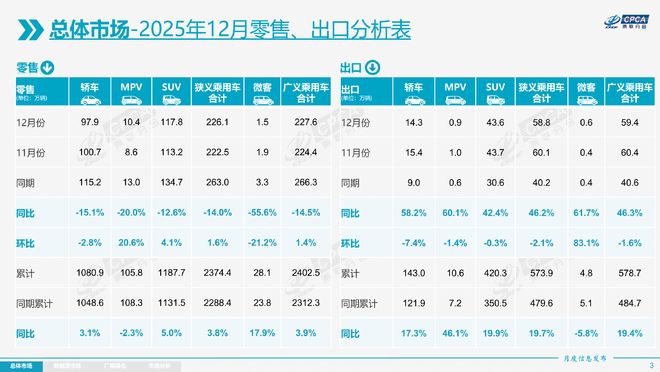
Core Insights - In 2025, China's passenger car market is projected to produce 29.63 million units, reflecting a year-on-year growth of 10.4% [1] - Wholesale sales are expected to reach 29.55 million units, up 8.8% year-on-year, while retail sales are forecasted at 23.74 million units, marking a 3.8% increase [1] Production and Sales Data - Cumulative production of new energy passenger vehicles is anticipated to be 15.35 million units, with a year-on-year growth of 26.1% [2] - Wholesale sales of new energy vehicles are projected at 15.32 million units, increasing by 25.2% year-on-year, and retail sales are expected to reach 12.81 million units, up 17.6% [2] Market Share and Brand Performance - In 2025, domestic brands are expected to capture 65% of the retail market share, an increase of 4.8 percentage points from the previous year [6] - The top ten wholesale sales rankings include BYD, Geely, Chery, Changan, FAW-Volkswagen, Great Wall, SAIC-GM-Wuling, SAIC Volkswagen, SAIC Passenger Cars, and Tesla China, with most brands (except FAW-Volkswagen, SAIC Volkswagen, and Tesla China) showing year-on-year growth [3][4] Export Trends - Passenger car exports are projected to reach 5.739 million units, reflecting a year-on-year increase of 19.7%, with new energy vehicle exports at 2.422 million units, up 86.2% [6] - The export of fuel vehicles is expected to decline by 5% [6] Market Dynamics - The penetration rate of new energy vehicles is nearing 60%, indicating a shift towards a "new energy-dominated" market phase [7] - The end of the vehicle purchase tax exemption is expected to boost new energy retail performance, achieving historical highs [6] Future Outlook - For January 2026, a slight year-on-year sales increase is anticipated due to more working days compared to the previous year [9] - New policies aimed at promoting domestic automotive consumption are expected to further stimulate sales [9]
能源金属涨价引爆千亿市场,头部企业加码锂电回收布局
Huan Qiu Wang· 2026-01-11 02:40
Core Viewpoint - The lithium battery recycling industry is undergoing a value reassessment driven by high energy metal prices, increased demand for energy storage, and supportive policies, leading to the formation of a green circular market exceeding 100 billion yuan by 2025 [1][6]. Industry Overview - The prices of key metals such as lithium, cobalt, and nickel are expected to remain high due to global mineral development cycles and a second surge in downstream energy storage demand [1]. - The industry is transitioning from extensive development to a more refined, standardized, and globalized phase, with a market size projected to exceed 100 billion yuan [1]. Company Performance - Companies like Greeenme and Tianqi have reported significant improvements in profitability due to increased retirement volumes and rising metal prices, with Greeenme's battery recycling volume reaching 36,000 tons, a 59% year-on-year increase [2]. - Tianqi's lithium battery recycling segment has turned profitable, aided by the lifting of black powder import restrictions and rising metal prices [2]. Strategic Initiatives - Leading companies are adopting a "capacity + capital" dual-drive strategy to capture market opportunities, with Greeenme planning to invest 400 million yuan to acquire shares in Henan Recycling Group and pursue a Hong Kong listing [4]. - Tianqi has established a processing capacity of 100,000 tons of used lithium batteries, with another 100,000 tons under construction, indicating a strong commitment to expanding its recycling capabilities [4]. Technological Advancements - Greeenme has achieved a lithium recovery rate exceeding 96.5% through its nine global recycling bases and has established partnerships with over 1,000 automotive and battery manufacturers [5]. - The industry is focusing on technological iteration and collaboration across the supply chain, with non-compliant small operations exiting the market, leading to a concentration of market share among companies with technological and environmental advantages [5]. Market Outlook - The lithium battery recycling industry is expected to experience accelerated growth over the next 3 to 5 years, with an annual growth rate projected to exceed 50%, potentially surpassing 100 billion yuan by 2030 [5][6]. - The industry's growth is not only driven by short-term fluctuations in energy metal prices but also by the necessity of closing the loop in the new energy industry chain, ensuring resource security and alleviating mining pressures [6].


2025年1-11月中国载货汽车产量为343万辆 累计增长13.3%
Chan Ye Xin Xi Wang· 2026-01-11 01:37
Core Viewpoint - The report highlights the growth trajectory of China's cargo vehicle industry, projecting significant increases in production and market potential from 2025 to 2031 [1] Industry Overview - According to the National Bureau of Statistics, the production of cargo vehicles in China is expected to reach 345,000 units in November 2025, representing a year-on-year growth of 21.1% [1] - From January to November 2025, the cumulative production of cargo vehicles in China is projected to be 3.43 million units, reflecting a cumulative growth of 13.3% [1] Companies Involved - Key listed companies in the cargo vehicle sector include: - FAW Jiefang (000800) - China National Heavy Duty Truck Group (000951) - Foton Motor (600166) - Jiangling Motors (000550) - Ankai Bus (000868) - Changan Automobile (000625) - Dongfeng Motor (600006) - Hanma Technology (600375) - GAC Group (601238) - Aoxin Bus (600213) [1]

我们为什么还在拼命“造车”?
汽车商业评论· 2026-01-10 23:05
Core Viewpoint - The automotive industry is undergoing significant transformation driven by electrification, intelligence, and globalization, with new energy vehicles (NEVs) being a key focus in the Chinese market. [5][6] Group 1: Industry Trends - From January to November 2023, domestic sales of NEVs reached 12.466 million units, a year-on-year increase of 23.2%, with passenger vehicles at 11.715 million units (up 21.3%) and commercial vehicles at 750,000 units (up 62.4%) [5] - The penetration rate of NEVs in China is expected to exceed 40% by 2024, with some months reaching 50%, indicating rapid growth and opportunity in the sector [15] - The competition among domestic NEV manufacturers has intensified, leading to a prolonged price war that has lasted nearly four years, with companies employing price cuts and limited-time offers to capture market share [5][6] Group 2: Supply Chain Transformation - The traditional linear supply chain model is being replaced by a networked ecosystem that emphasizes co-creation among manufacturers, technology companies, and suppliers to enhance product quality and cost control [6][20] - Long-term strategies are being developed to address compliance pressures from EU battery regulations and carbon emissions, necessitating improvements in supply chain resilience and green compliance [6][20] - Changan Automobile has implemented a systematic supplier certification process and expanded its supplier base to over 1,500, including 100 overseas suppliers, to build a global supply chain resource system [25][27] Group 3: Technological Advancements - The integration of advanced technologies such as AI and smart driving systems is reshaping the automotive landscape, with a focus on enhancing user experience while maintaining safety standards [17][20] - Changan is pursuing a modular and platform-based approach to vehicle design, allowing for greater flexibility and adaptability in production processes [28][29] - The company is also focusing on digital transformation, improving procurement and supply chain systems to enhance efficiency and connectivity [43] Group 4: Strategic Partnerships - Collaborative efforts with suppliers and technology partners are being emphasized to create a win-win ecosystem, fostering transparency and mutual support in the supply chain [36][40] - Changan is exploring diverse cooperation models with traditional Tier 1 suppliers and ICT giants, aiming for strategic alliances that address technological challenges [35][36] - The company is committed to building a shared, open, and win-win networked ecosystem, transitioning from short-term transactional relationships to strategic collaborations [21][36]


山城有个数字“练”车场(经济新方位·新场景新动能)
Ren Min Wang· 2026-01-10 22:20
本报记者 刘新吾 一辆搭载网联自动驾驶系统的新能源汽车正平稳行驶,前方路口突然有行人横穿马路,路侧传感器精准 识别,立即将数据回传云端,云端平台完成计算并下发指令,车辆提前减速避让…… 车能"交流"、路能"看见"、云能"决策",在西部(重庆)科学城智能网联汽车示范区,这样的路测场景时 时发生。 "在示范区,各类数据全面打通、实时更新。"科学城智能网联汽车创新中心云控技术中心副主任常雪阳 指着实时监控屏幕介绍,"借助'车路云一体化'技术,测试道路真正成为数字'练'车场。" 与传统封闭测试场不同,这个数字"练"车场包含50公里复杂城市道路,从城市主干道、匝道枢纽到社区 道路,覆盖了行人、非机动车等弱势交通参与者穿行,故障车占道等复杂情况。 政策精准扶持,路测场景快速成长,释放强劲产业带动效应—— 在测试场景的吸引下,15家车企统一标准开展联调测试,丰田、长安等车企的测试车辆积累大量数据, 进一步推动网联化辅助驾驶、虚实融合测试等技术快速迭代;智御维科、西部创源等配套企业应运而 生,其研发的平台、产品订单源源不断;招商车研实现整车热失控蔓延仿真,为安全设计等提供支 撑……西部(重庆)科学城集聚60余家智能网联汽车相 ...
集聚60余家智能网联汽车相关企业 山城有个数字“练”车场(经济新方位·新场景新动能)
Ren Min Ri Bao· 2026-01-10 21:54
不同车型、不同驾驶行为……在示范区,不断积累的海量真实数据,正助力系统决策模型持续进化,推 动创新技术从实验室逐步走向更广阔的应用。 一辆搭载网联自动驾驶系统的新能源汽车正平稳行驶,前方路口突然有行人横穿马路,路侧传感器精准 识别,立即将数据回传云端,云端平台完成计算并下发指令,车辆提前减速避让…… 车能"交流"、路能"看见"、云能"决策",在西部(重庆)科学城智能网联汽车示范区,这样的路测场景 时时发生。 "在示范区,各类数据全面打通、实时更新。"科学城智能网联汽车创新中心云控技术中心副主任常雪阳 指着实时监控屏幕介绍,"借助'车路云一体化'技术,测试道路真正成为数字'练'车场。" 与传统封闭测试场不同,这个数字"练"车场包含50公里复杂城市道路,从城市主干道、匝道枢纽到社区 道路,覆盖了行人、非机动车等弱势交通参与者穿行,故障车占道等复杂情况。 "对车辆来说,每次测试都是一次全真模拟。"常雪阳说,"对道路智能系统来说,每天也都在进行压力 测试。" 不只是智能网联新能源汽车,示范区可为所有类别的车辆提供服务。"只加装了一个小设备,我们的物 流车就用上了'智能网联',快递配送可以与信号灯、实时路况和云端系统等 ...
车企组团出逃俄罗斯,304亿直接打水漂?
虎嗅APP· 2026-01-10 13:26
Core Viewpoint - International car manufacturers that exited the Russian market two years ago are now facing significant challenges in potentially returning, with substantial investments at stake and geopolitical instability persisting [5][7]. Group 1: International Car Manufacturers' Exit - Many international car manufacturers, including Hyundai, voluntarily exited the Russian market in response to Western sanctions, selling their assets at symbolic prices while retaining buyback rights [5][10]. - The urgency of the situation has left companies like Hyundai grappling with the dilemma of either investing heavily to restore operations or losing significant investments made in local facilities [7][11]. - Mazda has opted not to exercise its buyback rights after selling its stake in a Russian joint venture, indicating that the decision to abandon the investment was relatively straightforward due to the lower production capacity of its facility compared to others [12][13]. Group 2: Buyback Rights and Future Decisions - Several international car manufacturers, including Renault, Ford, Nissan, and Mercedes-Benz, have retained buyback rights for their Russian assets, with expiration dates ranging from 2027 to 2029 [15][16]. - The geopolitical crisis has caught these companies off guard, as they initially viewed their exit as temporary, expecting to return once stability was restored [17][18]. - Renault's attempt to exercise its buyback rights was met with a demand for a substantial compensation of 112.5 billion rubles (approximately 9.7 billion RMB), highlighting the financial implications of re-entering the market [21][22]. Group 3: Rise of Chinese Car Manufacturers - The exit of major international brands has created a vacuum in the Russian automotive market, which has been seized by Chinese car manufacturers, leading to a significant increase in their market share from 9% in 2022 to 49% in 2023, and projected to reach 62% in 2024 [24][27]. - Chinese automotive exports to Russia are expected to grow significantly, with projected figures of 16.3 million units in 2022, 55.3 million in 2023, and 128 million in 2024 [28]. - By 2024, Chinese brands are anticipated to dominate the top sales rankings in Russia, with several brands like Haval, Chery, Geely, and Changan leading the market [29][30]. Group 4: Challenges Ahead for Chinese Manufacturers - Despite the initial success, Chinese car manufacturers face increasing challenges in Russia, including new tax regulations and negative media portrayals that could impact their market position [34][36]. - The Russian government has implemented higher taxes on imported vehicles, which could significantly reduce profit margins for Chinese manufacturers [37][38]. - Concerns regarding the reliability and quality of Chinese vehicles have been raised in Russian media, potentially affecting consumer perceptions and sales [39][40]. Group 5: Future Outlook - The future of the automotive market in Russia remains uncertain, with two potential trends emerging: international manufacturers may either reclaim their assets and re-enter the market, or they may abandon their investments, leaving Chinese brands to navigate a challenging environment [45][46]. - The complexity of the situation necessitates careful consideration from all manufacturers looking to establish a foothold in the Russian market, as they must prepare for various potential outcomes [42][46].
2025年汽车以旧换新超1150万辆,全年乘用车零售2374.4万辆
Xinda Securities· 2026-01-10 11:06
Investment Rating - The industry investment rating is "Positive" [2] Core Insights - The report highlights that in 2025, over 11.5 million vehicles will be replaced under the vehicle trade-in program, leading to a total retail of 23.744 million passenger cars, with approximately 54% being new energy vehicles [20][3] - The report indicates a projected growth in the automotive market, with a U-shaped sales trend expected for passenger vehicles in 2026, maintaining overall sales levels similar to 2025 [20] - Key companies to watch include BYD, Geely, Great Wall Motors, and others in the passenger vehicle sector, as well as major players in commercial vehicles and auto parts [3][20] Industry Performance - The A-share automotive sector underperformed the market, with a weekly increase of 2.53% compared to the 2.79% rise in the CSI 300 index, ranking 24th among A-share industries [3][9] - The report notes that the passenger vehicle segment saw a 3.8% year-on-year increase in retail sales, while new energy vehicles experienced a 17.6% growth [20] Key Industry News - The Ministry of Commerce announced that the vehicle trade-in program will exceed 11.5 million vehicles in 2025, contributing to over 1.6 trillion yuan in new car sales [20] - Geely received the largest L3 autonomous driving test license in China, covering an area of 9,224 square kilometers [20] - Baidu's autonomous driving platform, "萝卜快跑," obtained the first full unmanned testing license in Dubai, paving the way for commercial operations [20] Upstream Data Tracking - The report includes tracking of key material prices such as steel, aluminum, and lithium carbonate, which are crucial for automotive manufacturing [23][24]



车企密集明确2026销量目标,市场格局将会有哪些变化?
Xin Lang Cai Jing· 2026-01-10 10:07
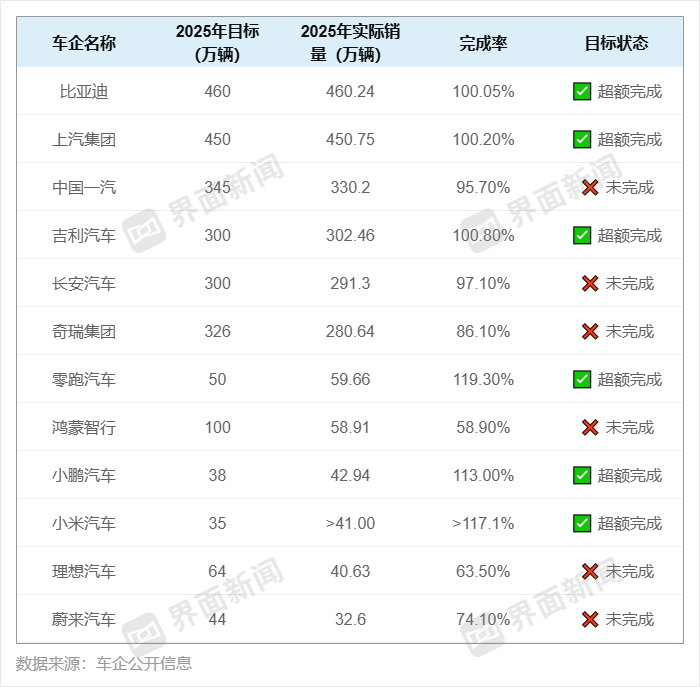
Core Insights - The Chinese automotive market is experiencing unprecedented differentiation as companies announce their annual sales and plans for 2026, reflecting a deep competition regarding survival, development, and industry positioning [1] Group 1: Sales Performance in 2025 - In 2025, six companies achieved their sales targets, including three traditional automakers (BYD, Geely, SAIC) and three new players (Leap Motor, Xpeng, Xiaomi) [1] - BYD led with 4.6024 million units sold, exceeding its target and becoming the global leader in pure electric vehicle sales [1] - Geely delivered 3.0246 million units, achieving a 100.8% completion rate and a 39% year-on-year growth [1] - SAIC's sales surpassed 4.5075 million units, marking a 12.32% increase year-on-year [1] - Leap Motor topped the new energy vehicle sales with 596,600 units delivered, achieving a 119% completion rate [2] - Xpeng delivered 429,400 units, a 113% completion rate with a 126% year-on-year growth [2] - Xiaomi, as a newcomer, delivered over 410,000 units, exceeding its first-year target [1] Group 2: Differentiation in Performance - Companies like Li Auto and Hongmeng Zhixing failed to meet their targets, with Li Auto delivering 406,000 units, only 63.5% of its goal, and Hongmeng Zhixing delivering 589,100 units, significantly below its 1 million target [2] - The performance disparity among automakers is attributed to differences in sales scale, product structure, transformation stages, and technological accumulation [2] - The differentiation is further accelerated by electrification and intelligent technology, along with strong policy guidance [2] Group 3: Strategic Approaches for 2026 - Automakers are adopting different strategies for 2026, categorized into three camps: aggressive, stable, and conservative [2] - Leap Motor and Hongmeng Zhixing represent the aggressive camp, with Leap aiming for 1 million units (a 67.5% increase) and Hongmeng targeting between 1 million to 1.3 million units, requiring up to 120% year-on-year growth [3][4] - The stable camp includes Great Wall and Xiaomi, focusing on steady growth rather than aggressive targets [7][8] - Great Wall set a target of over 1.8 million units for 2026, reflecting a 36% growth rate, while Xiaomi aims for 550,000 units, a 34% increase [7][8] Group 4: Challenges and Opportunities - Leap Motor's growth is supported by its dual breakthrough in scale and profitability, but it faces challenges in expanding production and maintaining quality [4] - Hongmeng Zhixing plans to launch 11 to 18 new models in 2026, but must balance brand differentiation and collaboration among its multiple brands [5] - The conservative camp, represented by Geely and Li Auto, emphasizes quality over sheer volume, with Geely targeting 3.45 million units for a 14% growth [10][11] - Li Auto and NIO are expected to adopt more cautious strategies in 2026, focusing on consolidating their market positions rather than aggressive growth [11][12] Group 5: Market Dynamics and Future Outlook - The 2026 Chinese automotive market is characterized by a strategic landscape where aggressive players like Leap and Hongmeng fight for market share, stable players like Great Wall and Xiaomi serve as the backbone of industry transformation, and conservative players like Geely and Li Auto represent rationalization in the industry [14] - The competition will shift from merely selling units to achieving profitability and sustainable sales, with a projected electric vehicle penetration rate exceeding 60% [15] - The outcomes of this competition will reshape the Chinese automotive industry and influence the global market dynamics [15]