
立高食品

Search documents
260只股中线走稳 站上半年线
Zheng Quan Shi Bao Wang· 2026-01-19 07:27
Core Viewpoint - The A-share market shows positive momentum with the Shanghai Composite Index closing above the six-month moving average, indicating a potential bullish trend in the market [1]. Group 1: Market Performance - The Shanghai Composite Index closed at 4114.00 points, with a gain of 0.29% [1]. - The total trading volume of A-shares reached 27,322.16 billion yuan [1]. Group 2: Stocks Breaking the Six-Month Moving Average - A total of 260 A-shares have surpassed the six-month moving average today [1]. - Notable stocks with significant deviation rates include: - Zhejiang Natural: 7.31% deviation rate, closing price at 27.11 yuan [1]. - Jingxing Paper: 7.12% deviation rate, closing price at 5.86 yuan [1]. - Hongrun Construction: 6.80% deviation rate, closing price at 9.68 yuan [1]. Group 3: Stocks with Smaller Deviation Rates - Stocks with smaller deviation rates that have just crossed the six-month moving average include: - Chuangye Heima: just above the six-month line [1]. - Fengshan Group: just above the six-month line [1]. - Anyang Steel: just above the six-month line [1].





消费论坛交流反馈——食品饮料行业周报(20260112-20260118):传统消费龙头探寻新路,成效初显
Huachuang Securities· 2026-01-19 07:25
Investment Rating - The report maintains a "Recommendation" rating for the food and beverage industry, indicating an expected increase in the industry index exceeding the benchmark index by more than 5% in the next 3-6 months [26]. Core Insights - The traditional consumer leaders in the food and beverage sector are exploring new paths, with initial positive results observed. The report highlights the acceleration of white liquor clearance and the catalyzing effect of the peak season for mass-market products [1][13]. - The liquor industry is currently at the bottom of its cycle, with expectations for sales to stabilize over the next three years. The report notes a significant price drop in high-end whiskey (approximately 50%) and a smaller decline in brandy (10-20%) due to decreased demand and a return to reasonable pricing [10]. - In the mass-market segment, companies are actively adjusting strategies, leading to improved performance. Notable companies include Xianle Health, which is leveraging overseas expansion and AI to drive growth, and West Wheat, which is enhancing its competitive advantage through channel expansion [11][12]. Summary by Sections 1. Meeting Feedback: Liquor at Cycle Bottom, Mass-Market Highlights - Liquor is at a cyclical low, with future sales expected to stabilize. The domestic brandy market remains stable, dominated by three major brands [10]. - The mass-market segment shows a divergence in demand, with companies like Xianle and West Wheat continuing to grow, while traditional companies are adjusting to improve performance [11]. 2. Investment Recommendations: Strengthening White Liquor Bottom, Catalyzing Mass-Market Peak Season - The report recommends Moutai and emphasizes the importance of Gujing, anticipating a recovery in demand as the Spring Festival approaches. The report suggests that companies are transitioning from passive responses to proactive adjustments [13]. - In the mass-market segment, the report highlights Anqi as a key recommendation, along with opportunities in restaurant supply chains and snack sectors as the Spring Festival approaches [13].
消费论坛交流反馈——食品饮料行业周报(20260112-20260118):传统消费龙头探寻新路,成效初显-20260119
Huachuang Securities· 2026-01-19 05:43
Investment Rating - The report maintains a "Recommendation" rating for the food and beverage industry, indicating an expected increase in the industry index exceeding the benchmark index by more than 5% in the next 3-6 months [26]. Core Insights - The traditional consumer leaders in the food and beverage sector are exploring new paths, with initial positive results observed. The report highlights the acceleration of white liquor clearance and the catalyzing effect of the peak season for mass-market products [1][13]. - The report discusses the current state of the liquor market, indicating that the洋酒 (foreign liquor) sector is at the bottom of its cycle, with expectations for sales to stabilize over the next three years. The decline in high-end whiskey prices has been approximately 50%, while brandy prices have decreased by 10-20% [10]. - In the mass-market segment, companies are actively adjusting their strategies, leading to improved performance. Notable companies include仙乐健康 (Xianle Health),西麦 (Ximai), and妙可蓝多 (Miaokelando), which are leveraging new channels and product innovations to drive growth [11][12]. Summary by Sections 1. Meeting Feedback -洋酒 is currently at the bottom of its cycle, with future sales expected to stabilize. The decline in sales is attributed to decreased demand and a return to reasonable pricing after previous high valuations [10]. - In the mass-market segment, there is a divergence in demand, with companies making adjustments that are starting to yield results. Growth is seen in functional foods and cheese products, while traditional sectors are still facing challenges [11]. 2. Investment Recommendations - For white liquor, the report recommends focusing on茅台 (Moutai) and古井 (Gu Jing), anticipating a recovery in demand as the Spring Festival approaches. The report suggests that the market is transitioning from passive responses to proactive adjustments, with a clearer outlook as the year progresses [13]. - In the mass-market segment,重点推荐安琪 (Anqi) and selected opportunities in餐供 (restaurant supply) such as安井 (Anjing) and巴比 (Babi). The report emphasizes the potential for growth in overseas markets and the importance of cost management [13].
资金高切低!大消费走强,大连圣亚涨停,安井食品涨超5%
Mei Ri Jing Ji Xin Wen· 2026-01-19 04:41
Group 1 - The Shanghai Composite Index experienced a rebound, rising 0.13% to close at 4107 points, with significant activity in the consumer sector, particularly in tourism and dining [1] - The State Council meeting on January 16 emphasized the need to accelerate the cultivation of new growth points in service consumption, highlighting the potential for growth as China's household consumption accounts for only about 40% of GDP, significantly lower than the average in developed countries [1] - The new round of government subsidies amounting to 62.5 billion yuan for "old-for-new" initiatives is expected to stimulate domestic demand and improve people's livelihoods [1] Group 2 - The Tourism ETF (562510.SH) tracks the CSI segmented tourism index, covering leading stocks in sectors such as duty-free, airlines, hotels, and attractions, including China Duty Free Group and China Eastern Airlines [1] - The Food ETF Huaxia (159151.SZ) tracks the CSI All Food Index, which includes leading stocks in seasoning, dairy, meat products, and snacks, and is designed to better reflect daily consumer needs by excluding traditional alcoholic beverages [1]

立高食品股价涨5.17%,工银瑞信基金旗下1只基金重仓,持有9万股浮盈赚取19.98万元
Xin Lang Cai Jing· 2026-01-19 03:09
Group 1 - The core viewpoint of the news is that Lihigh Food has seen a stock price increase of 5.17%, reaching 45.16 CNY per share, with a total market capitalization of 7.647 billion CNY [1] - Lihigh Food, established on May 11, 2000, and listed on April 15, 2021, specializes in the research, production, and sales of baking food ingredients and frozen baked goods [1] - The main revenue composition of Lihigh Food includes frozen baked goods at 54.35%, cream at 26.94%, other products at 7.85%, sauces at 6.85%, and fruit products at 4.02% [1] Group 2 - According to data, a fund under ICBC Credit Suisse has Lihigh Food as one of its top ten holdings, with an increase of 26,000 shares in the third quarter, totaling 90,000 shares, which represents 3.59% of the fund's net value [2] - The ICBC Food and Beverage Mixed A Fund (013289) has a current scale of 57.2543 million CNY and has achieved a year-to-date return of 1.92% [2] - The fund manager, Zhang Weisheng, has been in position for 8 years and 87 days, with the best fund return during his tenure being 115.93% [3]
中原证券晨会聚焦-20260119
Zhongyuan Securities· 2026-01-19 00:24
Core Insights - The report highlights the ongoing adjustments in the commercial real estate loan policies by the People's Bank of China, setting the minimum down payment ratio at 30% for commercial properties, including mixed-use properties [4][8] - The domestic battery and energy storage sectors are experiencing significant growth, with a reported cumulative production of 1,755.6 GWh and sales of 1,700.5 GWh in 2025, marking year-on-year increases of 60.1% and 63.6% respectively [5][8] - The semiconductor industry is witnessing a robust performance, with a 5.11% increase in the semiconductor sector index in December 2025, outperforming the broader market indices [16][17] - The food and beverage sector is under pressure, with a 4.05% decline in the sector index in December 2025, driven by poor performance in traditional categories like liquor and meat products [19][20] Market Performance - The A-share market has shown signs of volatility, with the Shanghai Composite Index closing at 4,101.91, down 0.26%, while the Shenzhen Component Index closed at 14,281.08, down 0.18% [3] - The semiconductor sector is highlighted as a leading performer, with significant increases in both production and sales, indicating strong demand and growth potential [16][17] - The food and beverage sector is facing challenges, with a notable decline in traditional product categories, while emerging categories like snacks and health products continue to show growth [19][20] Industry Analysis - The chemical industry is experiencing a slowdown in price declines, particularly in sectors like pesticides and polyester filament, suggesting a stabilization in pricing dynamics [14][15] - The gaming industry is reported to be growing steadily, with animation films leading box office growth, indicating a positive trend in entertainment consumption [23][26] - The new materials sector is projected to continue its growth trajectory, driven by increasing demand from manufacturing and technological advancements [30][31] Investment Recommendations - The report suggests focusing on sectors with strong growth potential, such as semiconductor equipment, storage modules, and battery technologies, as they are expected to benefit from ongoing technological advancements and market demand [17][18] - In the food and beverage sector, investment opportunities are recommended in soft drinks, health products, and baked goods, which are showing resilience despite overall sector challenges [20][21] - The report emphasizes the importance of monitoring macroeconomic indicators and policy changes that could impact market dynamics and investment strategies [12][13]
【转|太平洋食饮-26年度策略】底部向阳,寻找结构性亮点
远峰电子· 2026-01-18 11:38
Overall Sector Review - The food and beverage sector significantly underperformed the market, with a year-to-date decline of -0.62%, lagging behind the Shanghai Composite Index by 15.0 percentage points [2] - The sector experienced a deep correction after an initial rebound driven by expectations of consumption recovery and supportive policies, but the actual recovery rate was lower than anticipated, leading to a consensus on weak domestic demand [2] Subsector Performance - The snack sector outperformed with a year-to-date increase of 28.88%, driven by channel expansion and a revenue growth rate of 30.97% in the first three quarters [4] - Soft drinks also showed resilience with a 10.11% stock price increase, benefiting from strong travel demand and low-cost, high-frequency consumption [4] - The restaurant chain sector saw a rebound with gains of approximately 10.34% and 10.29% for pre-processed and baked goods, respectively [4] - The liquor sector, particularly high-end liquor, faced challenges with weaker sales and declining prices, while beer performance was supported but affected by high-end market constraints [4] Investment Insights - The sector is under pressure from deflationary trends and a weak recovery, with consumer confidence remaining low, indicating a shift to a "new normal" of low growth [8] - High-end consumption has shown slight recovery due to stock market wealth effects, but sustainability remains a concern [9] - The food and beverage sector's valuation is at historical lows, with a current PE (TTM) of 21.9X, indicating potential investment opportunities in undervalued segments [12] Fund Holdings - As of Q3 2025, the food and beverage sector's fund holdings decreased to 6.38%, nearing levels seen in 2016, with the liquor segment comprising 5.52% of this [14] - Fund holdings in the liquor sector increased for certain subsectors, including white liquor and seasoning products, while others saw declines [16] Long-term Trends - The liquor industry is undergoing its longest adjustment period since 2003, with significant price corrections and a potential bottoming out of valuations [21] - The white liquor sector has underperformed the market with a year-to-date return of -4.87%, reflecting weak demand and a divergence from broader market trends [24] - The third quarter of 2025 saw a significant decline in revenue and net profit for the white liquor sector, indicating a deep adjustment phase [27] Pricing Dynamics - The white liquor market is experiencing a general decline in prices, particularly in high-end segments, while lower price segments show resilience [29] - The average price of high-end products like Moutai has dropped significantly, while mid-range and lower-range products have maintained stability or slight increases [31] Investment Recommendations - The white liquor sector is advised to focus on inventory reduction and demand recovery, with a preference for leading brands that can maintain pricing power and product stability [32]







食品饮料行业:春节走访:河南、上海市场跟踪
GF SECURITIES· 2026-01-18 10:06
Core Insights - The report maintains a "Buy" rating for the food and beverage industry, consistent with previous ratings, indicating a positive outlook for the sector [4] - The report highlights the cautious inventory management in the liquor market, particularly in Henan, with the upcoming Spring Festival sales performance still uncertain [17][19] - The demand for frozen food in Henan is showing signs of improvement as preparations for the Spring Festival begin, with increased confidence among distributors [22] - In Shanghai, the "锅圈" (Guoquan) stores are undergoing significant renovations, leading to a notable increase in daily sales post-renovation [25][27] Weekly Focus: Henan & Shanghai Market Tracking - **Henan Liquor Market**: Inventory levels are low, and major brands like Moutai are seeing stable pricing, with the Spring Festival sales performance yet to be observed [17][19] - **Henan Food Supply Market**: Distributors are beginning to stock up for the Spring Festival, with a slight uptick in demand noted [22] - **Shanghai Guoquan Store Renovations**: The store renovations have led to a significant increase in daily sales, with new product categories contributing to revenue growth [25][27] Food and Beverage Sector Overview - The food and beverage sector experienced a decline of 2.1% in the week of January 12-16, underperforming compared to the CSI 300 index [29] - The valuation of the food and beverage sector stands at a PE-TTM of 21.2X, with the white liquor sector at 18.3X, indicating a relative valuation compared to the broader market [43][46] Recent Key Announcements & News - The report includes updates on major companies like Qianwei Culinary and Sanquan Foods, highlighting their strategic adjustments and product innovations aimed at enhancing competitiveness [23][24] - The report notes that the industry is moving away from price wars towards a focus on product innovation and quality assurance [24] Investment Recommendations - The report recommends key liquor brands such as Luzhou Laojiao, Shanxi Fenjiu, and Moutai, as well as consumer goods companies like Anjuke Foods and Tianwei Foods, indicating potential investment opportunities [8][12]


休闲食品板块1月16日跌0.7%,立高食品领跌,主力资金净流出6235.92万元
Zheng Xing Xing Ye Ri Bao· 2026-01-16 08:56
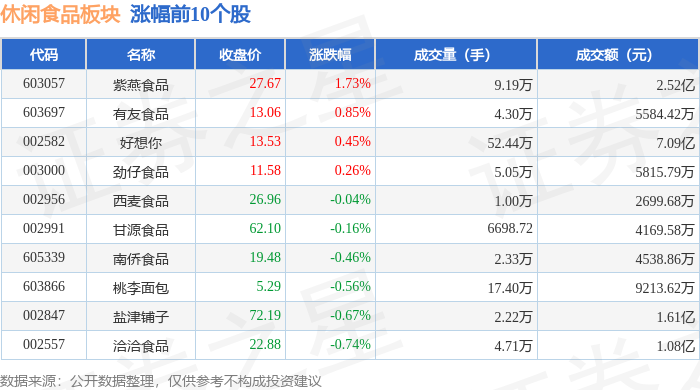
Market Overview - The leisure food sector experienced a decline of 0.7% on January 16, with Li Gao Food leading the drop [1] - The Shanghai Composite Index closed at 4101.91, down 0.26%, while the Shenzhen Component Index closed at 14281.08, down 0.18% [1] Individual Stock Performance - Ziyan Food closed at 27.67, up 1.73% with a trading volume of 91,900 shares and a transaction value of 252 million yuan [1] - Youyou Food closed at 13.06, up 0.85% with a trading volume of 43,000 shares and a transaction value of 55.84 million yuan [1] - Li Gao Food closed at 42.94, down 3.44% with a trading volume of 30,900 shares and a transaction value of 134 million yuan [2] - Black Sesame closed at 6.37, down 2.30% with a trading volume of 368,300 shares and a transaction value of 23.5 million yuan [2] Capital Flow Analysis - The leisure food sector saw a net outflow of 62.36 million yuan from main funds, while retail investors had a net inflow of 108 million yuan [2] - Main funds showed a net inflow of 36.01 million yuan into Haoxiangni, while Youyou Food experienced a net outflow of 3.85 million yuan from speculative funds [3] - Retail investors had a significant net outflow of 61.14 million yuan from Haoxiangni, indicating a divergence in investor sentiment [3]


广发证券:供需重构 餐供行业拐点渐显
Zhi Tong Cai Jing· 2026-01-16 07:25
Core Viewpoint - The restaurant supply industry is undergoing a structural transformation, shifting from "passive supporters" to "active drivers" as companies adapt to a more cautious capital expenditure environment and a less aggressive price competition landscape [1][2]. Supply Side - The peak of capital expenditure has passed, revealing opportunities for structural adjustment within the restaurant supply industry. The industry continues to grow driven by the expansion of the restaurant sector, increased chain rates, and high growth in food delivery services. However, the past few years of downturn in the downstream restaurant sector and supply surplus have accelerated industry consolidation. Leading companies are moving away from past extensive capacity expansion and distribution strategies towards efficient service for large clients and refined operations for smaller clients, focusing on quality growth through product innovation and customization [2]. Demand Side - Historical analysis shows that when the Consumer Price Index (CPI) transitions from negative to positive or enters an upward phase, market expectations for consumer recovery often lead to capital flowing into cyclical sectors like the restaurant supply chain. The CPI is expected to turn positive in October 2025, indicating a mild recovery in consumer demand, which creates a favorable macro environment for the restaurant supply sector. The performance of leading companies has shown improvement since Q3 2025, suggesting that while the industry has not entered a high-growth phase, it has passed its worst stage and is currently stabilizing, with potential for both performance and valuation recovery [3]. Valuation - The restaurant supply sector's valuation has fallen to historically low levels, and the sector remains underweight, providing a high margin of safety and emotional recovery potential. Key segments include: 1. Frozen baking: The industry is expected to maintain rapid growth with a CAGR of 22.1% from 2020 to 2025. Leading company Lihigh Foods (300973) is benefiting from new product launches and channel expansion, with significant growth potential in its frozen baking business and cream business due to domestic substitution acceleration [4]. 2. Frozen food: The price competition has significantly weakened, with leading company Anjui establishing a clear advantage over competitors in management, channels, and capacity. The company is expected to enjoy dual benefits from industry growth and market share increase due to a rich pipeline of new products in 2025 [4]. 3. Compound seasoning: The current penetration rate in China is only 25.4%, compared to over 50% in mature markets like Europe, the U.S., and Japan, indicating substantial growth potential. The long-term development of leading companies in Western-style compound seasoning, such as Baoli Foods (603170) and Chinese-style compound seasoning companies like Tianwei Foods (603317) and Richen Co. (603755) is promising [4]. Investment Recommendations - The sector is currently in a phase of low valuation and institutional holdings, with demand stabilizing and improving policy conditions. Capital expenditures have significantly decreased, and the competitive landscape is shifting from price wars to a more rational framework. Leading companies are actively pursuing new products and channels (membership supermarkets/new retail), mergers and acquisitions, and R&D initiatives, providing high certainty and elasticity. It is recommended to focus on large-cap stocks for allocation and small-cap stocks for elasticity, with particular attention to the performance improvements of Anjui Foods (603345), Lihigh Foods (300973), and Qianhe Flavor (603027), as well as the growth elasticity from new channels and category expansions of Tianwei Foods (603317), Guoquan (02517), and Qianwei Yangchu (001215) [5].



