长安

Search documents
江都崛起苏中铁路物流新枢纽
Xin Hua Ri Bao· 2025-09-07 21:57
Core Insights - The Jiangdu Railway Logistics Base, which began operations in October 2022, is enhancing the logistics landscape in the Suzhong region, with significant government investment and infrastructure development [1][2]. Group 1: Infrastructure and Investment - The Jiangdu District government has invested 680 million yuan to advance the logistics base, which spans approximately 553 acres, making it the largest and highest-standard railway logistics base in the Suzhong and Subei regions [1]. - The base has opened five sea-rail intermodal transport channels connecting major ports, forming a transportation network of "three ports and five channels" [1]. Group 2: Operational Efficiency - The logistics base has implemented a "one order system" service innovation, simplifying the transportation process and reducing costs by over 20% compared to traditional road transport [2]. - The base has established partnerships with major automotive manufacturers, providing comprehensive services that enhance delivery efficiency, with an expected annual dispatch volume of 15,000 vehicles [2]. Group 3: Competitive Advantage - The reduction in logistics costs is improving the competitiveness of regional enterprises, with significant savings on transportation costs for container shipments compared to road and water transport [3]. - The base has already dispatched 6,012 standard containers this year, including high-value products, facilitating local enterprises' integration into the global supply chain [3].
透视全球车企财报 看懂中国车企的弯道超车
2 1 Shi Ji Jing Ji Bao Dao· 2025-09-04 15:48
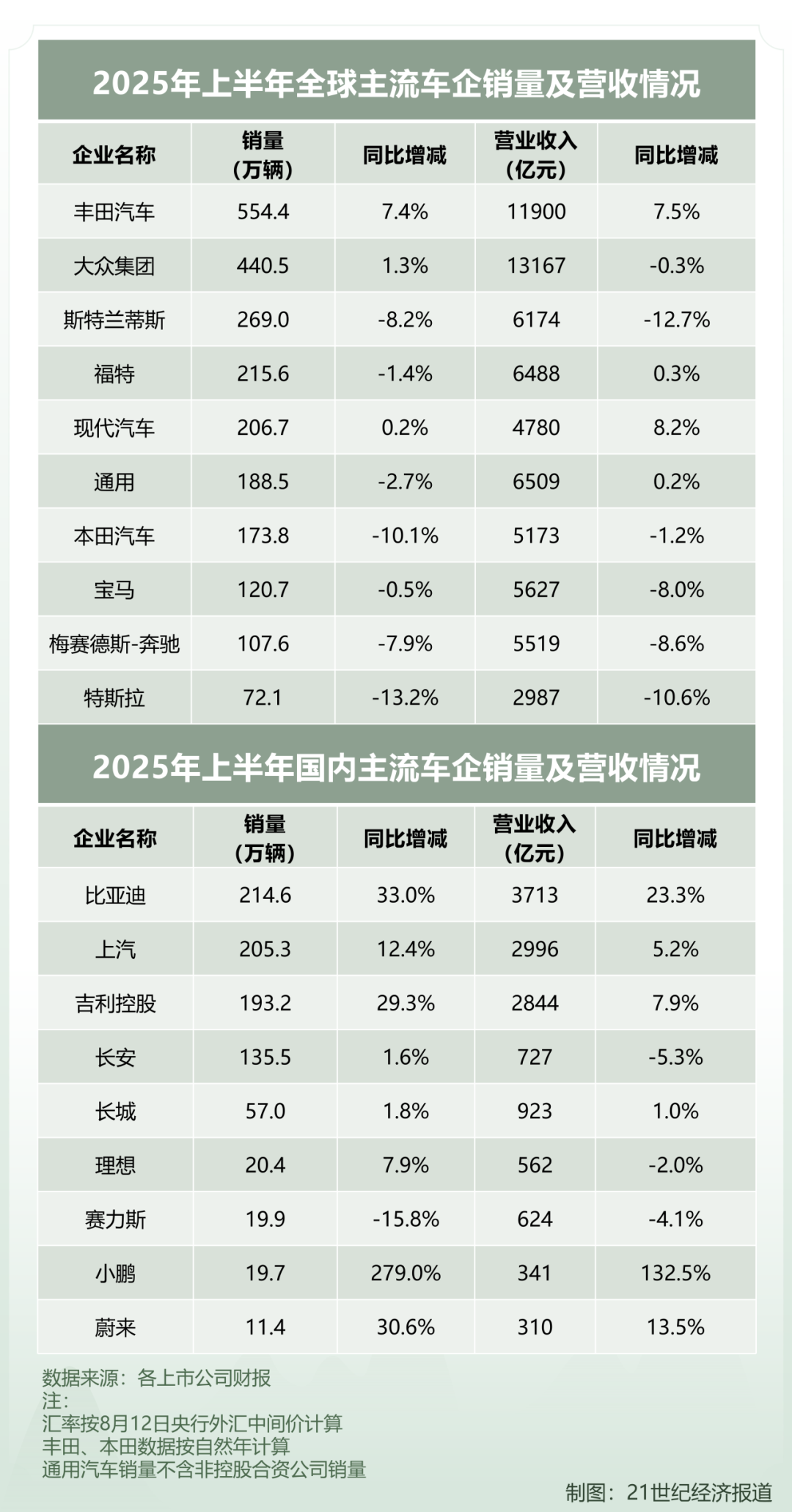
Core Insights - The global automotive industry is witnessing a shift, with Chinese automakers transitioning from technology followers to market leaders, driven by innovations in electrification and intelligence [1][7] - While many overseas automakers face stagnation or decline, Chinese companies are experiencing growth, particularly in sales and revenue [2][7] Sales and Revenue Performance - Chinese automakers are closing the gap with overseas giants in terms of sales and revenue, with significant growth rates [2] - In the first half of 2025, major global automakers like Toyota and Volkswagen reported modest sales growth of 7% and 1%, respectively, while several others, including Stellantis and Tesla, experienced declines [3][7] - In contrast, leading Chinese companies such as BYD and SAIC reported substantial sales increases, with BYD achieving a 33% rise in sales [4][7] Profitability and R&D Investment - Overseas automakers are facing significant profit declines, with companies like Toyota and Volkswagen seeing net profit drops of over 30%, while Ford's profit fell by 86% [12] - Chinese automakers, particularly BYD, have shown resilience in profitability, with BYD's net profit increasing by 14% [12] - R&D investments are rising among both domestic and international players, with BYD's R&D spending increasing by 53%, the highest among the top ten global automakers [13] Debt and Financial Health - Chinese automakers are actively optimizing their debt structures, with companies like BYD and Changan reducing their debt ratios, indicating a shift towards lower leverage and enhanced financial stability [17] - A healthier debt structure allows these companies to invest more in R&D and technology, supporting sustainable growth [17]



安徽首富,又去IPO敲钟了
投资界· 2025-08-30 07:19
Core Viewpoint - The article highlights the rise of Sunpower Technology as a significant player in the renewable energy sector, emphasizing its upcoming IPO in Hong Kong and its role in China's global expansion in the renewable energy market [3][14]. Company Overview - Sunpower Technology, founded by Cao Renxian in Hefei, has grown into a company with a market capitalization exceeding 200 billion RMB, focusing on solar inverters and expanding into energy storage and hydrogen energy [3][8]. - The company has achieved significant milestones, including being the first in China to develop a solar inverter with complete independent intellectual property rights in 2003 and successfully listing on the Shenzhen Stock Exchange in 2011 [7][8]. Financial Performance - In the first half of the year, Sunpower Technology reported a revenue of 43.53 billion RMB, a year-on-year increase of 40.34%, and a net profit of 7.73 billion RMB, up 55.97% from the previous year [11][12]. - The company's gross profit margin improved to 34.36%, attributed to brand premium, product innovation, and economies of scale [12]. Business Segments - For the first time, revenue from the energy storage business surpassed that of solar inverters, with energy storage systems generating 17.80 billion RMB, accounting for approximately 40.89% of total revenue [13]. - The overseas revenue reached 25.37 billion RMB, marking an 88.32% increase year-on-year, representing 58.3% of total revenue [14]. Industry Context - The article discusses the broader trend of Chinese renewable energy companies, including Sunpower Technology, expanding globally, with significant growth in exports of wind and solar products [17][18]. - The rise of Hefei as a hub for the new energy industry is noted, with multiple major companies and a target to produce over 200 million new energy vehicles by 2027 [15][16]. Future Outlook - Sunpower Technology's IPO in Hong Kong is part of a strategy to enhance its global presence and diversify funding channels, aligning with the trend of Chinese companies seeking international markets [14][18]. - The article concludes with a historical analogy, suggesting that China's renewable energy sector is entering a new era of global leadership, reminiscent of Zheng He's maritime expeditions [19].

智驾普及背后大赢家!地平线机器人半年报营收同比大增超67%
2 1 Shi Ji Jing Ji Bao Dao· 2025-08-29 14:50
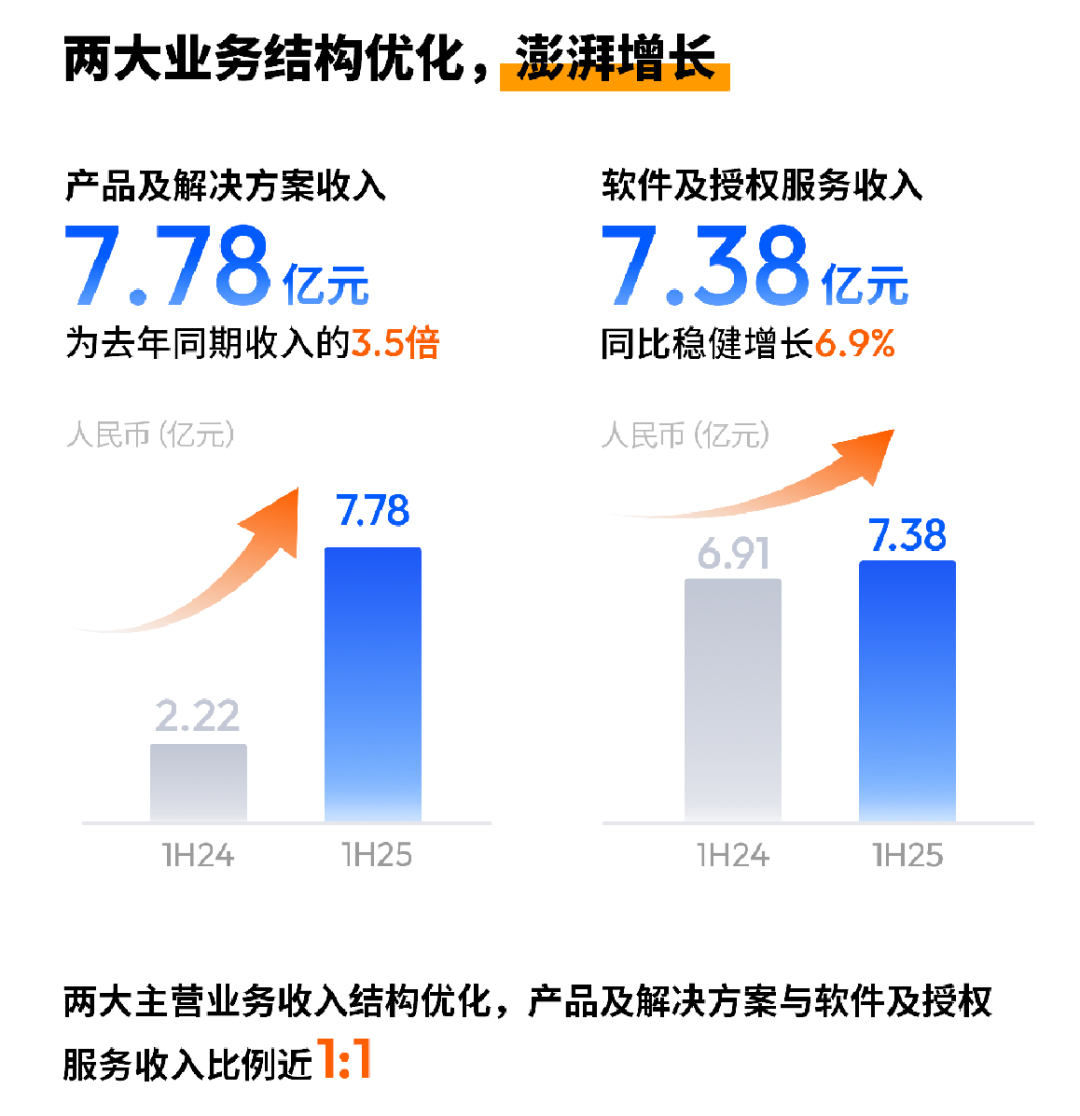
Core Viewpoint - Horizon has delivered an impressive performance in the intelligent driving competition, showcasing significant revenue growth and industry-leading gross margins in its recent financial report for the first half of the year [1][9]. Revenue and Growth - Horizon's revenue surged by 67.6% year-on-year to 1.567 billion yuan, with product solutions contributing a remarkable 250% increase to 778 million yuan [1][2]. - The company achieved a gross profit of 1.024 billion yuan, resulting in a gross margin of 65.4%, leading the industry [1][9]. - The hardware shipment of Horizon's Journey series exceeded 10 million units, making it the first intelligent driving technology company in China to reach this milestone [1]. Product and Market Dynamics - The increase in revenue is attributed to a significant rise in shipment volumes, with the Journey series processing hardware shipments reaching 1.98 million units, doubling year-on-year [5]. - The hardware supporting high-speed auxiliary driving features saw shipments of 980,000 units, a sixfold increase compared to the same period last year [5][8]. - The market for intelligent driving is shifting towards higher-end features, with models equipped with advanced driving assistance systems (ADAS) increasing from 20% to 32% of total sales [8]. Research and Development Investment - Horizon's R&D expenses reached 2.3 billion yuan, a 62% increase year-on-year, primarily for cloud services and urban auxiliary driving system investments [9]. - The company is focused on enhancing its delivery capabilities through substantial R&D investments, adhering to the principle of "investing first, yielding later" in the technology-intensive intelligent driving sector [9]. Future Outlook - The company is optimistic about the second half of the year, projecting total shipments to exceed 4 million units, with a balanced distribution between low-end and mid-to-high-end products [10][11]. - The Horizon SuperDrive (HSD) system is set to enter mass production, with the first model featuring this system, the Xingtai ET5, recently unveiled [10][14]. - Horizon is also expanding its partnerships with international automotive companies, aiming to penetrate overseas markets and establish collaborations with top-tier suppliers [17]. Strategic Insights - Horizon's success is attributed to its strategic focus on the automotive sector and its differentiated approach, emphasizing a "soft and hard integration" technology route [18][19]. - The company maintains a cautious financial strategy, ensuring sufficient cash reserves even during challenging periods, allowing it to navigate uncertainties effectively [21].

2025年7月中国占世界汽车份额34% 比亚迪全球市场份额第6
Feng Huang Wang· 2025-08-29 11:30
2025年世界市场进一步分化,中国份额逐步回升。2025年初,随着两新补贴政策逐步启动,导致中国汽 车销量回升,1月份额达到34%,但由于2月春节因素和美国、日本等市场的暂时偏高,中国2月世界份 额仅有31%,随着以旧换新补贴的推动车市逐月走强,7月中国的世界份额回升到34%的较好水平,较 去年提升3个百分点。 凤凰网科技讯 8月29日,乘联分会秘书长崔东树发文称,2025年7月的世界汽车销量达到773万台,同比 增7%,环比6月下降4%。 中国自主品牌全面提升世界份额。比亚迪(002594)、吉利、奇瑞、长安等自主表现较强。近期的新能 源发展迅速,中国自主车企走势较强,比亚迪达到世界第6位,吉利第9位,奇瑞第11位,电动化发展也 导致部分国际车企逐步走向衰落。除了美国市场异常暂时较强和铃木等印度市场较好的因素促进,其它 国际品牌份额全面较大的下滑。 ...
前7个月我国汽车产销量均超1800万辆
Mei Ri Jing Ji Xin Wen· 2025-08-28 12:29
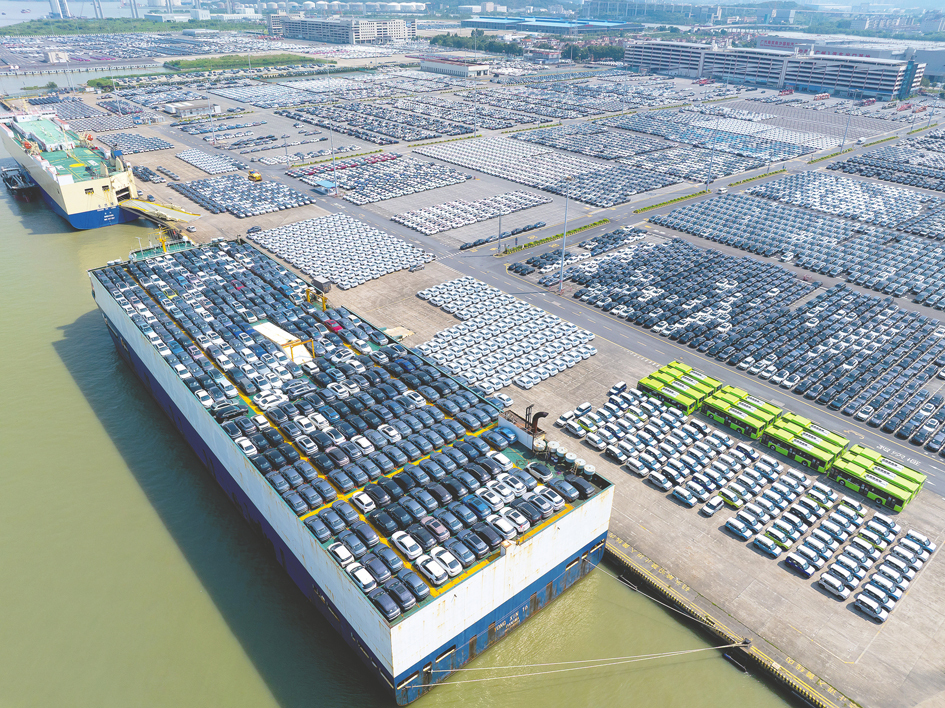
Core Viewpoint - The Chinese automotive market has shown significant growth in the first seven months of 2023, with production and sales increasing by 12% and 12.7% year-on-year, respectively, despite a seasonal decline in July [1][3]. Production and Sales Data - From January to July, the total automotive production reached 18.235 million units, while sales reached 18.269 million units, marking a year-on-year increase of 12.7% and 12% [1]. - In July alone, production and sales were 2.591 million and 2.593 million units, respectively, reflecting a month-on-month decline of 7.3% and 10.7%, but a year-on-year increase of 13.3% and 14.7% [1][3]. Market Dynamics - The decline in July's production and sales is attributed to the traditional off-season and scheduled equipment maintenance by manufacturers, leading to a seasonal slowdown [3]. - The "old-for-new" vehicle policy continues to show positive effects, and the introduction of new models by companies has contributed to stable market operations [3]. Passenger Vehicle Market - In July, the production and sales of passenger vehicles reached 2.293 million and 2.287 million units, with year-on-year growth of 13% and 14.7% [4]. - Chinese brand passenger vehicles accounted for 70.1% of total passenger vehicle sales in July, with a year-on-year increase of 3.8 percentage points [4]. - From January to July, the sales of Chinese brand passenger vehicles reached 10.873 million units, a year-on-year increase of 24.4%, with a market share of 68.6% [5]. Commercial Vehicle Market - In July, commercial vehicle production and sales were 298,000 and 306,000 units, respectively, showing a month-on-month decline but maintaining double-digit year-on-year growth [6]. - From January to July, commercial vehicle production and sales totaled 2.397 million and 2.428 million units, with year-on-year increases of 6% and 3.9% [6]. New Energy Vehicles (NEVs) - NEVs continued to show rapid growth, with July production and sales reaching 1.243 million and 1.262 million units, respectively, marking year-on-year increases of 26.3% and 27.4% [7]. - NEVs accounted for 48.7% of total new vehicle sales in July, with domestic sales surpassing 50% for the first time since December [7]. - From January to July, NEV production and sales reached 8.232 million and 8.22 million units, with year-on-year growth of 39.2% and 38.5% [7]. Export Performance - NEVs have become a major driver of export growth, with total automotive exports reaching 3.68 million units from January to July, a year-on-year increase of 12.8% [8]. - Traditional fuel vehicle exports decreased by 7%, while NEV exports surged by 84.6% [8]. - BYD's export growth was particularly notable, with a 130% increase, reaching 553,000 units [8].
基金早班车丨权益类ETF规模年内增逾两成四,历史首破四万亿
Sou Hu Cai Jing· 2025-08-26 00:41
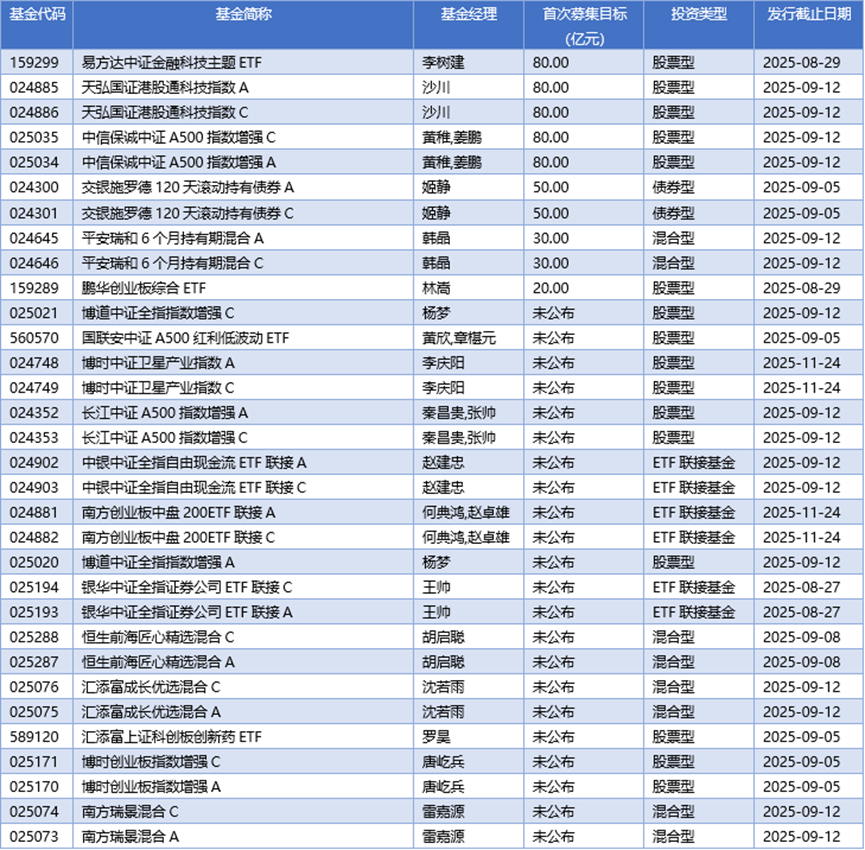
Group 1 - The total scale of domestic equity ETFs reached 41,170.94 billion yuan as of August 25, marking an increase of 7,982.72 billion yuan or 24.05% since the beginning of the year, setting a historical high [1] - The A-share market saw all three major indices rise, with the Shanghai Composite Index up 1.51% to 3,883.56 points, the Shenzhen Component Index up 2.26% to 12,441.07 points, and the ChiNext Index up 3% to 2,762.99 points, with total trading volume exceeding 31,411.37 billion yuan [1] - The issuance of public funds remained robust in August, with 157 new funds launched by August 25, a month-on-month increase of 5.37%, setting a new record for the year [2] Group 2 - The newly launched funds on August 25 included 32 funds, primarily equity and mixed funds, with the E Fund's China Securities Financial Technology Theme ETF targeting a fundraising goal of 8 billion yuan [2] - Over 90% of Fund of Funds (FOF) have reported positive performance this year, indicating strong momentum for incremental capital [2] - The top-performing fund on August 25 was the Huatai-PB Quality Growth Mixed A, with a daily growth rate of 8.0703% [6] Group 3 - The top-performing equity fund was the Caitong Integrated Circuit Industry Stock A, with a daily growth rate of 7.4611% [7] - The top-performing bond fund was the Baoying Rongyuan Convertible Bond A, with a daily growth rate of 2.0384% [7] - The top-performing mixed fund was again the Huatai-PB Quality Growth Mixed A, with a daily growth rate of 8.0703% [7] Group 4 - The total number of new funds launched in August included 125 equity funds, accounting for 79.62% of the total, with 96 being stock funds [2] - The market's positive sentiment is expected to continue, with the Shanghai Composite Index remaining above 3,800 points [2] - The issuance of new funds has maintained a level above 140 for two consecutive months, indicating strong investor interest [2]
靴子落地!知名央企宣布:退市!
Nan Fang Du Shi Bao· 2025-08-25 06:54
Core Viewpoint - Dongfeng Group is privatizing and delisting its shares to focus on the development of its electric vehicle brand, Lantu, which is set to become the first publicly listed subsidiary of a central enterprise in the new energy vehicle sector [1][2]. Group 1: Privatization and Listing Strategy - Dongfeng Group announced its decision to privatize and delist from the Hong Kong Stock Exchange, citing underperformance and a long-term undervaluation of its H-shares as key reasons [1][3]. - The company plans to distribute 79.67% of its shares in Lantu to its shareholders before Lantu's introduction to the Hong Kong Stock Exchange, aiming to enhance its financing capabilities and brand image [3][4]. - The overall acquisition price for the transaction is set at HKD 10.85 per share, with cash compensation of HKD 6.68 per share and equity compensation of HKD 4.17 per share [3]. Group 2: Lantu's Market Position and Financial Performance - Lantu has shown significant growth, with sales reaching 66,680 units from January to July 2023, marking an 85.8% year-on-year increase [4][5]. - The company is nearing profitability, having achieved a single-quarter profit in Q4 2022, although it reported a net loss of CNY 1.472 billion for 2023, which is expected to narrow to CNY 18 million in 2024 [2][4]. - Lantu's management emphasizes that the decision to pursue an IPO will depend on the company's actual development and not merely for the sake of going public [4]. Group 3: Future Outlook and Goals - Lantu has set an ambitious sales target of 200,000 units for the year, with a current achievement rate of 33%, but remains optimistic about meeting this goal due to new product launches in the second half of the year [5].
禾赛25Q2跟踪报告:GAAP盈利超预期,国内外客户拓展顺利
CMS· 2025-08-24 09:33
Investment Rating - The report maintains a "Recommended" rating for the industry, indicating a positive outlook for the sector's fundamentals and expectations for the industry index to outperform the benchmark index [5]. Core Insights - The report highlights that the company achieved a revenue of 706 million yuan in Q2 2025, representing a year-over-year increase of 53.9%, and a significant turnaround in GAAP net profit to 44 million yuan, exceeding expectations [1][2]. - The laser radar delivery volume exceeded expectations, with a total of 352,100 units delivered in Q2 2025, marking a year-over-year increase of 306.9%, driven primarily by the ADAS segment [3][4]. - The company has deepened collaborations with leading domestic clients and is steadily advancing its global expansion efforts, including partnerships with major automotive manufacturers [4]. Revenue Performance - In Q2 2025, the company reported a revenue of 706 million yuan, which aligns with the guidance provided for Q1 2025 [2]. - For the first half of 2025, the company achieved a total revenue of 1.232 billion yuan, reflecting a year-over-year growth of 50.6% [2]. Profitability Metrics - The gross margin for Q2 2025 was reported at 42.5%, with a slight year-over-year decrease of 2.6 percentage points, but an increase of 0.8 percentage points quarter-over-quarter [2]. - The GAAP net profit margin for Q2 2025 was 6.23%, significantly surpassing the breakeven guidance for Q1 2025 [2]. Delivery Volume and Market Share - The company delivered 54,790 units of laser radar in the first half of 2025, achieving a year-over-year increase of 276.2% [3]. - The company holds the leading market share in both the ADAS and robotics sectors, with the highest installation volume of laser radar in the ADAS field for the first half of 2025 [3]. Client Collaborations - The company has established partnerships with 24 automotive manufacturers, with recent agreements for 20 new models from major brands such as Geely and Great Wall [4]. - Internationally, the company is progressing with projects involving top European automotive manufacturers, laying the groundwork for mass production in 2026 [4].
或成央企新能源车第一股!岚图将登陆港股,东风集团股份退市
Nan Fang Du Shi Bao· 2025-08-23 03:11
Core Viewpoint - Dongfeng Group is privatizing and delisting to focus on developing its electric vehicle brand, Lantu, which is set to become the first publicly listed subsidiary of a central enterprise in the new energy vehicle sector [2][3]. Group 1: Company Strategy - Dongfeng Group's decision to privatize is driven by underperformance in overall results and a long-term undervaluation of its H-shares, which have lost their financing function [2]. - The merger will allow Dongfeng to concentrate on the new energy vehicle industry and integrate quality resources into strategic emerging industries, aiming to provide good returns to shareholders [2][3]. Group 2: Lantu's Market Position - Lantu is positioned as the core of Dongfeng's independent brand electric vehicle segment, with significant market influence and brand value [3]. - The introduction of Lantu to the Hong Kong Stock Exchange will enhance its financing channels, brand image, and international expansion, while also improving corporate governance [3]. Group 3: Financial Performance - Lantu is nearing profitability, having achieved a single-quarter profit in Q4 of the previous year, although it reported a tax-pre-loss of 1.98 billion yuan and a tax-after loss of 1.472 billion yuan for 2023 [3][4]. - For 2024, Lantu's tax-pre-loss is expected to narrow to 243 million yuan, with a tax-after loss of 18 million yuan [3]. Group 4: Transaction Details - The transaction involves a "share distribution + absorption merger" model, where Dongfeng will distribute 79.67% of Lantu's shares to all shareholders before Lantu's introduction to the stock exchange [4]. - The total acquisition price is set at 10.85 HKD per share, with a cash component of 6.68 HKD and a share component of 4.17 HKD [5]. Group 5: Sales and Growth Potential - Lantu's sales from January to July reached 66,680 units, marking an 85.8% year-on-year increase, with consistent monthly sales exceeding 10,000 units since March [5][6]. - Lantu aims to achieve a sales target of 200,000 units for the year, with confidence in meeting this goal due to new product launches in the second half of the year [6]. Group 6: Upcoming Products - The Lantu FREE+ has been successfully launched and is performing well in the market, while the Lantu Zhiyin, developed in collaboration with Huawei, is set to launch soon [7][8].