零跑汽车

Search documents
锂电行业2026年度策略报告:供需拐点已现,出海+固态共舞(附下载)
Xin Lang Cai Jing· 2026-01-04 01:18
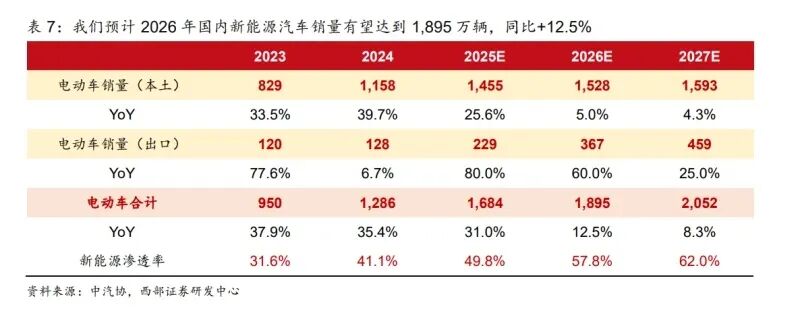
Domestic New Energy Vehicles - Domestic new energy vehicle sales are expected to reach 16.56 million units by 2026, representing a year-on-year increase of 13.8% [1] - In October 2025, domestic new energy vehicle sales were 1.715 million units, with a month-on-month increase of 20.0% and a year-on-year increase of 32.7% for the cumulative sales from January to October [1][2] - The penetration rate of new energy vehicles reached 51.6% in October 2025, up 3.9 percentage points year-on-year [1] Export of New Energy Vehicles - In October 2025, new energy vehicle exports reached 256,000 units, a year-on-year increase of 99.9% [2] - Cumulative exports from January to October 2025 totaled 2.014 million units, reflecting a year-on-year increase of 90.4% [2][10] - The overall automobile export volume in October 2025 was 666,000 units, with a month-on-month increase of 22.9% [2] Trends in Hybrid Models - Hybrid models are trending towards "large battery + small fuel tank," with increased battery capacity per vehicle [3] - The new D19 range-extended model from Leap Motor features an 80.3 kWh battery, achieving a pure electric range of over 500 km and a comprehensive range of 1,300 km [3] - The "old-for-new" vehicle replacement policy has led to significant growth in new energy vehicle sales, with an expected increase of 12.5% in 2026 [3] Global New Energy Vehicle Market - Global new energy vehicle sales are projected to reach 8.14 million units in 2026, with a year-on-year growth of 21.0% [12] - European electric vehicle sales are expected to continue growing due to stringent carbon emission policies, with an anticipated total of 4.87 million units sold in 2026, up 30.0% year-on-year [12] - The U.S. market may face challenges due to the cancellation of electric vehicle tax credits, with a projected decline in sales to 1.6 million units in 2026, down 4.5% year-on-year [13] Battery Production - Global battery production is expected to reach 1,510 GWh in 2026, representing a year-on-year increase of 17.33% [15] - Chinese battery manufacturers hold a 60% share of the global market, with CATL maintaining a leading position [15] - The global installed capacity of lithium batteries reached 811.7 GWh in the first nine months of 2025, up 34.7% year-on-year [15] Energy Storage Demand - Domestic energy storage demand is expected to grow significantly due to market-driven factors and capacity pricing policies [16] - The transition from policy-driven to market-driven demand for energy storage is anticipated to enhance internal project returns and stimulate installation [16] - In 2026, the favorable economic conditions for energy storage in Europe and emerging markets are expected to continue [17]


2025年新势力成绩单出炉,零跑小米小鹏完成年度目标
3 6 Ke· 2026-01-04 00:37
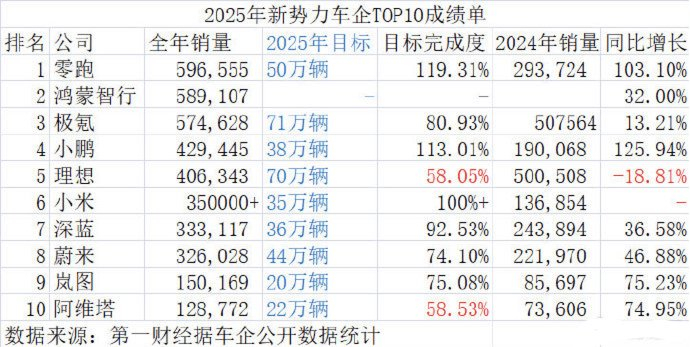
Core Insights - In 2025, only three new energy vehicle brands, Leap Motor, Xiaomi, and Xpeng, achieved their annual sales targets, with Leap Motor emerging as the top performer with nearly 600,000 units sold, exceeding its target by over 19% [1][4] - The performance of traditional leading brands, often referred to as "Wei Xia Li" (Weilai, Xiaopeng, and Li Auto), showed significant divergence, with Xpeng achieving a 125.94% year-on-year growth, while Li Auto experienced an 18.81% decline in sales [2] - State-owned enterprises like Changan and Dongfeng are also facing challenges in scaling their new energy vehicle brands, with Deep Blue and Avita struggling to meet their revised sales targets [3] Group 1: Performance of New Energy Vehicle Brands - Leap Motor sold 596,555 units, achieving a target completion rate of 119.31% and a year-on-year growth of 103.10% [4] - Hongmeng Zhixing delivered 589,107 units, marking a 32% increase year-on-year [1][4] - Zeekr, after merging with Lynk & Co, reported a total delivery of 574,628 units, but fell short of its target with an 80.93% completion rate [4] Group 2: Performance of Traditional Leading Brands - Xpeng sold 429,445 units, achieving a target completion rate of 113.01% and a year-on-year growth of 125.94% [2][4] - Li Auto's sales reached 406,343 units, but this represented a significant decline of 18.81% compared to the previous year, with a completion rate of only 58.05% against its initial target of 700,000 units [2][4] - NIO delivered 326,028 units, reflecting a year-on-year growth of 46.88%, but its main brand saw a decline in performance compared to the previous year [2][4] Group 3: Performance of State-Owned Enterprises - Deep Blue, a brand under Changan, sold 333,117 units, achieving a completion rate of 92.53% after revising its target down to 360,000 units [3][4] - Avita's sales remained low at 128,772 units, with a completion rate of only 58.53% against its target of 220,000 units [3][4] - Dongfeng's brand, Lantu, sold 150,169 units, achieving a completion rate of 75.08% [3][4]


汽车行业周报(2025/12/29-2026/1/2):汽车“以旧换新”政策延续,按比补贴利好中高端车型-20260103
GUOTAI HAITONG SECURITIES· 2026-01-03 14:01
Investment Rating - The report maintains an "Overweight" rating for the automotive industry [4][21]. Core Insights - The continuation of the "old-for-new" vehicle policy is expected to benefit mid-to-high-end models, with subsidies adjusted based on vehicle price ratios [2][18][19]. - Polestar, a high-end electric vehicle company, secured $300 million in financing, indicating strong interest in the European electric vehicle market [20]. - The report emphasizes the importance of differentiating vehicle models in a competitive market, particularly as the effects of the "old-for-new" policy diminish [21]. Summary by Sections Industry Weekly Market Review - The automotive index rose by 1% in the past week, while the new energy vehicle index remained flat. The automotive parts index increased by 2%, and the commercial vehicle index also rose by 1% [11][12]. - In the past month, the automotive index increased by 5%, with the automotive parts index up by 7% [11][12]. "Old-for-New" Vehicle Policy Continuation - The policy will continue into 2026, with subsidies for scrapping and replacing vehicles adjusted to a percentage of the vehicle price, benefiting mid-to-high-end models [18][19]. Financing for High-End Electric Vehicle Companies - Polestar announced a $300 million investment from Bilbao Bizkaia Kutxa and NATIXIS, highlighting the growing interest in electric vehicles in Europe [20]. Investment Strategy and Recommendations - The report suggests focusing on companies with high cost-performance ratios and emerging technologies, recommending leading firms such as 德昌电机控股 and 豪能股份 [21]. - It also highlights the importance of differentiation in vehicle models, recommending 长城汽车, 上汽集团, and 零跑汽车 [21]. - The report identifies opportunities in the data center power supply sector, recommending 潍柴动力 and 玉柴国际 [21]. - In the automotive parts sector, it suggests investing in耐世特 and 亚太股份 due to their growth potential [21].






新造车2025年复盘:零跑登顶,小鹏逆袭,理想遇挫
创业邦· 2026-01-03 10:22
Core Viewpoint - The 2025 sales data reveals a significant shift in the Chinese electric vehicle (EV) market, with new players like Leap Motor, Huawei's Homologous Intelligent Driving, and Xiaomi emerging as strong competitors against established brands like BYD and Geely [6][12]. Group 1: 2025 Sales Performance - BYD led the market with 4.6024 million units sold, achieving 100% of its target [7]. - Geely surpassed 3 million units, reaching 3.0246 million with a 39% year-on-year growth [7]. - Leap Motor emerged as the top new force with nearly 600,000 units sold, marking a 103% increase [8][12]. - Homologous Intelligent Driving ranked second among new forces with 589,100 units delivered, primarily driven by the Wanjie brand [8]. - Xiaomi entered the top five with over 400,000 units sold, leveraging its ecosystem and brand loyalty [17]. Group 2: Competitive Landscape - The competition among new forces has intensified, with Leap Motor, Homologous Intelligent Driving, and Xiaomi leading the charge, while traditional players like BYD and Geely maintain their dominance [10][12]. - The market is shifting from a focus on capturing the fuel vehicle market to a more competitive landscape where companies vie for each other's market share [10]. - The new forces are increasingly focusing on systemic capabilities rather than just product features or pricing [18]. Group 3: Strategic Insights - Leap Motor's success is attributed to its cost control and high component sharing rate, which allows it to offer competitive pricing while maintaining quality [15][18]. - Xiaomi's approach combines its consumer electronics experience with automotive production, achieving a gross margin of 26.4% in Q3 2025 [17]. - The high-end players like Ideal, Homologous Intelligent Driving, and NIO face challenges as the market shifts towards technology competition rather than just configuration [19][23]. Group 4: Future Outlook - The penetration rate of new energy vehicles is expected to exceed 60% in 2026, leading to intensified competition [10]. - Companies are setting ambitious sales targets for 2026, with Homologous Intelligent Driving aiming for 1 to 1.3 million units and Leap Motor targeting 1 million [10]. - The competition will evolve into a "value war," focusing on better battery performance, intelligent features, and overall vehicle quality [29][30].


首次!比亚迪超越特斯拉,全球电动汽车销量第一
自动驾驶之心· 2026-01-03 09:24
点击下方 卡片 ,关注" 自动驾驶之心 "公众号 戳我-> 领取 自动驾驶近30个 方向 学习 路线 >>自动驾驶前沿信息获取 → 自动驾驶之心知识星球 美国电动汽车制造商特斯拉公司2日公布的数据显示,该公司2025年全球交付汽车163.6万辆, 同比下降约8.6%。 这是特斯 拉有史以来首次在全年电动汽车销量上 被中国汽车制造商比亚迪超越。 特斯拉表示, 该公司2025年第四季度共交付41.8万辆汽车,同比下降15.6%,低于分析师预期的约43.4万辆。全年交付量为 163.6万辆,较2024年的179万辆明显下降,也低于市场预期的约165万辆。 我们也来复盘几家头部新势力的销量情况。 零跑汽车 以全年交付596,555辆,同比增长103.1%的成绩,成为新势力最大黑马, 超额完成50万辆的年度目标 ,达成率 119.31%。 小米汽车 以全年交付35万辆、达成率108.57%的成绩,成为新势力中增速最快的品牌。 中国汽车巨头 比亚迪 1月1日发布的数据显示,比亚迪2025年总体新车销量超460万辆,同比增长约8%,其纯电动汽车新车 销量超225万辆,同比增长约28%。比亚迪首次登顶全球纯电动汽车销量榜。 ...

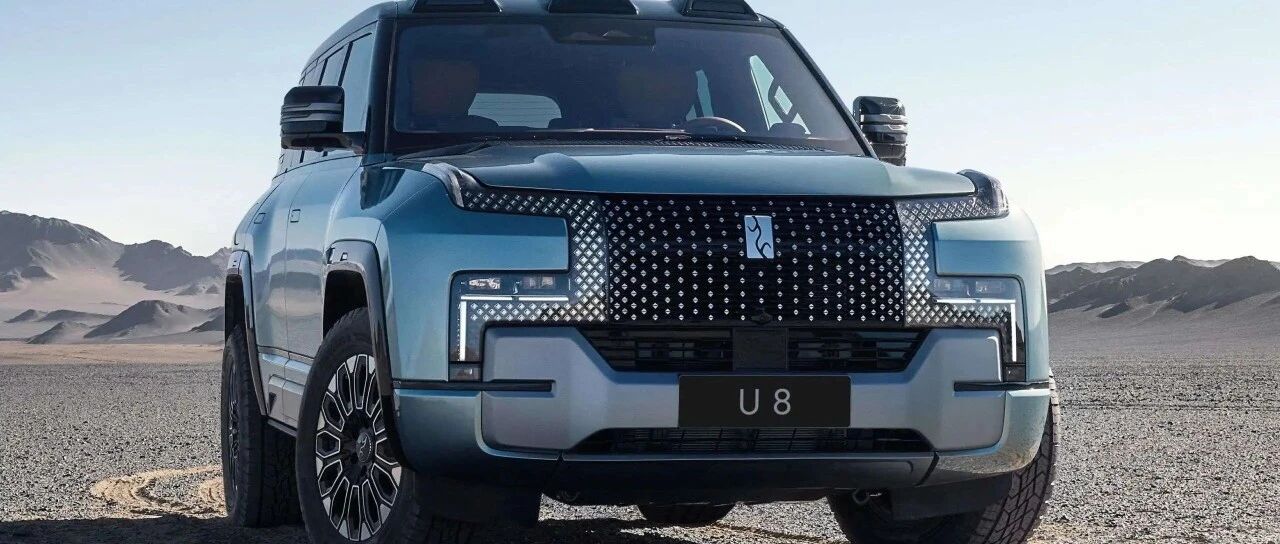
宁德时代三大动作;LG新能源痛失巨额订单;广东锂电企业冲刺IPO;欣旺达动力被索赔23亿;中创新航收购子公司股权;36家入围锂电池白名单
起点锂电· 2026-01-03 09:20
Group 1 - CATL plans to acquire a controlling stake in Jiangxi Shenghua New Materials, with an investment of 25.6338 billion yuan, resulting in a 51% ownership stake [4] - CATL enters the hydropower business by co-establishing a company to develop the Dadu River Danba hydropower station, with a total investment of 36 billion yuan and an installed capacity of 1.15 million kilowatts [5] - CATL introduces a "New Year Stay Bonus" policy for employees, offering at least 3,200 yuan for those who work during the Spring Festival, potentially increasing monthly income to 11,500 yuan for eligible employees [6] Group 2 - The Ministry of Industry and Information Technology announces the ninth batch of lithium battery whitelist, including 36 companies, with 27 battery manufacturers listed [7] - XWANDA Power faces a lawsuit for 2.314 billion yuan due to quality issues in battery cells delivered between June 2021 and December 2023 [8] - Zhongxin Innovation acquires an 8.3155% stake in Wuhan Company for 660 million yuan, increasing its ownership to 59.3155% [9] Group 3 - LG Energy Solution terminates a contract worth 3.9 trillion won (approximately 2.69 billion USD) with FBPS, leading to a total loss of 13.5 trillion won in recent contract cancellations [10][11] - Yichang Bangpu Times launches a new generation lithium iron phosphate project with an annual capacity of 450,000 tons, achieving industry-leading automation and domestic production rates [13] - Major lithium iron phosphate producers, including Hunan Youneng and Wanrun New Energy, announce production cuts for maintenance, reducing output by 1.5-3.5 million tons and 0.5-2 million tons respectively [14][15] Group 4 - Tian Nuo Ju Neng launches a high-performance silicon-based anode material project, achieving international leading performance metrics [16] - A 4.8 billion yuan lithium manganese iron phosphate project is signed in Yinchuan, aiming for an annual output of 130,000 tons [17] - Yu Gong High-Tech completes a multi-million A-round financing to support its automation equipment for the new energy sector [19] Group 5 - Guangdong Hengyien applies for an IPO to raise 839 million yuan for expansion and R&D, with fluctuating revenue and profit figures reported [20] - A 1.012 billion yuan battery material recycling project is underway in Ningde, aiming for an annual production capacity of 52,000 tons of battery materials [22] - Jiangsu Xinghua proposes a 1.6 billion yuan project for recycling and reusing 100,000 tons of waste lithium batteries, focusing on lithium iron phosphate and nickel-cobalt-manganese batteries [23] Group 6 - The automotive market is expected to see a strong start in January 2026 due to early implementation of consumer support policies [25] - The 2026 automotive subsidy policy will optimize support scope and adjust subsidy standards based on vehicle price [26][27] - FAW Group invests in Leap Motor, marking a significant collaboration in the automotive sector [28] Group 7 - The AITO M8 has surpassed 150,000 cumulative deliveries, becoming a top-selling model in its category [29] - CATL's chairman meets with Xiaopeng Motors' chairman to explore potential cooperation after a period of strained relations [30] - The chairman of Zotye Auto resigns for personal reasons, with the company stating that operations will continue normally [31][32]
【一周投资热点】宁德时代/新宙邦/珩创纳米再扩产!盐湖股份/盛新锂能/雪天盐业现大手笔收购
Xin Lang Cai Jing· 2026-01-03 03:51
Investment Expansion - CATL has signed an investment cooperation agreement for a new 30GWh power and energy storage battery production base in Guizhou, expanding its existing facility which already has a 30GWh capacity [1] - Capchem plans to invest up to 200 million RMB in Poland to enhance its lithium-ion battery materials production capacity by 50,000 tons per year through technical upgrades [2] - Capchem also announced a project in Saudi Arabia with an investment of approximately 260 million USD to produce 200,000 tons of carbonate solvent and 100,000 tons of ethylene glycol [3] - Hanchuang has launched a 4.8 billion RMB project in Ningxia to produce 130,000 tons of lithium manganese iron phosphate annually, enhancing the local battery materials industry [4] Production Commencement - CATL's subsidiary, Yichang Bangpu, has officially launched a new 450,000 tons per year lithium iron phosphate project, achieving a record of signing, starting, and completing the project within the same year [6][7] Major Projects and Developments - The largest independent energy storage demonstration project in China, with a capacity of 500,000 kW and 3 million kWh, has been completed in Inner Mongolia [8][9] - The largest all-vanadium flow battery energy storage station in China has been put into operation in Xinjiang, with a rated power of 200,000 kW and a storage capacity of 1 million kWh [10] Mergers and Acquisitions - Salt Lake Co. plans to acquire a 51% stake in Wenkang Salt Lake for 4.605 billion RMB to enhance its position in the salt lake industry [12] - Shengxin Lithium Energy intends to acquire a 30% stake in Qicheng Mining for 2.08 billion RMB, gaining full control over the company [13] Financing Activities - Taiblue New Energy has completed a financing round of over 400 million RMB to accelerate the production of solid-state batteries [14] - CATL is set to invest 2.563 billion RMB in Jiangxi Shenghua to gain a controlling stake in the company [15] Company Orders - CATL has signed contracts for 55 electric cargo ships, marking a significant milestone in the electric shipping industry [18] - LG Energy Solution has lost contracts worth 39 trillion KRW due to a client exiting the battery industry, impacting its revenue significantly [19]


车企2026谁家强?我们列出了13家看好与“欠佳”
虎嗅APP· 2026-01-03 03:13
Core Viewpoint - The Chinese automotive industry has shifted from a phase of rapid expansion driven by investment and storytelling to a focus on efficiency and realization, emphasizing cash flow, profitability models, technology compliance, and global operational capabilities [2][3]. Group 1: Market Volume - The key question for 2026 is whether the new energy vehicle (NEV) market can surpass the 20 million unit threshold, with growth driven by factors such as trade-in programs, lower-tier markets, and improved charging experiences [4][5]. - The Chinese government has introduced a new trade-in subsidy policy for 2026, which is expected to stimulate demand in the automotive sector [6][7]. - Predictions for 2026 NEV sales vary, with estimates ranging from a 10% growth (14.14 million units) to a more optimistic 28.4% growth (16.5 million units), particularly in the 150,000 to 200,000 yuan price range [8][10]. Group 2: Profit Expectations - The industry is transitioning from a focus on scale to profitability, with competition intensifying in the 200,000 to 400,000 yuan price range [9][22]. - Companies like Geely are expected to see profit growth from multiple sources, while others like GAC face significant challenges [31][32]. Group 3: L3 and Intelligent Driving - The introduction of L3 autonomous driving is expected to shift responsibility from drivers to manufacturers, leading to systemic changes in the automotive ecosystem [38][40]. - The L3 era will likely drive the standardization of L2 features across all vehicles, increasing competition in the intelligent driving space [42][43]. Group 4: Luxury Narrative - The luxury narrative in the NEV sector is becoming increasingly complex, with a need for brands to establish genuine value propositions beyond just high-end features [50][51]. - The market for luxury vehicles priced above 300,000 yuan is growing slowly, while more affordable segments are seeing significant growth [57][60]. Group 5: Overseas Expansion - Chinese automotive exports are projected to exceed 8 million units in 2025, with significant growth in markets like Mexico and the UAE [67][68]. - The establishment of overseas production facilities is crucial for meeting demand and avoiding trade barriers, with many companies rapidly expanding their international manufacturing capabilities [72][73]. Group 6: AI Cross-Industry Moves - The focus for 2026 will likely shift away from ambitious cross-industry ventures towards enhancing core automotive services through AI, as companies learn from past experiences [78][81].
每10辆就有1辆中国造,中国车企在欧洲卖爆了
创业邦· 2026-01-03 01:13
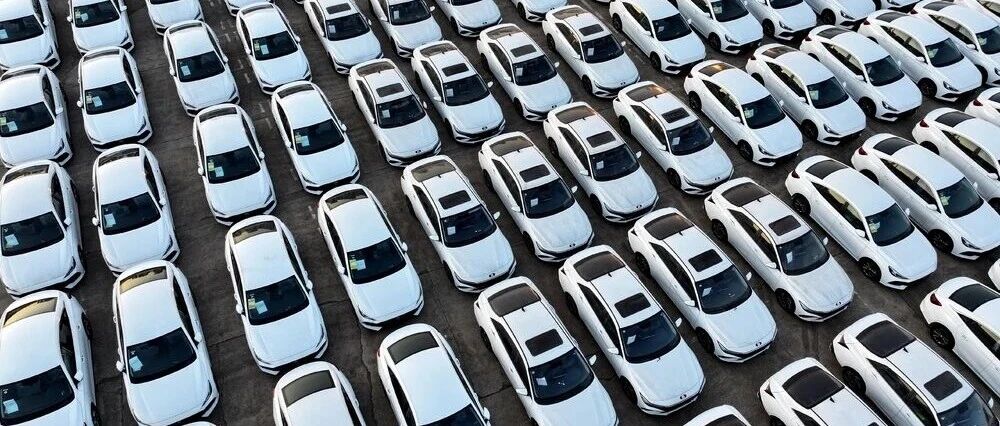
Core Viewpoint - Chinese electric vehicles (EVs) are significantly increasing their market share in Europe, overcoming high tariffs and competition from established local brands, indicating a successful penetration into a historically challenging market [5][7]. Market Performance - In 2025, Chinese brands are projected to capture 12.8% of the European EV market and over 13% in the hybrid vehicle sector, marking a historic high [7]. - In the UK, sales of Chinese automotive brands reached 187,800 units in the first 11 months of the year, doubling from the previous year, with expectations to exceed 200,000 units in 2025 [8][11]. - The average market share of Chinese brands in Western Europe is around 6%, with significant growth in countries like Spain and Norway [11]. Competitive Advantages - Chinese automakers benefit from a mature supply chain for new energy vehicles, allowing for stable supply and cost advantages compared to European manufacturers facing high production costs and battery shortages [13]. - The strategy of localizing production, such as Chery's assembly in Barcelona and BYD's new factory in Hungary, helps avoid tariffs and brings products closer to European consumers [14]. Technological Edge - Chinese companies lead in battery technology, with innovations like BYD's blade battery and CATL's high-energy-density batteries, meeting European demands for longer range and safety [14]. - Advanced smart features in vehicles from brands like XPeng and Leap Motor cater to tech-savvy European consumers [15]. Challenges Ahead - Trade barriers, such as a 45% anti-subsidy tax, and upcoming regulatory requirements pose significant challenges for Chinese automakers [15][17]. - Service and brand recognition remain weak compared to established European brands, with limited service networks and slower response times affecting customer retention [17]. - Adapting to stringent European standards for charging interfaces and carbon footprints adds to the cost of vehicle modifications [17].
全球新能源汽车新王者诞生,特斯拉黯然让位
Xin Lang Cai Jing· 2026-01-02 15:29
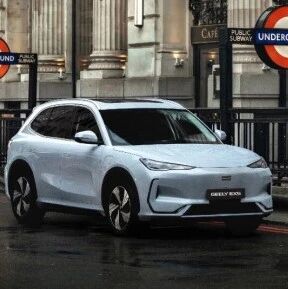
Core Insights - BYD has surpassed Tesla in global electric vehicle sales, achieving 2.26 million units in 2025, a nearly 28% increase from 2024, while Tesla's deliveries fell to 1.6 million, marking an 8.6% decline, the largest annual drop in its history [2][8] - Despite not yet entering the U.S. market, BYD's growth in the electric vehicle sector has outpaced Tesla, which relies heavily on the U.S. market for nearly half of its revenue [8][9] - Tesla's sales have been impacted by increased competition from BYD and other automakers, as well as political controversies surrounding CEO Elon Musk, leading to a significant drop in demand [9][10] Company Performance - BYD's total vehicle sales, including electric and plug-in hybrid models, are projected to exceed 4.6 million units in 2025, but the growth rate has fallen to its lowest in five years, indicating challenges in the Chinese market [10][11] - In the first three quarters of 2025, BYD's net profit declined, reflecting the pressures of intense competition and price wars in the domestic market [11] - BYD's market share in China has decreased from 35% in 2023 to 29% in the first eleven months of 2025, while competitors like Geely have seen significant growth [11] Market Dynamics - The U.S. electric vehicle market showed signs of weakness in late 2025, with Tesla's fourth-quarter deliveries dropping by 15.6% compared to the previous quarter [8][9] - Tesla's strategy to introduce lower-priced versions of its Model 3 and Model Y has not fully mitigated the impact of the expiring tax incentives, as these models come with reduced range and features [9] - The competitive landscape in China remains fierce, with over 150 automotive brands and more than 50 electric vehicle manufacturers, intensifying the pressure on BYD [11]