腾讯

Search documents
午评:港股恒指涨0.65% 科指涨1.14% 科网股活跃 生物医药股大涨
Xin Lang Cai Jing· 2025-12-19 04:02
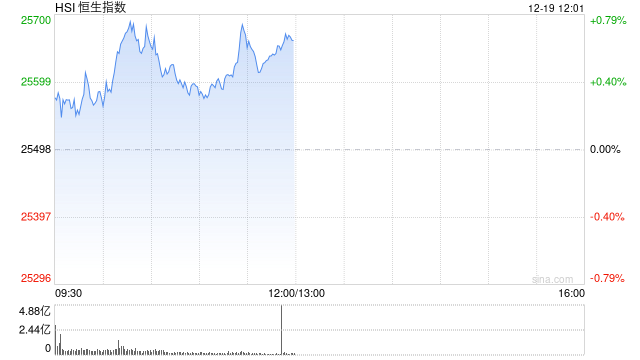
12月19日消息,港股三大指数集体上涨。截至午间收盘,恒生指数涨0.65%,报25663.41点,恒生科技 指数涨1.14%,国企指数涨0.50%。盘面上,科网股涨多跌少,美团涨超2%,网易、百度、腾讯涨超 1%,联想跌超1%;生物医药股普涨,药明康德涨超6%;中资券商股走强,招商证券涨超3%;智能驾 驶概念股活跃,佑驾创新涨超12%;今日智汇矿业、希迪智驾上市,智汇矿业涨超111%,希迪智驾跌 超8%。 | 名称 | | 量新价 | 涨跌幅 √ | | --- | --- | --- | --- | | 恒生科技指数 | N | 5480.00 | +1.14% | | 800700 | | | | | 恒生指数 | NV | 25663.41 | +0.65% | | 800000 | | | | | 国企指数 | Nº M | 8885.67 | +0.50% | | 800100 | | | | 生物医药股普涨,药明康德涨超6%。北京时间12月18日凌晨,参议院官网显示,搭载修订版《生物安 全法案》的美国2026财年国防授权法案(2026NDAA)获通过。新版本生物安全法未具体点名任何一家 公司。有券 ...

每日投资策略-20251219
Zhao Yin Guo Ji· 2025-12-19 03:55
Core Insights - The report highlights that the macroeconomic environment in 2026 will be influenced by U.S. midterm election pressures, defense demands in Europe and Japan, and China's focus on stable growth, leading to continued policy easing in the first half of the year [2] - The AI boom is expected to enhance efficiency and stock valuations but may also exacerbate job losses and economic K-shaped divergence [2] - The report suggests that the second half of 2026 may see a rebound in inflation due to global liquidity easing, a weaker dollar, and China's anti-involution efforts, potentially causing volatility in high-valuation assets [2] Industry Outlook Chinese Internet Software - 2026 is seen as a critical year for competing for user attention in the AI era, with a focus on lowering usage barriers, enhancing decision-making efficiency, and creating real value [2] - Companies with stable cash flows supporting AI investments and strong operational capabilities are expected to have higher long-term investment value [5] Semiconductor - The report maintains four core investment themes for 2026: AI-driven structural growth, China's semiconductor self-sufficiency trend, high-yield defensive allocations, and industry consolidation [7] - The global semiconductor market is projected to grow by 26% to $975 billion in 2026, with AI-related segments leading the growth [7] Technology - The global tech industry is expected to experience demand differentiation and accelerated AI innovation, with a focus on AI computing infrastructure and end-user AI products [8] - Key companies to watch include Apple, which is anticipated to have a year of innovation with new AI products [8] Consumer Sectors Essential Consumption - The report identifies three main investment themes: deepening consumption stratification, focusing on essential survival needs, and leveraging overseas expansion to hedge against domestic uncertainties [10][20] - Companies in the food and beverage sector, such as Nongfu Spring and China Resources Beverages, are recommended due to their stable demand and attractive valuations [21] Discretionary Consumption - The outlook for the discretionary consumption sector is cautious, with expected retail sales growth of about 3.5% in 2026, slightly down from 4% in 2025 [11] - The report suggests a focus on survival-type consumption and low-cost emotional comfort products, with recommendations for companies like Luckin Coffee and Bosideng [11][21] Automotive - The Chinese automotive industry is expected to show resilience despite pressures from subsidy reductions and tax incentives, with retail sales of passenger vehicles projected to remain stable [12] - Key trends include intensified competition and the introduction of new models, particularly in the new energy vehicle segment [12] Pharmaceuticals - The innovative drug sector has seen significant growth driven by overseas licensing deals, but future catalysts are expected to shift from upfront payments to milestone achievements [13] - The CXO industry is anticipated to continue its recovery in 2026, supported by a rebound in domestic R&D demand [13] Real Estate - The report forecasts a continued contraction in the real estate market, with total residential sales expected to decline by 8% in 2026 [16][17] - Investment themes include focusing on stock market service providers and companies with strong operational capabilities in commercial assets [18][19]





港股互联网、CXO方向有新催化!药明生物、阿里巴巴低位反弹
Mei Ri Jing Ji Xin Wen· 2025-12-19 03:37
Group 1 - The core viewpoint of the article highlights a rebound in two major sectors of Hong Kong stocks: internet and innovative pharmaceuticals, with the Hong Kong Stock Connect Technology ETF (159101.SZ) rising by 1.5% [1] - Key stocks such as WuXi Biologics increased by over 6%, and WuXi AppTec rose by over 4%, while Tencent, Meituan, and Alibaba experienced slight increases [1] - After three months of adjustment, the crowdedness in these two core sectors has returned to low levels, with recent catalysts for growth including Tencent's release of the mixed reality model and Baidu's Kunlun chip accelerating towards an IPO, projected to exceed 2 billion yuan in revenue by 2025 [1] Group 2 - The passing of the U.S. National Defense Authorization Act for fiscal year 2026 on December 18 is seen as beneficial for CXO companies like WuXi Biologics and WuXi AppTec, as the new version of the biosafety law does not specifically name any companies [1] - Improved relations between the two countries have also boosted market risk appetite [1] - The Hong Kong Stock Connect Technology ETF (159101.SZ) tracks the National Index for Hong Kong Stock Connect Technology, which has reduced exposure to consumer retail while increasing allocation to biopharmaceuticals and hardware equipment, allowing for greater index elasticity [1]
中金:披沙剖璞,公募基金港股投资策略解构
中金点睛· 2025-12-18 23:58
Core Viewpoint - The Hong Kong stock market is increasingly favored by mainland public funds due to its deep value opportunities, potential for future growth, and global diversification, leading to a rise in public fund participation in Hong Kong stocks [2][10]. Market Overview - As of Q3 2025, the number of equity funds including Hong Kong stocks reached 2,689, with a total scale of 2.63 trillion yuan. Active management funds dominate in both quantity and proportion, indicating a strong willingness from public institutions to flexibly allocate to the Hong Kong market [2][22]. - Active products show a steady increase in Hong Kong thematic funds, while balanced allocation funds have expanded significantly, with thematic and balanced funds numbering 92 and 872 respectively by Q3 2025 [2][31]. - Passive products are led by thematic funds, which have seen rapid growth, reaching 108 funds by Q3 2025, driven by the accelerated return of Chinese concept stocks and structural market trends [2][32]. Institutional Landscape - The concentration of management scale among different types of Hong Kong equity funds is gradually dispersing. As of Q3 2025, the CR5 for thematic, balanced, and minor participation funds stands at 60.3%, 35.8%, and 30.2% respectively [3][33]. - Passive products exhibit higher concentration due to scale effects and first-mover advantages, with CR5 for thematic, balanced, and minor participation funds at 67.0%, 67.9%, and 81.0% respectively [3][33]. Performance Analysis - Active management products show significant internal differentiation, indicating varying levels of management capability. Thematic funds have better upward momentum, while the advantages of active management are not prominently displayed [3][37]. - The median returns for passive and active thematic funds this year are 28.2% and 25.5%, respectively, suggesting that thematic focus may yield better market performance [3][37]. Strategy Characteristics - Thematic funds maintain a high Hong Kong stock position of around 90%, focusing on long-term trends rather than short-term fluctuations. They prefer H-shares with a balanced sector distribution [4]. - Minor participation funds view the Hong Kong market as a tactical allocation, focusing on short-term trading and flexible adjustments, with a preference for new economy sectors like technology and consumption [5]. - Balanced allocation funds maintain a Hong Kong stock position of 30-40%, frequently adjusting their allocations to capture excess returns through active cross-market timing [6]. Investment Value - The Hong Kong stock market has reversed its previous weak performance, with the Hang Seng Index rising 28.9% this year and 51.7% over the past two years, leading global major market indices [10]. - The market's flexible trading mechanisms and diverse funding structures position it uniquely to attract both domestic and international capital, enhancing its long-term investment value [10][15]. - As of November 30, 2025, the Hang Seng Index's PE ratio is 11.9, indicating a valuation advantage compared to other global markets, alongside a dividend yield of 3.0%, making it an attractive investment option [16][17].

美股三大指数集体收涨,纳指涨1.38%,美光涨超10%,中概指数涨近1%
Ge Long Hui· 2025-12-18 23:49
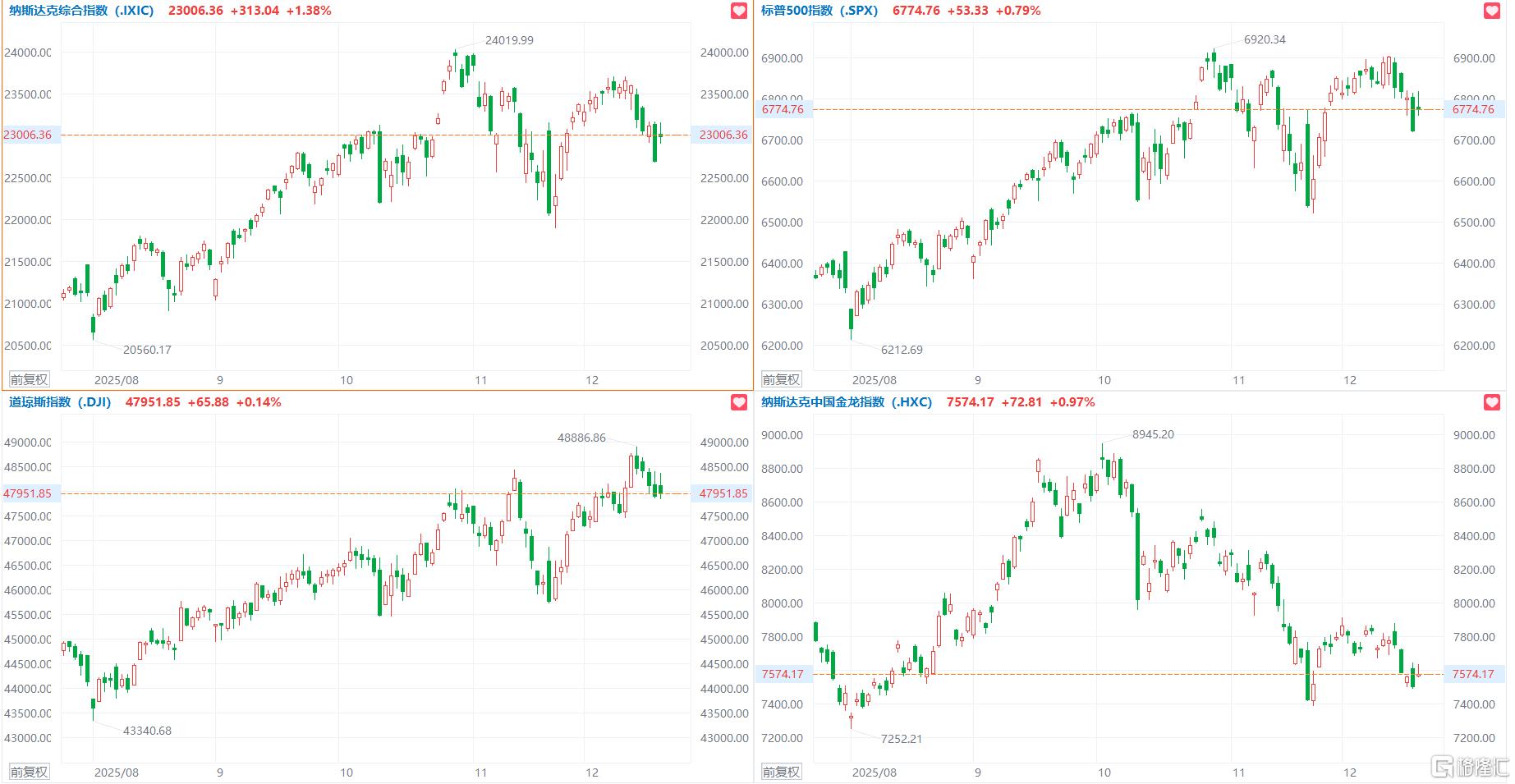
美国11月核心CPI年率意外回落,同比增长2.6%;美股三大指数集体收涨,道指涨0.14%,纳指涨1.38%,标普500指数涨0.79%,大型科技股普涨,特斯拉涨 超3%,亚马逊、Meta涨超2%,英伟达、谷歌、微软、博通涨超1%。 存储概念、半导体设备与材料涨幅居前,美光科技涨超10%,SanDisk涨超6%,西部数据涨超5%,科磊涨超4%,阿斯麦涨超2%。油气能源、加密货币、贵 金属跌幅居前,美国能源跌超4%,英国石油跌超3%,Coinbase跌超2%,雪佛龙跌超1%。 纳斯达克中国金龙指数收涨0.97%,热门中概股中,小鹏涨2.7%,美团、腾讯、文远知行、蔚来、网易、百胜中国至多涨1.7%,拼多多涨0.8%,新东方、理 想、阿里至少涨约0.2%。 ...
AI突围战,盯上数字文娱风口
2 1 Shi Ji Jing Ji Bao Dao· 2025-12-18 15:34
Core Insights - The article highlights the rapid growth and transformation of the digital entertainment industry in China, driven by AI technology and changing consumer demands [2][4][9] Industry Overview - The digital entertainment market in China is projected to reach a scale of 1.75 trillion yuan by 2024, indicating continuous market expansion [4] - The "14th Five-Year Plan" emphasizes the importance of cultural and technological integration, guiding the development of new cultural formats [2][4] Emerging Trends - New formats such as micro-short dramas are gaining popularity, with user numbers nearing 700 million and a market size expected to reach 50.4 billion yuan in 2024, reflecting a year-on-year growth of 34.9% [4] - Traditional sectors like gaming and trendy toys are revitalizing through IP innovation and technological empowerment, showcasing a competitive landscape with significant growth potential [4][5] AI Integration - AI is significantly enhancing production efficiency across various entertainment sectors, with game development time reduced from 10 days to just 1 hour for certain tasks [7] - Over 87.2% of companies in the gaming sector believe that AI-generated content (AIGC) technologies will be crucial for reducing development costs and improving creative processes [7] Consumer Engagement - The integration of AI is reshaping content production and business models, transitioning from selling assets to providing tools for unique content generation [8] - The demand for immersive and personalized experiences is driving innovation in content delivery, with AI facilitating tailored recommendations for consumers [9] Future Outlook - The convergence of AI and digital entertainment is expected to create new supply models and business opportunities, enhancing the industry's dynamism and creativity [9] - The future of top IPs may involve a complex ecosystem where AI generates content based on a defined worldview, shifting the focus from content control to ecosystem management [9]

股票市场概览:资讯日报:大型科技股拖累标普500指数四连跌-20251218
Guoxin Securities Hongkong· 2025-12-18 13:17
Market Overview - The S&P 500 index has experienced four consecutive declines, primarily driven by large technology stocks[1] - Major U.S. indices collectively fell, with the Nasdaq down nearly 2%[9] - The S&P 500 closed at 6,800, reflecting a decline of 1.16% for the day and a year-to-date increase of 14.28%[3] Hong Kong Market Performance - The Hong Kong stock market showed a significant recovery in the afternoon, with major indices rebounding after two consecutive days of decline[9] - Large technology stocks such as Meituan and Kuaishou rose nearly 2%, while Tencent and Alibaba increased over 1%[9] - The financial sector saw a collective rise, with China Life Insurance up over 4% and CITIC Securities up over 3%[9] Sector Highlights - Precious metals stocks strengthened, with China Silver Group rising over 7% due to a weaker dollar and expectations of interest rate cuts, pushing silver prices above $66 per ounce[9] - The aviation sector saw gains, with China Southern Airlines up over 5% as ticket bookings surged ahead of the New Year holiday[9] - The lithium battery sector also rose, driven by a significant increase in lithium carbonate futures prices, with Tianqi Lithium up 5.83%[9] Economic Indicators - Japan's November exports grew by 6.1% year-on-year, exceeding market expectations, with a trade surplus of 322.2 billion yen[13] - The U.S. Treasury yields have shown fluctuations, impacting market sentiment and investment strategies[18]






美国投资者,爆买中国科技ETF
Feng Huang Wang· 2025-12-18 10:07
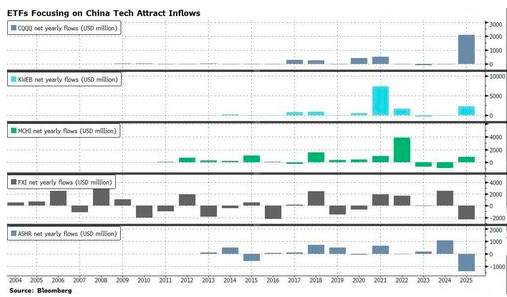
Group 1 - American investors are increasingly attracted to China's technology sector, with significant capital inflows into U.S.-listed ETFs focused on Chinese tech stocks, while non-tech funds are experiencing outflows [1][3] - The largest Chinese stock ETF in the U.S., KraneShares China Internet ETF (KWEB), has attracted $2.3 billion this year, potentially marking its best annual performance since 2021 [3] - In contrast, traditional sector-focused ETFs like iShares China Large-Cap ETF (FXI) have seen a net outflow of $2.3 billion this year, indicating a shift in investor sentiment towards technology [3] Group 2 - Analysts suggest that the launch of DeepSeek and trade tensions initiated by Trump have contributed to the inflow of funds into Chinese tech ETFs, with notable peaks in April and August aligning with tariff suspensions [3] - Citigroup's economists believe that China is rapidly catching up in both models and hardware in the AI sector, drawing parallels between the current state of the Chinese stock market and the U.S. market's past experiences [4] - Despite the competitive landscape between the U.S. and China in AI, American investors are increasingly investing in Chinese companies, with significant holdings in Alibaba and other tech firms [7] Group 3 - Investment firm Ruffer sees further upside for Chinese tech giants due to their lower price-to-earnings ratios compared to U.S. counterparts like Alphabet, indicating a potential undervaluation [10] - The chief investment officer of Krane Funds Advisors LLC highlights that the companies within KWEB are experiencing stock buybacks and attractive valuations, suggesting a possible revaluation of Chinese stocks by 2026 [10]
美国投资者爆买中国科技ETF
3 6 Ke· 2025-12-18 09:48
Group 1 - American investors are increasingly attracted to China's technology sector, with significant capital inflows into U.S.-listed ETFs focused on Chinese tech stocks, while non-tech funds are experiencing outflows [1][3] - The largest Chinese stock ETF in the U.S., KraneShares China Internet ETF (KWEB), has attracted $2.3 billion this year, potentially marking its best annual performance since 2021 [3] - In contrast, traditional sector-focused ETFs like iShares China Large-Cap ETF (FXI) have seen a net outflow of $2.3 billion this year [3] Group 2 - Analysts suggest that the launch of DeepSeek and trade tensions initiated by former President Trump have contributed to the inflow of funds into Chinese tech ETFs [3] - Citigroup's economists believe that China is rapidly catching up in both models and hardware in the AI sector, with 2025 being a pivotal year for narrowing the gap with the U.S. [4] - Despite the competitive landscape, U.S. investors are continuing to invest in Chinese companies involved in AI, with significant interest from hedge funds and venture capital firms [7] Group 3 - Ruffer, a London-based investment firm, sees further upside for Chinese tech giants due to their lower price-to-earnings ratios compared to U.S. counterparts like Alphabet [10] - The chief investment officer of Krane Funds Advisors LLC highlights that the companies within KWEB are experiencing stock buybacks and attractive valuations, suggesting a potential revaluation of Chinese stocks by 2026 [10] - Major U.S. investment firms, including Vanguard and BlackRock, have increased their holdings in Alibaba, indicating a growing confidence in Chinese tech stocks [7][10]
闪电结募!港股新基金大幅缩短发售期,逆势抢筹!
券商中国· 2025-12-18 09:37
Core Viewpoint - The recent adjustment in the Hong Kong stock market has led to a surge in new fund issuance, with many funds shortening their fundraising periods to capitalize on the market dip, indicating a strong belief in the investment value of Hong Kong stocks [1][5]. Fund Issuance Trends - New funds are significantly shortening their fundraising periods compared to previous practices, with examples including the 富国港股精选混合 fund, which moved its deadline from December 19 to December 10, raising 1.83 billion yuan [2]. - Other funds, such as 鹏扬基金 and 路博迈基金, have also adjusted their fundraising timelines, reflecting a broader trend of rapid fundraising in the current market environment [2]. Rapid Fund Deployment - New funds are not only closing fundraising early but are also quickly building their positions in the market. For instance, the 汇添富恒指港股通ETF achieved a 69.53% stock position just a week before its listing [3]. - This contrasts with previous cautious strategies where funds maintained low positions prior to listing, indicating a shift in approach due to market conditions [3]. Market Sentiment and Strategy Adjustments - The adjustment in fundraising strategies is driven by significant market corrections, with many funds seizing the opportunity to invest in fundamentally strong companies despite recent price declines [4]. - The rapid changes in fundraising strategies, such as those seen with 鑫元基金, highlight the dynamic nature of market conditions and the urgency to capture rebound opportunities [4]. Positive Outlook on Hong Kong Stocks - Multiple fund managers express optimism about the Hong Kong market, viewing the current adjustments as a favorable entry point for future growth, particularly in sectors like AI, internet, and innovative pharmaceuticals [5][6]. - The valuation of the 恒生科技指数 is noted to be significantly lower than that of comparable indices, suggesting a high potential for returns [5]. - Specific sectors identified for investment include technology growth, financial services, and cyclical stocks, indicating a strategic focus on areas with perceived value [5].