
供应链能力

Search documents
京东物流(02618)发布2025年度业绩,股东应占利润66.47亿元,同比增长7.2%
智通财经网· 2026-03-05 09:36
Core Viewpoint - JD Logistics reported a revenue of 217.15 billion RMB for the fiscal year ending December 31, 2025, representing an 18.8% year-on-year growth, driven by increased revenue from integrated supply chain clients and other customers [1] Group 1: Revenue Breakdown - Revenue from external customers reached 136.8 billion RMB, marking a 7.1% increase year-on-year [1] - Revenue from integrated supply chain clients surged from 87.4 billion RMB in 2024 to 116.2 billion RMB in 2025, a growth of 33.0% [2] - Revenue from other customers rose from 95.5 billion RMB in 2024 to 100.9 billion RMB in 2025, an increase of 5.7% [2] Group 2: Client and Service Expansion - The number of external integrated supply chain clients increased from 80,703 in 2024 to 91,161 in 2025, reflecting a growing demand for the company's services [2] - The average revenue per client for the fiscal year ending December 31, 2025, was 393,907 RMB, slightly down from 400,156 RMB in 2024 [2] Group 3: Supply Chain Capabilities - The company is continuously enhancing its supply chain capabilities, expanding its business boundaries and service depth through differentiated high-standard services [3] - JD Logistics has successfully doubled its self-operated overseas warehouse area, with nearly 200 bonded, direct mail, and overseas warehouses totaling around 2 million square meters [3] Group 4: Technological Innovation - The company is advancing the global application of self-developed automation equipment, with the first overseas smart warehouse launched in the UK in Q4 2025 [4] - JD Logistics successfully completed its first overseas drone test flight in Saudi Arabia in December 2025, showcasing the global replicability of its technological solutions [4]
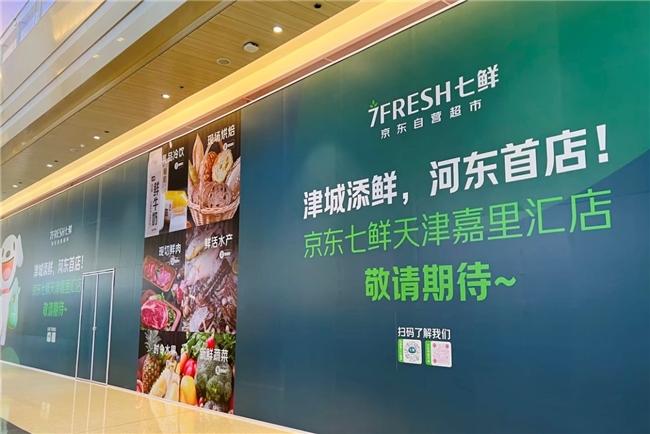
天津再添逛购物好去处!京东七鲜超市嘉里汇店2026年开业引爆期待
Zhong Jin Zai Xian· 2026-02-27 10:46
Core Insights - JD Fresh Supermarket is set to open its first store in the Hedong District of Tianjin, located in the Kerry Hui Shopping Center, enhancing the shopping experience for local residents and marking a significant milestone in JD Fresh's eight-year presence in Tianjin [1][3] Group 1: Store Opening and Location - The new store will fill a gap for high-quality fresh supermarkets in the Hedong District, providing affordable shopping options for families [1][3] - The store is strategically located in a prime area with good transportation links, aiming to serve both residential customers and office workers in the vicinity [3][9] Group 2: Consumer Engagement and Anticipation - The store has generated significant buzz on social media, with local consumers expressing excitement about the opening and inquiring about special products and opening promotions [3][9] - The pre-opening interest reflects the strong recognition and reputation JD Fresh has built among Tianjin residents over the past eight years [3][9] Group 3: Supply Chain and Product Offerings - JD Fresh Supermarket emphasizes its supply chain capabilities, including direct sourcing from farms and manufacturers, ensuring freshness and affordability [7] - The new store will continue to offer the brand's signature "24-hour fresh" products, ensuring that items like vegetables and fruits are delivered to shelves within 24 hours of harvest [7] - The store will feature a range of self-branded products that have received positive feedback on social media, catering to diverse and health-conscious consumer needs [7] Group 4: Market Position and Future Outlook - The opening of the new store is seen as a crucial step in optimizing JD Fresh's local service network and expanding its overall store layout in Tianjin [9] - The new store is anticipated to enhance the daily shopping experience for local residents, making fresh and affordable options more accessible [9]


美团50亿元收购叮咚,生鲜零售的出路到底在哪?
Sou Hu Cai Jing· 2026-02-11 13:50
Group 1 - The core viewpoint of the article highlights the unique development path of China's fresh food retail industry, which cannot simply replicate experiences from Japan and the West. The market for instant retail is expected to explode by 2025, reaching a scale of 1-2 trillion yuan, while traditional e-commerce and offline retail remain significantly larger at 15.2 trillion yuan and 44.3 trillion yuan respectively, indicating a rapid growth potential for instant retail [1] - The acquisition of Dingdong Maicai by Meituan is seen as a strategic adjustment reflecting profound changes in the fresh food retail industry, raising questions about quality versus scale, independent development versus reliance on larger platforms, and regional focus versus national expansion [1][3] - The acquisition is not merely about scale but focuses on quality positioning, as Meituan lacks a quality benchmark in the instant retail sector. Dingdong Maicai, known for its strict quality control and premium supply chain, fills this gap for Meituan, allowing it to leverage Dingdong's reputation to drive sales [4] Group 2 - The article outlines three potential paths for fresh food retail: instant retail, offline retail, and supply chain competition. Instant retail companies face a harsh reality with net profit margins around 1%, making acquisition or deep collaboration with larger platforms a rational choice to gain quality endorsement and supply chain capabilities [5] - Offline retail companies, while struggling with profitability (net profit margins of 1-3%), must focus on fine-tuned operations for sustained profitability or seek independent listings, as their value to larger platforms is limited [5] - Supply chain efficiency is identified as a critical competitive advantage, with logistics costs varying between 3% to 6%. The management of cold chain logistics and operational efficiency directly impacts product freshness and cost [6][7] Group 3 - The fresh food retail industry is shifting from blind expansion to rational contraction, with companies like Dingdong Maicai and Qian Dama focusing on core regional markets to establish competitive advantages. This strategic contraction is not a retreat but a focus on core strengths [8][10] - The construction of product strength through self-owned brands is emphasized as essential for meeting consumer demands for quality. Successful examples include Aldi and Hema, which have high self-brand product ratios [8] - Balancing service and efficiency is crucial for success in fresh food retail, as operational details in logistics, store operations, and product display can significantly affect competitiveness [9] Group 4 - China's fresh food retail model is distinct from Japan's vertical convenience stores and the West's pre-packaged goods, characterized by the rapid development of instant retail and innovative models like front warehouses [10] - The complexity of operations presents challenges but also opportunities for flexibility in meeting diverse consumer needs. The competition is shifting towards supply chain depth, product differentiation, and operational efficiency [11] - The ultimate battleground in fresh food retail lies in providing fresher, higher quality, and more convenient food options to consumers, determining the winners in this essential retail sector [11]


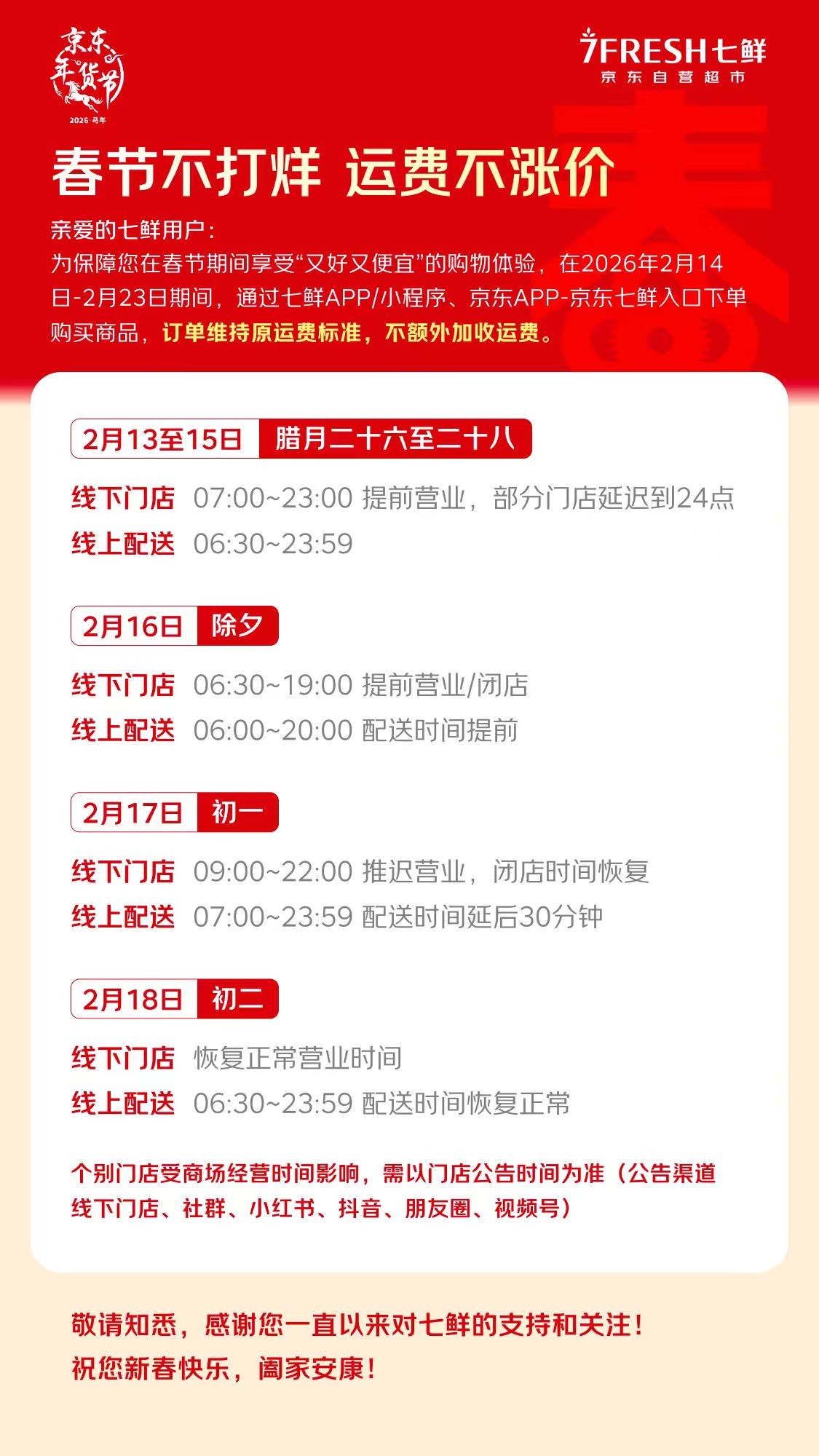
安心过好年:京东七鲜春节服务、运费双“坚守”,24小时菜新鲜到家
Sou Hu Wang· 2026-02-11 10:16
Core Viewpoint - JD Qixian Supermarket is committed to providing consumers with a convenient and affordable shopping experience during the Spring Festival by implementing "no closure during the Spring Festival" for the sixth consecutive year and maintaining stable shipping costs [1][3]. Group 1: Operational Adjustments - JD Qixian will extend operating hours from February 13 to February 15, adjusting to 7 AM to 11 PM, with online channels opening at 6 AM on New Year's Eve and physical stores at 6:30 AM [3]. - On New Year's Day, physical stores will operate from 9 AM to 10 PM, while online delivery will be available from 7 AM to midnight [3]. - From February 18, both online and offline channels will resume regular operating hours to ensure uninterrupted service during the Spring Festival [3]. Group 2: Cost Management and Delivery - JD Qixian promises not to increase shipping costs during the Spring Festival, with all rider subsidy costs borne by the company [3]. - The company has made sufficient preparations for delivery capacity and will provide additional subsidies to riders for orders during the holiday, ensuring delivery within 30 minutes [3][5]. Group 3: Supply Chain and Freshness Commitment - JD Qixian will continue to supply its industry-first "24-hour vegetables" and "24-hour eggs" during the Spring Festival, ensuring rapid delivery from farms to store shelves within 24 hours [5]. - The company emphasizes its robust supply chain capabilities and customer-centric service philosophy, aiming to enhance consumer confidence and convenience during the holiday shopping season [5].
太突然!刘强东拿下千亿大生意
Xin Lang Cai Jing· 2026-02-09 04:40
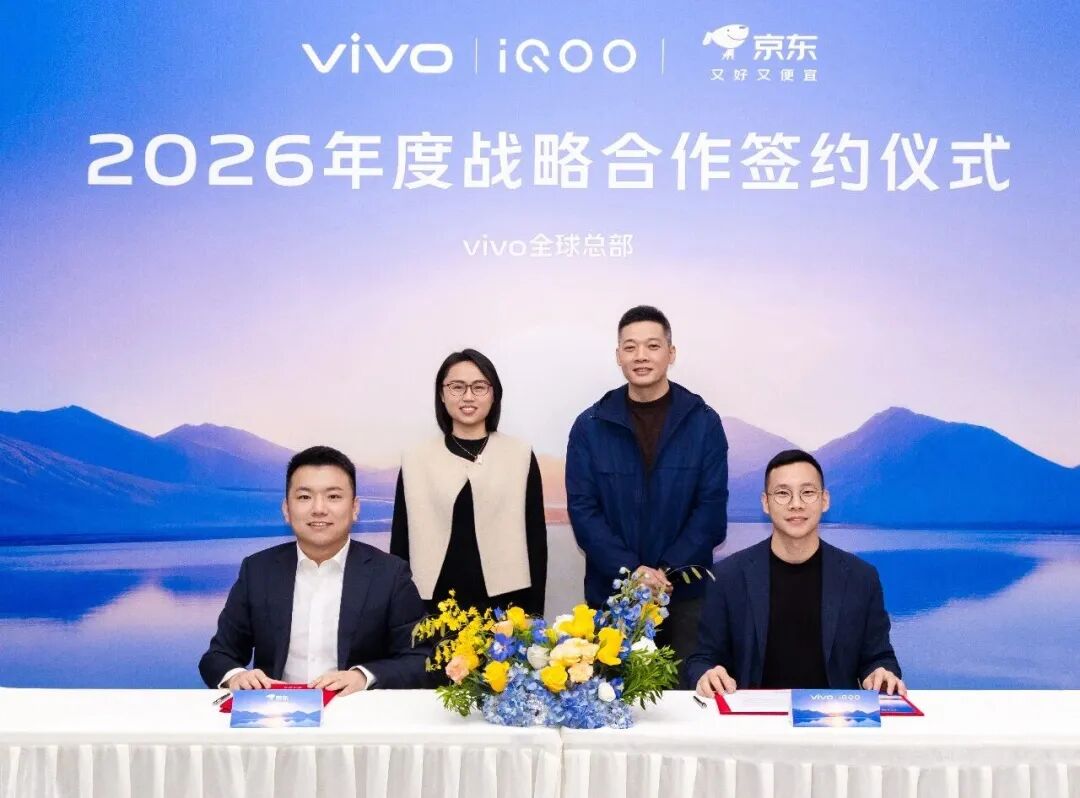
Core Insights - JD.com has successfully expanded its partnerships with major smartphone brands like Vivo, ZTE, Honor, and Xiaomi, aiming to sell 100 billion yuan worth of products through its channels over the next three years [1][18][20] - The collaboration between JD.com and smartphone manufacturers has evolved beyond simple supply and sales relationships into a more integrated ecosystem [12][27] Group 1: Strategic Partnerships - JD.com has secured exclusive national agency rights for brands like ZTE, Nubia, and Red Magic, setting ambitious sales targets of 10 billion yuan over three years [3][18] - The partnership with Vivo is characterized by a focus on user operations, product co-development, and deep channel engagement, leveraging JD.com's 700 million active users [20][21] - JD.com has also supported Honor in establishing overseas warehouses in the Middle East, facilitating the sale of over 2 million phones in Saudi Arabia [20][23] Group 2: Competitive Advantages - JD.com boasts a robust supply chain capability, with over 130 overseas warehouses across 23 countries, enabling rapid delivery times of 2-3 days in regions like Europe and Southeast Asia [9][24] - The company has transitioned from being a mere sales platform to a comprehensive partner for brands, offering services from market analysis to after-sales support, enhancing user experience [10][25] - JD.com has established a strong brand recognition among consumers for purchasing electronics, making it the go-to platform for 3C products, which is a significant advantage for smartphone manufacturers [11][26] Group 3: Market Positioning - The collaboration between JD.com and smartphone manufacturers has transcended traditional sales, evolving into a model of ecosystem co-construction [12][27] - JD.com has effectively utilized its long-term investments to create unique supply chain and service advantages that are difficult for competitors to replicate [12][28] - The company's strategic foresight has allowed it to secure a stable position in an increasingly uncertain market, benefiting both itself and its partners [13][29]
百胜中国(9987.HK)评:25Q4业绩超预期 26年同店收入及利润率预计继续改善
Ge Long Hui· 2026-02-06 06:50
Core Insights - The company achieved revenue of $2.823 billion in Q4 2025, representing a year-on-year increase of 9% (or 7% excluding foreign currency effects) [1] - Operating profit reached $187 million, up 25% year-on-year (or 23% excluding foreign currency effects) [1] Sales Performance - Same-store sales growth accelerated in Q4 2025, with system sales increasing by 7% year-on-year (KFC +8%, Pizza Hut +6%) [1] - Same-store sales increased by 3% year-on-year (KFC +3%, Pizza Hut +1%) [1] - KFC's same-store transaction volume and average ticket price grew by 3% and remained stable, respectively, while delivery sales surged by 34% year-on-year [1] - Pizza Hut's same-store transaction volume rose by 13%, but the average ticket price fell by 11% [1] Store Expansion - The company added 587 new stores in Q4 2025 (KFC +357, Pizza Hut +146), bringing the total to 18,101 stores [2] - The company plans to add 1,706 new stores in 2025, with a target of 1,600-1,800 new stores [2] - By 2026, the company aims to exceed 20,000 stores with over 1,900 new stores, accelerating the pace of expansion [2] Operational Efficiency - Restaurant profit margin improved to 13.0% in Q4 2025, up 0.7 percentage points year-on-year [2] - Core operating profit was $185 million, a 23% increase year-on-year, driven by operational efficiency and favorable commodity prices [2] - Net profit for Q4 2025 was $140 million, up 24% year-on-year, with a 14% increase when excluding the impact of investments in Meituan [2] New Business Developments - The company made significant progress in new business initiatives, including the expansion of KFC Coffee to 2,200 stores and KPRO to over 200 stores [3] - The WOW concept helped Pizza Hut enter over 100 new cities, enhancing brand penetration in lower-tier markets [3] - The introduction of core and innovative products contributed to sales growth, with KFC launching new chicken products and Pizza Hut's handmade thin-crust pizza gaining popularity [3] Profit Forecast and Valuation - The company raised its net profit forecast for 2026-2027 to $1.027 billion and $1.109 billion, respectively, with an additional forecast for 2028 at $1.183 billion [4] - The projected EPS for 2026-2028 is $2.90, $3.13, and $3.34, respectively [4] - The current stock price corresponds to a PE ratio of 17x, 16x, and 15x for 2026-2028, indicating strong growth potential in the fast-food sector [4]
美团收购叮咚买菜,梁昌霖发布内部信
Xin Lang Cai Jing· 2026-02-05 12:18
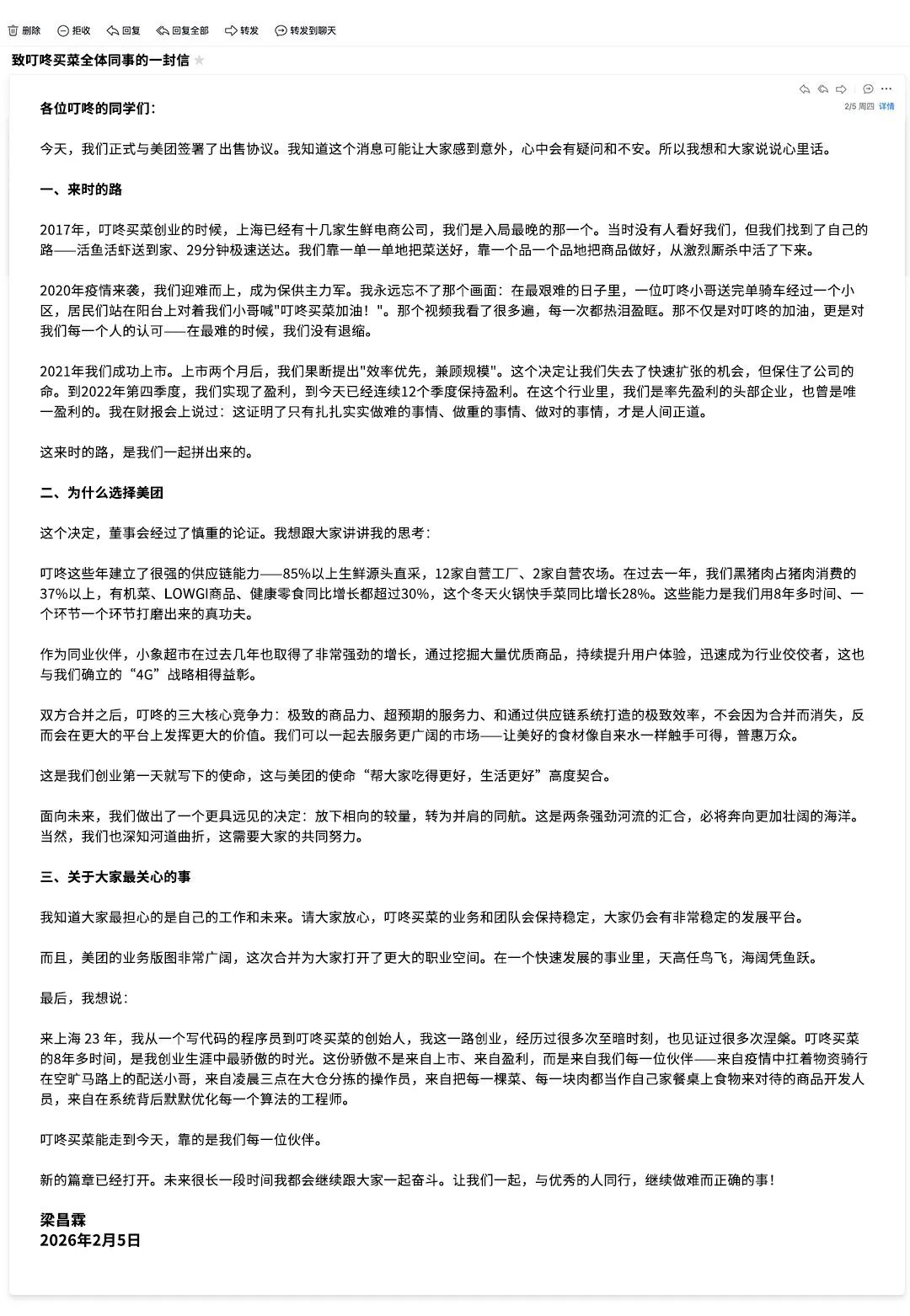
Group 1 - The core announcement is that Meituan plans to acquire Dingdong Maicai, a leading fresh e-commerce company in mainland China, for $717 million. The agreement allows the transferor to withdraw up to $280 million from the target group, provided that the net cash of the target group remains above $150 million. This acquisition will make Dingdong Maicai an indirect wholly-owned subsidiary of Meituan, and its financial performance will be consolidated into Meituan's financial statements [1][23][24]. Group 2 - Dingdong Maicai's founder, Liang Changlin, addressed employees, acknowledging that the news of the acquisition might come as a surprise and could raise questions and concerns among staff [2][25]. - The company has built strong supply chain capabilities over the years, with over 85% of fresh produce sourced directly, 12 self-operated factories, and 2 self-operated farms. In the past year, black pork accounted for over 37% of pork consumption, and organic vegetables, LOWGI products, and healthy snacks saw over 30% year-on-year growth [6][28]. - The merger is expected to enhance Dingdong's core competitive advantages, including exceptional product quality, service, and supply chain efficiency, allowing both companies to serve a broader market [6][28][29]. Group 3 - The decision to merge with Meituan was made after careful consideration by the board, aiming to align with Meituan's mission of helping people eat better and live better [7][39]. - Employees were reassured that Dingdong Maicai's business and team would remain stable, providing a solid development platform for staff [8][40]. - The merger is anticipated to open up greater career opportunities for employees within Meituan's extensive business landscape [8][41].
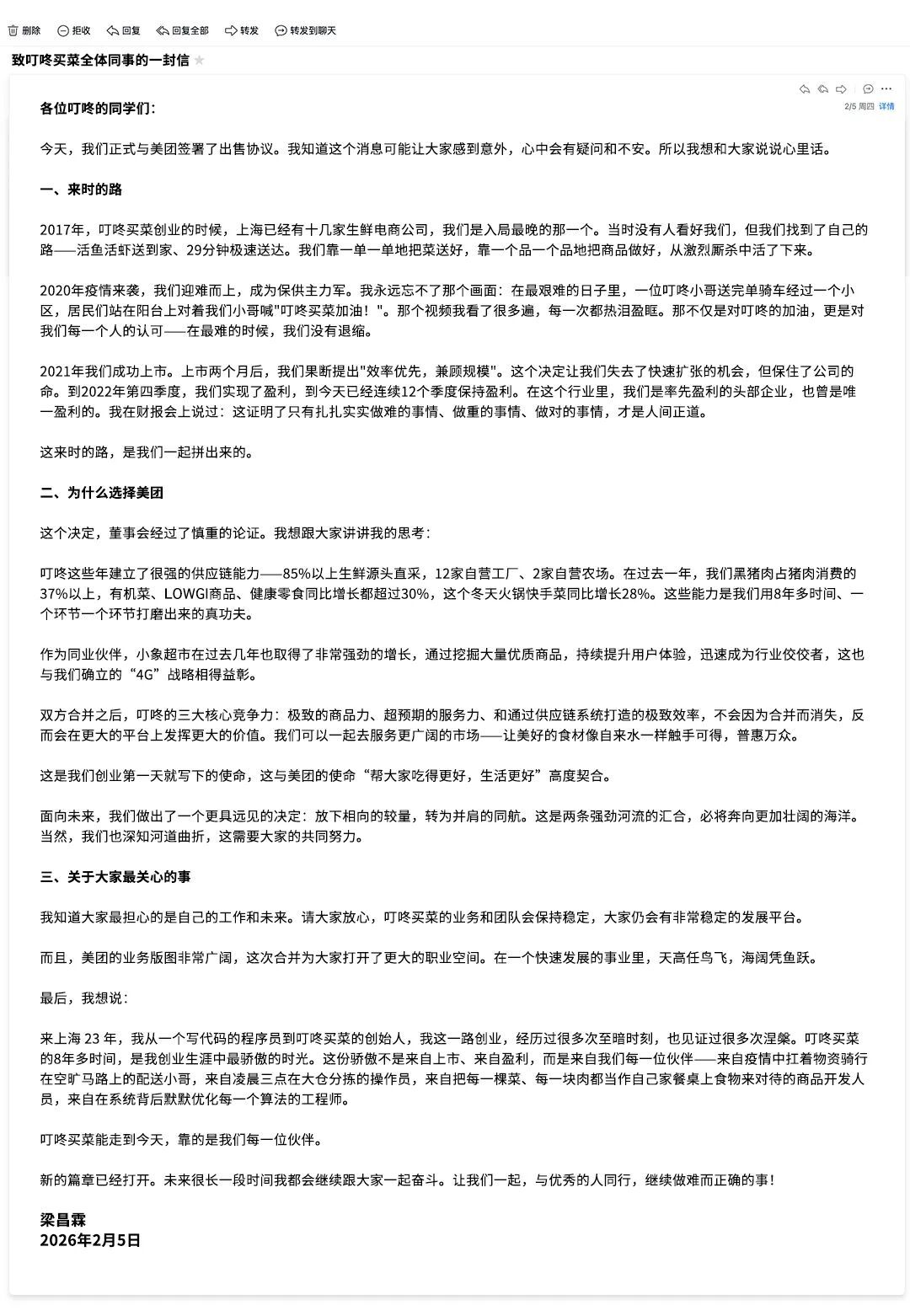
叮咚买菜创始人梁昌霖发全员信,回应为何并入美团
Feng Huang Wang· 2026-02-05 11:10
Core Viewpoint - Meituan announced its intention to acquire Dingdong Maicai for approximately $717 million, which will make Dingdong Maicai an indirect wholly-owned subsidiary of Meituan, integrating its financial performance into Meituan's financial reports [1]. Group 1: Acquisition Details - The acquisition will allow Dingdong Maicai to leverage Meituan's larger platform, enhancing its capabilities in product strength, service delivery, and supply chain efficiency [1][6]. - Dingdong Maicai has established a strong supply chain with over 85% of its fresh products sourced directly from suppliers, and operates 12 self-owned factories and 2 self-owned farms [6][8]. - The company has achieved profitability for 12 consecutive quarters, positioning itself as a leading profitable player in the fresh e-commerce sector [4][6]. Group 2: Employee Impact - The existing business operations and team structure of Dingdong Maicai will remain stable post-acquisition, ensuring job security for employees [2][8]. - The merger is expected to provide employees with broader career development opportunities within Meituan's extensive business landscape [9]. Group 3: Historical Context - Dingdong Maicai was founded in 2017 and has navigated a competitive landscape, achieving significant milestones including profitability and a successful IPO [4][10]. - The company has focused on efficiency over rapid expansion, which has allowed it to survive and thrive in a challenging market [4][6]. Group 4: Future Outlook - The merger aligns with both companies' missions to improve food accessibility and quality, suggesting a strategic partnership aimed at serving a larger market [7][10]. - The leadership emphasizes a commitment to continue working closely with the team to ensure a smooth transition and sustained growth [2][12].
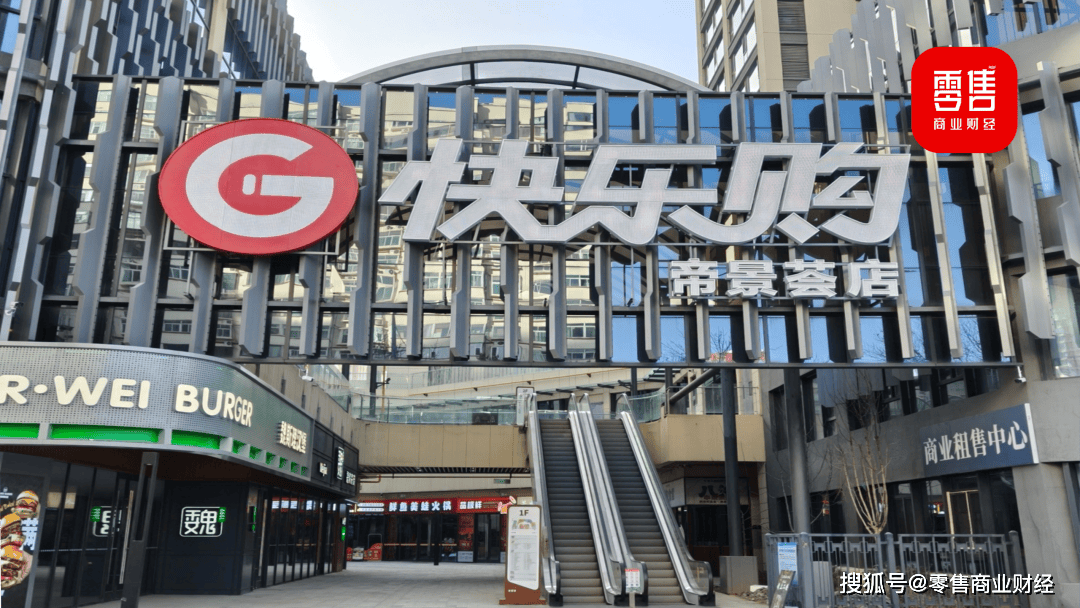
实探快乐购超市,温州品牌的晋地求生之道
Sou Hu Cai Jing· 2026-01-20 19:52
Core Insights - The article discusses the successful expansion of the supermarket brand "Happy Shopping" in Taiyuan, contrasting its focused retail capabilities with traditional supermarkets' shortcomings [2][3] - Happy Shopping has opened three stores in Taiyuan since 2022, gradually expanding its influence in the Shanxi province [2] - The brand aims to enhance consumer experience through meticulous operational details and a focus on "consumption upgrade" [3][7] Group 1: Expansion and Market Position - Happy Shopping has established a steady expansion pace, opening one store per year, and has plans to further penetrate the Shanxi market [2] - The brand's core shareholders maintain a clear ownership structure, ensuring consistent operational management across its stores [2] - Despite a slow expansion rate, Happy Shopping has become a notable player in Taiyuan's retail market, often compared favorably to local competitors [2][3] Group 2: Operational Excellence - The store layout and design at Happy Shopping are tailored to enhance the shopping experience, creating a pleasant atmosphere for consumers [3][7] - The brand incorporates service-oriented slogans and a warm ambiance to foster customer satisfaction [3] - Happy Shopping's operational details, such as the "no disturbance" shopping carts, reflect its commitment to improving customer experience [7] Group 3: Product Offering and Pricing Strategy - Happy Shopping's product range, particularly in the bakery category, is diverse and competitive, with prices often lower than those of leading competitors like Hema [9][10] - The supermarket maintains a focus on affordability, offering various fresh food items at competitive prices compared to local rivals [14][15] - However, the brand faces challenges in its product offerings, particularly in self-branded items, which are currently lacking compared to competitors [20][21] Group 4: Competitive Landscape and Future Challenges - The retail market in Taiyuan is undergoing significant changes, with new brands emerging and traditional ones adjusting their strategies [3][24] - Happy Shopping's future success will depend on its ability to scale operations, enhance product quality, and develop a differentiated private label product line [24][29] - The competition is intensifying, with local brands like Yijiaqin and established players like Meitehao also expanding their presence in the region [24][29]
星宸科技:公司每年KGD采购量过亿级
Zheng Quan Ri Bao Wang· 2026-01-13 11:12
Core Viewpoint - The company, Xingchen Technology, is leveraging its scale in KGD procurement and partnerships with major storage suppliers to secure production capacity and optimize pricing in a supply-constrained market [1] Group 1: Company Operations - The company has an annual KGD procurement volume exceeding 100 million units, allowing it to collaborate closely with multiple mainstream storage suppliers [1] - By utilizing scale effects, the company prioritizes securing production capacity and negotiating optimal prices, ensuring a rapid supply guarantee [1] Group 2: Market Dynamics - In the context of industry shortages, many customers are shifting from external storage to the company's built-in storage products due to shortages and price surges, resulting in increased orders [1] - The company enhances its pricing power through long-term agreements to lock in production capacity and maintains cost-effectiveness via scale effects, transforming supply chain capabilities into growth drivers and competitive barriers [1]