
投资回报率

Search documents
高瓴持股近7年首次减持格力电器格力电器总市值退守2000亿关口
Di Yi Cai Jing· 2026-02-26 07:59
Group 1 - Hillhouse Capital plans to reduce its stake in Gree Electric Appliances by 2%, leading to a 2.1% drop in the company's stock price to 37.68 yuan, with a total market capitalization of 211 billion yuan [1] - Hillhouse Capital's investment cost when acquiring shares in 2019 was 46 yuan, and the investment returns have primarily come from dividends, while the stock price has decreased by nearly 20% during the same period [1] - The investment duration of 7 years is considered long, and even after the reduction, Hillhouse Capital will still hold a significant stake in Gree Electric Appliances [1] Group 2 - Gree Electric's air conditioning sales are expected to be unsatisfactory in the second half of 2025, influenced by real estate constraints and rising copper prices, which may pressure the company's performance [1] - There are concerns about whether Gree Electric can maintain its market capitalization above the 200 billion yuan threshold due to these challenges [1]

TikTok Shop放大招,投1美元至少收5美元!2026年,TikTok Shop连续推出重磅政策,正以前所未有的力度重塑跨境卖家的运营格局与盈利模型。 先是推出了极具诱惑力的“智能促销计划”,承诺为符合条件的商家提供高达5倍的投资回报率,保证每1美元TikTok广告投入至...
Sou Hu Cai Jing· 2026-02-11 09:23
Core Insights - TikTok Shop is implementing significant policies to reshape the operational landscape and profit models for cross-border sellers, including a "Smart Promotion Plan" promising up to 5x return on investment (ROI) for qualifying merchants [1] - The platform has upgraded its "Brand Management" model, allowing for country-specific pricing and dual-track settlement between "content" and "shelf" areas, indicating a move towards more specialized and branded operations [1][2] Group 1: Smart Promotion Plan - The "Smart Promotion Plan" acts as a high-return advertising agreement for quality merchants, leveraging traffic resources to encourage increased advertising and coupon investments [2] - Merchants must maintain a store performance score of at least 3.5 out of 5, which requires consistent order fulfillment and customer service performance to qualify for the promised ROI [2] - The plan demands high advertising capabilities from merchants, necessitating budget and bidding control to maintain cost advantages in a competitive environment [2] Group 2: Brand Management Model Upgrade - The upgrade to the "Brand Management" model allows for country-specific pricing across multiple regions, requiring merchants to abandon a one-size-fits-all pricing strategy [2] - Merchants must dynamically adjust pricing for potentially dozens or hundreds of SKUs based on market consumption levels, competitive environments, and logistics costs [2] - The dual-track settlement system between "content" (live streaming, short videos) and "shelf" (marketplace) alters the logic of profit accounting [3] Group 3: ERP Solutions - The ERP system from 易仓 provides centralized management for advertising and traffic operations, allowing merchants to monitor key metrics like GMV and ROI in real-time [4] - The "Influencer Management" feature integrates a vast array of influencer resources, aiding merchants in effectively managing promotions in the "content" area [4] - The ERP's profit settlement function automates the extraction of over 55 fee items from platform bills, enabling multi-dimensional analysis of costs and profits [4] - Additional features like data dashboards and order fulfillment tracking ensure operational stability for merchants [5]
亚马逊Q4财报解读:市场反应过度,经营状况依旧稳健
美股研究社· 2026-02-06 10:55
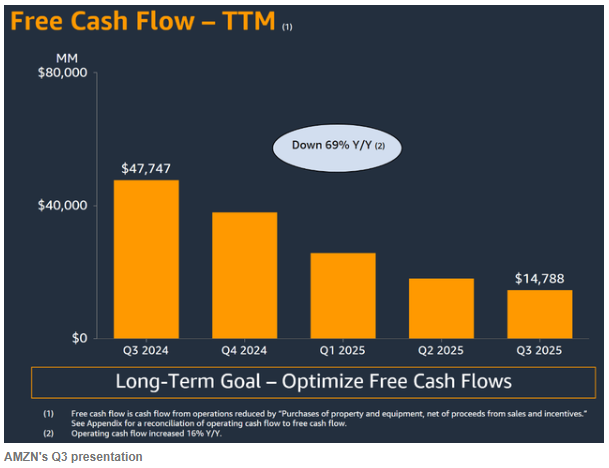
Core Viewpoint - Despite exceeding revenue expectations, Amazon's stock price fell approximately 8% after the release of its Q4 2025 earnings report, primarily due to slightly lower-than-expected earnings per share and a significant capital expenditure guidance for 2026 [1] Financial Performance - Q4 2025 net sales reached $213.4 billion, a year-over-year increase of 14%, surpassing market expectations of $211.23 billion [1] - Diluted earnings per share were $1.95, a 5% year-over-year increase, slightly below the expected $1.96 [1] - Amazon's operating cash flow for the trailing twelve months (TTM) grew 20% year-over-year to $139.5 billion, but TTM free cash flow dropped 71% year-over-year to $11.1 billion due to rising capital expenditures [2] Business Segment Performance - Amazon Web Services (AWS) revenue for the quarter was $35.6 billion, a significant year-over-year increase of 24% [1] - Advertising services revenue reached $21.3 billion, growing 22% year-over-year [2] - Retail business showed stable growth in the high single digits [1] Capital Expenditure Guidance - Amazon's CEO Andy Jassy indicated that capital expenditures for 2026 are expected to reach $200 billion, which is higher than Alphabet's guidance of $175-185 billion [3] - The anticipated capital expenditure has raised concerns among investors regarding the return on investment [5] Market Reaction and Analyst Outlook - Following the earnings report, Amazon's stock price has retraced approximately 20% [9] - Analysts believe that despite short-term valuation concerns, Amazon remains a dominant player in multiple trillion-dollar markets and is well-positioned for long-term growth [9] - The five-year expected compound annual growth rate for Amazon has surpassed the TQI 15% investment threshold, leading analysts to upgrade the stock rating to "Buy" [10]



人工智能在数据管理中的投资回报率:炒作与可衡量的结果
3 6 Ke· 2026-02-05 03:53
Core Insights - The article discusses the ambitious promises made by AI vendors in the data management field, emphasizing the need for a realistic evaluation of the actual return on investment (ROI) from these technologies [1][2] - It highlights the gap between the technical feasibility demonstrated in controlled environments and the practical implementation challenges faced in complex enterprise settings [2] Group 1: AI's Promises and Realities - AI in data management is marketed as capable of creating "autonomous data platforms" with minimal human intervention, promising "zero-touch data quality" [1] - Despite the optimism surrounding AI's capabilities in pattern recognition and anomaly detection, significant challenges remain in real-world applications due to legacy systems and organizational politics [2] Group 2: Tangible Benefits of AI in Data Management - AI can significantly enhance metadata tagging and enrichment, achieving 60% to 80% automation coverage compared to nearly zero with manual methods, leading to improved data catalog integrity [4] - Machine learning methods for data quality anomaly detection can reduce data quality incidents by 30% to 50%, enabling earlier detection of issues and enhancing confidence in data-driven decisions [6] - AI classifiers can effectively identify and classify personally identifiable information (PII), improving compliance and reducing data breach risks [7] - Machine learning-based entity resolution can increase matching accuracy by 20% to 40%, leading to more reliable master data and better customer insights [8] Group 3: Overhyped Aspects of AI - Natural language processing for SQL generation remains weak, as it struggles with complex queries and often requires experienced analysts for validation [10][11] - The notion of fully automated data governance is a misconception, as human judgment is essential for making governance decisions [12] - The belief that AI can autonomously develop data strategies oversimplifies the complexities involved in strategic decision-making [13] Group 4: Hidden Costs of AI Implementation - The importance of preparing training data and context is often underestimated, requiring significant effort to create high-quality datasets [14] - Continuous AI tuning and performance management are necessary, as data and business rules evolve over time [14] - Integration complexities with existing tools and workflows can increase implementation costs and maintenance burdens [14] Group 5: Measuring ROI from AI Investments - Organizations should establish clear baseline metrics before deployment to effectively measure improvements in data management [16] - Success metrics should be directly related to business value rather than technical performance, focusing on tangible outcomes like reduced time to find relevant data [16] - AI applications in data management typically require 6 to 12 months to demonstrate significant ROI, necessitating patience and ongoing user adoption efforts [16] Group 6: Practical Path Forward - Organizations should focus on specific problems rather than just the technology itself, ensuring that AI initiatives are aligned with clear objectives [19] - A realistic timeline and expectations are crucial, as AI can improve data management outcomes but requires effort and investment in foundational practices [19] - AI should be viewed as a tool to enhance human capabilities rather than a replacement, emphasizing the importance of governance and data literacy [19]
亚马逊Q4业绩料“再度炸裂”,分析师目标价看涨近30%
美股IPO· 2026-02-02 07:37
Core Viewpoint - Amazon (AMZN.US) is expected to report strong fourth-quarter earnings, with analysts predicting a high probability of an impressive performance, despite the stock nearing historical highs [3][4]. Group 1: Financial Performance and Projections - Amazon's sales increased from $107 billion in 2025 to over $637 billion in the last 12 months (TTM), while operating income rose from approximately $2.2 billion to about $68.6 billion during the same period [3]. - The company has consistently exceeded earnings per share (EPS) expectations for 11 consecutive quarters, with the most recent quarter showing a 25.3% beat [4]. - For the upcoming fourth quarter, management has set revenue guidance between $206 billion and $213 billion, indicating a year-over-year growth rate of 11.56% [4]. - Analysts have updated their models based on Amazon's conservative guidance, leading to a more optimistic outlook for fourth-quarter earnings [4]. Group 2: Capacity Expansion and Business Structure - Amazon plans to increase its capacity by adding over 1,000 megawatts in the fourth quarter, which is expected to help meet the high demand for AI infrastructure and convert backlog orders into actual revenue [5]. - The shift towards AWS (Amazon Web Services) and existing operational leverage is likely to support higher-than-expected revenue and EPS growth [5]. - The company is expected to invest over $150 billion in capital expenditures for the 2026 fiscal year, the highest among the "Tech Seven" giants [4]. Group 3: Cost Management and Market Position - Amazon's recent decision to cut about 10% of its workforce aims to transition from high-cost labor to AI-driven solutions, potentially increasing profit margins and allowing for reinvestment in AI infrastructure [6]. - Compared to other large-cap stocks, Amazon is considered one of the cheapest, with its forward P/E ratio close to or below the average of its peers [6]. - The company is projected to achieve the highest EPS growth rate among its peers over the next two years [8]. Group 4: Valuation and Target Price - Amazon is expected to trade at a P/E ratio of 28-30 by the end of 2027, supported by its growth advantage over similar-sized competitors [11]. - Consensus EPS estimates for fiscal years 2023 and 2024 are expected to exceed by 6.8% and 7.46%, respectively, with further upward revisions anticipated for fiscal year 2026 [11]. - The target price for Amazon's stock is set at $312.82 per share, representing a 28.7% upside from the current price, based on a 29x P/E ratio [11].

亚马逊(AMZN.US)Q4业绩料“再度炸裂”,分析师目标价看涨近30%
Zhi Tong Cai Jing· 2026-02-02 07:06
Core Viewpoint - Amazon appears undervalued ahead of its Q4 earnings report, with a potential upside of over 28% in the next 12 months, and strong performance expected for Q4 [1] Group 1: Financial Performance - Amazon's revenue increased from $107 billion in 2025 to over $637 billion in the last 12 months, with operating income rising from approximately $2.2 billion to about $68.6 billion during the same period [1] - In Q3, Amazon exceeded revenue and EPS expectations by 1.35% and 25.3% respectively, marking the 11th consecutive quarter of EPS exceeding expectations [2] - Management set a revenue guidance for Q4 between $206 billion and $213 billion, indicating a year-over-year growth rate of 11.56% [2] Group 2: Capacity and Infrastructure - Amazon plans to increase its capacity by adding 1,000 megawatts in Q4, which will help meet the high demand for AI infrastructure and convert backlog orders into actual revenue [3] - The company is expected to exceed $150 billion in capital expenditures for FY2026, the highest among the "Tech Seven" [2] Group 3: Market Sentiment and Valuation - Analysts believe that the current market consensus is overly pessimistic, particularly regarding the outlook after Q4, and that FY2026 guidance will be strong [1][3] - Amazon is considered one of the cheapest mega-cap stocks, with its forward P/E ratio close to or below the average of its peers [4] - The expected EPS growth rate for Amazon is the highest among similar-sized companies, justifying a trading multiple of 28-30 times by the end of 2027 [6][9] Group 4: Future Projections - The consensus EPS for FY2023 and FY2024 is expected to exceed by 6.8% and 7.46% respectively, with further outperformance anticipated for FY2026 and FY2027 [9] - The projected EPS for FY2027 is estimated at $10.79, leading to a target price of $312.82 per share, representing a 28.7% increase from the current stock price [9]
异动点评:美科技股退潮与联储紧缩预期升温,贵金属及有色板块大幅回落,锡价跌停
Guang Fa Qi Huo· 2026-02-02 06:49
1. Report Industry Investment Rating No information provided. 2. Core Viewpoints of the Report - In the short - term, tin prices are vulnerable to market sentiment, geopolitical situations, and short - term supply - demand changes, with intensified fluctuations and high risks. It's recommended that investors participate cautiously to avoid sharp volatility. In the long - term, the core support for the upward shift of tin prices remains solid, and it's advisable to wait for market sentiment to stabilize or prices to have a reasonable correction and then adopt a strategy of going long on dips. [7][8] 3. Summary by Relevant Catalogs 3.1 Market Performance - Affected by the retreat of US technology stocks and the rising expectation of Fed tightening, tin prices dropped significantly from the night session on January 29th. As of February 2nd, the main contract of Shanghai tin hit the 11% daily limit down to 392,650 yuan/ton. [1] 3.2 Driving Factors 3.2.1 Impact of US Technology Stocks and Fed Expectations - Microsoft's Q4 2025 earnings report showed that huge capital expenditures in AI infrastructure, model training, and cloud services did not lead to significant revenue growth. This concern hit the high - valuation logic of technology stocks, especially AI concept stocks. Microsoft's stock price plunged over 10% on January 30th, with a single - day market value evaporation of about $420 billion. [2] - The news that Kevin Warsh will be nominated as the next Fed Chairman on January 29th, and the official announcement by Trump on January 30th. Warsh is a "hawk" on monetary policy. The expectation of his taking office led to the anticipation of accelerated global dollar liquidity tightening, causing a sell - off in precious metals and non - ferrous metals. [3] 3.2.2 Supply Recovery in Myanmar - From November to December 2025, China's imports of tin ore and concentrates from Myanmar increased significantly year - on - year. In November, imports were 7,190.21 physical tons (about 1,636.05 metal tons), with a month - on - month increase of 89.94% and a year - on - year increase of 92.16%. In December, imports were 6,205.43 physical tons (1,342.37 metal tons), a 17.95% month - on - month decrease but a 183.32% year - on - year increase. [5] - The recovery of Myanmar's supply eased the tight domestic tin ore supply, and the processing fees of smelters increased. As of February 2nd, the processing fee of 40% tin concentrates in Yunnan rose to 14,000 yuan/ton, a monthly increase of 2,000 yuan/ton; the processing fee of 60% tin concentrates in Guangxi, Hunan, and Jiangxi also rose to 10,000 yuan/ton, a monthly increase of 2,000 yuan/ton. [6] 3.3 Future Outlook - In the long - term, the upward shift of tin prices is supported by three factors: long - term rigid constraints on the supply side (low global tin ore reserve - to - production ratio, supply disruptions in major producing areas, limited new large - scale mining projects, and rising mining costs); profound changes in the demand structure (the "AI arms race" boosting the demand for high - end semiconductor packaging and electronic soldering materials); and the re - evaluation of the strategic value of tin due to global technological competition and industrial chain security concerns. [7]

香港金管局:2025年第四季“百分百担保特惠贷款”坏账率为18.67%
智通财经网· 2026-02-02 05:48
他表示,市场未来变数多,包括地缘政治、美国息率走向,所以外汇基金的规模需要分散风险。他说, 贵金属亦有投资价值,但价格变化与债券等不同。 香港金管局总裁余伟文表示,外汇基金与政府的分帐行之有效,以外汇基金投资组合的6年滚动投资回 报率作基准,或者3年期外汇基金票据债息,以较高者为准,可以令政府投资收益较可预测及稳定。 智通财经APP获悉,香港金管局副总裁李达志表示,2025年第四季香港"百分百担保特惠贷款"坏账率升 至18.67%,较第三季上升0.5-0.6个百分点,较早期增加逾3个百分点的增速放缓。 李达志指,外汇基金持有少量实金,商品投资组合中部分与黄金相关,但数量不多。虽然过去两年金价 升幅强劲,但刚过去周末跌幅,尤其银价跌幅惊人。 ...
境外权益(港美股)周度策略报告-20260201
Guo Tai Jun An Qi Huo· 2026-02-01 12:21
Report Industry Investment Rating There is no information about the report industry investment rating in the given content. Core Viewpoints - This week, the three major US stock indexes showed mixed performance. The Dow fell 0.42%, the S&P 500 rose 0.34%, and the Nasdaq fell 0.17%. The nomination of Wash as the next Fed Chairman, tech giant earnings reports, and geopolitical risks are the three core factors driving the US stock market this week [6]. - In the short - term, under regulatory guidance, the slow - bull market with a "slower slope" is progressing steadily. Before the Spring Festival, market liquidity may be weak. It is recommended to focus on high - performance technology stocks and balance with low - level cyclical dividend - paying stocks. Next week, pay attention to the mapping opportunities of A - share hardware and Hong Kong stocks (Internet) when US tech giants release their earnings reports [13]. - In the medium - term, for Chinese stocks, it is recommended to focus on three main lines: technology assets with clear industrial trends supported by policies, some new energy sectors with "supply - side clearance" and "demand - side improvement", and the non - ferrous metals sector benefiting from tight supply, strong structural demand, and interest - rate cut catalysis [13]. - AI in the US stock market is a local bubble rather than a systemic one. The market is currently punishing individual companies with aggressive capital expenditures. The current situation may be similar to that in 1997 from the perspective of the ROIC of the technology industry. It is necessary to dynamically track whether the "ROIC - WACC" of US tech giants and the index level shows a sharp convergence trend [25]. Summary by Related Catalogs US Stocks - This week, Microsoft's stock price dropped significantly. The gap between software companies represented by Microsoft/Oracle and the Philadelphia Semiconductor Index (hardware) has further widened. Nearly one - third of S&P 500 component stocks have disclosed their earnings reports, and the Q4 2025 earnings of US stock sectors are still strong [3]. - Next week, chip stocks AMD, Qualcomm, and Google and Amazon among the "Magnificent Seven" will release their earnings reports. The market will further assess the US economy and the rhythm of future interest - rate cuts through the upcoming US non - farm payroll data. The earnings performance of US tech giants next week is a key window for verifying the "AI bubble". In the short - term, it is necessary to be vigilant about the risk of higher volatility in the US stock market next week. In the medium - term, the report is still optimistic about the investment opportunities in the US stock hardware sector [8]. - AI is a local bubble. Since November 2025, the AI narrative has shifted from rewarding Capex spending to worrying about "liability - like" CAPEX and low visibility of return on investment. The current market pricing is punishing "individual" companies with aggressive capital expenditures, not a systemic risk. The ROIC of the "Magnificent Seven" tech giants has shown a downward inflection point in the past two quarters. It is necessary to track the divergence between "financing growth" and "profit growth" and whether the decline in ROIC will spread to the index level [21][25]. Chinese Stocks - This week, the overall Chinese stock market was slightly volatile, but there were bright spots in the structure. High - performance technology stocks and low - level cyclical stocks with high dividends led the gains. The leading sectors included gold and jewelry, optical modules, and oil and gas exploration [9][10]. - February is the month with the highest winning rate for A - shares over the years. In the short - term, under regulatory guidance, the slow - bull market is progressing steadily. It is recommended to focus on high - performance technology stocks and balance with low - level cyclical dividend - paying stocks. Next week, pay attention to the mapping opportunities of A - share hardware and Hong Kong stocks (Internet) when US tech giants release their earnings reports [12][13]. - In the medium - term, Chinese stocks are recommended to focus on three main lines: technology assets with clear industrial trends supported by policies, some new energy sectors with "supply - side clearance" and "demand - side improvement", and the non - ferrous metals sector benefiting from tight supply, strong structural demand, and interest - rate cut catalysis [13]. - A - share companies with expected profit growth of more than 100% are mainly concentrated in the electronics, basic chemicals, pharmaceutical biology, and power equipment industries [14].
机器人“烧钱”也要上春晚打拳
Jing Ji Guan Cha Wang· 2026-01-30 12:28
Core Viewpoint - The 2024 Spring Festival Gala marks a significant shift in sponsorship from internet giants to embodied intelligence companies, reflecting changes in the technology industry and the urgency of these companies to prove their capabilities to investors and the B2B market [1][4][13] Group 1: Sponsorship Dynamics - Four humanoid robot companies, including Yushutech and Galaxy General, will perform at the Spring Festival Gala, showcasing their products in a bid to attract investment and market attention [1][2] - The shift from internet companies to hard-tech companies as sponsors indicates a new trend in the Spring Festival Gala's sponsorship landscape, with hard-tech companies now taking center stage [6][8][13] - The sponsorship fees for internet companies have significantly increased over the years, with past sponsors like Tencent and Alibaba spending billions, while humanoid robot companies are now attempting to gain visibility despite their smaller budgets [8][12] Group 2: Market Implications - The global humanoid robot market is projected to generate only $440 million by 2025, indicating that even leading companies like Yushutech are still in the early stages of revenue generation [6][8] - The participation of humanoid robot companies in the Spring Festival Gala is seen as a strategic move to enhance brand visibility and attract potential investors, especially as the industry prepares for a significant shakeout in 2026 [4][11] - The effectiveness of past sponsorships has been questioned, with many companies finding that the return on investment from the Spring Festival Gala does not meet expectations, leading to a more cautious approach from tech firms [12][14] Group 3: Performance and Audience Engagement - The performances of humanoid robots at the Spring Festival Gala are intended to demonstrate their capabilities and appeal to a broader audience, potentially increasing consumer interest in humanoid robots [4][5] - The historical context of the Spring Festival Gala shows that it has been a platform for significant user engagement and brand exposure, but the diminishing returns on investment have prompted companies to reassess their strategies [10][14] - The competition among humanoid robot companies to appear at the Spring Festival Gala is intensifying, as missing out could result in a loss of market relevance [11][15]
