
量化紧缩(QT)

Search documents
沃什或盼美联储缩表, 但现实掣肘恐难如愿
Xin Lang Cai Jing· 2026-02-17 14:47
被提名出任美联储主席的沃什(Kevin Warsh)或许希望缩减资产负债表,但在不对金融体系进行重大 改造的情况下,他很难如愿;即便进行了调整,这一目标也未必能实现。 这是因为美联储当前实现货币政策目标的运作机制,依赖于银行体系持有大量资金。金融体系的流动性 水平及美联储调控工具的运用,最终会限制美联储资产规模能缩减到什么程度,同时还要让货币市场保 持平稳运行。 多数美联储观察人士认为,要突破这种市场重力,需要在美联储管理货币市场利率的方式上作出调整, 并配合修改监管规则以改变银行对准备金的胃纳。 "要让美联储在金融市场上的足迹更小,并没有一条直截了当的路径,"蒙特利尔银行资本市场分析师表 示。"事实是,除非通过监管改革来降低银行对准备金的需求,否则(系统公开市场账户)的持仓规模 要显著缩小,可能并不现实——而这一进程需要数季度而非数月才能显现。" "我们理解,当一家央行的资产负债表很大时,能够便利政府融资,但这是非常不可取的,且会干扰金 融市场,"布兰代斯大学(Brandeis University)的Stephen Cecchetti与纽约大学的Kermit Schoenholtz在2 月8日的博客贴文中 ...
FPG财盛国际:流动性周期成比特币核心驱动力
Xin Lang Cai Jing· 2026-02-12 13:30
Core Insights - The price trend of Bitcoin is undergoing a significant paradigm shift, with market reactions to liquidity pressures surpassing concerns over the Federal Reserve's interest rate cuts [1][3] - Bitcoin is evolving from a mere "inflation hedge" to a real-time barometer of the global financial environment [2][4] Group 1: Market Dynamics - Investors must distinguish between "currency price" (interest rates) and "currency quantity" (liquidity), as recent data shows that even with interest rate cut expectations, Bitcoin may face downward pressure if global liquidity tightens due to quantitative tightening (QT) or Treasury cash management tools [1][3] - Bitcoin exhibits "canary asset" characteristics, reacting to liquidity shortages before traditional markets do, due to its high dependence on leverage [1][3] Group 2: Key Influencing Factors - The Federal Reserve's balance sheet reduction plan, the pace of Treasury issuance, and changes in the scale of overnight reverse repurchase agreements (ON RRP) are critical factors determining Bitcoin's price ceiling [1][3] - These hidden "financial pipeline" changes are more sudden and destructive compared to the frequently repriced interest rate paths [1][3]

缩表-“美联储财政部协议”-降息,这就是沃什的“阳谋”?
Hua Er Jie Jian Wen· 2026-02-11 03:44
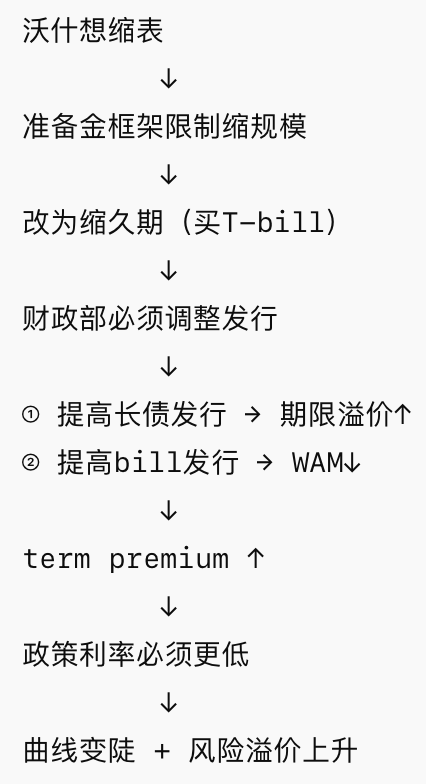
Core Viewpoint - The article discusses the need for the Federal Reserve to adjust its balance sheet strategy by shifting from long-term to short-term Treasury securities to reduce duration risk and potentially lower policy interest rates [1][19]. Group 1: Current State of the Fed's Balance Sheet - As of early 2026, the Federal Reserve's balance sheet is approximately $6.6 trillion, significantly higher than pre-pandemic levels of $4.4 trillion and $0.9 trillion before the Global Financial Crisis (GFC) [2]. - The balance sheet structure is deemed "distorted" by some analysts, with reserves nearing $3 trillion, accounting for 12% of bank assets [2][16]. - The weighted average maturity (WAM) of the Fed's Treasury holdings is about 9 years, compared to only 3 years before the GFC, indicating a longer duration risk [2][11]. Group 2: Proposed Strategy for Duration Management - The proposed strategy involves the Fed reinvesting maturing securities into short-term Treasury bills (T-bills) instead of similar long-term assets, which could increase T-bill holdings from $289 billion to approximately $3.8 trillion over five years [23]. - This shift would reduce the Fed's portfolio duration from 9 years to about 4 years, aligning more closely with pre-GFC norms [23][24]. Group 3: Coordination with the Treasury - Successful implementation of this strategy requires coordination with the Treasury to avoid market disruptions. If the Treasury increases long-term debt issuance without Fed support, it could lead to a significant supply-demand imbalance in the long-term bond market [25]. - The ideal scenario would involve the Treasury maintaining long-term issuance levels while increasing T-bill issuance to meet the Fed's needs, stabilizing the market [28]. Group 4: Implications for Interest Rates and Market Dynamics - A shorter duration portfolio may lead to an increase in term premiums, necessitating a reduction in policy interest rates to maintain economic stability [29]. - Research indicates that to offset the effects of a shorter duration portfolio, the federal funds rate may need to be lowered by 25 to 85 basis points [29][36].


盘前:纳指期货涨0.06% 软件股劲升
Xin Lang Cai Jing· 2026-02-10 13:41
Market Overview - Global stock markets have returned to historical highs, with Japan's market continuing its upward trend and software stocks stabilizing, boosting overall risk appetite [2][30] - As of the report, Dow futures rose by 0.06%, S&P 500 futures increased by 0.11%, and Nasdaq futures gained 0.06% [3][30] - European markets saw the Stoxx 600 index slightly retreat from a record high, while Kering Group surged by 11% due to signs of recovery in its Gucci business [4][30] Japanese Market - The Nikkei 225 index closed up by 2.3%, with other Asian markets showing moderate gains: Hang Seng Tech Index up by 0.5%, Shanghai Composite Index up by 0.1% [5][31] - The market anticipated that the victory of the ruling party would benefit the Japanese stock market due to planned fiscal stimulus, with unexpected rebounds in Japanese government bonds and the yen [5][31] Economic Data Focus - Traders are awaiting a series of U.S. economic data, with retail sales being the first major report expected to show resilience in consumer spending despite high living costs and a weak job market [6][32] - Upcoming data includes non-farm payrolls and inflation metrics, which will influence expectations regarding the Federal Reserve's interest rate path [6][32] Technology Sector Insights - PineBridge Investments' Mike Kelly expressed confidence in the current tech stock rebound, emphasizing the importance of identifying winners in the evolving landscape of disruptive technologies [7][33] - Ecofi Investissements' Karen Georges anticipates an economic rebound in the second half of the year, although short-term consumer data may appear less optimistic [7][33] Currency and Commodity Movements - The Chinese yuan strengthened to its highest level against the dollar since May 2023, following reports of regulatory recommendations to reduce U.S. Treasury exposure [7][33][34] - Gold prices maintained above $5,000, with traders awaiting new catalysts, while Bitcoin fell by 2.3% to $68,708 [6][36] Company-Specific Developments - Datadog's stock surged over 10% in pre-market trading, while Spotify's shares rose by 11% due to expected profits exceeding forecasts [15][42] - Conversely, Coca-Cola's stock fell over 2% as its fourth-quarter net revenue missed market expectations [17][43] - Ferrari's stock jumped nearly 10% due to strong demand, with orders extending to the end of 2027 [20][46]
沃什掌舵美联储或政策常规化 沪金高位消化强支撑1095
Jin Tou Wang· 2026-02-10 06:10
Group 1 - Gold futures are currently trading around 1133.04, with a recent price of 1120.74 yuan per gram, reflecting a 4.88% increase, and a high of 1134.46 and a low of 1116.40 [1] - The short-term outlook for gold futures appears bullish, as the market is showing signs of upward momentum [1] Group 2 - Former Federal Reserve Governor Walsh, known for prioritizing anti-inflation measures, has criticized the Fed's expanded role in the economy and advocates for a return to traditional functions [3] - Walsh's potential appointment as Fed Chair is unlikely to lead to significant changes in monetary policy, as decisions are heavily reliant on the consensus of the Federal Open Market Committee (FOMC) [3] - Walsh and Treasury Secretary Basant advocate for reducing the Fed's market footprint, primarily through accelerated balance sheet reduction, but this approach may create conflicting signals regarding interest rates and balance sheet management [4] Group 3 - The gold market is currently in a clear upward trend, with prices oscillating upwards along the moving average system, indicating a solid bullish foundation [5] - Recent price action suggests a normal consolidation phase after a rapid increase, rather than a trend reversal, with key support levels remaining intact [5] - Resistance is noted in the 1125-1130 range, while support is identified in the 1100-1095 range, with a potential for upward movement if resistance is broken [5]
花旗:沃什或采取循序渐进方式缩表 避免重燃货币市场紧张情绪
智通财经网· 2026-02-09 22:33
Core Viewpoint - Citigroup strategists suggest that Kevin Warsh, nominated as the Federal Reserve Chair, is likely to gradually reduce the central bank's balance sheet of approximately $6.6 trillion to avoid reigniting tensions in the money market [1] Group 1: Federal Reserve's Balance Sheet Management - Any resumption of Quantitative Tightening (QT) could pressure the $12.6 trillion repurchase market, which is crucial for banks' short-term borrowing needs [1] - The Federal Reserve paused its balance sheet reduction in December due to significant fluctuations in the repurchase market, indicating a high threshold for restarting QT [1] - Warsh, a former Fed governor, has long advocated for a substantial reduction in the central bank's financial footprint, which expanded significantly during the global financial crisis and the COVID-19 pandemic [1] Group 2: Potential Strategies Under Warsh's Leadership - Citigroup identifies several "de-leveraging" options under Warsh, with the least resistance path being the rolling of maturing long-term Treasury bonds into short-term debt to lower the weighted average maturity of holdings [2] - Other measures may include reducing the current monthly Treasury bond purchase of $40 billion or allowing mortgage-backed securities (MBS) to mature naturally [2] - The baseline scenario anticipates a reduction in monthly purchases to about $20 billion starting mid-April, continuing throughout the year [2] Group 3: Treasury Issuance and Market Dynamics - The Treasury may welcome foreign demand for Treasury bonds from the Fed, leading to a greater reliance on short-term debt issuance and delaying the increase in long-term bond issuance [3] - Citigroup forecasts that the issuance of long-term bonds may not begin until November 2026, with a risk of further delays until February 2027 [3]
沃什力挺,影响深远!时隔75年,美联储又要和美国财政部达成协议了?
Hua Er Jie Jian Wen· 2026-02-09 01:20
Core Viewpoint - The nomination of Waller as the next Federal Reserve Chair has sparked significant interest on Wall Street regarding his proposal for a new agreement between the Federal Reserve and the U.S. Treasury, aimed at reshaping their relationship, potentially impacting the $30 trillion U.S. Treasury market and fundamentally altering the Fed's balance sheet management [1][2]. Group 1: Proposed Agreement - Waller has called for a new version of the "1951 Agreement" to reform the relationship between the Federal Reserve and the Treasury, which historically limited the Fed's footprint in the bond market and established its autonomy in monetary policy [2]. - The proposed agreement would clearly define the size of the Fed's balance sheet and align it with the Treasury's debt issuance plans, addressing concerns raised during the financial crisis and the COVID-19 pandemic regarding the Fed's extensive asset purchases [2][3]. Group 2: Treasury's Position - Treasury Secretary Yellen shares Waller's skepticism towards prolonged quantitative easing (QE), advocating for its use only in genuine emergencies and with coordination among government departments [3]. - A streamlined new agreement may stipulate that the Fed can only conduct large-scale Treasury purchases with Treasury approval, aiming to halt QE as market conditions allow [3]. Group 3: Asset Composition Shift - There is an expectation that a more substantive agreement could lead to a significant shift in the Fed's asset holdings, moving from medium- and long-term securities to Treasury bills with maturities of 12 months or less [4]. - This shift would enable the Treasury to reduce the issuance of notes and bonds or at least avoid significant increases in issuance [4][5]. Group 4: Market Risks and Concerns - While enhanced coordination may aim to lower borrowing costs for U.S. borrowers, any fundamental changes carry risks, including concerns about the Fed's independence and its potential alignment with fiscal policy [6]. - Analysts warn that a public agreement linking the Fed's balance sheet to Treasury financing could undermine the Fed's inflation-fighting mandate, leading to increased volatility and diminished attractiveness of U.S. assets [6]. Group 5: Skepticism on Formal Agreement - Some experts express skepticism about the likelihood of a formal agreement, suggesting that while cooperation may increase, it could also reduce the chances of a formalized arrangement [7]. - There are proposals for the Fed to exchange its $2 trillion mortgage-backed securities portfolio for Treasury bills, aimed at lowering mortgage rates, but this faces significant obstacles [7].
中国银河证券:由沃什领导的美联储或将开启央行角色的深刻转变
智通财经网· 2026-02-06 00:55
Core Viewpoint - The nomination of Kevin Warsh as the next Federal Reserve Chairman by Trump is not merely a personnel change but signals a shift in the defense of the dollar and U.S. Treasury credit, with the dollar index rising by 1% on the announcement [2]. Group 1: Warsh's Monetary Policy Views - Warsh is a clear critic of the current Federal Reserve's policies, opposing quantitative tightening (QT) during market turmoil and questioning the Fed's focus on price stability [2]. - He criticizes the Fed's reliance on data and its disconnect from reality, emphasizing the need for credible monetary policy and a return to normalization, opposing unlimited quantitative easing (QE) [2][3]. Group 2: Proposed Reforms for the Federal Reserve - Warsh advocates for a revival of the Fed's core framework while eliminating past policy errors, focusing on reducing the balance sheet to control inflation, which could create room for lowering interest rates [3]. - He stresses the importance of the Fed and Treasury fulfilling their respective roles and calls for a reassessment of the 1951 Treasury-Fed Accord, emphasizing the need for Fed independence [3]. Group 3: Impact on Major Assets - The leadership change at the Fed should not be automatically interpreted as a major market trend shift; the impact of policies on the U.S. economy is fundamental to dollar pricing [4]. - Under Warsh's leadership, the Fed may transition from a supportive role post-financial crisis to a more traditional, rule-based approach, with expectations of a stronger dollar in the short term and a slow bearish trend in the long term [4]. - Short-term U.S. Treasury yields are expected to rise, putting pressure on prices, while long-term inflation expectations are anchored around 2% [4].

闷驹颐谁是沃什?美联储最年轻理事,雅诗兰黛家族女婿,其岳父第一个建议特朗普买下格陵兰岛-伯南克-罗纳德-紧张局势-知名企业-唐纳·川普-唐纳德·特朗普
Sou Hu Cai Jing· 2026-02-05 11:20
当地时间30日,美国总统特朗普宣布提名凯文·沃什为下一任美国联邦储备委员会主席。 沃什有显赫的家庭背景。他的夫人出身于著名的雅诗兰黛家族,其 岳父罗纳德·劳德是特朗普总统的老友兼重要支持者,是第一个向特朗普提出买下格陵兰岛的人。这为沃什在政界和商界都提供了独特的人脉资源。 图为凯文·沃什 毕业于哈佛斯坦福麻省 最年轻的美联储理事曾反对降息 沃什1970年出生于美国纽约州奥尔巴尼,来自一个犹太家庭。1992年,他获得斯坦福大学公共政策学士学位,主修经济学和政治学。之后,沃什进入哈佛法 学院学习,并于1995年以优异成绩获得法学博士学位。他还曾在麻省理工学院斯隆管理学院和哈佛商学院修读市场经济学和债务资本市场课程。 1995年至2002年,沃什进入摩根士丹利,一路晋升为摩根士丹利并购部门的执行董事。 2002年至2006年,沃什开始进入美国联邦政府的经济决策圈中,担任总统经济政策特别助理兼国家经济委员会执行秘书,为总统和高级政府官员就美国经济 相关问题提供建议。 2006年1月,布什提名沃什填补美联储理事的空缺职位。当时35岁的沃什,成为美联储历史上最年轻的理事,还因其年龄和经验不足而受到一些批评。 特朗普与沃什 ...
沃什缩表引关注伦敦金反弹藏拐点
Jin Tou Wang· 2026-02-04 06:02
Group 1 - The latest price of London gold is 1131.77 yuan per gram, reflecting an increase of 28.69 yuan, or 2.60%, compared to the previous trading day [1] - The opening price for the day was 1102.94 yuan per gram, with a daily high of 1134.28 yuan and a low of 1094.88 yuan [1] Group 2 - Mizuho Securities highlights that Kevin Warsh, nominated by Trump for the Federal Reserve Chair, advocates for reducing the central bank's balance sheet, which may require a more interventionist approach in daily monetary market operations [2] - The current reserve levels are nearing their limits, and a reduction in the balance sheet could lead to issues in the federal funds market, increasing volatility and undermining the Fed's control over short-term interest rates [2] - Warsh's previous tenure at the Fed and his calls for reducing the central bank's financial footprint are noted, with the Fed's asset portfolio having surged from approximately $800 billion two decades ago to a peak of $8.9 trillion in June 2022, before decreasing to $6.6 trillion [2] Group 3 - If the Fed under Warsh continues to reduce its balance sheet, it is suggested to replace the federal funds rate with the overnight repo rate as a key short-term benchmark, which would require more active Fed intervention to stabilize volatility [3] - The recommendation includes encouraging counterparties to utilize the Standing Repo Facility (SRF) more frequently, which allows banks to borrow cash against collateral like U.S. Treasuries [3] Group 4 - Gold experienced a strong rebound on Tuesday, maintaining an upward trend across Asian, European, and American trading sessions, closing with a significant bullish candlestick [4] - A previous trading strategy involved executing a long position at 4912 and closing at 4945 for profit, with the initial target set at breaking the 5000 mark, but the decision was made to secure profits early due to market fluctuations [4] - Despite the recent rebound, the short-term trend remains bearish, indicating that the current rise is merely a corrective move, with expectations of a return to a downward trend once the rebound momentum wanes [4]