市场风格切换

Search documents
击鼓传花的最后一棒?
鲁明量化全视角· 2025-09-28 04:44
Core Viewpoint - The market continues to show signs of divergence, with the broad indices rising while many individual stocks are experiencing consecutive declines. The current market structure is more fragmented than usual, making it difficult for traditional investment strategies to achieve stable positive returns [3]. Market Overview - The Shanghai Composite Index rose by 0.21% and the CSI 300 Index increased by 1.07% last week, while the CSI 500 Index saw a 0.98% rise. However, a significant number of stocks in the market have shown two consecutive weekly declines [3]. - The LPR (Loan Prime Rate) remained unchanged in September, indicating limited room for interest rate cuts in the near term, which may not be favorable for the market's high expectations [3]. - Domestic commodity prices have been performing better than overseas prices since August, largely due to the implementation of the "anti-involution" policy [3]. Investment Strategy - The recommendation is to reduce positions to low levels and focus on avoiding the market, particularly in the small-cap sector, as the market style shifts towards large-cap stocks [2][3]. - The technology sector, which has been active recently, may face macroeconomic headwinds due to the stable LPR and stronger domestic industrial prices compared to overseas [3]. - The financial sector, a key representative of large-cap industries, has already entered a phase of continuous adjustment, raising concerns about when the technology growth sector will no longer support the indices [3]. Technical Analysis - There are indications that the market's upward movement is being driven by retail investors, as institutional funds appear to be distributing shares to them, a common characteristic of market tops [4]. - The short-term momentum model suggests focusing on the basic chemical industry as a potential area of interest [4].


牛市加速期表现最弱的行业终局
Xinda Securities· 2025-09-24 08:03
Group 1 - The report highlights that from late June to August, while major indices accelerated upward, the banking sector experienced a decline, with an absolute return decrease of 0.39%, underperforming the Shanghai Composite Index by approximately 16 percentage points, ranking last among all primary industries [2][8][10] - Historical cases, such as the electronics industry in Q4 2014, show that sectors can underperform during bull market acceleration phases due to style shifts, yet still strengthen in the later stages of the bull market [2][13][15] - The report identifies that if a leading sector in a bull market becomes the weakest performer during an acceleration phase, it is often due to changes in market style rather than weak earnings, suggesting potential for recovery in the later stages of the bull market [2][27][28] Group 2 - The banking sector from March to May 2007 was noted as one of the weakest performers during the latter half of the bull market's main upward wave, despite strong overall performance in the financial cycle bull market from 2005 to 2007 [28][34][41] - The communication sector also underperformed during the same period, with a 28% increase compared to the Shanghai Composite Index's 53% rise, indicating a mismatch with market style and weak earnings expectations [43][44][48] - The banking sector from May to July 2020 showed weak performance during a bull market, with a 7.8% increase while the Shanghai Composite Index rose by 21.4%, attributed to a shift towards small-cap growth stocks [50][55][61]
有色大牛,悄悄翻倍了
Ge Long Hui A P P· 2025-09-14 09:12
Core Viewpoint - The article highlights the significant growth and performance of Luoyang Molybdenum Co., Ltd. (洛阳钼业) in the context of the A-share market, particularly driven by its copper and cobalt production and the rising prices of these metals [1][9]. Company Overview - Luoyang Molybdenum's revenue was approximately 60 billion yuan before 2013, primarily from domestic operations, but it has since expanded through overseas acquisitions, including significant stakes in copper and cobalt mines in Congo and Ecuador [3]. - By 2024, the company expects to produce 650,000 tons of copper and 114,000 tons of cobalt, marking substantial year-on-year growth of 65% and 106%, respectively [3][10]. Financial Performance - From 2020 to 2024, Luoyang Molybdenum's revenue and net profit have shown compound annual growth rates of 17.2% and 55%, respectively, with the latter growing significantly faster due to the strong performance of its mining operations [3][4]. - In the first half of 2025, the company reported revenue of 94.77 billion yuan, a year-on-year decline of 7.83%, but net profit surged by 60% to 8.67 billion yuan, driven by increased production and favorable pricing [7]. Market Dynamics - The price of copper has risen dramatically from a low of $4,371 per ton in 2020 to $10,064.5 per ton, resulting in improved profitability for the company, with gross profit margins increasing from 7.47% to 21% [4]. - The company has also benefited from a reduction in financial expenses, which fell by 44% due to decreased borrowing and interest rates [7]. Future Outlook - Luoyang Molybdenum's future growth is supported by its strategic resource acquisitions and the anticipated increase in copper and cobalt production over the next five years [10]. - The company is expected to maintain a favorable growth trajectory, with copper prices likely to remain strong due to supply-demand dynamics and macroeconomic factors [10][11]. Industry Context - The A-share market has seen significant movements, with the technology and financial sectors leading the way, while cyclical sectors like metals are expected to benefit from a potential shift in market focus [18][22]. - The current valuation of Luoyang Molybdenum, with a PE ratio of 17 and a PB ratio of 3.97, suggests that it remains within a reasonable range without significant bubble risks [23].


久违的深跌出现了 下一步思路是什么?
Mei Ri Jing Ji Xin Wen· 2025-09-04 07:54
Market Overview - The market experienced a significant decline on September 4, with major indices such as the Shanghai Composite Index falling by 1.25%, the Shenzhen Component Index by 2.83%, and the ChiNext Index by 4.25% [2][3] - The total trading volume in the Shanghai and Shenzhen markets reached 2.54 trillion yuan, an increase of 180.2 billion yuan compared to the previous trading day [2] Index Performance - The ChiNext Index and the Sci-Tech 50 Index saw the largest declines, with drops of 4.25% and 6.08% respectively [4] - The average stock price fell by 2.36%, marking a cumulative decline of 5.79% over three days [6] Sector Performance - Retail, food, paper, and photovoltaic sectors showed positive performance, while sectors such as CPO, semiconductors, components, and military industries faced significant declines [2] - Financial sectors, including banks and brokerages, showed signs of recovery in the afternoon, with notable gains in stocks like Agricultural Bank of China, which rose over 5% [8][10] Technology Sector - Technology leading stocks experienced substantial volatility, with major declines in stocks like Zhongji Xuchuang (-13.39%) and Xinyisheng (-15.58%) [15] - Despite the downturn, some analysts believe the mid-term logic for the technology sector remains solid, viewing the current adjustments as strategic opportunities for future investments [16] Market Sentiment and Future Outlook - There is a prevailing sentiment of market correction, with questions raised about whether the market has reached its peak and how long the adjustment period will last [13] - Analysts suggest that the market is currently in a favorable environment with improved liquidity and potential inflows from global funds, indicating a possibility of steady upward movement in the near term [13]
创业板市值“老二”易主了!市场风格会切换吗?
Mei Ri Jing Ji Xin Wen· 2025-09-03 09:50
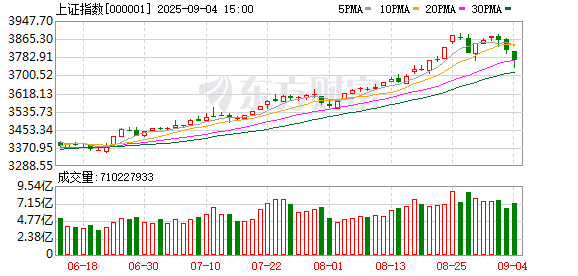
Market Overview - The A-share market showed mixed performance with the Shanghai Composite Index and Shenzhen Component Index down by 1.16% and 0.65% respectively, while the ChiNext Index rose by 0.95% [1] - The trading volume in the Shanghai and Shenzhen markets exceeded 2.3 trillion yuan, a significant decrease of over 500 billion yuan compared to the previous day [1] Market Sentiment and Technical Analysis - Market sentiment is nearing a low point, and a rebound will require increased trading volume [2] - Key technical levels to watch include the August 26 high of 3888 points for upward momentum and the August 28 low of 3761 points for potential further declines [2] - The performance of small-cap and micro-cap stocks has been notably weak, particularly in the CSI 1000 Index and CSI 2000 Index [2] Valuation Trends - Recent weeks have seen low valuation stocks outperform high valuation stocks across the A-share market [3] - The valuation gap between small-cap and large-cap stocks remains significant, with historical high ratios in PE valuations between various indices [3] Sector Performance - The communication equipment sector showed some recovery, with a 1.1% increase in the sector index, driven by strong performances from stocks like Zhongji Xuchuang and Tianfu Communication [3] - Zhongji Xuchuang's market capitalization has surpassed that of Dongfang Caifu, marking a shift in the second-largest market cap on the ChiNext [4] Impact of Major Stocks - Major stocks like "Yizhongtian" contributed significantly to the ChiNext Index's performance, indicating their influence on broader market movements [5] - The upcoming Apple product launch is anticipated to impact the performance of consumer electronics stocks, with analysts divided on the potential for a major upgrade cycle driven by the iPhone 17 [5][6] Investment Opportunities - Recent trends suggest that the market's adjustment phase may provide entry points for investors, particularly in small-cap and micro-cap stocks that have seen substantial gains since April 8 [7] - The CPO sector, represented by "Yizhongtian," is crucial for determining the future trajectory of AI hardware stocks, with a focus on key components like CPO, PCB, and AI chips [7]





A股高位休整 机构热议风格切换方向
Shang Hai Zheng Quan Bao· 2025-09-02 18:31
Group 1 - The A-share market experienced a pullback after a continuous rise, with the technology sector, particularly AI-related stocks, facing profit-taking, leading to declines in major indices [1][2] - The Shanghai Composite Index closed at 3858.13 points, down 0.45%, while the Shenzhen Component Index and the ChiNext Index fell by 2.14% and 2.85%, respectively [1] - The total trading volume in the Shanghai and Shenzhen markets reached 28,750 billion yuan, an increase of 1,250 billion yuan compared to the previous day [1] Group 2 - The robotics sector was one of the few technology themes that rose, with companies like Zhejiang Rongtai and Longxi Co. hitting the daily limit up [1] - Yu Tree Technology announced plans to submit its listing application between October and December, following its listing guidance initiated by CITIC Securities [1] - The precious metals sector showed strength, with Western Gold hitting the daily limit up for two consecutive days, and gold prices reaching a historical high of $3,508.69 per ounce [1] Group 3 - The AI sector faced significant profit-taking, with leading companies like Xinyi Sheng and Zhongji Xuchuang seeing their stock prices drop by 7.80% and 5.44%, respectively [2] - The influx of leveraged funds and private capital has been notable, but their stability is questioned, as their flow is closely tied to market sentiment [2] - The current PB valuation of the Shenwan secondary sector is at a historically high level, indicating a potential shift towards lower-value assets [2] Group 4 - The market is shifting towards an investment logic focused on economic recovery, with a strong emphasis on AI-related industries [3] - The ongoing "anti-involution" policy is improving the operational conditions of domestic manufacturing enterprises, while overseas interest rate cuts are favorable for global manufacturing recovery [3] - Three investment themes are recommended: physical assets benefiting from domestic and overseas manufacturing recovery, long-term assets in insurance and brokerage sectors, and opportunities in A-share heavyweight stocks related to domestic demand [3]
行情稳步上行,如何看待后市?
Shang Hai Zheng Quan Bao· 2025-08-31 14:15
Group 1 - The core viewpoint is that the current equity market valuation is still within a reasonable pricing range, and future market trends depend on fundamental improvements to digest existing valuations [1][2] - As of August 22, the Shenyin Wanguo A-share index's price-to-earnings (P/E) ratio is 21.68 times, which is at the 76th percentile of the past 10 years and the 65th percentile of the past 20 years, indicating a relatively high P/E ratio despite the price-to-book (P/B) ratio being at a historical median level [1] - The stock-bond valuation ratio has fallen below the 40th percentile, suggesting that equity assets still hold certain allocation value [1] Group 2 - Recent disclosures of listed companies' semi-annual reports indicate an improvement in performance compared to the same period in the previous two years, suggesting a potential bottoming out of fundamentals [2] - The market style is expected to shift from the previous "dividend + small-cap" structure to high-growth sectors if fundamentals confirm a recovery [2] - Overall, the market is likely to continue a "central oscillation with an upward shift" in its operational rhythm in the near term [2]
这两周能扛住超额回撤的量化,有什么不一样的吗?
雪球· 2025-08-30 03:05
Core Viewpoint - The article discusses the recent performance of quantitative strategies in the investment market, highlighting a shift in market style and the impact on various quantitative strategies [5][6][11]. Group 1: Market Performance - The benchmark index for the CSI 500 had a weekly return of 3.87%, while the CSI 1000 had a return of 3.45% during the week of August 18-22 [4]. - The absolute returns of the CSI 300 and CSI 500 indices have improved significantly, while the previously leading quantitative stock selection strategies have fallen behind [10][11]. Group 2: Quantitative Strategy Analysis - The article notes a significant shift in market style, with funds moving from small-cap stocks to mid and large-cap stocks, which has affected the performance of quantitative models [11]. - The article emphasizes that the recent volatility in both excess and absolute returns indicates a challenging environment for quantitative strategies [10][11]. Group 3: Specific Quantitative Strategies - Strict risk-controlled quantitative index strategies have performed relatively well during the recent style switch due to their lower exposure to micro-cap stocks and a focus on fundamental support [16]. - Extreme volume-price driven quantitative stock selection strategies have shown high sensitivity to market changes, allowing for quicker adjustments in response to style shifts [19]. - Balanced factor quantitative stock selection strategies have demonstrated resilience against the recent market style changes, maintaining stability in returns [22][23]. Group 4: Broader Index Strategies - Full index strategies that track the CSI Full Index have shown balanced performance across large, mid, and small-cap stocks, providing a reliable option regardless of market style [26][31]. - The CSI Full Index has outperformed most mainstream indices recently, with a year-to-date return of 18.3%, indicating strong performance across various market conditions [30][31].

半夏宏观对冲2025年7月报
2025-08-27 15:20
Summary of Key Points from the Conference Call Industry Overview - The macroeconomic environment is described as "heartfelt but stagnant," indicating a lack of significant movement in the real economy despite some initial optimism regarding commodity prices. After a surge in prices, most commodities have reverted to previous levels as demand remains unchanged [10][11]. Core Insights and Arguments - The current market dynamics have shifted from a focus on existing capital to new capital inflows. This change is driven by certain assets demonstrating clear profitability, leading to increased investment in the context of low interest rates and asset scarcity [11]. - Two main themes for capital inflow have been identified: quantitative strategies and insurance, with corresponding investments in small-cap A-shares and dividend-paying Hong Kong stocks. This trend suggests that small-cap stocks are outperforming large-cap stocks, and H-shares are outperforming A-shares [11]. - A potential shift in market style is anticipated in the coming months, particularly as bank bad debt risks become more apparent. Current fiscal policies, especially in the real estate sector, are expected to gain momentum, which may lead to a performance shift favoring cyclical and large-cap blue-chip stocks over small-cap stocks [11]. Investment Plans - **Gold**: A small allocation is recommended, indicating a cautious approach to this asset class [12]. - **Interest Rates**: The fundamental outlook remains unchanged, with a focus on maintaining a loose monetary environment. A certain proportion of medium- to short-term government bond futures has been allocated [13]. - **Commodities**: A balanced approach with both long and short positions is maintained, reflecting a selective strategy based on fundamental differences among commodities [14]. - **Equities**: No significant changes from the previous month. Long-term holdings consist of 40% in stocks that exhibit cyclical characteristics, high dividends, and low price-to-book ratios [15]. - **Mid-term Holdings**: Approximately 20% in stock index futures, benefiting from high discounts that provide adequate protection against short-term declines [16]. Additional Important Content - The report emphasizes that it is not a legal basis for investment decisions and disclaims any responsibility for investment outcomes resulting from the information provided [8][18][19]. - The document outlines the qualifications required for investors to engage with the fund, including minimum asset thresholds and income requirements, ensuring that only qualified investors participate [18]. This summary encapsulates the key points from the conference call, highlighting the current market conditions, investment strategies, and important disclaimers regarding the information provided.
中国资产重估:人民币逼近7.15,中概五连涨创5个月新高
Hua Er Jie Jian Wen· 2025-08-27 00:20
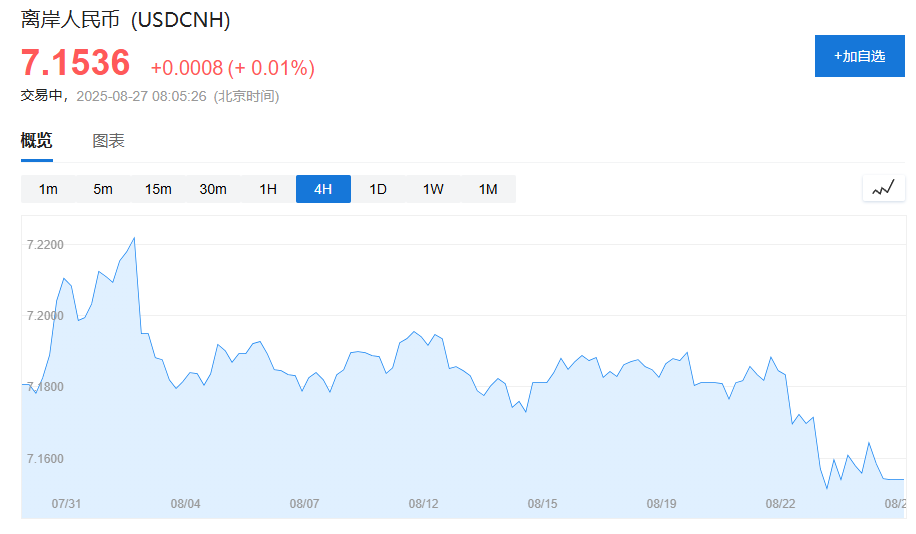
Group 1 - The core viewpoint is that confidence in Chinese assets is recovering, as evidenced by the strengthening of the RMB and the rise of the Nasdaq Golden Dragon China Index [1][3] - The onshore and offshore RMB exchange rates have risen for three consecutive days, approaching the significant level of 7.15, despite the People's Bank of China setting the midpoint rate lower at 7.1188 [1] - The Nasdaq Golden Dragon China Index has achieved five consecutive gains, reaching its highest level since March 20, indicating a significant improvement in overseas investor sentiment [3] Group 2 - Positive signals from improved China-U.S. relations and domestic policies aimed at supporting the AI sector are enhancing market sentiment [5] - There is a potential shift in the core logic of asset pricing in the Chinese market, with a focus on the recovery of the Producer Price Index (PPI) and the possibility of a transition in asset styles [5] - If policies aimed at improving corporate competition, such as "anti-involution," are effectively implemented, it could lead to a rise in inflation in the real economy, prompting a transition to a more favorable asset style [5] Group 3 - The direction of the RMB exchange rate is a key variable in the current asset revaluation, with strong export performance supporting the currency [6] - There is an expectation that if the U.S. dollar enters a depreciation cycle, foreign capital will likely increase its holdings of Chinese equity assets [6] - September is seen as a critical observation window, where a potential interest rate cut by the Federal Reserve could create favorable conditions for RMB appreciation [6]