
美元指数

Search documents
资金跟踪系列之十二:北上活跃度回升,整体继续净卖出
SINOLINK SECURITIES· 2025-09-22 12:55
Macro Liquidity - The US dollar index has rebounded, and the degree of the China-US interest rate "inversion" has deepened, with inflation expectations also rising [1][14] - Offshore US dollar liquidity has generally loosened, while the domestic interbank funding situation remains balanced [1][19] Market Trading Activity - Overall market trading activity has increased, with most industry trading activities remaining above the 80th percentile [2][25] - Major indices' volatility has also risen, with the communication sector's volatility exceeding the 80th historical percentile [2][31] - Market liquidity indicators have declined, with all sectors' liquidity indicators below the 40th historical percentile [2][36] Institutional Research - The electronic, pharmaceutical, communication, non-ferrous metals, and automotive sectors have seen high research activity, while sectors like steel, electricity, utilities, machinery, light industry, building materials, and real estate have shown a rising trend in research activity [3][43] Analyst Forecasts - Analysts have continued to lower the net profit forecasts for the entire A-share market for 2025/2026, with the proportion of stocks with upward revisions increasing [4][50] - The net profit forecasts for sectors such as non-bank financials, chemicals, coal, and retail have been raised for 2025/2026 [4][21] - The net profit forecast for the Shanghai Stock Exchange 50 index for 2025/2026 has been adjusted upward [4][23] Northbound Trading Activity - Northbound trading activity has increased, but there continues to be a net sell-off overall [5][31] - Based on the top 10 active stocks, the buy-sell ratio in sectors like electronics, electric new energy, and communication has risen, while it has decreased in non-bank financials, pharmaceuticals, and non-ferrous metals [5][32] Margin Financing Activity - Margin financing has reached a high point not seen since September 2024, with a net purchase of 466.70 billion yuan last week [6][35] - The main net purchases in margin financing were in the electronic, non-bank financial, and machinery sectors, while net sales were seen in military, non-ferrous metals, and coal sectors [6][39] Active Equity Funds and ETFs - Active equity funds have increased their positions, particularly in coal, communication, and home appliance sectors, while reducing positions in computers, non-bank financials, and electronics [7][45] - ETFs have continued to see net subscriptions, primarily in personal ETFs, with significant net purchases in non-bank financials, non-ferrous metals, and machinery sectors [7][52]
黄金,继续向上冲击!
Sou Hu Cai Jing· 2025-09-22 09:02
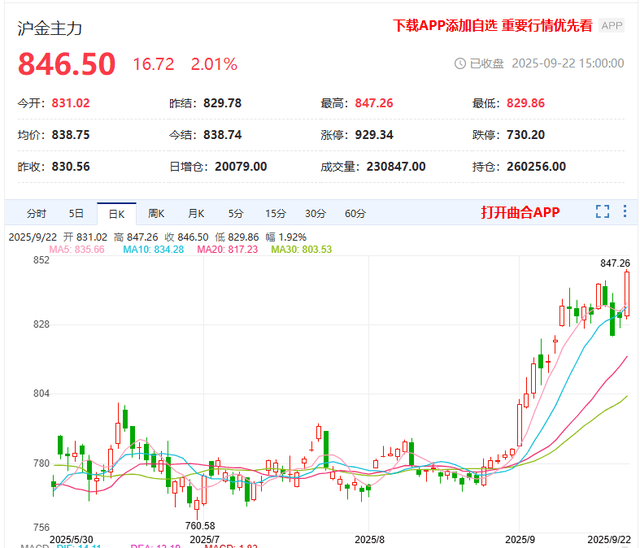
Group 1 - Wall Street analysts have returned to a neutral outlook on gold prices following the Federal Reserve's interest rate cut, with 40% expecting prices to rise in the coming week, 20% predicting a decline, and 40% anticipating a sideways movement [1] - Retail investors have cooled their enthusiasm, with 58% optimistic about price increases, 24% forecasting declines, and 18% expecting consolidation, indicating a retreat from previous bullish sentiment [1] - The Shanghai gold price surged to a historic high, increasing by 2.01% to close at 846.5 yuan per gram [1] Group 2 - According to GF Futures, the market's interpretation of the Federal Reserve's interest rate decision is neutral, with the dollar index rebounding after a decline [3] - Technical indicators suggest that the precious metals market has entered an overbought condition, leading to a potential pullback as funds may exit due to the "buy the rumor, sell the news" logic [3] - The outlook for the future indicates that with increasing risks in the U.S. labor market, the dual characteristics of "strengthened expectations - compromised independence" in the Federal Reserve's policy path will continue to suppress the dollar index and U.S. Treasury yields, while geopolitical tensions in Europe and the U.S. will increase institutional demand for precious metals as a safe haven [3]

上周三大人民币汇率指数均下跌 人民币对美元小幅升值
Xin Hua Cai Jing· 2025-09-22 06:19
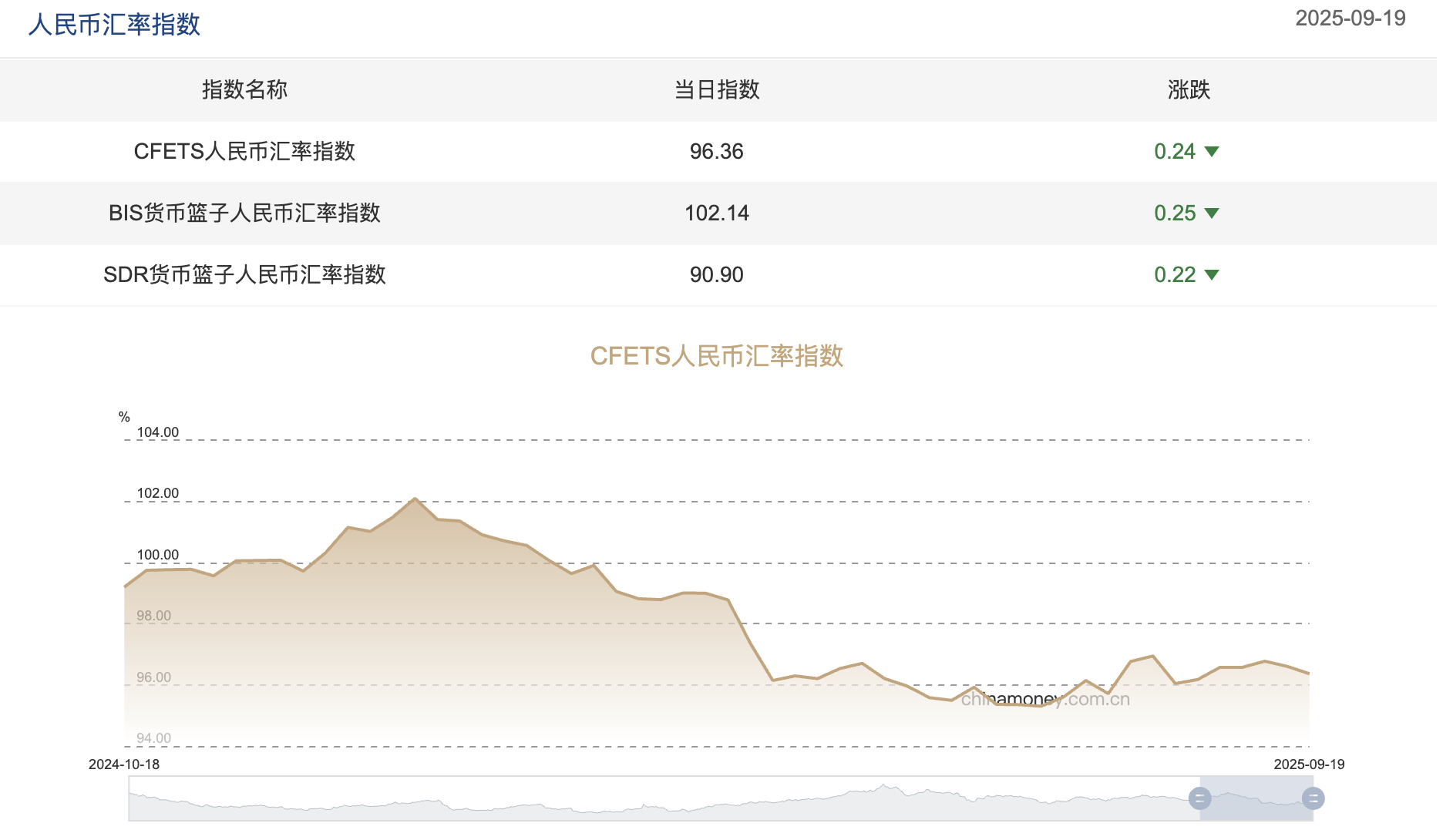
Exchange Rate Indices - The three major RMB exchange rate indices all experienced declines in the week of September 19, with the CFETS RMB index at 96.36, down 0.24% week-on-week [1][2] - The BIS currency basket RMB index reported 102.14, reflecting a 0.25% decrease, while the SDR currency basket RMB index stood at 90.90, down 0.22% [1][2] RMB to USD Exchange Rate - The RMB to USD exchange rate showed slight appreciation, achieving a "three-price unification" with onshore and offshore RMB rates rising to new highs for the year [6][7] - The offshore RMB briefly surpassed 7.10, closing at 7.1196, with a cumulative increase of 41 basis points for the week, while the onshore RMB closed at 7.1188, up 58 basis points [6][7] - The RMB central parity rate against the USD was reported at 7.1128, with a weekly decline of 109 basis points [6][7] Influencing Factors - The RMB's appreciation was driven by a combination of internal and external factors, including a weaker USD index due to the Federal Reserve's interest rate cuts, which provided passive appreciation momentum for non-USD currencies like the RMB [6][7] - Analysts noted that the overall cross-border capital flow remained stable, supporting the RMB's continued appreciation, although the central parity rate's influence on the appreciation speed was noted to be moderate [7][8] Future Outlook - Experts suggest that the RMB's future appreciation may depend on the sustained weakness of the USD, with a moderate pace of appreciation expected [8] - There is potential for accelerated recovery in the RMB's value as foreign capital is anticipated to flow into RMB-denominated assets, driven by narrowing interest rate differentials between China and the US [8]
管涛:三方面因素支撑人民币汇率走强
Sou Hu Cai Jing· 2025-09-22 02:20
Core Viewpoint - The strengthening of the RMB exchange rate is a result of a combination of internal and external factors, as stated by the chief economist of China Securities, Guan Tao [1] Group 1: Reasons for RMB Strengthening - The first reason is the failure of the "American exceptionalism" narrative and the damage to the credibility of the US dollar, leading to a significant depreciation of the dollar [1] - The second reason is the recovery of the Chinese economy and the improvement in the prospects for technological innovation, which has led to a re-evaluation of Chinese assets [1] - The third reason is the positive progress in China-US economic and trade negotiations since mid-May, which has improved market sentiment [1] Group 2: Future Outlook for RMB - Market analysis suggests that the RMB may enter a new appreciation cycle [1] - Guan Tao believes that the RMB exchange rate is not significantly deviating from the equilibrium level, with factors influencing both appreciation and depreciation present simultaneously [1] Group 3: Positive Factors Influencing RMB - Four favorable factors are identified: 1. The Federal Reserve's potential return to interest rate cuts, which may weaken the dollar index further [1] 2. Trump's aggressive trade policies and interference with the independence of the Federal Reserve could further harm the international credibility of the dollar [1] 3. Active promotion of economic and trade negotiations by both China and the US [1] 4. China's proactive measures against external economic pressures and the continuous vitality of technological innovation [1] Group 4: Market Volatility - Guan Tao indicates that due to numerous internal and external uncertainties, the RMB exchange rate may experience more pronounced two-way fluctuations [1]
美联储新理事米兰首秀引爆全球关注!
Sou Hu Cai Jing· 2025-09-22 02:14
汇通财经APP讯——在美联储政策决策的关键时刻,新任理事米兰以独立姿态亮相,他公开表示将独立 分析经济数据,并在周一(9月22日)的纽约发言中全面阐述自己的利率观点。这位新上任的理事强 调,自己没有从特朗普总统那里收到任何政策指示,这不仅缓解了市场对美联储独立性的疑虑,还凸显 出当前利率政策的分歧。米兰支持更大幅度的降息,与美联储主流共识形成鲜明对比,而明尼亚波利斯 联储主席卡什卡利则认为米兰的上任不过是常规人事变动,并对美联储的公众信任表示乐观。整个事件 反映出美国经济政策在就业、通胀和政治影响之间的微妙平衡,值得投资者密切关注。 米兰的独立政策宣言 米兰作为美联储的新任理事,在上周五(9月19日)的公开表态中明确强调了自己的独立性。他表示, 自己将基于对经济数据的客观解读来制定政策,不会受到外部干扰。这位理事刚刚在上周的会议中宣誓 就职,并在会上支持降息50个基点,这让他成为唯一持此观点的人。米兰承认自己的立场与众不同,并 承诺将在周一的发言中详细解释背后的经济逻辑和计算过程。他认为,当前的利率水平距离"中性"还有 较大差距,经济中不存在明显的通胀风险,尤其是在严格移民政策的影响下,住房需求将受到抑制,从 ...
永安期货贵金属早报-20250922
Yong An Qi Huo· 2025-09-22 02:01
Group 1: Price Performance - London Gold's latest price is 3643.70 with no change [3] - London Silver's latest price is 41.86 with no change [3] - London Platinum's latest price is 1369.00 with no change [3] - London Palladium's latest price is 1161.00 with no change [3] - WTI Crude's latest price is 63.57 with no change [3] - LME Copper's latest price is 9962.50 with a change of 20.00 [3] - The US Dollar Index's latest value is 97.37 with no change [3] - Euro to US Dollar's latest exchange rate is 1.18 with no change [3] - Pound to US Dollar's latest exchange rate is 1.36 with no change [3] - US Dollar to Japanese Yen's latest exchange rate is 148.00 with no change [3] - US 10 - year TIPS's latest value is 1.75 with a change of 0.02 [3] Group 2: Trading Data - COMEX Silver's latest inventory is 16300.91 with no change [4] - SHFE Silver's latest inventory is 1159.44, a decrease of 44.08 [4] - Gold ETF's latest holding is 994.56, an increase of 18.90 [4] - Silver ETF's latest holding is 15205.14 with no change [4] - SGE Silver's latest inventory is 1283.61 with no change [4] - SGE Gold's latest deferred fee payment direction is 2, an increase of 1.00 [4] - SGE Silver's latest deferred fee payment direction is 1 with no change [4]

海外周报20250921:美联储降息后,市场交易逻辑将如何转变?-20250921
Soochow Securities· 2025-09-21 13:01
Group 1: Federal Reserve Actions - The Federal Reserve lowered interest rates by 25bps as expected during the September FOMC meeting, with indications of two more rate cuts within the year and an additional cut next year, which is more hawkish than market expectations[2] - Following the FOMC meeting, the 10-year U.S. Treasury yield rose by 6.31bps to 4.127%, while the 2-year yield increased by 1.59bps to 3.572%[3] - The market initially reacted to a more dovish 2025 dot plot but later adjusted to a more hawkish outlook for 2026, influenced by Powell's statements[3] Group 2: Market Reactions - The S&P 500 and Nasdaq indices rose by 1.22% and 2.21% respectively, driven by the Fed's rate cut and positive developments in U.S.-China TikTok negotiations[3] - The U.S. dollar index increased by 0.10% to 97.64, reflecting a mixed response to the Fed's actions and economic data[3] - Gold prices initially rose by 1.16% to $3685 per ounce but later declined, indicating volatility in response to the Fed's hawkish stance[3] Group 3: Economic Indicators - U.S. retail sales for August increased by 0.6%, surpassing expectations of 0.2%, with core retail sales (excluding autos) rising by 0.7% against a forecast of 0.4%[3] - Initial jobless claims for the week ending September 13 fell to 231,000, below the expected 240,000, indicating a strengthening labor market[3] - The Atlanta Fed's GDPNow model predicts a Q3 2025 GDP growth of 3.3%, while the New York Fed's Nowcast model estimates it at 2.1%[3] Group 4: Political Risks - The failure of temporary spending bills in the Senate raises the risk of a federal government shutdown on October 1, increasing political uncertainty in the market[4] - The potential for Trump to gain more influence over the Federal Reserve could lead to a shift from a data-dependent to a Trump-dependent policy framework, impacting future monetary policy decisions[4]

贺博生9.21黄金强势上涨原油弱势下跌下周行情走势预测及开盘操作建议
Sou Hu Cai Jing· 2025-09-21 11:17
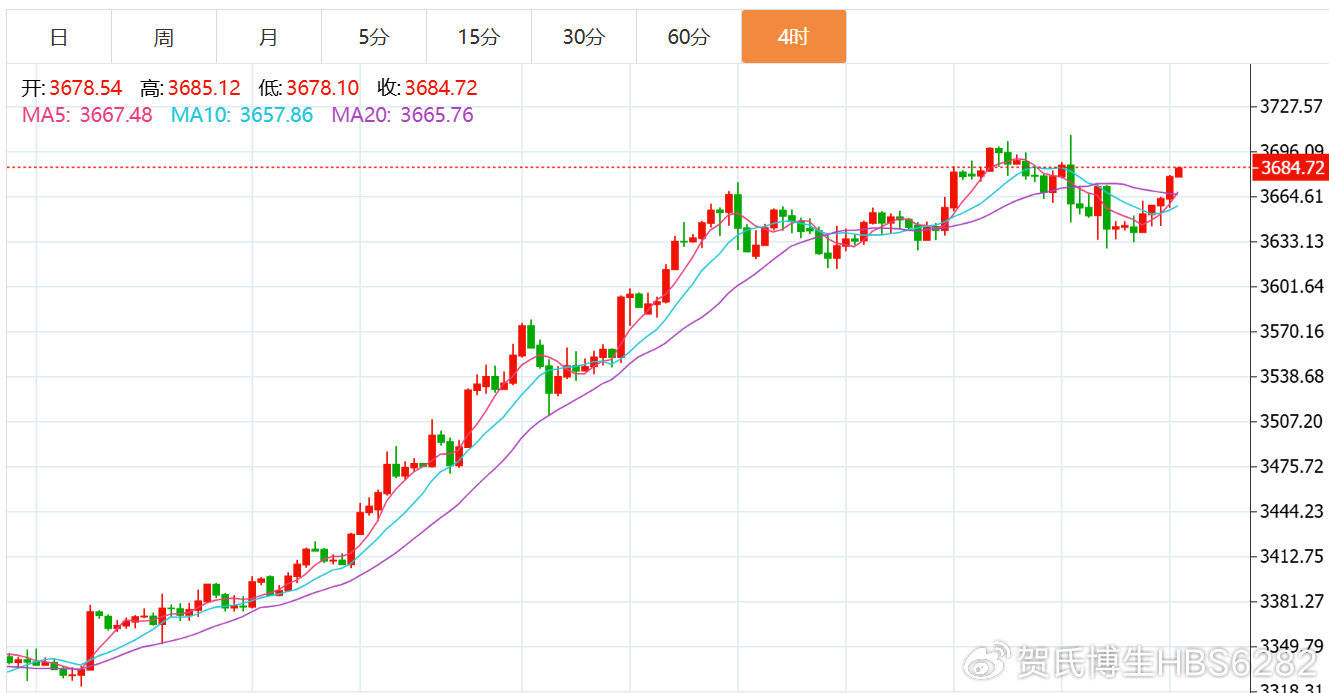
一样的行情,不一样的指导,不一样的人生。新手的特点就是不懂技术,盲目进场。他们每次交易只考虑一个问题:认为只要预判了市场涨跌就可以去做这 笔交易。这种重方向、轻位置的做法使得交易者一败涂地。其实,顺势而为的"势"跟"方向"是有很大差别的,因为市场的运动方向呈现震荡的形态运行,而 市场的趋势往往是全局性的。在我这里,我能做的是帮你合理的把控仓位,利用支撑和阻力位下单,让每一单有理可依,有迹可循。买卖点位不应该是随意 进场,请对自己的资金负责。如果你对行情真的无法把握,可以前来找到我,多一个分析师对你来说没有任何损失,永远记住一句话,专业的人做专业的 事,一切实战只为盈利,合作只为双赢。 黄金下周行情趋势分析: 黄金消息面解析:周五(9月19日)美盘时段,现货黄金收复部分失地,在对美联储利率决议出现周中震荡反应后,结束了两日连跌。现货黄金盘中交投于 3685美元左右,涨幅近1.12%。美元指数延续美联储决议后的反弹势头,从2022年2月以来的低点(约96.22)回升。该指数徘徊在97.62附近,接近五日高 点。根据芝商所(CME)美联储观察工具,市场认为10月降息25个基点的概率为91%,12月再次降息的概率接近 ...
21社论丨内外因共振,人民币汇率具有较强支撑
Sou Hu Cai Jing· 2025-09-19 22:10
Group 1 - The Federal Reserve's recent interest rate cut has led to a weakening of the US dollar, providing strong upward momentum for non-US currencies, including the Renminbi [1][2] - On September 17, the offshore Renminbi broke the 7.10 mark against the US dollar, reaching a high of 7.0995, the first time since November of the previous year [1][2] - The narrowing interest rate differential between China and the US is a significant factor contributing to the Renminbi's strength, although the fundamental economic conditions also play a crucial role [2][3] Group 2 - International capital flows are a key determinant of exchange rates, and the expectation of a weaker dollar is becoming more likely as the Fed continues its rate-cutting path [2] - China's economic resilience and the relative decline in productivity growth in Western countries are supporting the Renminbi's appreciation [3][4] - Deutsche Bank has expressed optimism about the Renminbi, predicting it could break the 7 mark by 2025 and appreciate to 6.7 by 2026, reflecting a positive outlook on Chinese assets [3] Group 3 - The willingness of foreign trade enterprises to engage in currency exchange is increasing, leading to a net inflow in the foreign exchange market [4] - The People's Bank of China's monetary policy is effectively stabilizing exchange rate expectations, reducing the likelihood of rapid appreciation or depreciation of the Renminbi [4] - The market's expectation of a stable Renminbi value is likely to persist, although the introduction of more exchange rate hedging tools may increase the volatility of the Renminbi in the future [4]
铜价:冲高回落符合预期,多空因素交织待解
Sou Hu Cai Jing· 2025-09-19 21:24
Group 1 - The core viewpoint is that the recent rise and subsequent fall in copper prices align with expectations, indicating potential high-level fluctuations in the coming months [1] - The increase in copper prices was driven by a decline in the US dollar index, but the fundamental factors do not support further price increases [1] - Positive factors for copper prices include agreements on tariff policies between the US and other countries, increased expectations for interest rate cuts leading to a weaker dollar, and upward support levels [1] Group 2 - Negative factors affecting copper prices include the potential for fluctuating tariff policies, reduced global demand due to these policies, and adjustments to US copper tariff policies leading to extremely high COMEX inventories [1]