
春季躁动

Search documents
市场延续“春季躁动”行情,转债跑出超额
Jianghai Securities· 2026-01-19 07:48
- The report primarily focuses on the performance of the convertible bond market, highlighting weekly changes in indices such as the Shanghai Convertible Bond Index, Shenzhen Convertible Bond Index, and CSI Convertible Bond Index, with weekly returns of 1.124%, 0.872%, and 1.075%, respectively[7] - The convertible bond market's trading volume and value for the week were 268,485.48 million units and 52,260,646.36 million yuan, showing week-over-week increases of 7.33% and 10.32%, respectively[7] - The median conversion premium rate of the convertible bond market was approximately 33.06%, with an arithmetic average of 45.21%, reflecting slight fluctuations compared to the previous week[12] - The report provides a detailed breakdown of convertible bond prices, categorizing them into ranges such as below 100, 100-110, 110-120, and so on, with the majority (47.12%) priced above 140[32] - The top five performing convertible bonds for the week were Jin 05 Convertible Bond, Aohong Convertible Bond, Shuangle Convertible Bond, Huiche Convertible Bond, and Huayi Convertible Bond, with weekly returns of 98.89%, 57.30%, 57.30%, 35.34%, and 24.20%, respectively[18][19] - The bottom five performing convertible bonds for the week were Zai 22 Convertible Bond, Tianjian Convertible Bond, Guanglian Convertible Bond, Huggong Convertible Bond, and Shentong Convertible Bond, with weekly returns of -25.23%, -19.41%, -16.67%, -12.10%, and -11.45%, respectively[18][19] - The report tracks convertible bond clauses, noting that 110 bonds triggered downward revision clauses, and six bonds were at risk of triggering conditional redemption clauses, including Tianjian Convertible Bond, Sailong Convertible Bond, Shentong Convertible Bond, Zhubang Convertible Bond, Beigang Convertible Bond, and Huazheng Convertible Bond[39]
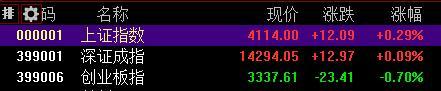
A股收评:沪指缩量涨0.29%,电网设备股掀涨停潮
Ge Long Hui· 2026-01-19 07:31
Market Overview - China's GDP is projected to grow by 5% year-on-year by 2025, with A-shares showing mixed performance today; the Shanghai Composite Index rose by 0.29% to 4114 points, while the Shenzhen Component increased by 0.09%, and the ChiNext Index fell by 0.7% [1] - The total market turnover reached 2.73 trillion yuan, a decrease of 324.3 billion yuan compared to the previous trading day, with over 3500 stocks rising [1] Sector Performance - The State Grid announced that fixed asset investment during the 14th Five-Year Plan period is expected to reach 4 trillion yuan, leading to a surge in the electric grid equipment sector, with over ten stocks hitting the daily limit [2][6] - Precious metals stocks performed strongly, with Sichuan Gold and Zhaojin Mining both hitting the daily limit, and other stocks like Shandong Gold and Zhongjin Gold also seeing significant gains [4][5] - The Hainan Free Trade Zone concept stocks surged, with Hainan Development hitting the daily limit and other stocks like Shen Nong Agriculture and Jinpan Technology also showing strong performance [8][9] - The commercial aerospace sector was active, with stocks like Oke Yi and Can Neng Electric hitting the daily limit, driven by successful tests of a manned spacecraft by Beijing Chuan Yue Technology [10][11] Notable Declines - The Kimi concept and AI corpus sectors saw declines, with stocks like People's Daily and Vision China hitting the daily limit down [2] - Communication equipment stocks faced significant losses, with Ruijie Networks dropping over 12% and other stocks like Cambridge Technology and Oriental Communication hitting the daily limit down [12][14] - Baogang Co. experienced a sharp decline of 5.2% following an explosion at its plate factory, resulting in casualties and production disruptions [15][16] Future Outlook - The market is expected to transition to a volatile trend after reaching previous highs, with increased focus on earnings disclosures as January progresses. Companies with better-than-expected earnings or those that stabilize post-disclosure are likely to attract attention [18]


天量资金,动向延续
Zhong Guo Ji Jin Bao· 2026-01-19 04:17
Core Viewpoint - On January 16, the A-share market experienced a decline, with a net outflow of over 85.5 billion yuan from the stock ETF market, indicating a continued trend of capital withdrawal [2][3]. Group 1: Market Performance - The three major indices in the A-share market closed lower, with the Shanghai Composite Index down 0.26%, the Shenzhen Component Index down 0.18%, and the ChiNext Index down 0.2% [3]. - The semiconductor industry chain saw significant gains, particularly in advanced packaging and memory sectors, while the cultural media and short drama gaming sectors experienced adjustments [3]. Group 2: ETF Fund Flows - As of January 16, the total scale of 1,308 stock ETFs in the market was approximately 4.9 trillion yuan, with a reduction of 15.365 billion units in fund shares, leading to a net outflow of 85.505 billion yuan [3][4]. - Industry-themed ETFs and strategy-style ETFs saw substantial inflows, amounting to 19.118 billion yuan and 1.768 billion yuan, respectively [4]. - The ETF tracking the semiconductor materials and equipment index had the highest single-day net inflow of 2.995 billion yuan [4]. Group 3: Notable Inflows - A total of 57 ETFs had net inflows exceeding 1 billion yuan on January 16, with the top three being the non-ferrous metals ETF, semiconductor equipment ETF, and electric grid equipment ETF, which saw net inflows of 1.811 billion yuan, 1.785 billion yuan, and 1.562 billion yuan, respectively [4]. - Leading fund companies continued to attract net inflows, with E Fund's semiconductor equipment ETF and artificial intelligence ETF each receiving over 600 million yuan [4]. Group 4: Market Outlook - The broad-based ETFs experienced the largest net outflow, totaling 106.907 billion yuan, with the CSI 300 index products seeing a net outflow of 58.007 billion yuan [6]. - Market analysts expect a "spring offensive" driven by ample liquidity and improved risk appetite, particularly as 2026 marks the beginning of the "14th Five-Year Plan" [6].

天量资金,动向延续
中国基金报· 2026-01-19 04:09
Group 1 - On January 16, the A-share market opened high but closed lower, with all three major indices declining. The stock ETF market continued to experience net outflows, with a total outflow of over 85.5 billion yuan on that day [2][4]. - As of January 16, the total scale of 1,308 stock ETFs in the market was approximately 4.9 trillion yuan. The number of fund shares decreased by 15.365 billion, leading to a net outflow of 85.505 billion yuan based on average pricing [4][5]. - Industry-themed ETFs and strategy-style ETFs saw significant inflows, amounting to 19.118 billion yuan and 1.768 billion yuan, respectively. ETFs tracking the semiconductor materials and equipment index had the highest single-day inflow of 2.995 billion yuan [5]. Group 2 - On January 16, 57 ETFs had net inflows exceeding 1 billion yuan, with the top three being the non-ferrous metals ETF (1.811 billion yuan), semiconductor equipment ETF (1.785 billion yuan), and electric grid equipment ETF (1.562 billion yuan) [5][6]. - The top 20 stock ETFs by net inflow included the non-ferrous metals ETF, semiconductor equipment ETF, and electric grid equipment ETF, with respective inflows of 1.811 billion yuan, 1.785 billion yuan, and 1.562 billion yuan [6]. - Conversely, broad-based ETFs experienced significant net outflows, totaling 106.907 billion yuan, with the CSI 300 index products seeing a net outflow of 58.007 billion yuan [8][9]. Group 3 - The fund manager from E Fund indicated that January is a traditional "opening red" window for credit issuance, expecting the market to enter a "spring offensive" driven by ample liquidity and improved risk appetite [10]. - ICBC Credit Suisse Fund anticipates that more industrial policy details will be implemented in 2026, particularly in technology innovation and green transformation, with monetary policy likely to remain moderately loose [11].

股指期货:跟随政策方向,平稳运行
Guo Tai Jun An Qi Huo· 2026-01-19 01:23
1. Report Industry Investment Rating - No relevant content provided 2. Core Viewpoints of the Report - Last week, the market rose and then fell, reaching a new high in this rebound. The Shanghai Composite Index dropped 0.45%, the Shenzhen Component Index rose 1.14%, and the ChiNext Index rose 1%. The rapid rise brought policy cooling pressure, with the three major exchanges increasing the margin ratio for margin trading and the CSRC emphasizing prevention of large market fluctuations. Although the central bank mentioned a structural interest rate cut, the overall space for full - scale easing is limited [1]. - In the later stage, the policy aims to consolidate the stable and positive market trend while preventing large fluctuations. With the "Spring Rally" sentiment intensifying and the upward slope of the market steepening, the market is expected to enter a stronger - side oscillatory state, ending the previous unilateral upward trend. If the market rises too fast again, more policy cooling measures will be introduced. Given the current fundamental background, a significant decline is unlikely [2]. - Factors to watch include December economic data in China, local two - sessions, the Bank of Japan's interest rate meeting, and the Fed's policy direction [3]. 3. Strategy Recommendations Short - term Strategy - The intraday trading frequency can refer to the 1 - minute and 5 - minute K - line charts. The stop - loss and take - profit levels for IF, IH, IC, and IM can be set at 91 points/114 points, 74 points/45 points, 179 points/251 points, and 221 points/294 points respectively [3]. Trend Strategy - Adopt a strategy of being more bullish on pullbacks. The core operating range of the IF2601 main contract is expected to be between 4595 and 4832 points; for the IH2601 main contract, it is between 3004 and 3143 points; for the IC2601 main contract, it is between 7992 and 8527 points; and for the IM2601 main contract, it is between 7953 and 8489 points [3]. Variety Strategy - Hold the strategy of shorting IF (or IH) and going long on IC (or IM) [4] 4. Summary by Directory 4.1 Spot Market Review - Last week, global stock indices showed mixed performance. The Nikkei 225 rose 3.84%, the Taiwan Weighted Index rose 3.70%, and the Hang Seng Index rose 2.34%, while the NASDAQ dropped 0.66% and the Shanghai Composite Index dropped 0.45% [7]. - Since 2025, major domestic indices have shown varying degrees of increase. The CSI 1000 has risen 36.4%, the CSI 500 has risen 40.7%, etc. Last week, the major domestic indices also showed mixed performance, with the ChiNext Index rising 1% and the Shanghai Composite Index dropping 0.45% [7]. - In the CSI 500 index, most industries rose last week, with the information industry rising 6.29% and the raw material industry rising 2.71%. In the CSI 300 index, industries showed mixed performance, with the information industry rising 2.88% and the consumer industry dropping 2.73% [10]. 4.2 Stock Index Futures Market Review - Last week, the IC main contract of stock index futures had the largest increase, and the IM main contract had the largest amplitude [16]. - The trading volume of stock index futures declined, and the open interest first rose and then declined [16]. - The report also presented the basis (futures - spot) trend of stock index futures main contracts and the cross - variety ratio of stock index futures main contracts [16]. 4.3 Index Valuation Tracking - As of January 9, the P/E ratio (TTM) of the Shanghai Composite Index was 17.14 times, that of the CSI 300 Index was 14.42 times, and that of the SSE 50 Index was 12.01 times. The P/E ratio (TTM) of the CSI 500 Index was 33.94 times, and that of the CSI 1000 Index was 46.78 times [17][18]. 4.4 Market Capital Flow Review - The report showed the changes in the balance of margin trading in the two markets, the share of newly established equity - biased funds, the decline in the capital interest rate last week, and the net investment of the central bank [20][22].
【机构策略】“春季躁动”行情面临短期压力位考验
Zheng Quan Shi Bao Wang· 2026-01-19 01:20
Group 1 - The "spring excitement" market faces short-term pressure due to three main factors: complex overseas macro environment, increased uncertainty in Federal Reserve monetary policy, and domestic regulatory measures aimed at stabilizing the market [1] - The U.S. economy is exhibiting a "K-shaped recovery" as it approaches the mid-term election year in 2026, leading to increased external uncertainties [1] - The market's liquidity expectations are tightening, limiting the valuation expansion space for risk assets, as indicated by low expectations for a rate cut in January [1] Group 2 - The proactive cooling measures taken by the regulatory authorities aim to prevent severe short-term consequences from a potential market frenzy, while maintaining a positive long-term outlook [2] - The recent market adjustments are seen as healthy and sustainable, laying a solid foundation for future index stability [2] - The current A-share market retains strong upward momentum due to factors such as increased household savings entering the market and improvements in performance driven by a new wave of technological industrial revolution [2]
回归业绩!主题轮动加快,聚集这些板块
Zheng Quan Shi Bao Wang· 2026-01-19 00:45
Group 1 - The market is expected to experience a shift from a one-sided trend driven by narratives and capital to a more performance-focused environment as annual report forecasts approach [2][4] - The adjustment of financing margin ratios is seen as a signal to guide rational investment and maintain market stability, with a focus on sectors like traditional manufacturing and resource pricing [2][5] - The recent regulatory measures aim to prevent excessive speculation and market manipulation, leading to a more rational return of market sentiment [3][4] Group 2 - The focus is shifting towards sectors with strong demand support and industrial catalysts, particularly in low-position technology areas such as domestic computing power and new energy [3][4] - The upcoming earnings disclosures are expected to heighten the competitive sentiment around performance, with attention on sectors that may exceed expectations [4][9] - The market is likely to transition into a consolidation phase after reaching previous highs, with a recommendation for investors to adopt a stable allocation strategy [5][7] Group 3 - The "spring market" is facing short-term pressures due to various factors, including complex overseas macro environments and domestic regulatory intentions [6][8] - Despite recent market weaknesses, there is potential for continued upward movement in the AI application sector, driven by strong fundamentals [6][11] - The overall market valuation remains reasonable, supported by macro policies and a gradual recovery in corporate earnings [9][10]



十大券商一周策略:历次“降温”后反而大概率创新高,围绕业绩博弈情绪升温,长牛慢牛基础进一步夯实
Sou Hu Cai Jing· 2026-01-19 00:00
Group 1 - The A-share market is transitioning from an "emotion-driven" phase to one anchored by performance, indicating a shift towards a more stable upward trend [1][2] - As the annual report preview period approaches, the focus of investment logic is shifting from narrative-driven speculation to performance verification [1][2] - A robust investment strategy should combine high-growth sectors like AI computing with cyclical sectors such as resources and manufacturing to create a balanced portfolio [1][2] Group 2 - The adjustment of financing margins does not alter the overall upward trend of the market but will impact its structure, leading to increased competition among thematic sectors [2][4] - The current market environment suggests that the next key verification point will be the performance disclosures in April, with a focus on sectors like AI applications and robotics [3][4] - The market is expected to experience short-term fluctuations, with a focus on sectors benefiting from supply-demand improvements, such as new energy and consumer goods [4][5] Group 3 - The policy environment remains supportive, with indications of potential interest rate cuts, which could bolster market confidence and support a long-term bullish trend [6][7] - The current market structure is likely to see a rotation towards sectors with strong fundamentals, such as industrial resources and consumer recovery channels [3][7] - The investment focus should remain on sectors with high growth potential, including AI, semiconductor equipment, and traditional manufacturing [3][5][10] Group 4 - The "spring rally" is facing short-term pressures due to complex macroeconomic conditions and regulatory measures aimed at stabilizing the market [8][9] - Despite recent market corrections, the underlying logic for AI applications remains intact, suggesting continued investment opportunities in this area [8][12] - The overall market sentiment is expected to stabilize, with a focus on sectors like electronics, power equipment, and non-bank financials as potential investment areas [9][10]
“春季躁动”行情仍在延续 市场主线有望回归业绩基本面
Shang Hai Zheng Quan Bao· 2026-01-18 18:15
Group 1 - The current "spring rally" in the A-share market is ongoing, with a focus on the collaboration of fiscal policy, monetary policy, and industrial capital providing a solid foundation for market growth [2][4] - Recent adjustments in financing margin ratios are expected to impact market structure, leading to intensified capital competition in thematic sectors, while the reliance on narrative-driven single-sided rallies may diminish [3][5] - The upcoming earnings forecast period is anticipated to shift market focus back to performance metrics, with high-growth sectors expected to yield excess returns for companies with solid fundamentals [4][5] Group 2 - Institutions suggest that the market's main focus may shift from thematic concepts lacking fundamental support to sectors with sustainable growth potential [4][5] - Investment strategies are recommended to include a combination of resources and traditional manufacturing, with attention to sectors such as chemicals, non-ferrous metals, power equipment, and new energy [5][6] - There is a suggestion to monitor the expansion of technology industries, particularly in AI computing, AI applications, and robotics [6]

春季躁动中场休息
AVIC Securities· 2026-01-18 14:56
Core Insights - The report highlights that the A-share market is currently experiencing a phase of regulatory adjustments aimed at controlling excessive market enthusiasm while ensuring sustainable growth [8][9][10] - It emphasizes the importance of the AI technology revolution and the trend of de-globalization, which are expected to persist for the next 5-10 years, creating investment opportunities in related sectors [9][10][22] - The report suggests that the Chinese economy is in a transition phase, benefiting from a unified market policy and a low-interest-rate environment, which may lead to increased foreign capital inflows into RMB assets [10][12] Market Overview - The A-share market saw a significant trading volume of 3.99 trillion yuan on January 14, marking a historical high, but subsequently retreated to around 3 trillion yuan, indicating a cooling of market exuberance [8][9] - The report notes that the recent increase in the financing margin ratio from 80% to 100% by the regulatory authority reflects a counter-cyclical adjustment strategy [8][9] Investment Opportunities - The report recommends focusing on investment opportunities in commodities such as copper, rare earths, and gold, which are expected to gain value amid geopolitical tensions and the ongoing trend of de-globalization [10][18][20] - It also points out that the rapid development of AI is likely to drive demand for computing power and related infrastructure, benefiting sectors like new energy vehicles and resource materials [22][24] Economic Trends - The report anticipates that the global economy will continue to experience a loose monetary policy environment, with fiscal expansions expected in major economies, which may further enhance liquidity and support resource sectors [20][22] - Historical data indicates that periods of RMB appreciation are often accompanied by significant foreign capital inflows into Chinese assets, suggesting a favorable outlook for the A-share market [10][12]