
风险溢价

Search documents
PGIM警告:即便哈塞特执掌美联储,也没能力按特朗普意愿“快速降息”
Hua Er Jie Jian Wen· 2025-12-04 10:27
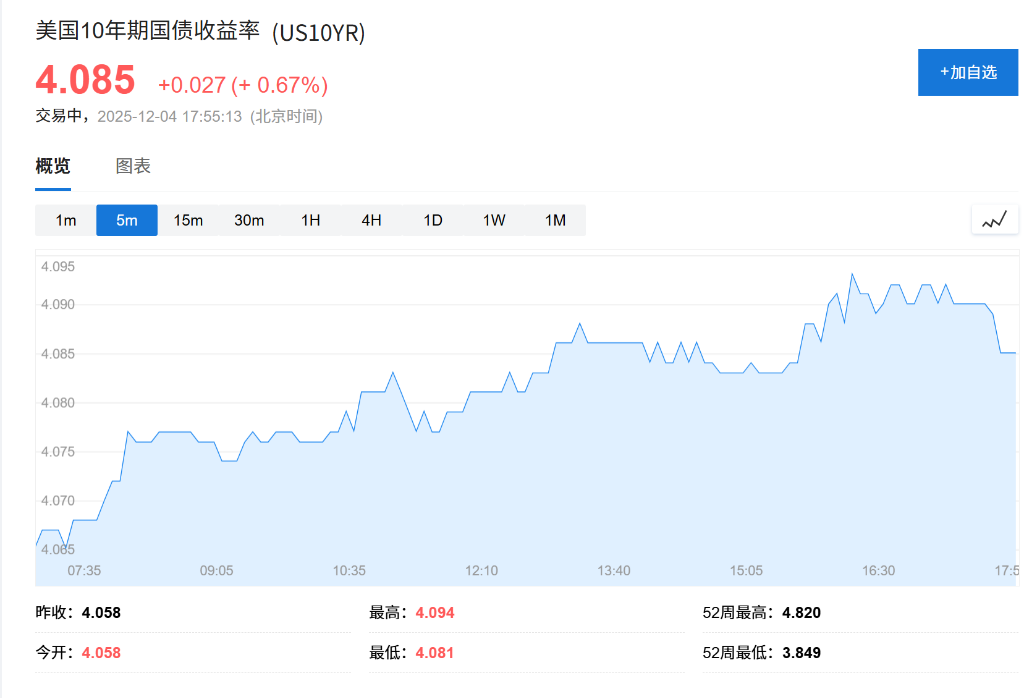
近日,PGIM固定收益公司的联席首席投资官Gregory Peters在接受媒体采访时警告称,即便现任白宫国家经济委员会主任哈赛特最终被任命为下 一届美联储主席,他可能也没有能力实现特朗普所希望的快速降息,因为美联储的利率决策终究由委员会集体决定。 这一警告发出之际,市场正热议哈赛特若执掌美联储,可能会为迎合特朗普而采取激进的货币宽松政策。特朗普本周表示,美联储主席的角逐 已"缩减至一人",并称哈赛特是"潜在的美联储主席人选",这让哈赛特成为该职位的头号热门。 哈赛特成为热门人选已引发投资者对美联储独立性的新一轮担忧。Peters指出,这一担忧正在转化为风险溢价,并被计入全球主权债券的定价中。 他强调,美联储的独立性"仍然是投资者的一个主要关切点"。 然而,尽管市场对此高度关注,但美国国债收益率在周四表现平稳基准10年期国债收益率维持在4.08%,对政策敏感的2年期国债收益率微升1个 基点至3.50%。 | 概览 | 图表 | | | | | | | | | | | | | --- | --- | --- | --- | --- | --- | --- | --- | --- | --- | --- | -- ...

冠通期货早盘速递-20251202
Guan Tong Qi Huo· 2025-12-02 05:05
Report Summary Key Information - The Guangzhou Futures Exchange will adjust the trading margin standard and trading limit of the polysilicon futures PS2601 contract. Effective from the settlement on December 3, 2025, the speculative trading margin standard will be adjusted to 13%, and the hedging trading margin standard will be adjusted to 12%. Starting from the trading session on December 3, 2025, the single - day opening volume of non - futures company members or clients on the polysilicon futures PS2601 contract shall not exceed 500 lots [2] - The Henan Bureau of the National Mine Safety Administration has ordered Henan Shenhuo Coal & Power Co., Ltd.'s Xinzhuang Coal Mine to suspend production for rectification for 2 days due to major accident hazards [2] - The ANRPC monthly rubber report shows that in October 2025, natural rubber prices showed a bearish trend. In 2025, the global natural rubber production is expected to increase slightly by 1.3% compared to 2024, and demand is expected to increase by 0.8% [2] - As of November 28, 2025, the commercial inventory of soybean oil in key regions across China was 117.88 million tons, a decrease of 0.11 million tons from the previous week, a decline of 0.09%. The commercial inventory of palm oil in key regions was 65.35 million tons, a decrease of 1.36 million tons from the previous week, a decline of 2.04% [2] - The US ISM Manufacturing PMI index in November dropped 0.5 points to 48.2, remaining below the 50 boom - bust line for nine consecutive months, marking the largest contraction in four months. The new orders index dropped to the fastest contraction rate since July, and the backlog of orders had the largest decline in seven months [3] Plate Performance - Key areas of focus include urea, coking coal, silver, asphalt, and PVC [4] - In the night session, the non - metallic building materials sector rose 2.77%, the precious metals sector rose 30.31%, the oilseeds and oils sector rose 9.08%, the non - ferrous metals sector rose 23.79%, the soft commodities sector rose 2.75%, the coal, coking, steel, and ore sector rose 12.35%, the energy sector rose 2.84%, the chemical sector rose 10.87%, the grain sector rose 1.39%, and the agricultural and sideline products sector rose 3.84% [4] Plate Position - The document presents the position changes of commodity futures plates in the past five days, but specific data is not clearly stated in text form [5] Performance of Major Asset Classes | Category | Name | Daily Return (%) | Monthly Return (%) | Annual Return (%) | | --- | --- | --- | --- | --- | | Equity | Shanghai Composite Index | 0.65 | 0.65 | 16.77 | | | SSE 50 | 0.81 | 0.81 | 11.51 | | | CSI 300 | 1.10 | 1.10 | 16.30 | | | CSI 500 | 1.00 | 1.00 | 24.03 | | | S&P 500 | - 0.53 | - 0.53 | 15.83 | | | Hang Seng Index | 0.67 | 0.67 | 29.78 | | | German DAX | - 1.04 | - 1.04 | 18.49 | | | Nikkei 225 | - 1.89 | - 1.89 | 23.58 | | | FTSE 100 | - 0.18 | - 0.18 | 18.71 | | Fixed - income | 10 - year Treasury Bond Futures | 0.12 | 0.09 | - 0.81 | | | 5 - year Treasury Bond Futures | 0.10 | 0.09 | - 0.66 | | | 2 - year Treasury Bond Futures | 0.03 | 0.03 | - 0.55 | | Commodity | CRB Commodity Index | 0.41 | 0.41 | 2.03 | | | WTI Crude Oil | 1.71 | 1.97 | - 17.20 | | | London Spot Gold | 0.30 | 0.30 | 61.24 | | | LME Copper | 0.00 | 0.00 | 27.26 | | | Wind Commodity Index | 2.12 | 2.12 | 36.63 | | Other | US Dollar Index | - 0.03 | - 0.03 | - 8.36 | | | CBOE Volatility Index | 0.00 | 0.00 | - 5.76 | [6]
A股市场快照:宽基指数每日投资动态-20251201
Jianghai Securities· 2025-12-01 12:22
- The report primarily focuses on tracking and analyzing the performance of broad-based indices in the A-share market, including metrics such as daily returns, moving averages, turnover rates, risk premiums, PE-TTM, and dividend yields[1][2][3] - The turnover rate of the indices is calculated using the formula: $ \text{Turnover Rate} = \frac{\Sigma(\text{Circulating Shares of Component Stocks} \times \text{Turnover Rate of Component Stocks})}{\Sigma(\text{Circulating Shares of Component Stocks})} $ This metric highlights the liquidity and trading activity of the indices, with the highest turnover rate observed for CSI 2000 (3.91) and the lowest for SSE 50 (0.22)[17] - The risk premium is calculated relative to the 10-year government bond yield, serving as a measure of the relative investment value of the indices. For instance, the current risk premium for CSI 500 is 1.15%, with a 5-year historical percentile of 85.24%, indicating a relatively high valuation compared to historical levels[27][31] - The PE-TTM (Price-to-Earnings Trailing Twelve Months) is used as a valuation metric. For example, the current PE-TTM for CSI 1000 is 46.97, with a 5-year historical percentile of 95.95%, suggesting a high valuation relative to its historical range[37][43] - Dividend yield is analyzed as a measure of cash return to investors. For instance, the current dividend yield for SSE 50 is 3.31%, with a 5-year historical percentile of 36.53%, indicating a moderate level compared to its historical distribution[48][53] - The report also examines the kurtosis and skewness of daily return distributions for the indices. For example, the CSI 2000 index has the smallest negative skewness (-0.37) and the highest kurtosis (1.38) among the indices, indicating a more concentrated return distribution with fewer extreme negative returns[23][25]
国债期货交易数据
Yong An Qi Huo· 2025-12-01 01:22
1. Global Asset Market Performance - Main economies' 10 - year treasury bond yields: US 4.015, UK 4.440, France 3.408, Germany 2.688, Italy 3.398, Spain 3.163, Switzerland 0.149, Greece 3.286, Japan 1.806, Brazil 6.144, China 1.830, South Korea 3.346, Australia 4.515, New Zealand 4.253 [1] - Main economies' 2 - year treasury bond yields: US 3.491, UK 3.736, Germany 2.026, Japan 0.972, Italy 2.175, China (1Y yield) 1.394, South Korea 2.848, Australia 3.807 [1] - USD exchange rates against major emerging - economy currencies: Brazil 5.335, Russia (not available), South Africa zar 17.113, South Korean won 1467.300, Thai baht 32.195, Malaysian ringgit 4.133 [1] - RMB exchange rates: On - shore RMB 7.075, Off - shore RMB 7.071, RMB central parity rate 7.079, RMB 12 - month NDF 6.936 [1] - Main economies' stock indices: S&P 500 6849.090, Dow Jones Industrial Average 47716.420, NASDAQ 23365.690, Mexican index 63596.780, UK index 9720.510, France CAC 8122.710, Germany DAX 23836.790, Spanish index 16371.600, Russian index (not available), Nikkei 50253.910, Hang Seng Index 25858.890, Shanghai Composite Index 3888.596, Taiwan index 27626.480, South Korean index 3926.590, Indian index 8508.706, Thai index 1256.690, Malaysian index 1604.470, Australian index 8918.688, Emerging - economy index 1366.920 [1] - Credit bond indices: US investment - grade credit bond index 3552.300, Euro - zone investment - grade credit bond index 266.285, Emerging - economy investment - grade credit bond index 290.250, US high - yield credit bond index 2898.070, Euro - zone high - yield credit bond index 408.890, Emerging - economy high - yield credit bond index 1801.247 [1] 2. Stock Index Futures Trading Data - Index performance: A - share closing price 3888.60, up 0.34%; CSI 300 closing price 4526.66, up 0.25%; SSE 50 closing price 2969.62, down 0.09%; ChiNext closing price 3052.59, up 0.70%; CSI 500 closing price 7031.55, up 1.15% [2] - Valuation: CSI 300 PE(TTM) 13.94, down 0.01; SSE 50 PE(TTM) 11.83, down 0.05; CSI 500 PE(TTM) 32.03, up 0.36; S&P 500 PE(TTM) 27.22, up 0.14; Germany DAX PE(TTM) 18.48, up 0.05 [2] - Risk premium: S&P 500 1/PE - 10 - year interest rate - 0.34, down 0.04; Germany DAX 1/PE - 10 - year interest rate 2.72, down 0.03 [2] - Fund flow: A - share latest value 190.92, 5 - day average - 112.89; Main board latest value 147.52, 5 - day average - 147.45; ChiNext latest value 37.44, 5 - day average 25.57; CSI 300 latest value - 41.10, 5 - day average 0.41 [2] 3. Other Trading Data - Transaction amount: Shanghai and Shenzhen stock markets latest value 15857.96, down 1239.98; CSI 300 latest value 3418.32, down 759.58; SSE 50 latest value 850.32, down 200.74; SME board latest value 3098.26, down 177.49; ChiNext latest value 4567.21, down 380.14 [3] - Main contract basis: IF basis - 20.86, - 0.46%; IH basis - 6.42, - 0.22%; IC basis - 57.35, - 0.82% [3] - Treasury bond futures: T2303 closing price 108.15, up 0.03%; TF2303 closing price 105.71, up 0.03%; T2306 closing price 107.94, up 0.04%; TF2306 closing price 105.75, down 0.02% [3] - Fund rates: R001 1.4252%, down 9.00 BP; R007 1.5222%, unchanged; SHIBOR - 3M 1.5800%, unchanged [3]
【广发金工】AI识图关注中药、银行和红利
广发金融工程研究· 2025-11-30 07:12
Market Performance - The Sci-Tech 50 Index increased by 3.21% and the ChiNext Index rose by 4.54% over the last five trading days, while the large-cap value index decreased by 0.21% [1] - The large-cap growth index gained 2.63%, the Shanghai 50 Index rose by 0.47%, and the small-cap index represented by the CSI 2000 increased by 4.50% [1] - The communication and electronics sectors performed well, while the oil, petrochemical, and banking sectors lagged behind [1] Valuation Levels - As of November 28, 2025, the static PE of the CSI All Share Index is at a percentile of 79%, with the Shanghai 50 and CSI 300 at 75% and 71% respectively [1] - The ChiNext Index is close to the 48th percentile, while the CSI 500 and CSI 1000 are at 60% and 57% respectively, indicating that the ChiNext Index's valuation is relatively at the historical median level [1] ETF and Fund Flows - In the last five trading days, ETF inflows amounted to 8.2 billion yuan, while margin trading decreased by approximately 19.1 billion yuan [2] - The average daily trading volume across both markets was 172.38 billion yuan [2] Thematic Investment Focus - The latest thematic investment focus includes traditional Chinese medicine, banking, and high-dividend stocks, specifically targeting indices such as the CSI Traditional Chinese Medicine Index, CSI Banking Index, and the Shanghai State-Owned Enterprises Dividend Index [2][3] Long-term Market Sentiment - The report includes observations on the proportion of stocks above the 200-day moving average, indicating long-term market sentiment [13] Risk Preference Tracking - The report tracks the risk preference between equity and bond assets, providing insights into market behavior [14] Financing Balance - The report discusses the financing balance, which is crucial for understanding market liquidity and investor sentiment [16] Individual Stock Performance - A statistical distribution of individual stock performance year-to-date based on return intervals is provided, highlighting the performance landscape [18] Oversold Indices - The report notes instances of oversold conditions in certain indices, which may present potential buying opportunities [20]


分析师:日本国债对预算可能恶化作出反应
Sou Hu Cai Jing· 2025-11-27 06:27
Core Viewpoint - Japan's fiscal situation remains tight, with potential deterioration in the 2026 budget, as indicated by rising government bond yields [1] Group 1: Fiscal Situation - Helaba's Samuel Will reports that Japan's budget balance has improved in recent years but is expected to worsen in 2026 [1] - The government is focusing on growth through investment and strengthening defense capabilities, but must monitor rising debt and geopolitical tensions [1] Group 2: Bond Yields - The 10-year Japanese government bond yield decreased by 1.9 basis points to 1.792% [1] - The 30-year Japanese government bond yield increased by 0.4 basis points to 3.331% [1]
王增武:以非线性数学期望破解低利率下的不确定性溢价
2 1 Shi Ji Jing Ji Bao Dao· 2025-11-24 10:35
Core Viewpoint - The current economic and financial logic has shifted from linear to nonlinear, necessitating new approaches to wealth management and asset allocation in a low-interest-rate environment [3][4]. Group 1: Theoretical Insights - The 2008 financial crisis highlighted the inadequacy of traditional linear models in predicting significant market events, emphasizing the need for a focus on uncertainty in investment decisions [3]. - Nonlinear mathematical expectations are essential for understanding the uncertainty that characterizes current market conditions, as traditional risk premiums only address quantifiable risks [3][4]. - Embracing uncertainty can lead to excess returns, and recognizing different types of uncertainty is crucial for effective asset management [4][5]. Group 2: Practical Applications - Three main strategies for wealth management in a low-interest-rate environment include expanding service boundaries to meet client needs, diversifying asset classes to include innovative financial products, and employing various investment strategies to enhance returns [5][6]. - The importance of refined risk control and volatility management is underscored, as many institutions have failed to anticipate risks in nonlinear environments [5][6]. - Tools such as machine learning can help investors transform uncertainty into manageable risks, ultimately leading to wealth preservation and growth [6].

资产配置全球跟踪2025年11月第4期:资产概览:美元兑日元逼近160关口
GUOTAI HAITONG SECURITIES· 2025-11-24 09:23
Group 1: Cross-Asset Overview - Global risk appetite has decreased, leading to a synchronized decline in both equity and commodity markets. As of the week ending November 21, the VIX and MOVE indices have shown significant increases, indicating heightened market volatility. Major global stock indices have generally retreated, with technology and growth sectors underperforming. Precious metals and crude oil have also recorded declines, while the Chinese bond market saw a slight increase. The US dollar index has surpassed 100, and the Japanese yen has depreciated significantly, approaching the 160 mark against the dollar [7][12][40]. Group 2: Equity Market Performance - The technology sector has faced notable declines, with the MSCI Global Index down by 2.5%. In developed markets, US stock indices experienced a slight rebound due to dovish comments from the Federal Reserve, but overall, they closed lower for the week. The S&P 500 and Dow Jones fell by 1.9%, while the Nasdaq dropped by 2.7%. European indices also retreated, with the STOXX50 down by 3.1% and the German DAX by 3.3%. In the emerging markets, the A-share small-cap, ChiNext, and STAR Market indices fell more than the overall A-share index, which was down by 5.1%. Conversely, the Russian RTS index surged by 9.1% [20][27][40]. Group 3: Bond Market Dynamics - The Chinese bond market is characterized by a "bear steepening" yield curve, with the overall yield curve shifting upward. The 10Y-2Y yield spread has widened, indicating a marginal increase in long-term yields. In contrast, the US bond market is exhibiting a "bull steepening" trend, with the yield curve moving downward. The probability of a Federal Reserve rate cut in December has risen to 71%, reflecting a shift in market expectations [40][42][51]. Group 4: Commodity and Currency Trends - Commodity prices have generally declined, with the South China and CRB commodity indices falling by 1.8% and 2.2%, respectively. Among 13 major commodity futures, only three recorded price increases, with iron ore leading the gains. The US dollar index has risen by 0.9%, surpassing 100, while the Japanese yen has depreciated by 1.2%, nearing the 160 mark against the dollar. This depreciation benefits Japanese exporters but increases inflationary pressures [4][12][40].
大类资产早报-20251121
Yong An Qi Huo· 2025-11-21 01:33
| 指数表现 | A股 | 沪深300 | 上证50 | 创业板 | 中证500 | | --- | --- | --- | --- | --- | --- | | 收盘价 | 3931.05 | 4564.95 | 3008.29 | 3042.34 | 7061.95 | | 涨跌(%) | -0.40 | -0.51 | -0.40 | -1.12 | -0.85 | | 估值 | 沪深300 | 上证50 | 中证500 | 标普500 | 德国DAX | | PE(TTM) | 14.14 | 12.03 | 32.17 | 25.98 | 18.06 | | 环比变化 | -0.02 | 0.01 | -0.27 | -0.41 | 0.09 | | 风险溢价 | 沪深300 | 上证50 | 中证500 | 标普500 | 德国DAX | | 1/PE-10利率 | 3.70 | 5.77 | -0.38 | -0.24 | 2.82 | | 环比变化 | 0.00 | 0.00 | 0.00 | 0.11 | -0.04 | | 资金流向 | A股 | 主板 | 中小企业板 | 创业板 | 沪 ...
A股市场快照:宽基指数每日投资动态-20251119
Jianghai Securities· 2025-11-19 12:31
- The report tracks the performance of various broad-based indices in the A-share market, including their daily, weekly, monthly, and yearly changes. For instance, on November 18, 2025, all tracked indices fell, with the CSI 2000 and CSI 500 experiencing the largest declines of -1.32% and -1.17%, respectively[1][2][10] - The report compares the indices against their moving averages and their positions relative to the highest and lowest points over the past 250 trading days. For example, all tracked indices have fallen below their 5-day and 10-day moving averages, with the CSI 2000 still above its 20-day moving average[13] - The report provides data on the trading volume and turnover rates of the indices. On November 18, 2025, the CSI 2000 had the highest trading volume share at 24.98%, followed by the CSI 300 at 22.28% and the CSI 1000 at 22.17%. The turnover rates for these indices were 4.48, 2.85, and 2.83, respectively[15] - The report analyzes the distribution of daily returns for the indices, noting that the ChiNext Index has the largest negative kurtosis deviation, while the CSI 1000 has the smallest. The CSI 2000 has the smallest negative skewness, while the SSE 50 has the largest[21][23] - The report examines the risk premiums of the indices relative to the 10-year government bond yield. As of November 18, 2025, the SSE 50 and CSI 300 had relatively high 5-year percentile risk premiums of 37.62% and 24.29%, respectively, while the CSI 2000 and CSI 500 had lower values of 15.95% and 13.41%[25][28][29] - The report evaluates the PE-TTM (Price-to-Earnings ratio based on trailing twelve months) of the indices as a measure of valuation. The CSI 1000 and CSI 500 had high 5-year percentile values of 96.86% and 95.45%, respectively, while the CSI 2000 and ChiNext Index had lower values of 82.64% and 55.04%[37][40][41] - The report assesses the stock-bond yield ratio, which compares the inverse of the PE-TTM to the 10-year government bond yield. None of the indices were above their 80% percentile (opportunity value), and none were below their 20% percentile (danger value)[43] - The report tracks the dividend yields of the indices, noting that the ChiNext Index and CSI 1000 had relatively high 5-year historical percentile values of 70.58% and 39.17%, respectively, while the CSI 500 and CSI 2000 had lower values of 16.94% and 13.55%[45][50][51] - The report monitors the net asset value break rates of the indices, indicating the proportion of stocks trading below their net asset value. As of the latest data, the break rates were 22.0% for the SSE 50, 16.0% for the CSI 300, 11.6% for the CSI 500, 7.2% for the CSI 1000, 2.45% for the CSI 2000, 1.0% for the ChiNext Index, and 5.65% for the CSI All Share Index[52]