
反内卷政策

Search documents
王天丰:“股债跷跷板”或将脱敏,债市后续怎么看?
Sou Hu Cai Jing· 2025-09-18 15:55
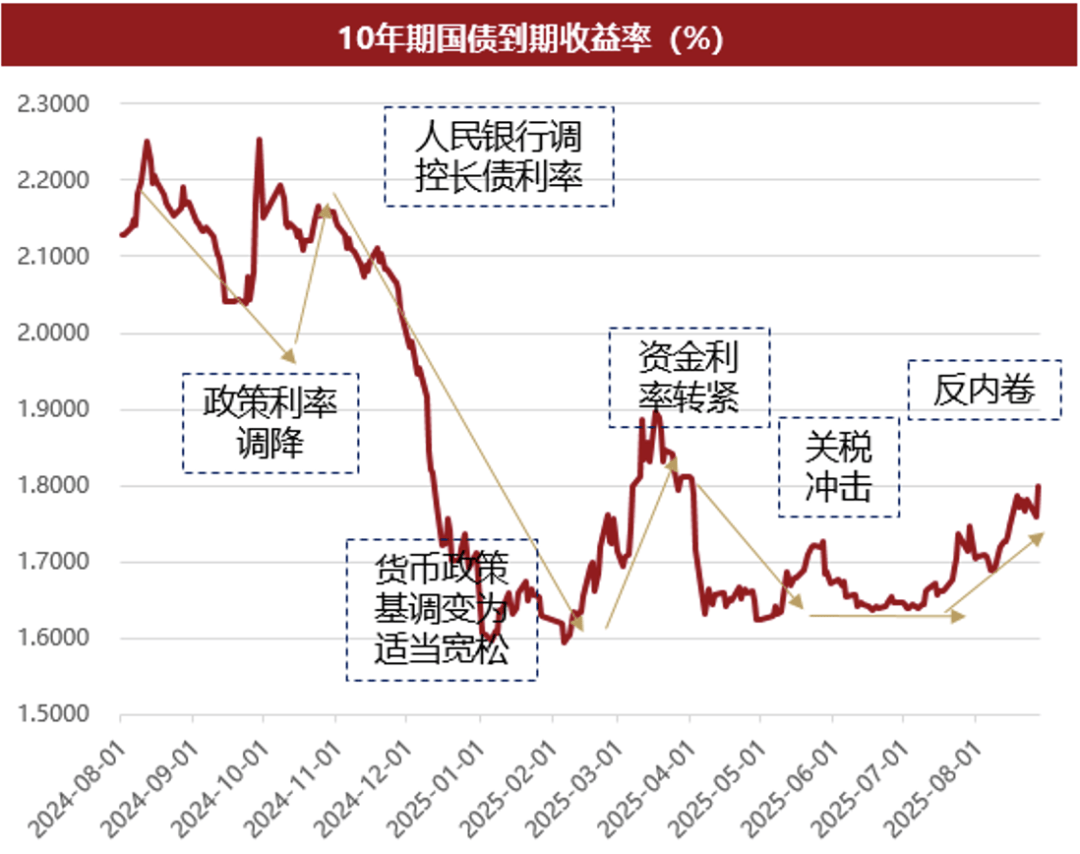
Group 1 - The bond market has shown a weak and fluctuating trend since Q3 2025, with the ten-year government bond yield rising from approximately 1.63% to 1.78%, an increase of about 15 basis points [1][3][8] - The yield curve has exhibited a rare "bear steepening" characteristic, indicating changes in growth and inflation expectations influenced by commodity and stock market movements [7][8] - Credit bonds have performed relatively well, with the funding environment remaining loose since mid-year, and market leverage returning to historical average levels [1][8] Group 2 - The Federal Reserve's policies are a key variable affecting the bond market, with expectations of multiple rate cuts in the second half of the year due to a weakening U.S. economy and a deteriorating labor market [1][9][14] - Domestic economic indicators, such as retail sales and fixed asset investment, have shown marginal weakness, with expectations that overall economic growth may fall below annual targets [1][20][24] - The "anti-involution" policy is being advanced towards legalization and marketization, which may have long-term implications for inflation and economic stability [1][28][29] Group 3 - The ten-year government bond ETF (511260) is highlighted as a valuable investment tool due to its low fees, transparency, and stable historical returns, making it a preferred choice for bond market allocation [2][35][39] - The ETF has consistently achieved positive returns from 2018 to 2024, making it suitable for long-term investment strategies [2][35] - The bond market's current yield levels are considered neutral to low, with limited downward space due to the central bank's stance, necessitating attention to the policy combination of "central bank easing + government bond issuance" [33][34]

研究框架培训:反内卷研究框架
2025-09-18 14:41
Summary of Conference Call Records Industry or Company Involved - The discussion revolves around the **反内卷 (Anti-Involution) policy** and its implications across various industries, including **traditional manufacturing** (steel, coal, building materials) and **emerging manufacturing** (photovoltaics, lithium batteries, new energy vehicles) [1][5][6]. Core Points and Arguments 1. **Introduction of Anti-Involution Policy**: The policy was first proposed in July 2024 and aims to address overcapacity issues in both traditional and emerging manufacturing sectors, with acceleration expected in Q2 2025 [1][3]. 2. **Current Supply-Side Situation**: The domestic supply-side situation is characterized by a third capacity cycle's downward phase, which has lasted nearly four years since late 2021, leading to significant overcapacity in certain industries [2][5]. 3. **Differences from Previous Supply-Side Reforms**: Unlike the previous reforms focused mainly on steel and coal through administrative measures, the current policy encompasses a broader range of industries and is driven more by industry self-discipline rather than strict government mandates [5][8]. 4. **Indicators for Evaluating Industry Performance**: Key indicators for assessing industry performance under the Anti-Involution policy include **industrial added value**, **PPI (Producer Price Index)**, and **capacity** [1][6]. 5. **Emerging Industries' Challenges**: New energy sectors, despite low price indicators, are experiencing a negative cycle of price-for-volume exchanges, necessitating external intervention to break this cycle [6][10]. 6. **Need for Comprehensive Approaches**: The current demand landscape is more complex, influenced by local government competition and new entrants, requiring a more integrated approach to effectively reduce excess capacity [7][8]. 7. **Real-Time Monitoring of Prices**: Price is identified as the core indicator that needs continuous tracking to navigate the complexities of the current market environment [9][10]. Other Important but Possibly Overlooked Content 1. **Evaluation Metrics**: The willingness of enterprises to participate can be gauged by the proportion of loss-making companies and interest coverage ratios, while long-term sustainability can be assessed through concentration trends and the proportion of state-owned enterprises [11]. 2. **Capital Expenditure Trends**: Changes in capital expenditure and government subsidy trends are critical for understanding the resistance to capacity reduction across various sectors [11][12]. 3. **Sector-Specific Insights**: Industries such as steel, glass, and the new energy chain are highlighted as areas requiring focused attention due to their unique challenges and performance metrics [12][13]. 4. **Pathways to Overcome Involution**: Industries can escape involution through policy-driven profit certainty, breaking negative cycles, and ensuring price stability [9][10]. This summary encapsulates the key insights from the conference call, providing a comprehensive overview of the Anti-Involution policy's implications across various sectors and the necessary metrics for evaluation.
万家基金“周期鬼才” 叶勇:锚定顺周期,做战略性布局
Sou Hu Cai Jing· 2025-09-18 11:44
Group 1 - The article highlights Ye Yong's unique experience and expertise in macro and industry cycles, which has led to significant investment success in sectors like energy, gold, and industrial metals [1][3][4] - Ye Yong's funds, managed under Wan Jia Fund, have shown impressive returns, with Wan Jia Trend leading at 73.07% and Wan Jia Cycle Driver at 51.75% over the past year [1] - His investment strategy is characterized by a deep understanding of macroeconomic trends and the ability to identify cyclical opportunities, particularly in the context of the current global economic shifts [1][5][16] Group 2 - Ye Yong's background as a financial journalist and his roles in equity investment have provided him with a solid foundation for understanding macroeconomic and cyclical trends [3][4] - He emphasizes the importance of recognizing the cyclical nature of various industries, advocating for a top-down investment approach rather than a narrow focus on cyclical stocks [8][9] - Ye Yong's insights into the commodity cycle indicate a shift from a decade-long downtrend to an upward cycle, particularly in resources like coal and oil [5][10] Group 3 - The article discusses Ye Yong's perspective on the "anti-involution" policy, which he believes has significant implications for macroeconomic stability and industry dynamics [16][17] - Ye Yong argues that the current economic environment necessitates a comprehensive approach to address overcapacity across various sectors, unlike previous supply-side reforms [16][18] - He predicts that the Producer Price Index (PPI) will see a turning point in the second half of the year, potentially reversing the deflationary spiral [21][30] Group 4 - Ye Yong outlines three key investment areas for the upcoming year: industrial metals, traditional cyclical leaders, and post-cyclical sectors, indicating a strategic shift towards cyclical assets [32][34][35] - He identifies copper as a core investment due to its stable demand and supply dynamics, likening its importance to that of oil in previous commodity bull markets [13][32] - The article emphasizes the need for investors to adapt their perceptions of resource stocks, as the current market conditions favor a transition from a downtrend to an uptrend in commodity prices [10][30]
瑞达期货纯碱玻璃产业日报-20250918
Rui Da Qi Huo· 2025-09-18 10:21
Report Summary 1. Report Industry Investment Rating - Not provided in the content 2. Core Viewpoints - For soda ash, supply is expected to be ample, demand to stabilize, and prices to remain under pressure, but there may be variables with "anti - involution" hype. Short - term upward movement is still under pressure. It is recommended to buy on dips for the soda ash main contract [2]. - For glass, the supply is still at a low level with a slight increase, and the demand is affected by the sluggish real estate market. The overall inventory has a destocking trend. The market may fluctuate around the demand side. It is recommended to buy on dips after the sentiment stabilizes [2]. 3. Summary by Directory Futures Market - Soda ash main contract closing price: 1306.98 yuan/ton, down 28 yuan/ton; glass main contract closing price: 1208 yuan/ton, down 2 yuan/ton [2]. - Soda ash main contract open interest: 1391918 lots, down 52376 lots; glass main contract open interest: 1291147 lots, down 13158 lots [2]. - Soda ash top 20 net open interest: - 259926, down 12111; glass top 20 net open interest: - 203637, down 29650 [2]. - Soda ash exchange warehouse receipts: 35 tons, unchanged; glass exchange warehouse receipts: 754 tons, down 286 tons [2]. - Soda ash basis: - 71 yuan/ton, up 23 yuan/ton; glass basis: - 124 yuan/ton, up 26 yuan/ton [2]. - 1 - 5 month glass contract spread: - 120, down 12; 1 - 5 month soda ash contract spread: - 94, down 10 [2]. Spot Market - North China heavy soda ash: 1235 yuan/ton, down 5 yuan/ton; Central China heavy soda ash: 1300 yuan/ton, unchanged [2]. - East China light soda ash: 1250 yuan/ton, unchanged; Central China light soda ash: 1215 yuan/ton, up 5 yuan/ton [2]. - Shahe glass sheets: 1084 yuan/ton, unchanged; Central China glass sheets: 1140 yuan/ton, up 10 yuan/ton [2]. Industry Situation - Soda ash plant operating rate: 87.29%, up 1.07 percentage points; float glass enterprise operating rate: 76.01%, unchanged [2]. - Glass in - production capacity: 16.02 million tons/year, up 0.06 million tons/year; glass in - production line number: 225, unchanged [2]. - Soda ash enterprise inventory: 174.71 million tons, down 5.04 million tons; glass enterprise inventory: 6158.3 million weight cases, down 146.7 million weight cases [2]. Downstream Situation - Real estate new construction area cumulative value: 352060000 square meters, up 48416800 square meters; real estate completion area cumulative value: 250340000 square meters, up 24673900 square meters [2]. Industry News - Multiple news including diplomatic meetings, state - owned enterprise restructuring, service consumption promotion, and policy expansion in certain industries [2]. Macro - aspect and Viewpoint Summary - In August, industrial added value above designated size increased by 5.2% year - on - year, and social retail sales increased by 3.4% year - on - year [2]. - Soda ash supply: domestic operating rate and output are rising, and some backward capacities may be phased out in the long run [2]. - Soda ash demand: glass production is at a low level with a slight increase, and photovoltaic glass has a small impact on soda ash demand [2]. - Glass supply: production is at a low level with a slight increase, and profit is rising due to price increase [2]. - Glass demand: the real estate market is sluggish, downstream orders are slightly increasing, and inventory is fluctuating around demand [2].

光控资本:本轮慢牛行情的基础仍然存在
Sou Hu Cai Jing· 2025-09-18 04:21
Group 1 - The A-share market showed resilience amidst a generally subdued Asia-Pacific market, with three major indices rising, although the number of stocks rising was slightly less than those falling, indicating market differentiation and style rotation [3] - The A-share market is expected to maintain a steady upward trend in the short term, supported by the influx of household savings into the capital market, which is crucial for the market index's strength [3] - The sectors performing well included optical electronics, photovoltaic equipment, and batteries, while sectors like precious metals, retail, and travel showed weaker performance [1][3] Group 2 - The recent net inflow of global funds into the A-share market is attributed to the acceleration of household savings transitioning to the capital market, creating a continuous source of incremental funds [1] - The market is anticipated to experience new investment opportunities amidst structural optimization, with close attention needed on policy changes, funding conditions, and external market developments [1] - The current valuation of A-shares remains attractive in the medium to long term, with future "anti-involution" policies and demand-side policies being critical factors for determining the market's height [3]

国泰海通:收支有待提振
Ge Long Hui· 2025-09-18 03:51
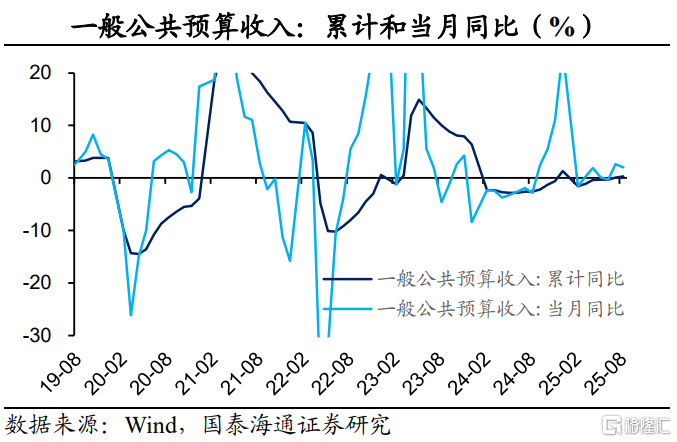
Group 1: Narrow Income - National general public budget revenue grew by 0.3% year-on-year from January to August 2025, with August's growth at 2%, down from 2.6% in July [1][4] - The decline in PPI has eased the drag on tax revenue, and the securities transaction stamp duty has provided significant support to tax revenue [1][4] - Corporate income tax revenue saw a substantial rebound, mainly due to a low base last year, while personal income tax and consumption tax revenue growth slowed [1][6] Group 2: Narrow Expenditure - National general public budget expenditure increased by 3.1% year-on-year from January to August 2025, with August's growth at 0.8%, down from 3% in July [1][8] - Expenditure in the social welfare sector continued to grow significantly, while infrastructure spending remained low [1][10] - Central government expenditure grew by 8.0%, significantly higher than local government expenditure growth of 2.3% [1][8] Group 3: Government Fund - National government fund budget revenue decreased by 1.4% year-on-year from January to August 2025, with a notable decline in land use rights transfer revenue [2][13] - Government fund budget expenditure grew by 30.0% year-on-year, driven by accelerated bond issuance by various levels of government [2][13] - The implementation of policy financial tools is expected to support domestic demand expansion [2][13]

中邮证券:在建产能增速连续转负 化工行业格局向好
智通财经网· 2025-09-18 03:00
基础化工板块在建工程连续三个季度环比增速转负,供给拐点再次确认。 2025年Q2基础化工板块总固定资产约14465亿元,同比增长16%,环比2025年一季度增长5%,总在建工 程合计3504亿元,同比减少10%,环比2025年一季度减少6%。在建工程已经自2024年Q3以来连续三个 季度环比转负。在反应行业投资情况的核心比率2025年Q2在建工程/固定资产比率仅为24%,较近年高 点2023年Q2的37%,已经下降13pct,国内基础化工行业目前新建产能增速已经大幅度回落,行业供给 端扩产已经减速,格局向好,一方面反应过去几年基础化工行业利润下行行业的自主约束,一方面是行 业政策对于产能过剩行业进行约束。后续来看,随着行业供给端政策约束和国内大市场需求推动,基础 化工板块景气度有望走向上通道。 风险提示:产品价格大幅下跌的风险,新增产能投放进度超预期的风险,原材料市场波动剧烈风险和下 游需求不及预期的风险。 2025年上半年基础化工总结,营业收入和净利润稳中带升。 基础化工板块(采用申万2021版行业分类)2025年Q2总实现营业收入6111亿元,同比增长1%,环比增长 10%,环比是近三个季度以来首次转正。 ...
废铜行业税收政策调整对当前行情影响探讨
Hua Tai Qi Huo· 2025-09-18 02:14
Group 1: Report Summary - The 770th document of the National Development and Reform Commission in August 2025 included "tax rebates" in the list of illegal investment - promotion practices. Enterprises registered after May 2024 should cancel local retention rebates by the end of August, while those registered before can have a buffer until 2027. Some regions like Jiangxi and Anhui have already suspended rebates in September [2]. - The policy targets the "white - slip accounting" model in the recycled copper industry, and the practice of relying on local fiscal tax refunds of 4 - 6 percentage points is restricted, causing a sharp increase in enterprise costs [2]. - Referring to the experience of the lead industry, the recycled lead industry is in a "standardization pain period" with polarization. Leading enterprises adapt quickly, while small and medium - sized enterprises face challenges [3]. - When the scrap copper industry enters the "no - rebate era", enterprises should shift their competitiveness from "fiscal bonuses" to "real spreads", and investors should focus on local implementation rhythm and copper price rebound height [3]. Group 2: Background and Review - Since 2016, the policy orientation of the recycled metal industry has evolved from "environmental protection rectification" to "tax standardization". In the early stage, many small - scale scrap copper recycling workshops were shut down due to environmental non - compliance [10]. - Since 2019, policy focus has shifted to tax regulatory supervision. The "reverse invoicing" mechanism in 2024 marked the upgrade of the tax supervision system [10]. Group 3: Impact of Tax Policy on Domestic Scrap - related Enterprises Lead Industry Example - Before the "reverse invoicing" policy, the recycled lead industry had problems such as high tax costs, tax evasion, and environmental risks due to the lack of input tax deductions [11]. - After the implementation of the "reverse invoicing" policy, there were challenges such as data traceability difficulties, regional policy differences, and slow integration of individual recyclers [12][13]. - The recycled lead industry shows polarization. Leading enterprises' market share has reached over 50%, while small and medium - sized enterprises' capacity utilization has dropped from 75% to 45% [3][13]. Impact on Scrap Copper Enterprises - The 770th document affects the scrap copper industry. Enterprises relying on local fiscal tax refunds face cost - doubling pressure [20]. - In the worst - case scenario of full cancellation of rebates, the comprehensive tax rate of recycled copper enterprises will rise from 5.6% to 11.7% - 13.3%, and production capacity will shrink significantly. In the neutral scenario of partial cancellation, the impact is relatively mild [22]. - Enterprises should improve the proportion of taxable purchases at the raw material end, transfer taxes to downstream at the sales end, choose regions with long policy buffer periods, and use financial tools such as futures [3][24]. Group 4: Current Situation of Domestic Recycled Copper Rods - In the past 5 years, domestic recycled copper rod capacity has increased by nearly 400%, but there are many inefficient capacities. Since the second half of this year, enterprises have little profit [25]. - From January to July 2025, domestic scrap - produced blister copper output increased by 13.60% year - on - year, while scrap copper imports decreased by 0.5% year - on - year. The loss of the US as an import source may limit future import growth [26]. Group 5: Summary and Hedging Strategy Suggestions - The government's rectification of recycled resources and tax norms aims to ensure the stable supply of important resources and eliminate unfair competition. However, it may impact raw material supply in the short term [4][28]. - Considering various factors, copper prices may remain strong from September to October. Enterprises with buying hedging needs are advised to buy on dips, and those with selling hedging needs should increase hedging efforts in the price range of 84,000 - 84,500 yuan/ton [4][28].
大越期货玻璃早报-20250918
Da Yue Qi Huo· 2025-09-18 02:04
交易咨询业务资格:证监许可【2012】1091号 大越期货投资咨询部 胡毓秀 从业资格证号:F03105325 投资咨询证号:Z0021337 联系方式:0575-85226759 重要提示:本报告非期货交易咨询业务项下服务,其中的观点和信息仅作参考之用,不构成对任何人的投资建议 。 我司不会因为关注、收到或阅读本报告内容而视相关人员为客户;市场有风险,投资需谨慎。 玻璃早报 2025-9-18 每日观点 玻璃: 1、基本面:玻璃生产利润回落,行业冷修高位,开工率、产量下降至历史同期低位;下游深加工 订单整体偏弱,不及往年同期,地产终端需求疲弱;偏空 2、基差:浮法玻璃河北沙河大板现货1080元/吨,FG2601收盘价为1234元/吨,基差为-154元,期 货升水现货;偏空 3、库存:全国浮法玻璃企业库存6158.30万重量箱,较前一周减少2.33%,库存在5年均值上方运 行;偏空 4、盘面:价格在20日线上方运行,20日线向上;偏多 5、主力持仓:主力持仓净空,空增;偏空 6、预期:玻璃基本面疲弱,短期预计震荡运行为主。 影响因素总结 利多: 1、"反内卷"政策影响下,浮法玻璃行业存产能出清预期。 利空: ...
五矿期货文字早评-20250918
Wu Kuang Qi Huo· 2025-09-18 01:33
Report Industry Investment Ratings No relevant content provided. Core Views - After continuous upward movement, high - level hot sectors such as AI have shown divergence recently. With the shrinking market trading volume, short - term indices face adjustment pressure. However, in the long - term, the policy support for the capital market remains unchanged, and the idea of buying on dips is still the main strategy [3]. - In the bond market, considering the slowdown of economic data in August, the expected easing of funds, and the need to pay attention to the stock - bond seesaw effect, the bond market is expected to oscillate and repair in the short - term [5]. - For precious metals, although the Fed's interest - rate meeting was not as dovish as expected, the market's expectation of the Fed's rate cut will rise with the appointment of a new chairman. A long - position approach should be maintained, with a focus on the upward price potential of silver [7]. - In the non - ferrous metals sector, different metals have different trends. For example, copper prices are expected to oscillate, zinc and lead are expected to be strong in the short - term, and nickel is recommended to be bought on dips in the long - term [9][11][13]. - In the black building materials sector, although the black sector is currently under pressure from weak actual demand, with the possible implementation of overseas fiscal and monetary policies and the opening of China's policy space, it may gradually become more cost - effective for long - positions, with the key point around mid - October [28]. - In the energy and chemical sector, the views on different products vary. For example, crude oil is recommended for long - positions, while PVC is recommended for short - positions [41][46]. - In the agricultural products sector, the strategies for different products also differ. For example, for pigs, pay attention to the possibility of a low - level rebound and short - selling after the rebound; for sugar, maintain a bearish view [54][62]. Summaries by Catalog Macro - finance Stock Index - **Message**: From January to August, the national general public budget revenue was 14.8198 trillion yuan, a year - on - year increase of 0.3%. The Ministry of Industry and Information Technology solicited opinions on relevant standards for intelligent connected vehicles. CATL's sodium - new batteries will be supplied in batches next year. Dongshan Precision said the supply of optical chips is tight [2]. - **Basis Ratio of Stock Index Futures**: The basis ratios of IF, IC, IM, and IH for different periods are provided [2]. - **Trading Logic**: After the previous rise, high - level sectors have diverged, and short - term indices face adjustment pressure. In the long - term, the policy support for the capital market remains unchanged [3]. Treasury Bonds - **Market**: On Wednesday, the main contracts of TL, T, TF, and TS all rose [4]. - **Message**: From January to August, the national general public budget revenue was 14.8198 trillion yuan, a year - on - year increase of 0.3%. The central bank conducted 418.5 billion yuan of 7 - day reverse repurchase operations, with a net investment of 114.5 billion yuan [4]. - **Strategy**: Considering the slowdown of economic data in August and the expected easing of funds, the bond market is expected to oscillate and repair in the short - term, but pay attention to the stock - bond seesaw effect [5]. Precious Metals - **Market**: Gold and silver prices declined. The Fed cut interest rates by 25 basis points, but the statement was not as dovish as expected, and precious metal prices were under short - term pressure [6]. - **Market Outlook**: Powell's statement on monetary policy was neutral. The voting pattern of the interest - rate meeting implies a change in the probability of the new Fed chairman. The market's expectation of the Fed's rate cut will rise with the appointment of a new chairman. A long - position approach should be maintained, with a focus on silver [7]. Non - ferrous Metals Copper - **Market**: After the Fed's interest - rate meeting, copper prices adjusted. LME copper inventory decreased, and the cash/3M spread was at a discount [9]. - **Outlook**: The Fed's policy was less loose than expected, but there are some disturbances in the overseas copper mine industry. In the short - term, copper prices are expected to oscillate [9]. Aluminum - **Market**: After the Fed's interest - rate meeting, aluminum prices declined. LME aluminum inventory remained unchanged, and domestic inventories increased [10]. - **Outlook**: The Fed's statement was cautious, but the downstream is in the traditional consumption season, and aluminum prices are expected to be supported [10]. Zinc - **Market**: Zinc prices showed different trends in the domestic and overseas markets. Zinc concentrate inventories increased, and processing fees were differentiated [11]. - **Outlook**: The zinc market is expected to be strong in the short - term, and if the zinc ingot export window opens, domestic zinc prices may rise [11]. Lead - **Market**: Lead prices rose. Lead concentrate inventories increased slowly, and the TC decreased. The inventory of lead batteries decreased [12]. - **Outlook**: With the improvement of industrial data and market sentiment, lead prices are expected to break through the oscillation range and be strong in the short - term [12]. Nickel - **Market**: Nickel prices oscillated. The cost of Indonesian nickel ore decreased slightly, and the demand for nickel iron was supported [13]. - **Outlook**: Although refined nickel inventories are under pressure, in the long - term, nickel prices are expected to be supported by policies. It is recommended to buy on dips [13]. Tin - **Market**: Tin prices oscillated. The supply of tin ore in Myanmar was slow to recover, and the inventory of tin ingots increased slightly [14][15]. - **Outlook**: With a significant decrease in supply and a marginal improvement in demand, tin prices are expected to be strong and oscillate [15]. Carbonate Lithium - **Market**: The spot index of carbonate lithium increased slightly, and the futures price also rose [16]. - **Outlook**: The fundamental improvement of carbonate lithium has been reflected in the price. Pay attention to industrial information and the impact of the Fed's policy [16]. Alumina - **Market**: The alumina index declined, and the import window opened [17]. - **Outlook**: The alumina market is expected to be in a state of over - capacity in the short - term. It is recommended to wait and see, paying attention to supply - side policies and the Fed's policy [17]. Stainless Steel - **Market**: Stainless steel prices declined, and the inventory decreased [18]. - **Outlook**: Due to the weak demand in the real estate industry, the overall market demand is weak, and the market is in a wait - and - see state [18]. Cast Aluminum Alloy - **Market**: Cast aluminum alloy prices declined slightly, and the inventory increased [19]. - **Outlook**: Although the peak season characteristics are not obvious, the cost is strongly supported, and prices are expected to remain high in the short - term [19]. Black Building Materials Steel - **Market**: The prices of rebar and hot - rolled coils showed different trends. The inventory of rebar increased, while the inventory of hot - rolled coils decreased slightly [21][22]. - **Outlook**: The demand for rebar is weak, while the demand for hot - rolled coils is relatively strong. If demand cannot be effectively restored, steel prices may decline [22]. Iron Ore - **Market**: Iron ore prices rose slightly, and the supply and demand situation changed [23][24]. - **Outlook**: In the short - term, iron ore prices are expected to oscillate. Pay attention to the recovery of downstream demand and overseas macro - changes [24]. Glass and Soda Ash - **Glass**: Prices declined slightly, and the inventory decreased. The supply increased slightly, and the demand was weak. It is recommended to be cautiously bullish [25]. - **Soda Ash**: Prices declined slightly, and the inventory decreased. The supply decreased slightly due to equipment maintenance, and the demand was mainly for rigid needs. It is expected to fluctuate within a narrow range [26]. Manganese Silicon and Ferrosilicon - **Market**: Manganese silicon and ferrosilicon prices rose. The spot prices were stable [27]. - **Outlook**: Both are expected to oscillate within a range, and it is recommended to wait and see [27]. Industrial Silicon and Polysilicon - **Industrial Silicon**: Prices rose slightly. The supply increased, and the demand was supported. The inventory remained high. It is recommended to pay attention to industry policies [30][31]. - **Polysilicon**: Prices declined slightly. The supply was close to the same - period high, and the inventory transfer was limited. Pay attention to capacity integration policies [32][33]. Energy and Chemicals Rubber - **Market**: The supply of rubber may be affected by weather, and the demand is in a seasonal off - season. The inventory decreased [35][36]. - **Outlook**: Adopt a long - position approach in the medium - term and wait and see in the short - term [39]. Crude Oil - **Market**: Crude oil and refined oil prices rose. The U.S. EIA data showed changes in inventory [40]. - **Outlook**: Maintain a long - position approach for crude oil, as the fundamentals support the price, and if the geopolitical premium returns, prices may rise [41]. Methanol - **Market**: Methanol futures prices rose slightly, and the spot price declined. The inventory was high, and the demand was expected to improve [42]. - **Outlook**: The fundamentals are expected to improve, and it is recommended to look for long - position opportunities and 1 - 5 positive spreads [42]. Urea - **Market**: Urea futures prices declined, and the spot price was stable. The inventory was rising, and the demand was weak [43]. - **Outlook**: Prices are expected to fluctuate within a range, and it is recommended to look for long - position opportunities [43]. Pure Benzene and Styrene - **Market**: Spot prices rose, and futures prices declined. The BZN spread is expected to repair, and the inventory is decreasing [44][45]. - **Outlook**: It is recommended to buy on dips for the pure benzene US - South Korea spread [44]. PVC - **Market**: PVC prices rose, and the inventory increased. The supply was strong, and the demand was weak [46]. - **Outlook**: It is recommended to short - sell on rallies, but beware of upward fluctuations due to policy sentiment [46]. Ethylene Glycol - **Market**: EG prices rose, and the inventory increased. The supply was high, and the demand was stable [47]. - **Outlook**: It is recommended to short - sell on rallies, but beware of the risk of the weak expectation not being realized [48]. PTA - **Market**: PTA prices rose, and the inventory decreased. The supply was affected by unexpected maintenance, and the demand was stable [49]. - **Outlook**: It is recommended to wait and see, paying attention to the improvement of the terminal and raw - material maintenance [49]. p - Xylene - **Market**: PX prices rose, and the inventory decreased. The load was high, and the downstream PTA load was low [50]. - **Outlook**: It is recommended to wait and see, paying attention to the recovery of the terminal [50]. Polyethylene (PE) - **Market**: PE futures prices rose, and the spot price was stable. The inventory was decreasing, and the demand was expected to increase [51]. - **Outlook**: Prices are expected to oscillate upward [51]. Polypropylene (PP) - **Market**: PP futures prices rose, and the spot price was stable. The supply pressure was high, and the demand was gradually recovering [52]. - **Outlook**: In the short - term, there is no obvious contradiction, and prices are expected to oscillate [52]. Agricultural Products Pigs - **Market**: Pig prices declined, and the supply was expected to be high in September [54]. - **Outlook**: Pay attention to the possibility of a low - level rebound and short - selling after the rebound, and continue the far - month reverse - spread strategy [54]. Eggs - **Market**: Egg prices were mostly stable, and the supply was stable [55]. - **Outlook**: It is recommended to wait and see, and consider short - term long - positions in the far - month contract when the price falls and the position increases [55]. Soybean and Rapeseed Meal - **Market**: U.S. soybean prices oscillated, and domestic soybean meal prices declined slightly. The inventory was at a high level [56][57]. - **Outlook**: The soybean import cost is expected to be weak. Soybean meal is expected to oscillate within a range, waiting for a driving factor [58]. Oils and Fats - **Market**: Malaysian palm oil export and production data showed changes. Domestic oil prices declined [59]. - **Outlook**: Oils and fats are expected to be strong and oscillate in the medium - term. It is recommended to buy on dips after the price stabilizes [60]. Sugar - **Market**: Sugar futures prices declined, and the spot price was stable. The supply increased, and the demand was weak [61][62]. - **Outlook**: Maintain a bearish view on sugar prices, and pay attention to the Brazilian production [62]. Cotton - **Market**: Cotton futures prices oscillated, and the spot price rose slightly. The downstream operating rate increased, and the inventory was low [63][64]. - **Outlook**: Cotton prices are expected to oscillate in the short - term [64].