
春季行情

Search documents
尾盘突发!000858,强势涨停!白酒股,全线爆发!
Xin Lang Cai Jing· 2026-01-29 09:11
炒股就看金麒麟分析师研报,权威,专业,及时,全面,助您挖掘潜力主题机会! 今日,A股小幅震荡,主要股指涨跌互现,大盘蓝筹股全线走强,上证50盘中一度大涨逾2%,上证指 数、沪深300等也小幅飘红,科技成长股有所调整,科创50大跌逾3%,创业板指、北证50等也小幅下 挫。下跌个股远多于上涨个股,成交温和放大至3.26万亿元。 Wind实时监测数据显示,传媒行业获得逾220亿元主力资金净流入,食品饮料获得逾168亿元净流入, 计算机获得逾138亿元净流入,有色金属获得逾73亿元净流入,房地产获得逾51亿元净流入,非银金 融、银行均获得超40亿元净流入。电子行业则遭主力资金净流出逾364亿元,电力设备净流出逾54亿 元,国防军工、机械设备均净流出超20亿元。 个股方面,蓝色光标获得逾45亿元净流入,科大讯飞获得逾36亿元净流入,五粮液、铜陵有色均获得超 20亿元净流入,北方稀土、盛和资源等11股也获得超10亿元净流入。 | HCRa | 名称 | 现价 | 主力净流入额 ▼ | | --- | --- | --- | --- | | 600519 | 贵州茅台 1437.72 c | | 57.08亿 | | 30 ...


券商晨会精华 | 黄金或仍有较大上涨空间
智通财经网· 2026-01-29 03:20
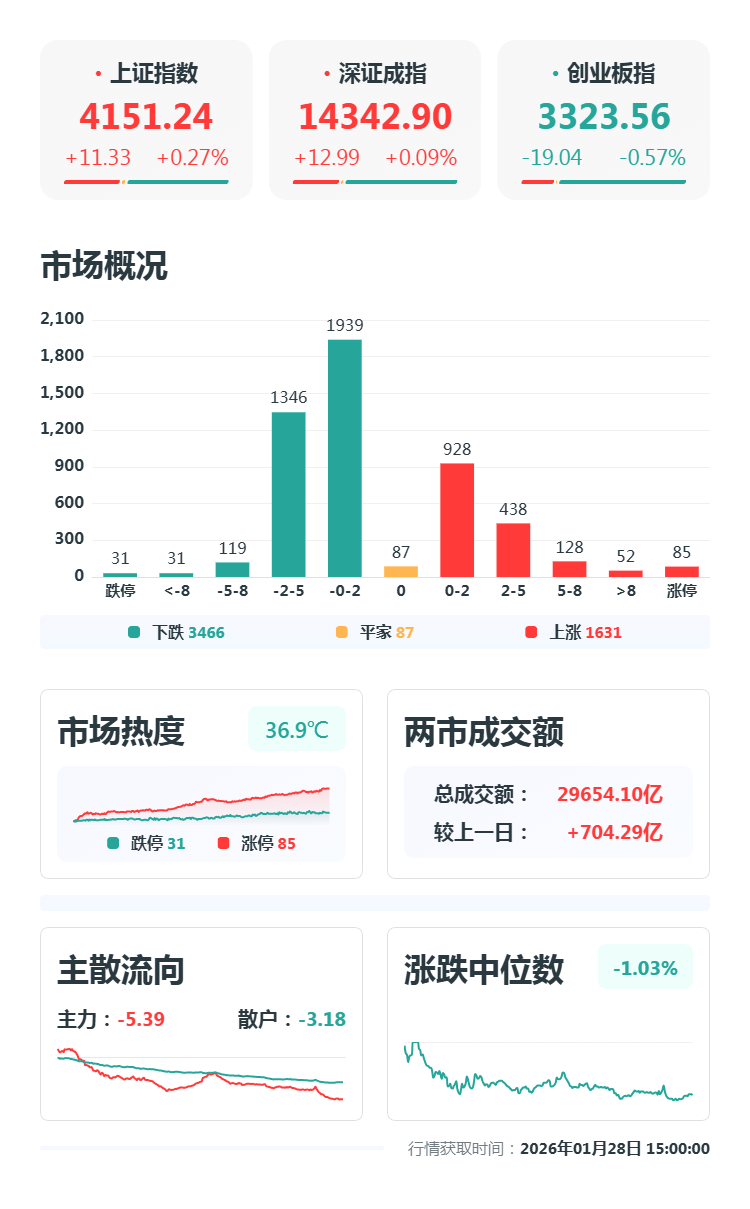
昨日沪指、深成指冲高回落,创业板指高开低走,盘中一度跌超1%。沪深两市成交额2.97万亿,较上 一个交易日放量704亿。盘面上,全市场超3600只个股下跌。从板块来看,资源股全天领涨,贵金属、 油气、电解铝方向轮番爆发,中国黄金4连板,湖南黄金3连板,中曼石油、晓程科技3天2板,四川黄金 10天6板,招金黄金8天5板,石化油服、准油股份涨停,中国铝业涨停创16年新高。分散染料概念集体 走高,浙江龙盛、闰土股份、亚邦股份涨停。存储芯片概念表现活跃,中微半导触及20CM涨停,气派 科技20CM涨停。下跌方面,医药医疗、光伏等板块跌幅居前。其中医药医疗概念走弱,百普赛斯、必 贝特跌超10%。截至收盘,沪指涨0.27%,深成指涨0.09%,创业板指跌0.57%。 历史上春季行情平均持续天数约70天,期间上证指数涨幅中位数约13.7%,本轮春季行情从2025年12月 17日开始,目前仅一个月,考虑到今年春节时间较晚叠加当前慢牛的环境,春季行情有望持续更长时 间。结合中观景气、盈利能力、筹码分布、估值、交易、周期阶段和赛道价值等多个维度,本期推荐关 注:电子(半导体)、传媒(广告营销、游戏、影视)、机械(自动化设备、工程 ...
港股开盘 | 恒指低开0.72% 贵金属板块走强 赤峰黄金(06693)涨超6%
智通财经网· 2026-01-29 01:40
1月29日,恒生指数低开0.72%,恒生科技指数跌0.79%。盘面上,贵金属板块强势,赤峰黄金涨超6%、 山东黄金涨超4%;锂矿股走弱,赣锋锂业、天齐锂业跌约2%。 中信证券认为,展望2月,在港股业绩预期已有显著调整,叠加内外部资金面的扰动因素也已告一段 落,判断港股2025年12月下旬以来的春季行情或将延续,整体呈现春节前大盘股有相对收益,政策方向 支持的成长行业表现更优的态势。春季后需关注下一个解禁高峰期或对港股流动性预期的影响。短期建 议关注三大主线:1)"十五五"政策方向,包括生物制造、具身智能、6G(核心股)等;2)政策推动基本预 期逆转的外卖平台和地产;3)受益于春季躁动的非银。 本文转载自腾讯自选股,智通财经编辑:蒋远华。 国金策略认为,在AI投资宏观风险较低、降息周期下全球制造业景气度向上的背景下,会有更多行业 的景气度出现改善,投资者可能还是会更加关注增长率而非股息率。因此在红利策略内部,行业选择上 可以更多地向基本面要弹性。跨市场比较来看,港股红利依旧具备性价比,但对于个人投资者而言考虑 到红利税之后可能就没那么明显。 华泰策略认为,2025年人民币(相对美元)升值超4%。宏观视角,202 ...

中信证券港股2月展望:春季行情延续 关注三大主线
Zhi Tong Cai Jing· 2026-01-29 01:21
Core Viewpoint - The report from CITIC Securities indicates that the Hong Kong stock market is expected to continue its spring rally from late December 2025, with a focus on large-cap stocks before the Lunar New Year and better performance in growth sectors supported by policy directions [1] Group 1: Market Performance and Trends - The performance expectations for Hong Kong stocks have significantly adjusted, with a slowdown in the downward revision of earnings forecasts since late December 2025 [1] - The average return of the Hang Seng Index during the spring rally over the past eleven years is 2.4%, with a weekly win rate of 70.8%, particularly strong in 2019, 2021, and 2023, averaging a 10.6% increase [2] - The upcoming earnings reports for Hong Kong stocks are expected to be concentrated from late March to early April, indicating a period of performance vacuum [1][2] Group 2: Investment Focus Areas - Short-term investment focus should be on three main lines: 1) "14th Five-Year Plan" policy directions including biomanufacturing, embodied intelligence, and 6G; 2) food delivery platforms and real estate benefiting from policy-driven expectations; 3) non-bank financials benefiting from the spring rally [1] - The "15th Five-Year Plan" is expected to guide long-term investment opportunities, with strategic emerging industries like new energy, new materials, and quantum technology likely to receive policy support [3] Group 3: Liquidity and Market Dynamics - The liquidity outlook for Hong Kong stocks is expected to improve as the market approaches the next peak of stock unlocks, with significant reductions in unlock amounts in January and February 2026 [1] - Historical data shows that net inflows from southbound trading in January and February account for an average of 19.3% and 27.9% of the annual total, respectively [2]

招商策略2月行业配置关注:景气修复的线索和春季行情的演绎
Xin Lang Cai Jing· 2026-01-28 14:43
格隆汇1月28日|招商策略研报指出,过去一个月市场总体小幅震荡上行,部分涨价资源品、AI景气催 化的TMT板块表现较好。展望2月份,行业配置重点关注景气修复的线索和春季行情的演绎,聚焦顺周 期+科技领域,同时随着春节临近,增加对部分可选消费的关注。结合中观景气、盈利能力、筹码分 布、估值、交易、周期阶段和赛道价值等多个维度,本期推荐关注电子(半导体)、传媒(广告营销、 游戏、影视)、机械(自动化设备、工程机械)、电力设备(电池、电网设备、光伏设备)、基础化 工、社会服务等。 ...
和讯投顾张义明:26年会有春季行情吗?
Sou Hu Cai Jing· 2026-01-28 08:44
Core Viewpoint - The concept of a "spring market" in the stock market is somewhat misleading, and it is more important to focus on liquidity and policy support as key factors for market performance [1] Group 1: Liquidity Factors - The spring market relies on improved liquidity, which is typically characterized by increased budget availability and cash flow during this period [1] - Companies with significant performance improvements and strong cash flow support are recommended for investment, as they have a higher probability of receiving unexpected liquidity compared to ordinary companies [1] - Additionally, companies with a gross profit margin above 30% are highlighted as potential investment opportunities in the current complex market environment [1] Group 2: Policy Factors - Attention should be given to upcoming important policy meetings, as the directions provided during these meetings will indicate which industries are prioritized for support [1] - Although specific policies have not yet been announced, it is anticipated that they will likely focus on industrial technology companies with core technologies and export capabilities, as well as domestic infrastructure stocks closely related to national livelihood and consumption [1]
A股收评:三大股指走势不一 资源股全线爆发 四川黄金10天6板、中国黄金4连板
Jin Rong Jie· 2026-01-28 07:50
Market Performance - The A-share market showed mixed performance on the 28th, with the Shanghai Composite Index rising by 0.27% to 4151.24 points, and the Shenzhen Component Index increasing by 0.09% to 14342.89 points, while the ChiNext Index fell by 0.57% to 3323.56 points [1] - The total trading volume in the Shanghai, Shenzhen, and Beijing markets reached 29,923 billion yuan, an increase of 708 billion yuan from the previous day, with nearly 3,700 stocks declining [1] Sector Highlights - Resource stocks experienced a significant surge, with China Gold achieving four consecutive trading limits, and Hunan Gold achieving three consecutive trading limits [1] - The storage chip concept saw active performance, with Zhongwei Semiconductor hitting a 20% limit up and Qipai Technology also reaching a 20% limit up [1] - The coal sector rebounded in the afternoon, driven by improving supply-demand dynamics, with Shanxi Coking Coal hitting the limit up and other companies like Lu'an Environmental Energy and Jinkong Coal also rising [1] Price Trends - The average price of thermal coal is projected to reach 824.9 yuan/ton in Q4 2025, reflecting a month-on-month increase of 8%, while coking coal is expected to average 1,725.7 yuan/ton, up 10% month-on-month [1] Livestock Sector - The livestock sector showed localized movements in the afternoon, with Xiaoming Co. rising over 10%, and other companies like Dabeinong and Luoniushan also seeing gains [2] - The average price of piglets in the fourth week of January was reported at 25.96 yuan/kg, up 4.5% from the previous week, while the average price of eggs was 9.03 yuan/kg, up 2.7% [2] ETF Trading Activity - There was a significant increase in ETF trading volume, reaching a record high of 7,525 billion yuan, with notable contributions from the CSI 300 ETFs [2] Investment Strategies - The market is expected to enter a period of heightened activity in February, particularly in the AI application sector, with a focus on small-cap, growth, and thematic stocks [6] - Investment opportunities in the AIDC power supply sector are identified, including power supply units, energy storage, and third-generation semiconductors [6] Currency Impact - The RMB is projected to appreciate over 4% against the USD by 2025, with potential continued appreciation into 2026, which historically correlates with better performance of AH equities [7]

牛市旗手何时归?春季行情下的金融板块破局之路
Xin Lang Cai Jing· 2026-01-27 03:20
Core Viewpoint - The non-bank financial sector has experienced significant fluctuations, with the insurance sector reaching a five-year high before facing a two-week correction, highlighting a divergence in the driving logic between insurance and brokerage firms [1] Group 1: Insurance Sector Value Reassessment - The insurance sector is undergoing a value reassessment driven by liability-side reforms, asset-side recovery, and regulatory easing, leading to sustained fundamental improvements since 2025 [2] - Structural optimization on the liability side is central to the value recovery, with regulatory changes lowering the guaranteed interest rates for various insurance products, thus alleviating long-term risks and improving the cost structure [3] - The asset side has seen a reversal in returns, with the ten-year government bond yield stabilizing at 1.84% by the end of 2025, improving the industry's profit outlook and driving significant profit growth among major insurers [4] - Regulatory easing and product strategy optimization have created a synergistic effect, supporting valuation recovery in the insurance sector, particularly through the promotion of dividend insurance products [5] Group 2: Liquidity Support in the Insurance Sector - The influx of medium- to long-term funds into the market has become a key feature since 2025, with these funds favoring high-dividend assets, making the insurance sector a primary beneficiary [6] - Policies initiated in early 2025 aimed at promoting medium- to long-term funds entering the market have provided comprehensive institutional support for insurance investments [6] - A positive cycle has formed where increased returns from equity investments lead to more funds flowing into the insurance sector, enhancing liquidity and market activity [7] Group 3: Brokerage Sector Performance and Future Direction - The brokerage sector is experiencing a paradox of high earnings growth but stagnant stock prices, attributed to regulatory changes and shifts in market funding flows [8] - Despite impressive earnings growth in 2025, the brokerage sector has not led market rallies, contrasting sharply with its role during the 2015 bull market, due to intensified regulation and a shift in investor focus [9] - Mergers and acquisitions are seen as a necessary path for restructuring the brokerage industry, with government support aimed at enhancing international competitiveness and optimizing resource allocation [12] Group 4: Structural Opportunities in Non-Bank Financial Sector - The non-bank financial sector is positioned for structural opportunities as the equity market recovers, benefiting from increased trading volumes and improved profitability in both brokerage and insurance sectors [13] - The brokerage sector is currently undervalued, with significant potential for valuation recovery, particularly through mergers and acquisitions that enhance competitive positioning [14] - The insurance sector is expected to see continued growth in new policy premiums, driven by attractive product offerings in a low-interest-rate environment, making it a core focus for investment [15]
早盘直击|今日行情关注
申万宏源证券上海北京西路营业部· 2026-01-27 02:26
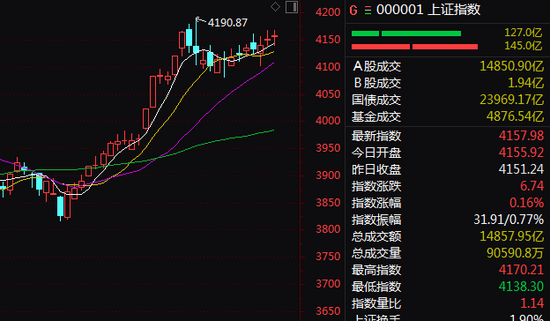
Group 1 - The spring market is entering a transition period with noticeable acceleration in sector rotation, as the market shifts from rapid ascent to a phase of horizontal consolidation, leading to unclear main lines and increased industry rotation [1] - The two main lines of the current spring market, commercial aerospace and AI applications, have shown significant divergence, impacting market sentiment [1] - Investors are focusing on relatively low-position sectors, particularly strong cyclical industries, resulting in a "high-cut-low" market characteristic typical of the transition period [1] Group 2 - On Monday, the two markets experienced differentiated fluctuations with trading volume at relatively high levels, as the Shanghai Composite Index opened high but closed lower, remaining above the 5-day moving average [1] - The Shenzhen Component Index underperformed compared to the Shanghai market, experiencing a larger adjustment but also closing above the 5-day moving average [1] - Market hotspots were mainly concentrated in upstream industries such as petrochemicals and non-ferrous metals, with large-cap blue-chip stocks performing strongly while small-cap and tech stocks saw adjustments [1] Group 3 - The Shanghai Composite Index has entered a horizontal consolidation phase after a continuous rebound, having started an upward trend in mid-December and reaching a new high in mid-January before entering the current fluctuation phase [1] - The current market characteristics include sector differentiation and a decrease in overall market volatility, with a need to monitor the support strength of the 5-day moving averages for various indices in the short term [1]

大厂资本开支大头在AI,创业板软件ETF华夏(159256)持仓股网宿科技涨停
Mei Ri Jing Ji Xin Wen· 2026-01-26 07:39
Group 1 - The A-share software application sector experienced a noticeable pullback, with the ChiNext Software ETF Huaxia (159256) closing down by 0.97%. Among its holdings, Wangsu Science & Technology hit the daily limit up, while Shunwang Technology rose over 11%. In contrast, previously popular stocks like Aerospace Zhizhuang fell over 10%, and Sifang Jingchuang dropped over 4% [1] - The total trading volume of the ChiNext Software ETF Huaxia exceeded 140 million yuan, with a turnover rate of over 20% [1] - Tencent's annual meeting highlighted that 2025 is expected to be a significant year for AI, with intense competition in the industry. Tencent is focusing its investments primarily on AI, while maintaining a steady approach in other areas like community group buying and food delivery [1] Group 2 - In the AI industry chain, the software sector plays a crucial role in both the midstream technology layer and the downstream application layer, providing essential technical support and facilitating the implementation of AI applications [2] - Specifically, the software industry in the midstream technology layer offers AI frameworks, development platforms, and algorithm models, which are foundational for AI application development [2] - In the downstream application layer, the software industry integrates AI technology with various sectors to promote the practical application of AI [2]
