
春季躁动

Search documents
春季躁动进入下半场:量缩价涨:躁动下半场:量缩价涨——策略周聚焦
Huachuang Securities· 2026-01-18 12:46
Group 1 - The spring market rally has entered its second half, characterized by reduced trading volume and rising prices, as regulatory signals promote a return to rationality in the market [4][6][10] - The average maximum increase of the Shanghai Composite Index during the past 16 spring rallies was 15.8%, while the current rally has seen a maximum increase of 9.8%, indicating potential for further price increases [10][12] - Economic data is showing positive trends, with expectations for a continued rally supported by improving PPI figures and favorable policies from the government [10][20] Group 2 - The focus of the market is shifting from risk appetite to earnings growth, with a notable increase in the proportion of companies reporting positive earnings forecasts, reaching 37.8% as of January 17 [13][19] - The reduction in competitive pressure (internal competition) is leading to a significant increase in the proportion of companies with improved earnings, particularly in industries such as steel, construction materials, and media [20][22] - The overall improvement in earnings among non-financial companies in the A-share market is evident, with a 5.8% increase in the proportion of companies reporting positive net profit growth [20][22] Group 3 - Investment recommendations focus on sectors with strong earnings growth expectations, including non-bank financials, cyclical industries, and technology innovation [23][24] - Non-bank financials have shown the highest proportion of earnings revisions, with a 400% increase in companies adjusting their profit forecasts positively [23][24] - Cyclical sectors such as materials and energy are expected to benefit from fiscal stimulus and demand-side support, with significant upward revisions in profit forecasts [23][24]
从星辰到算力,春季躁动基础仍在?
ZHONGTAI SECURITIES· 2026-01-18 08:46
Report Industry Investment Rating - The report does not explicitly mention the industry investment rating [1][2][3] Core Viewpoints of the Report - The spring rally in the A-share market at the beginning of the year was driven by the fear of missing out, but after the regulatory adjustment of the minimum margin ratio for margin trading, the market shifted from a rapid rise to a slow bull market. The two - margin funds did not leave but switched from high - leverage to low - leverage sectors. The left - hand force of the spring rally came from institutional investors, while foreign capital and margin trading formed the right - hand acceleration, with foreign capital participating more actively [2][15] - The AI industry chain is the main direction where funds form a consensus. The logic of "storage driving computing power, and computing power leading to applications" is expected to be a popular investment direction. Insurance in the financial sector can contribute absolute returns, and industries such as chemicals, home appliances, and panels can be considered for portfolio investment [3][28][29] Summary According to the Directory Market Review: From High - Speed Growth to Active Cooling - At the beginning of the year, the A - share market experienced a spring rally. From the beginning of the year to January 13, the Sci - tech Innovation 50 index rose 9.33%, and sectors such as media, computer, and national defense and military industry led the gains. The proportion of margin trading turnover in the total turnover reached 11.5%, approaching the upper limit of the historical average plus twice the standard deviation [8] - On January 14, the regulatory authorities announced an increase in the margin ratio from 80% to 100%, which was a measure to cool down the over - heated market sentiment. After the adjustment, there was a "hot - cold switch" in the broad - based index and industry structure. In the broad - based index, leveraged funds shifted from small - cap to large - cap stocks. In the industry structure, funds shifted from high - volatility themes to undervalued blue - chips [11][12][13] Slow Bull Trend Established, Leverage Cooling, but Bullish Sentiment Remains - Margin trading accelerated the spring rally but was not the dominant force. The spring rally was mainly driven by domestic institutional investors, with foreign capital and margin trading accelerating on the right - hand side, and foreign capital's participation was more significant. Comparing the trading volume ratios of 9 trading days before and after New Year's Day, the trading volume ratio of north - bound funds increased from 10.2% to 11.6%, while that of margin trading only increased from 11.0% to 11.4% [15] - While broad - based ETFs experienced large - scale outflows, theme - based ETFs continued to see inflows. For example, from January 14 to 16, the average daily net outflow of the CSI 300 ETF reached 14.71 billion yuan, while sectors such as non - ferrous metals, consumption, securities, and medical devices saw capital inflows [19][20] Tightening Micro - environment Accelerates Stock Game, with Both Offensive and Defensive Strategies - The marginal tightening of the micro - liquidity environment led to a stock game and structural optimization. The AI industry chain remained the main line, and some funds flowed back to sectors such as home appliances and chemicals with high safety margins [25] - The capital flow in the AI industry showed a "spiral relay" pattern, starting from storage chips and commercial aerospace, moving to AI applications, and then flowing back to storage and spreading to embodied intelligent robots. The semiconductor and media ETFs remained at the forefront, indicating strong market recognition of the AI industry chain [26] Index Uptrend Slows, Strong Focus on the AI Industry Chain - The AI industry chain's "storage - computing power - application" logic is expected to be a popular investment direction. The performance of US stocks provides a strong reference, and the continuous strength of overseas technology giants has raised the valuation ceiling for A - share counterparts [28] - Insurance in the financial sector can contribute absolute returns. It benefits from the bull market and the rise of the technology sector in terms of asset - side profitability and has defensive properties when offensive sectors adjust [28] - For portfolio investment, technology sectors can provide high returns and elasticity, while sectors such as chemicals, home appliances, and panels with improving fundamentals and healthy chip structures can be used as stable investment options [29]
周末五分钟全知道(1月第2期):A股“历史最大成交”后如何演绎?有何规律?
GF SECURITIES· 2026-01-18 06:06
Core Insights - The report analyzes the historical patterns of A-share market performance following significant trading volume increases, indicating that market sentiment often shifts after peak trading volumes, with only a few sectors maintaining strong momentum [3][4][5] - It highlights that sectors with robust fundamental expectations tend to sustain their strength post-volume spikes, such as construction during the Belt and Road Initiative in 2014 and AI-related sectors in 2025 [3][4][5] Historical Volume Analysis - A total of six significant volume spikes in A-shares have been identified, characterized by a trading volume increase of 1.5 times or more, with the most recent occurring on January 12, 2026, when the trading volume reached 3.6 trillion yuan [6][7] - Historical data shows that after these volume spikes, the market generally experiences a one-month period of limited risk, with an average return of 1.8% and a median return of 2.7% [26][27] - Over the subsequent three months, the market tends to enter a consolidation phase, with an average decline of 5.05% [26][27] Sector Performance Post-Volume - The report indicates that sectors leading in performance before a volume spike often do not maintain their positions in the following months, suggesting a shift in market focus [37][41] - For instance, sectors like construction and technology have shown varying degrees of performance continuity after volume spikes, with some sectors like food and beverage maintaining strength due to external factors such as foreign investment [41][42] Small vs. Large Cap Stocks - Historically, small-cap stocks tend to outperform large-cap stocks in the month following a volume spike, although this trend does not hold consistently over a three-month period [47][48] - The report emphasizes the importance of monitoring market sentiment and sector fundamentals to gauge future performance [55] Future Market Outlook - The report projects that the A-share market will likely experience a strong upward trend from late January to mid-March 2026, driven by seasonal effects and positive earnings forecasts [4][52] - Key sectors to watch include copper, energy storage, and semiconductor industries, which are expected to perform well in the upcoming months [4][55]
港股开盘 | 恒指高开0.64% 芯片股走强 中芯国际(00981)等涨近2%
智通财经网· 2026-01-16 01:39
Group 1 - The Hang Seng Index opened up 0.64% and the Hang Seng Tech Index rose by 0.94%, with strong performance in chip stocks like SMIC and Hua Hong Semiconductor, which both increased by nearly 2% [1] - According to China Merchants Securities, the lagging performance of Hong Kong stocks compared to A-shares is due to overseas liquidity dynamics, with a 95.6% probability of the Federal Reserve pausing interest rate cuts in January [1] - Huatai Securities noted that after a month of pessimistic consolidation, the Hong Kong market sentiment index has entered a panic zone, historically leading to a significant increase in the probability of rising prices in the following month [1] Group 2 - Industrial opportunities in the AI sector are highlighted, with a focus on leading internet companies, suggesting a potential resonance of buying interest from both domestic and foreign investors [2] - The report emphasizes the importance of dividend assets in a low-interest-rate environment, recommending sectors such as insurance, banking, energy, property management, and public utilities [2] - New consumption trends are identified, focusing on three main lines: traditional service-oriented consumption transformation led by chain hotels, Z-generation consumption including trendy toys and beauty products, and high-end consumption [2]

东吴证券晨会纪要2026-01-16-20260116
Soochow Securities· 2026-01-16 01:27
Macro Strategy - The report discusses the impact of RMB appreciation on exports, suggesting that RMB exchange rate is more a result of export recovery rather than a cause [8] - Historical data shows that during previous RMB appreciation periods, export growth remained stable, indicating that exchange rate fluctuations do not significantly hinder export performance [8] - The report highlights that the competitive advantage of Chinese exports is increasingly driven by technological barriers rather than price advantages, as the structure of exports continues to optimize [8] Fixed Income - The report analyzes the bond market dynamics from 2016 to 2018, noting that the primary driver of the bear market was policy tightening, which led to a significant rise in short-term interest rates [12] - Current conditions differ as long-term rates are rising due to economic recovery expectations, while short-term rates remain low, suggesting that a repeat of the 2017 bear market is unlikely [12] - Historical examples indicate that a bear market typically requires both rising short-term rates and liquidity tightening, which is not present in the current environment [12] Company Analysis Dazhu CNC (301200) - The company is expected to achieve a net profit of 7.85-8.85 billion RMB in 2025, representing a year-on-year increase of 160.64% to 193.84% [13] - The growth is driven by accelerated expansion in AI PCB production and increased demand for high-end PCB equipment [13] - The profit forecast for 2025-2027 has been revised upwards due to strong market demand, with a projected net profit of 8.4 billion RMB in 2025 [13] Changjiang Power (600900) - The company reported a net profit of 341.67 billion RMB for 2025, a 5.14% increase year-on-year, driven by stable power generation growth [15] - The report indicates that the company’s revenue is supported by increased electricity sales from its hydropower stations [15] - The profit forecast for 2025-2027 has been adjusted to 341.67 billion RMB for 2025, reflecting a slight downward revision due to expected declines in electricity prices [15] CITIC Securities (600030) - The company achieved a net profit of 300.5 billion RMB in 2025, marking a 38% increase year-on-year, supported by a vibrant market trading environment [16] - The report highlights the company's strong position in the equity underwriting market, with significant growth in IPO and refinancing activities [16] - Profit forecasts for 2025-2027 have been revised upwards, with expected net profits of 301 billion RMB in 2025 [16]


【机构策略】A股市场短期内波动或有所加剧
Zheng Quan Shi Bao Wang· 2026-01-16 01:21
Group 1 - The A-share market showed mixed performance on Thursday, with major indices fluctuating [1][2][3] - The semiconductor industry chain and CPO sector performed well, while commercial aerospace and AI application sectors experienced significant adjustments [1][2] - The market's trading volume decreased significantly, with total turnover dropping to over 1 trillion yuan, yet absolute volume remained close to 3 trillion yuan, indicating potential structural opportunities [1][2] Group 2 - The market's trading activity has become more active since January, with margin financing balances rising, indicating clear signs of new capital entering the market [2] - The domestic risk-free interest rate continues to decline, leading to a trend of residents moving deposits to equity markets, providing ample liquidity [2] - The CPI showed a slight increase year-on-year, indicating marginal improvement in domestic demand, which supports the ongoing market rally [2][3] Group 3 - Technical analysis indicates that the Shanghai Composite Index found support around the 4100-point mark, suggesting potential for new highs if this level holds [3] - The overall exchange rate environment remains favorable for A-shares, despite a rebound in the US dollar index [3] - The macroeconomic fundamentals are improving, contributing to a structural slow bull market in A-shares, with investors advised to focus on resilient performance opportunities amid market fluctuations [3]
春季躁动已开场!我的“三条线”布局和ETF吃肉心得
Ge Long Hui· 2026-01-15 13:06
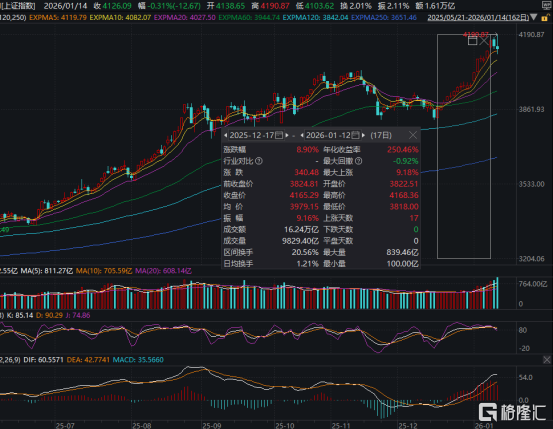
Group 1 - The spot gold price has reached $4600 per ounce and silver has surpassed $90 per ounce, marking historical highs [1] - The Shanghai Composite Index experienced a historic 17-day consecutive rise of 8.9% before facing a two-day adjustment, indicating a potential bull market pullback [1][3] - The spring market rally appears to have started earlier this year, with expectations for a clearer structural market in 2026 [4] Group 2 - The "spring rally" is characterized by a significant seasonal trend in the A-share market, typically occurring from late December to the first quarter of the following year, driven by macroeconomic policies, capital flow, and corporate earnings improvements [5] - Historical data shows that the spring rally usually starts in late January and ends around mid-March, lasting approximately 30 trading days, with an average index increase of about 15% [5][6] Group 3 - During the spring rally, the market has generally favored small-cap and growth stocks, with the TMT sector leading, particularly the computer sector with an average increase of 23% [7] - Key sectors to watch this year include technology and resource sectors, driven by policies aimed at "stabilizing growth" and "strengthening technology" [7][8] Group 4 - The first investment focus is on technology innovation and growth sectors, particularly in AI, which is expected to drive a surge in chip demand [8] - The second focus is on the recovery of manufacturing and resource sectors, influenced by global metal supply chain changes [8] - The third focus is on consumer recovery and overseas opportunities [9] Group 5 - The company has adjusted its portfolio through ETFs, with a focus on the semiconductor sector, which is showing signs of recovery, particularly in the storage chip market [10] - The resource sector is also a key investment area, with strong performance driven by geopolitical tensions and expectations of a weaker dollar [10] - The consumer sector is being targeted for investment, with attractive valuations in Hong Kong stocks despite recent pullbacks [11]

恒指突破27000点后再回落,未来能否走出震荡?
Di Yi Cai Jing· 2026-01-15 11:43
1月15日早盘,市场憧憬人工智能应用新产品发布,港股一度上涨再次突破27000点大关,恒生指数触及 27207的高点,但早上10点后就开始调整。 15日下午3点,央行下调各类结构性货币政策工具利率0.25个百分点的消息,也未明显刺激港股回升, 恒生指数收跌0.28%,报收26923点,成交2904亿港元。 光大证券国际策略师伍礼贤称,本轮港股已率先突破2025年11月13日的27189点高位,接下来还有2024 年10月的27382点需要突破,指数高点不再呈现"一浪低于一浪"的下降轨道,技术形态有所改善,叠加 近期日均成交维持在3000亿港元左右,流动性保持活跃,指数依然有向上动能。此外,上周内地融资保 证金比例上调对两地市场造成的冲击已初步消化,在基本面并未出现明显变化的前提下,对港股后续走 势维持偏正面看法。 慧研智投投资顾问李谦分析,恒生指数第四次放量突破27000点后回落,能否突破前期高点成为短期焦 点。本轮行情兼具跨年及春季躁动特征,与A股形成呼应。历史数据显示,每年一季度市场资金面相对 充裕,政策发布密集,投资者参与热情高,行情持续时间通常较长。从结构看,科技股仍是主线,恒生 指数整体运行于慢牛通 ...
宏观点评20260115:春季躁动后半程,行业如何轮动?-20260115
Soochow Securities· 2026-01-15 08:21
Market Trends - The spring market rally from December to February historically shows an average increase of 16%-18% for the Shanghai Composite Index and the Wind All A Index from 2010 to 2025[1] - The current spring rally is considered to be in its latter half, with a potential for a price increase lasting about one month before entering a consolidation phase[2] Industry Performance - Growth and technology sectors have a win rate exceeding 80%, with average excess returns over 3%[12] - High-end manufacturing follows, with average excess returns above 2%, while sectors like computing, communication, and electronics show average excess returns exceeding 4%[12] Sector Rotation - As of 2026, strong sectors include military (commercial aerospace), automotive (robots), and utilities, while previously leading sectors like non-ferrous metals and machinery are in a consolidation phase[3] - The focus should be on sectors with unchanged industrial trends but relatively lower recent gains, such as lithium batteries, energy storage, humanoid robots, innovative drugs, and AI hardware[32] Risks - Market sentiment can change rapidly, leading to accelerated contraction in trading volume[34] - Potential risks include slow progress in technological breakthroughs, tightening global liquidity due to changes in overseas market expectations, and increased geopolitical risks[34]
广发基金投顾团队:关注2026“春季躁动”,聚焦两大结构性方向
Zhong Zheng Wang· 2026-01-15 06:28
2025年四季度,A股市场在经历前期快速上涨后进入震荡整理期,市场交投活跃度有所回落,板块轮动 加快;债券市场则呈现震荡走弱格局。 展望2026年第一季度,广发基金投顾团队认为,近期市场主要指数持续上行,沪指也已经来到4100点附 近,整体市场风险偏好较高,在企业盈利周期延续修复、国内政策基调明晰、市场流动性相对偏宽的情 况下,重点关注春季躁动机会与市场热点结构变化。 四季度回顾:股债走势分化,价值风格补涨 回顾四季度,A股整体呈现区间震荡走势。在经历前期快速上涨后,市场进入阶段性整理,中美贸易摩 擦反复与AI产业前景的讨论带来短期扰动,"十五五"规划落地和12月重要会议召开释放积极政策信号, 对市场形成支撑。 风格方面,避险情绪有所回升,红利、价值风格开始补涨,成长风格有所回落,市场呈现再平衡态势。 债券市场方面,四季度整体震荡偏弱。10月在政策预期博弈中窄幅震荡,11月受地产债展期等信用事件 冲击持续走弱,12月在降息预期收缩、超长债供给担忧等因素影响下,收益率曲线明显走陡,30年期国 债表现承压。 后市展望:结构机会为主,关注春季行情 展望2026年第一季度,广发基金投顾团队对权益市场维持中性偏乐观看法 ...