
反内卷

Search documents
汽车周报:补贴落地践行渐进,看好预期修复下的交易机会-20251229
Shenwan Hongyuan Securities· 2025-12-29 07:16
Investment Rating - The report maintains a positive outlook on the automotive industry, particularly focusing on the mid-to-high-end and used car markets, as well as the impact of new subsidies [2]. Core Insights - The upcoming subsidies are expected to alleviate previous concerns regarding the total market volume for 2026, with a focus on companies like BYD and Geely, which cater primarily to mid-to-low-end demand [2]. - The report highlights the potential for significant performance improvement in parts manufacturers in the first half of 2026 due to subsidy support, recommending companies with strong fundamentals and low valuations [2]. - The report identifies new energy vehicle companies such as XPeng, NIO, and Li Auto, which have advantages in AI and robotics, as potential investment opportunities [2]. - The report notes a positive trend in the used car market and overall dealer profitability, recommending companies like Uxin [2]. - The report emphasizes the importance of state-owned enterprise reforms, particularly for SAIC and Dongfeng, as a key area to watch [2]. Industry Update - According to the China Passenger Car Association, the average daily retail sales of passenger cars in the third week of December reached 77,000 units, a year-on-year decrease of 11% but a month-on-month increase of 9% [2]. - The automotive industry recorded a total transaction value of 582.81 billion yuan for the week, with an industry index increase of 2.74%, outperforming the Shanghai Composite Index [6]. - The report indicates that 172 automotive stocks rose while 94 fell, with the largest gainers being Chaojie Co., Longi Machinery, and Zhejiang Sebao [11]. Market Conditions - The report notes that traditional and new energy raw material price indices have risen recently, with traditional vehicle raw materials increasing by 1.3% week-on-week and 1.0% month-on-month, while new energy vehicle raw materials rose by 5.6% week-on-week and 6.8% month-on-month [62]. - The automotive industry’s price-to-earnings ratio stands at 29.17, ranking 19th among all sectors, indicating a moderate valuation compared to the Shanghai Composite Index's 14.15 [8][10]. Key Events - The report highlights the optimization of toll road policies and the improvement of autonomous driving regulations as significant developments that will enhance the operational efficiency of the transportation system [3][4]. - The report mentions the launch of the first L3 autonomous driving license plate in China, awarded to Changan Automobile, marking a milestone in the industry [24][44].




2026年金融市场的十大预测
表舅是养基大户· 2025-12-29 07:12
Core Insights - The article presents a forecast for the financial market in 2026, emphasizing the importance of adjusting investment strategies in light of ongoing market trends and economic conditions [2][4]. Group 1: Investment Philosophy - Emphasis on the unprecedented low interest rate environment and the importance of quality equity investments [3][4]. - Investors are advised to avoid the temptation of quick profits and to extend their investment horizons [5]. - The article highlights the cyclical nature of markets, suggesting that after a prolonged bull market, a period of consolidation or correction is likely [5]. Group 2: Key Trends for 2026 - The end of the global interest rate reduction cycle is anticipated, with varying impacts on stocks, bonds, and currencies [8][20]. - De-globalization remains a dominant trend, with fiscal policies being a common response to this phenomenon [9][30]. - The A-share market is expected to focus on relative value within asset classes, with a significant wave of fixed income products emerging [10][38]. - The Hong Kong stock market is projected to show increasing valuation advantages [11][60]. - The financial industry is expected to experience accelerated differentiation and consolidation [12][68]. - The wealth management sector is entering a new era of diversified asset allocation [13][71]. - The AI sector is entering a phase of significant differentiation, with a focus on who can build effective ecosystems [14][81]. - The trend of "anti-involution" is expected to continue, impacting investment strategies [15][90]. - A new era of outbound investment for Chinese companies is emerging, driven by global supply chain restructuring [16][94]. - Two significant trends are identified: accelerated asset securitization by local governments and societal K-shaped economic divergence [17][101]. Group 3: Market Implications - The anticipated end of the interest rate reduction cycle suggests that the valuation uplift from declining rates will slow, making profit-driven sectors more critical [26][25]. - The article discusses the expected impacts on various asset classes, including U.S. stocks, A-shares, and bonds, highlighting the need for strategic adjustments in investment positions [27][28][29]. - The A-share market is seen as a critical area for investment, with a focus on its relative value compared to other asset classes [43][48]. - The article emphasizes the importance of understanding the core role of the stock market in economic development and its potential as a wealth reservoir [49][50].


ETF盘中资讯|化工板块意外回调,是风险还是机遇?化工ETF(516020)跌超1%!机构仍乐观
Jin Rong Jie· 2025-12-29 07:11
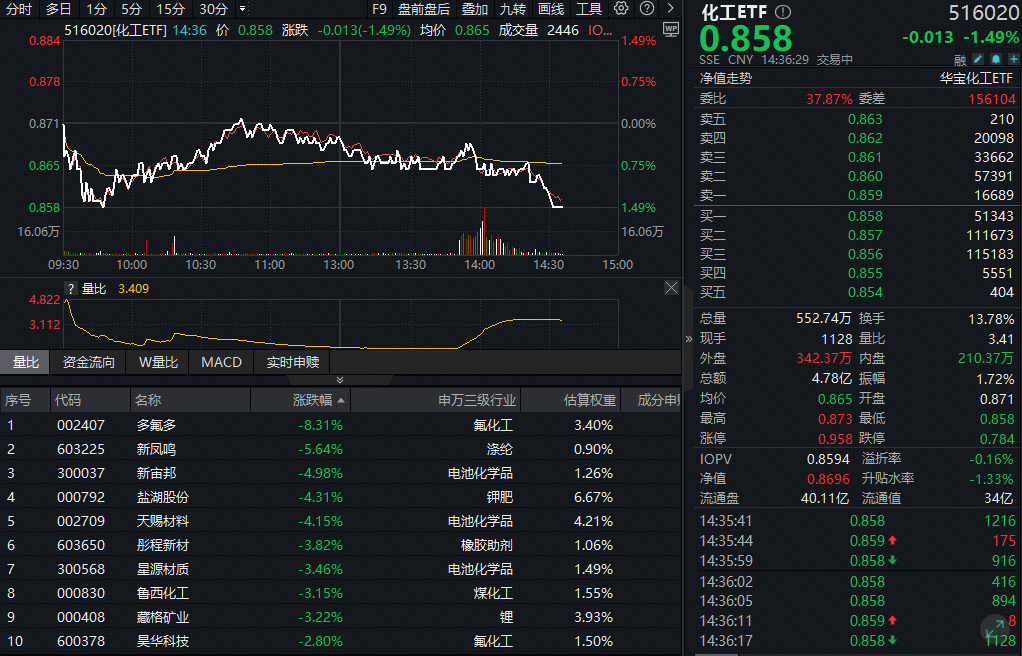
Group 1 - The chemical sector experienced a pullback on December 29, with the Chemical ETF (516020) showing a decline of 1.49% during the trading day [1][2] - Key stocks in the sector, including fluorine chemicals, lithium batteries, and potash fertilizers, saw significant declines, with companies like Duofu Du falling over 8% and Xin Fengming dropping over 5% [1][2] - Despite the current pullback, the chemical sector has performed well this year, benefiting from the "anti-involution" trend, with the Chemical ETF's index showing a year-to-date increase of 40.35%, outperforming major indices like the Shanghai Composite Index and CSI 300 [1][3] Group 2 - Analysts from China Galaxy Securities predict that the chemical industry may see a turning point in 2026, driven by negative growth in capital expenditure and the ongoing "anti-involution" trend, which is expected to lead to a rational return of chemical prices and profit levels [4] - Dongxing Securities anticipates an improvement in the chemical industry's prosperity in 2026 due to better supply-demand dynamics and a decrease in raw material costs, presenting a good opportunity for investment [4] - The Chemical ETF (516020) is highlighted as an efficient way to gain exposure to the chemical sector, with nearly 50% of its holdings concentrated in large-cap leading stocks, allowing investors to capitalize on strong investment opportunities [4]
周度产量小幅下降 锰硅期货盘面以震荡偏强为主
Jin Tou Wang· 2025-12-29 07:05
News Summary Core Viewpoint - The overall market for silicon manganese is showing signs of slight recovery, with production rates and prices experiencing minor increases, while inventory levels remain a concern for manufacturers [1][4][5]. Group 1: Production and Operational Data - The operating rate of 187 independent silicon manganese enterprises nationwide was reported at 36.78%, an increase of 1.17% from the previous week [1]. - Daily average production reached 27,510 tons, reflecting a week-on-week increase of 620 tons [1]. - A silicon manganese alloy plant in Inner Mongolia has ignited a 66,000 KVA furnace, expected to produce approximately 400 tons per day in about two weeks [2]. Group 2: Market Trends and Inventory - The Zhengzhou Commodity Exchange recorded 23,277 manganese silicon futures warehouse receipts, a decrease of 187 from the previous trading day, with a total decline of 374 receipts over the past week, representing a 1.58% drop [2]. - Over the past month, manganese silicon futures warehouse receipts have increased by 2,088, marking a growth of 9.85% [2]. - The current market for silicon manganese is characterized by a slight upward trend in spot prices, with manufacturers showing a strong cost support but still facing inventory pressure [4]. Group 3: Price Dynamics and Demand - The manganese ore market is experiencing a structural inventory issue, leading to a fragile balance, while the demand for lower-cost semi-carbonate ore is expected to rise due to changes in the smelting process [5]. - Seasonal declines in pig iron production are noted, alongside a slight decrease in weekly silicon manganese output and inventory [5]. - The recommendation for market participants is to consider buying on dips, as the market shows potential for recovery [5].

(年终特稿)中国经济这一年:汽车产业迎三大变革
Zhong Guo Xin Wen Wang· 2025-12-29 07:03
中新社记者 刘文文 新能源汽车正以不可逆转的趋势,逐渐从市场新秀蜕变为主导力量。 2025年,中国汽车产业在"换挡提速"中迎来结构性重塑。其中,三个重要变革为行业写下鲜明注脚,也 指明了中国汽车未来发展的新方向。 北方工业大学汽车产业创新研究中心研究员张翔对中新社记者表示,这一转变无疑是今年汽车产业发展 的分水岭事件。中国汽车工业协会数据显示,10月新能源汽车新车销量占汽车新车总销量比重首超 50%,达51.6%,占有率首次过半。这不仅意味着燃油车主导时代的加速落幕,更表明新能源汽车的市 场认可度实现质的飞跃。 智驾"驶"入寻常百姓家 中新社北京12月29日电 题:中国经济这一年:汽车产业迎三大变革 2025年堪称"全民智驾元年"。罗兰贝格汽车行业首席研究员陈春栋受访时表示,这一年,自动驾驶技术 实现从高端车型"奢侈品"到大众市场"标配"的跨越,一场以智驾普惠化为核心的产业浪潮全面掀起。 今年以来,"智驾平权"趋势愈发明显。具备L2级组合驾驶辅助功能的车型价格已下探至10万元人民币区 间。如埃安i60等车型凭借"越级"智驾配置成为市场热门,打破了智驾与高端车的固有绑定,让更多普 通消费者体验到科技出行的便利。 ...
化工板块意外回调,是风险还是机遇?化工ETF(516020)跌超1%!机构仍乐观
Xin Lang Ji Jin· 2025-12-29 06:50
Group 1 - The chemical sector experienced a pullback on December 29, with the chemical ETF (516020) showing a decline of 1.49% during the day [1] - Key stocks in the sector, including fluorine chemicals, lithium batteries, and potash fertilizers, saw significant declines, with companies like Duofuduo dropping over 8% and Xin Fengming over 5% [1] - Despite today's decline, the chemical sector has performed well this year, benefiting from the "anti-involution" trend, with the chemical ETF's index showing a cumulative increase of 40.35% year-to-date, outperforming major A-share indices [3][4] Group 2 - The current decline in the chemical sector is viewed as a normal correction following a period of continuous growth, with no significant negative news impacting the sector [3] - Analysts from Huazhang Securities noted that the "anti-involution" trend is likely to enhance self-discipline among chemical companies, leading to a rational return of chemical prices and profit levels [5] - Looking ahead, China Galaxy Securities anticipates a negative growth in capital expenditure for the chemical industry in 2024, with supply-side contractions expected to improve the supply-demand balance, potentially marking a cyclical turning point for the industry by 2026 [5][6] Group 3 - Dongxing Securities highlighted that the chemical industry's outlook for 2026 is positive, with expected improvements in supply-demand dynamics and a reduction in cost pressures from raw materials like crude oil and coal [6] - The chemical ETF (516020) is recommended as an efficient way to invest in the sector, covering various sub-sectors and concentrating nearly 50% of its holdings in large-cap leading stocks [6]
南华期货金融期货早评-20251229
Nan Hua Qi Huo· 2025-12-29 05:21
1. Report Industry Investment Ratings No specific industry investment ratings are provided in the report. 2. Core Views of the Report - The market last week was characterized by the strong rise of non - ferrous metals and the accelerated appreciation of the RMB. There are risks of correction in non - ferrous metals and uncertainties in the long - term appreciation of the RMB [2]. - The stock index is expected to be volatile and strong in the short term, but there is pressure to continue rising; the bond market is not pessimistic in the medium term, and short - term trading should maintain a band - trading idea [5][7][8]. - The SCFI European line has a complex market situation with both positive and negative factors, and there are uncertainties in the future trend [9][10][12]. - In the non - ferrous metals market, platinum and palladium have high - level volatility, and there are opportunities for long - term price increases but short - term risks; gold and silver are still strong, but silver has high price risks; copper, aluminum, zinc, tin, etc. have different price trends and influencing factors [14][19][21]. - In the black market, steel prices are expected to be volatile, iron ore is neutral with price support and pressure, and the situation of coking coal and coke depends on factors such as production resumption [33][34][36]. - In the energy and chemical market, the oil price is in a low - level shock, and the performance of various chemical products such as LPG, PTA - PX, MEG - bottle chips, etc. is affected by factors such as supply and demand and macro - policies [44][45][48]. - In the agricultural products market, the supply and demand of live pigs need to be verified, the performance of oilseeds, oils, cotton, sugar, etc. is affected by factors such as supply and demand relationship and policy [82][83][86]. 3. Summaries According to Relevant Catalogs Financial Futures - **Macro**: The market is influenced by factors such as the two - main - line characteristics of non - ferrous metals and RMB appreciation, and there are risks in the short - term rise of non - ferrous metals and uncertainties in the long - term appreciation of the RMB [1][2]. - **RMB Exchange Rate**: There is a discussion about the long - term appreciation of the RMB, but there are limitations in applying relevant theories. The narrowing of the Sino - US interest rate differential is the core trigger for appreciation, and there are potential risks [4]. - **Stock Index**: The stock index is expected to be volatile and strong in the short term, but there is pressure to continue rising, and it is necessary to pay attention to the breakthrough of the index [5][7]. - **Treasury Bond**: The bond market is not pessimistic in the medium term, and short - term trading should maintain a band - trading idea [8]. - **Container Shipping European Line**: The SCFI European line has a complex market situation with both positive and negative factors, and there are uncertainties in the future trend [9][10][12]. Commodities Non - Ferrous Metals - **Platinum & Palladium**: There is high - level volatility, and the long - term price is expected to rise, but there are short - term risks. Attention should be paid to factors such as policy adjustments and market supply and demand [14][15][17]. - **Gold & Silver**: They are still strong, but silver has high price risks, and short - term trading should be cautious [19][20]. - **Copper**: The price is affected by the game between industrial and speculative funds, and there are risks in trading around the New Year [21][23]. - **Aluminum Industry Chain**: Aluminum is expected to be volatile and strong, alumina has an oversupply situation, and cast aluminum alloy is recommended to pay attention to the price difference with aluminum [24][25]. - **Zinc**: It is expected to be in a wide - range shock [26][27]. - **Tin**: It is expected to be in a wide - range shock, and there is limited upward space in the short term [27]. - **Lithium Carbonate**: There is a risk of short - term callback, but there are opportunities to build long positions in the medium and long term [28][29]. - **Industrial Silicon & Polysilicon**: Industrial silicon has limited short - term improvement in fundamentals, and polysilicon is in a shock state. Attention should be paid to technical aspects [30][31]. - **Lead**: It is expected to be in a shock range [32]. Black Metals - **Rebar & Hot - Rolled Coil**: Steel prices are expected to be volatile, with support from the cost side and pressure from demand [33][34]. - **Iron Ore**: The fundamentals are neutral, with price support from steel mill replenishment demand and pressure from high supply [35][36]. - **Coking Coal & Coke**: The future trend depends on factors such as the resumption of domestic mines and the production of iron and steel enterprises [37][38]. - **Silicon Iron & Silicon Manganese**: They are expected to be volatile and strong in the short term, but the upward space is limited [39][40]. Energy and Chemicals - **Pulp - Offset Paper**: The pulp market is neutral, and the offset paper market has a slight increase in valuation. Attention should be paid to downstream demand [42][44]. - **Crude Oil**: The core contradiction is the game between short - term geopolitical risk premiums and weak fundamentals, and it is in a low - level shock [45]. - **LPG**: The near - term is supported, and the future is under pressure. Attention should be paid to marginal changes [46][47]. - **PTA - PX**: There is a situation of strong expectation and weak reality. PX has a good supply - demand pattern, but there is a risk of callback [48][51]. - **MEG - Bottle Chips**: The demand side is weak, and the valuation is under pressure. The market is expected to be affected by macro - narratives [53][54]. - **Methanol**: It is recommended to buy at a low level [55][56]. - **PP**: It is expected to be in a shock pattern, and the focus is on the scale of device maintenance in January [58][59]. - **PE**: It is expected to be in a bottom - shock pattern, and the upward space is limited [61][62]. - **Pure Benzene - Styrene**: They have rebounded at a low level, but it is not recommended to chase high prices [63][64]. - **Fuel Oil**: High - sulfur fuel oil has a weak cracking situation, and low - sulfur fuel oil has limited cracking drive. Both are recommended to wait and see [65][67]. - **Rubber**: It is expected to be in a wide - range shock pattern, and different rubber varieties have different trading strategies [68][70]. - **Urea**: It is recommended to try to buy the far - month contract [71][72]. - **Soda Ash & Caustic Soda & Glass**: Soda ash has an oversupply expectation; glass has high inventory and low - season pressure; caustic soda is in a weak state and is expected to be in a wide - range shock [73][74][76]. - **Log**: It can be considered to use an option double - selling strategy [78][79]. - **Propylene**: It is necessary to pay attention to marginal changes, and the price is expected to be in a low - level shock [80][81]. Agricultural Products - **Live Pigs**: The supply and demand in the peak season need to be verified. The short - term is based on fundamentals, and the long - term can be bullish [82]. - **Oilseeds**: The short - term is affected by weak reality, but there are opportunities for phased rebounds [83][84]. - **Oils**: They are expected to be in a wide - range shock in the short term, and palm oil is relatively strong [86]. - **Cotton**: There is a risk of short - term callback, but there is upward space in the long term. Attention should be paid to downstream orders and policy changes [87][88]. - **Sugar**: There is pressure for the price to rise further in the short term [89]. - **Eggs**: The long - term egg - laying hen capacity is excessive, and short - term trading should be cautious [90]. - **Apples**: There is pressure on the disk due to the slowdown in consumption, and there are opportunities to build long positions after a pullback [91][92]. - **Red Dates**: They are expected to be in a low - level shock in the short term, and the long - term price is under pressure [93].
寒霜未尽,道阻且长
Dong Zheng Qi Huo· 2025-12-29 05:14
年度报告——玻璃 寒霜未尽,道阻且长 [走Ta势bl评e_级Ra:nk] 玻璃 : 看跌 [Table_Summary] ★地产竣工端缩量态势下,浮法玻璃需求或继续下滑: 2026 年玻璃盘面针对地产政策能够展开的博弈空间有限,主要 因为政策逻辑已经发生重大转变,当前政府部门更倾向于通过 宏观的改善来带动地产。2026 年地产竣工端预计继续面临有效 稳地产政策缺位、竣工储备缩水、存量商品房去库压力大以及 房企流动性压力大等多重压力,预计 2026 年竣工面积较 2025 年下滑 10%左右,继续拖累浮法玻璃需求端。而从另一方面, 2024 年以来单位建筑面积玻璃用量开始大幅提升,能够在一定 程度上对冲部分来自竣工端的负面冲击。综合测算,2026 年浮 法玻璃消费量或较 2025 年下滑 3%左右。 ★供给继续缩量,关注潜在减产可能: 能 源 化 工 2026 年浮法玻璃产量的上行潜在增量将主要来自 2025 年年内 因环保压力延后到 2026 年春节后点火的部分产线,主要因为该 部分新建产线所用的产能置换指标即将到期。除此之外,2026 年有点火计划的产线多为视行情点火,市场下行阶段的点火概 率较低。而下行潜 ...
工业企业利润延续放缓,结构性亮点凸显
China Post Securities· 2025-12-29 05:00
Group 1: Industrial Profit Trends - In November, the total profit growth rate of industrial enterprises was -13.1%, a decrease of 7.6 percentage points from the previous value, marking two consecutive months of decline[10] - The cumulative profit growth rate for industrial enterprises from January to November was 0.1%, down 1.8 percentage points from the previous value[10] - The average recovery period for accounts receivable increased to 70.4 days in November, up 3.7 days year-on-year, indicating a decline in asset turnover efficiency[15] Group 2: Cost and Revenue Dynamics - The operating revenue growth rate for industrial enterprises from January to November was 1.6%, a decrease of 0.2 percentage points from the previous value[11] - The profit margin for industrial enterprises was 5.29%, down 0.11 percentage points year-on-year, with a profit growth rate of -2.04%[12] - The cost per 100 yuan of operating revenue was 85.5 yuan, reflecting a year-on-year increase of 0.19%[12] Group 3: Sector-Specific Insights - The profit growth rate for the raw materials manufacturing sector was 16.6% from January to November, contributing 2.0 percentage points to the overall profit growth of industrial enterprises[16] - High-tech manufacturing profits grew by 10.0% year-on-year, significantly outpacing the average industrial profit growth rate[19] - The aerospace and intelligent consumer equipment sectors showed notable profit increases, with profits in the semiconductor equipment sector rising by 97.2%[19] Group 4: Economic Outlook and Policy Focus - The economic fundamentals are showing signs of a phase of slowdown, with expectations of continued marginal profit decline in industrial enterprises[20] - The focus of macroeconomic policy is shifting towards stimulating investment and managing low inflation, as indicated by recent policy discussions[20]
华能调增高效光伏组件采购占比,光热发电规模发展意见发布
Ping An Securities· 2025-12-29 04:55
Investment Rating - The report maintains an "Outperform" rating for the industry [1] Core Insights - The report highlights the increasing procurement ratio of high-efficiency photovoltaic components by Huaneng Group, indicating a shift towards higher efficiency in solar energy production [6] - The development of concentrated solar power (CSP) is emphasized, with a target of reaching 15GW of installed capacity by 2030, aiming for cost parity with coal power [7] - The report notes significant growth in the wind power index, outperforming the broader market, and provides insights into the performance of various renewable energy sectors [4][11] Summary by Sections Wind Power - The wind power index increased by 5.97%, outperforming the CSI 300 index by 4.02 percentage points, with a current PE_TTM valuation of approximately 26.26 times [4][11] - The delivery of the world's first methanol dual-fuel super-large oil tanker indicates a growing demand for hydrogen and methanol applications in the shipping sector, which is seen as a promising direction for renewable energy [10][26] Photovoltaics - Huaneng Group has adjusted its procurement framework for photovoltaic components, increasing the expected procurement capacity for high-efficiency components from 2.5GW to 3.5GW, while reducing the capacity for medium-efficiency components [6][7] - The report suggests that the shift towards high-efficiency components aligns with the government's push for quality and responsible pricing in the photovoltaic sector [6] Energy Storage & Hydrogen - The National Development and Reform Commission and the National Energy Administration have released opinions promoting the large-scale development of CSP, targeting a total installed capacity of 15GW by 2030 [7] - The report recommends investments in energy storage companies and highlights the potential for growth in distributed energy storage markets, particularly in residential and commercial sectors [7] Investment Recommendations - The report suggests focusing on companies with strong competitive positions in energy storage and wind power, including Yangguang Electric and Mingyang Smart Energy, while also recommending attention to leading photovoltaic companies like Longi Green Energy and Trina Solar [7]



