反内卷

Search documents
诺安基金股市点评:市场情绪渐暖,建议积极关注
Xin Lang Cai Jing· 2025-12-29 01:53
Market Overview - The market has shown steady growth this week, with the Shanghai Composite Index at 3963.68 points, up 1.88%, the Shenzhen Component Index at 13603.89 points, up 3.53%, and the ChiNext Index at 3243.88 points, up 3.90% [3] Sector Performance - **Metals Sector (+6.43%)**: Gold and silver prices have reached historical highs, driving significant gains in the metals sector. COMEX gold futures surpassed $4510, with an increase of over 1%. COMEX silver futures rose over 4%, peaking at $71.79 per ounce, marking the first time silver has crossed the $70 per ounce threshold. Platinum and palladium futures surged by 10% and 7%, respectively. Year-to-date, gold prices have increased by over 71%, potentially achieving the best annual performance since 1979, while silver prices have risen approximately 147% [4] - **Defense and Aerospace Sector (+6.00%)**: The commercial aerospace sector in China is reducing launch costs through reusable rockets, large-scale satellite manufacturing, and increased launch frequency. This is expected to lead to a rapid decline in launch costs, transitioning commercial aerospace from technology validation to market expansion. Additionally, space computing is emerging as a promising application area due to its low energy consumption and efficient data transmission capabilities [4] - **Power Equipment Sector (+5.37%)**: There is a trend of price increases across the supply chain, with end-users beginning to accept higher-priced components. The photovoltaic industry is experiencing a "de-involution," with two specific routes: "promoting the orderly exit of backward production capacity" and "new high-quality capacity being steadily introduced." The lithium hexafluorophosphate price remains high, with long-term pricing shifting to monthly negotiations, indicating tight supply and demand conditions [5] Macro and Regulatory Developments - The internet platform pricing is facing strong regulation, with three departments issuing the "Internet Platform Pricing Behavior Rules," effective from April 10, 2026. The People's Bank of China has announced a one-time credit repair policy [5] - **Overseas Economic Data**: The U.S. GDP for Q3 showed a significant annualized quarter-on-quarter growth of 4.3%, exceeding market expectations of 3.3%. The offshore RMB has strengthened, surpassing the 7.0 mark against the USD, with the onshore RMB also nearing this threshold [5] Focus Areas - Key sectors to monitor include AI and technology, domestic demand-related sectors, and "de-involution" related sectors [6] - Ongoing tracking of real estate, fiscal, consumption data, price index data, overseas economic data, and changes in U.S.-China tariff policies is recommended [6]


光大证券晨会速递-20251229
EBSCN· 2025-12-29 01:52
Group 1: Macro Insights - The US real estate market is currently in a "weak supply and demand" state, with expectations of a weak recovery by 2026 due to challenges in policy transmission and external risks [2] - Industrial profits in November continued to decline year-on-year, with only the midstream equipment sector showing stable growth, while upstream and downstream sectors weakened [3] - The A-share market has not shown clear signs of a bull market peak, indicating continued potential for market performance [4] Group 2: Market Strategies - The A-share market is expected to experience a spring rally supported by ongoing policy efforts and capital inflows, with a focus on growth and consumer sectors [5] - The REITs market has shown signs of price recovery after five weeks of decline, with notable returns compared to other asset classes [6] - Credit bond issuance increased by 15.42% week-on-week, indicating a positive trend in the credit market [7] Group 3: Industry Research - The green methanol sector is rapidly growing under the "carbon neutrality" initiative, with a focus on companies that have established a complete supply chain [10] - The engineering machinery industry is witnessing a recovery in domestic demand and accelerated overseas growth, with several key manufacturers recommended for investment [11] - Strategic metals are expected to see investment opportunities due to favorable supply-demand dynamics and resource nationalism [12] Group 4: Company Research - Sinopec Engineering's acquisition of the East China Pipeline Design Institute is expected to enhance its competitive edge in pipeline transportation [19] - China Oil Engineering has signed a $424 million EPC contract for a pipeline project in Kazakhstan, indicating its proactive expansion into overseas markets [20] - Jinhui Liquor is positioned to benefit from regional brand advantages and market expansion, with strong revenue and profit growth projections [21]
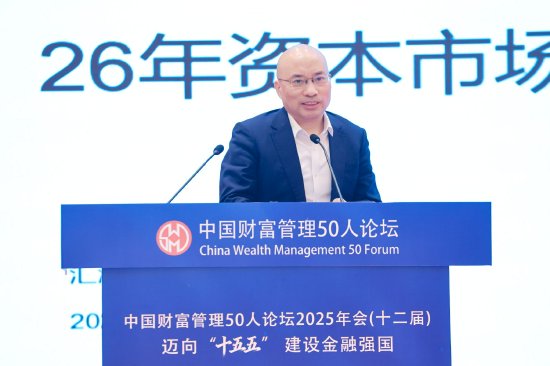
袁建军回应三大关切话题:业绩、信心、居民储蓄齐向好
Xin Lang Cai Jing· 2025-12-29 01:36
Core Viewpoint - The 2025 China Wealth Management Forum emphasizes the theme of building a financial powerhouse, with discussions focusing on asset allocation and investment outlook for 2026, addressing key concerns of institutional investors regarding performance, confidence, and the migration of household savings to capital markets [1][6]. Group 1: Performance Outlook - The worst performance phase is believed to be over, with gradual improvement expected due to two main factors: government measures to curb excessive competition and a decline in capital expenditures by listed companies, leading to a necessary contraction in production capacity [3][8]. - Export growth is significantly contributing to performance, with AI driving 3% of the 6% global trade growth this year, and global interest rate cuts expected to support exports in 2024. Notably, 11 out of the top 20 stocks held by funds have over 50% of their revenue from exports, indicating a shift from quantitative to qualitative performance improvements [3][8]. - By the third quarter of 2025, non-financial listed companies are projected to show year-on-year earnings growth, supported by economic structural transformation, which will provide a fundamental basis for the increase in A-share market capitalization [3][8]. Group 2: Investor Confidence - Historical patterns of A-share market performance, such as the interruptions of three consecutive upward trends since 2005, are not expected to repeat in 2026, as current conditions do not replicate past triggers for significant declines [4][9]. - A substantial improvement in A-share volatility has been observed, supported by a significant reduction in IPOs and refinancing activities over the past two years, which has addressed the issue of market expansion and laid the groundwork for steady index growth [4][9]. Group 3: Household Savings Migration - There is a clear indication that household savings are beginning to migrate towards capital markets, as evidenced by a significant increase in the issuance of rights funds and the majority of public funds achieving a net asset value exceeding 1 yuan, signaling a shift in asset allocation [4][9].
反内卷后光伏产业链涨价-盈利修复带动光伏行情回归
2025-12-29 01:04
Summary of Key Points from Conference Call Industry Overview - The solar industry is currently experiencing a reversal of "involution," aimed at avoiding price competition and achieving reasonable profitability, which is driving a comprehensive price recovery across the industry chain [1][2] - Despite a potential temporary decline in global solar installations in 2026, multiple factors such as AI and IDC electricity demand, overseas power shortages, and domestic policy expectations may support overall demand, potentially exceeding market expectations [1][3] Core Insights and Arguments - Recent price increases in the solar sector are primarily driven by the reversal of involution, which is expected to gradually expand profitability across various segments of the industry [2] - The sixth round of power transmission and distribution bidding is progressing steadily, with a total bid amount of approximately 13 billion RMB, indicating ongoing development in ultra-high voltage distribution network renovations [3][10] - The solar industry chain's value recovery presents certain investment opportunities, with the main industry chain's price-to-book ratio currently at a low level, indicating potential for systematic value reconstruction [4] Key Companies to Watch - Recommended companies in the solar sector include Tongwei Co., GCL-Poly Energy, LONGi Green Energy, Tianhe Energy, JA Solar, JinkoSolar, Daqo New Energy, and GCL New Energy, all of which possess strong competitiveness and growth potential within the main industry chain [5] Data Center Developments - The recent release of H200 chip supply is expected to significantly drive domestic AIGC (Artificial Intelligence Generated Content) construction, supported by government policies aimed at enhancing computing power [6] - Companies such as Zhongheng Electric, Shenghong Co., Magpow and Oulu Tong are highlighted for their advantageous positions in HVDC and server power supply sectors [6] Lithium Battery Materials - The lithium battery materials segment is experiencing price recovery due to supply-demand dynamics, with advancements in solid-state battery materials and new equipment such as sulfide electrolytes and voltage devices [7] - Companies to focus on include Xiapu New Energy, Zhongyi Technology, and equipment providers like Lacnor and Xian Dao Intelligent, as well as traditional material companies like Enjie [7] Energy Storage Sector - There is a high and reasonable market expectation for future large-scale energy storage demand, particularly for AIDC (Artificial Intelligence Data Center) applications, which can enhance power supply stability and emergency response [8] - Companies such as Sungrow Power, Canadian Solar, and De Ye Co. are noted for their strong development potential in the energy storage field [8] Wind Power Industry - The wind power sector saw a 110% year-on-year increase in installations in November, benefiting from strong installation expectations as the 14th Five-Year Plan concludes [9] - Companies to watch include Goldwind Technology, Mingyang Smart Energy, and Yunda Co., with additional opportunities in overseas markets for companies like Dayin Heavy Industry and Zhenjiang Co. [9] Grid Investment Dynamics - The ongoing sixth round of power transmission and distribution bidding, with a total bid amount of approximately 13 billion RMB, indicates a steady development trajectory for ultra-high voltage distribution network renovations [10]
沥青开工率明显改善:每周经济观察2025年12月29日-20251229
Huachuang Securities· 2025-12-29 00:14
宏观研究 每周经济观察: (一)景气向上 证 券 研 究 报 告 【每周经济观察】第 52 期 沥青开工率明显改善 1、华创宏观 WEI 指数震荡回升。截至 12 月 21 日,该指数为 5.22%,环比前 一周上行 0.06 个点。 2、地产销售:商品房住宅成交面积同比降幅继续收窄。我们统计的 67 个城 市,截至 12 月 26 日当周,商品房成交面积同比为-19%。12 月前 26 日累计同 比为-26%。11 月同比为-34%。 3、基建:石油沥青装置开工率改善。截至 12 月 24 当周,开工率为 31.3%, 较上周环比回升 3.7 个点,较去年同期高 5.4 个点。 4、价格:铜价、金价、油价均上涨。COMEX 黄金收于 4546.2 美金/盎司,上 涨 4.6%;LME 三个月铜价收于 12218 美元/吨,上涨 4.1%;美油收于 56.7 美 元/桶,上涨 1.1%,布油收于 60.6 美元/桶,上涨 1.4% (二)景气向下 1、耐用品消费:乘用车零售低位运行。12 月第三周,乘用车零售同比增速- 11%,前值-17%。12 月前三周累计同比-18.8%。11 月全月同比为-8.1%。 ...
十大券商一周策略:A股跨年行情启动,人民币汇率与春季躁动行情有望共振,新主线浮出水面
Jin Rong Jie· 2025-12-28 23:58
Group 1 - The market is expected to maintain structural opportunities driven by liquidity easing, policy expectations, and a strengthening yuan, with consensus on sectors like technology manufacturing, resource products, and beneficiaries of yuan appreciation [1][4][5] - A total of 39 out of 360 industry/theme ETFs reached new highs in December, with established sectors like telecommunications and non-ferrous metals leading, alongside emerging sectors like commercial aerospace [2][3] - The focus remains on sectors with low heat and high long-term ROE potential, such as chemicals, engineering machinery, and new industries like commercial aerospace, while also tracking the trend of yuan appreciation [3][4] Group 2 - The spring market conditions remain favorable, supported by liquidity and investor expectations, with a potential for volatility in early 2026 due to upcoming events like the Spring Festival and the Two Sessions [4][10] - The yuan's appreciation is expected to enhance domestic purchasing power and attract foreign capital back to Chinese assets, creating significant potential for asset revaluation [5][6] - Key sectors to watch include AI investments, global manufacturing recovery, and consumer sectors benefiting from increased domestic demand, such as aviation, hotels, and food and beverage [9][11][12] Group 3 - The current market is characterized by a lack of clear bull market signals, but the foundation remains solid with improving fundamentals and capital inflows [7][12] - The market is likely to experience a structural and rapid rotation of sectors, with a focus on technology themes and non-bank financial sectors [16][15] - The upcoming spring market is anticipated to show upward momentum, with opportunities for low-positioning strategies and sector switching rather than aggressive trend-following [16][14]
跨越2025 年终行情能否连涨收官?请看本周十大券商策略
智通财经网· 2025-12-28 23:37
Core Viewpoint - The Chinese stock market is experiencing a positive trend as it approaches the end of 2025, with significant movements in various sectors and a focus on potential investment opportunities for 2026 [1][30]. Group 1: Market Trends and Predictions - The Shanghai Composite Index has achieved an "eight consecutive days of gains" [1]. - The total scale of Chinese ETFs has surpassed 6 trillion, setting a new historical high [1]. - Major brokerages have provided insights on market trends, with predictions for 2026 focusing on sectors that may dominate [2][5][13]. Group 2: Sector Analysis - Citic Securities highlights that 39 out of 360 industry/theme ETFs reached new highs in December, with a focus on telecommunications, non-ferrous metals, and commercial aerospace as key sectors [3]. - Industry sectors such as chemicals, engineering machinery, and new energy are expected to see increased attention and potential growth due to their long-term return on equity (ROE) improvement [4]. - Guotai Junan emphasizes the importance of capital markets in driving social confidence and investment, marking a shift from traditional investment methods to more capital-intensive approaches [5]. Group 3: Currency and Economic Factors - The recent appreciation of the Renminbi is attributed to a weaker US dollar and seasonal capital inflows, which may support the Chinese stock market [9][30]. - The potential for a significant influx of capital back into China is anticipated, driven by the reversal of previous trends in currency valuation and investment sentiment [9][10]. - The structural transformation of the Chinese economy is expected to reduce uncertainty and enhance investment opportunities, particularly in technology and manufacturing sectors [7][24]. Group 4: Investment Strategies - Investment strategies are shifting towards sectors that benefit from the current economic environment, including AI hardware, renewable energy, and consumer services [19][31]. - Brokers suggest focusing on thematic trading opportunities in sectors like robotics, commercial aerospace, and healthcare, which are expected to gain traction in the upcoming year [19][31]. - The market is advised to adopt a cautious approach, emphasizing low-cost entry points and avoiding high-risk positions as the market stabilizes [35][36].



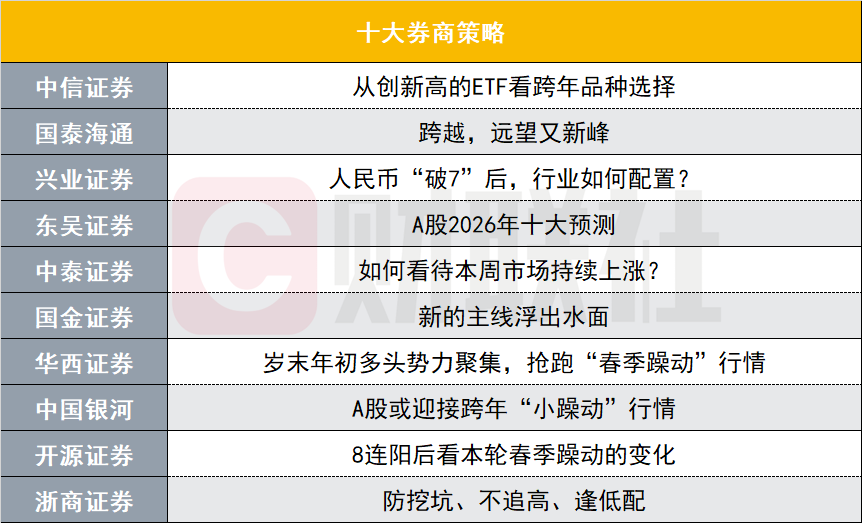
十大券商一周策略:A股跨年行情已经启动,新的主线浮出水面
Zheng Quan Shi Bao· 2025-12-28 22:47
Group 1 - The core viewpoint is that the A-share market is experiencing a cross-year rally, driven by liquidity and positive policy expectations, with a focus on sectors like AI, commercial aerospace, and materials [9][10][11] - 39 out of 360 industry/theme ETFs reached new highs in December, with established sectors like telecommunications and non-ferrous metals leading, while new sectors like commercial aerospace are gaining traction [1] - The market consensus is shifting towards sectors representing competition in next-generation infrastructure between China and the US, with a focus on manufacturing and pricing power in the global market [1][2] Group 2 - The strategy emphasizes structural opportunities in a volatile market, with a preference for sectors with low concentration but rising attention and long-term ROE potential, such as chemicals and engineering machinery [2] - The outlook for the RMB is positive, with expectations of appreciation driven by improved domestic conditions and external factors, which could lead to significant capital inflows and asset revaluation [4][5] - The spring market is expected to benefit from favorable conditions, including liquidity support and upcoming policy events, with a focus on technology and cyclical sectors [3][10][12] Group 3 - The investment focus is on sectors that benefit from RMB appreciation, such as those with high import material dependency and those that can leverage increased domestic purchasing power [5] - The market is characterized by a structural rotation, with a focus on technology themes and sectors like commercial aerospace, nuclear power, and robotics [12][14] - The overall sentiment is optimistic, with expectations of a continued upward trend in the market leading up to the Spring Festival, supported by strong institutional buying and favorable policy expectations [11][13][14]
2025年度产业经济十大热点事件: “科技叙事”重塑投资逻辑 “反内卷”再造产业生态
Zheng Quan Shi Bao· 2025-12-28 22:23
Group 1: AI and Technology Developments - The launch of DeepSeek-R1 in January 2025 has become a core investment theme, driving significant capital market momentum and shifting the focus from performance competition to cost, efficiency, and commercialization capabilities in the AI sector [2] - The AI industry has seen a concentration of funds towards leading companies, with notable stock performances such as the "Yi Zhong Tian" combination, which saw gains exceeding 450% [2] - The human-robotics sector has entered a commercialized phase, with over 46 billion yuan in total orders and more than 20,000 units sold, indicating a shift from conceptual collaborations to practical applications [4][5] Group 2: Film and Entertainment Industry - The film "Nezha 2" achieved a record-breaking box office of 15.4 billion yuan, marking a significant milestone for the Chinese animation industry and contributing to a total annual box office of over 50 billion yuan, a 75 billion yuan increase from 2024 [3] - The success of "Nezha 2" and other animated films reflects the growing market potential for domestic animation, providing a reference for future creative and investment strategies in the film industry [3] Group 3: Market Dynamics and Competition - The intense competition in the food delivery industry, initiated by JD's entry with a no-commission model, has led to significant market disruptions and a series of subsidy wars among major platforms, resulting in a 141 billion yuan loss for Meituan's core local business despite record user numbers [7] - Regulatory bodies have intervened to address the chaotic competition, leading to commitments from major platforms to improve service quality and return to rational development [7] Group 4: Capital Market Trends - The A-share market has seen a record high in cash dividends, totaling 2.61 trillion yuan, reflecting an increase in companies' willingness to return profits to shareholders and enhancing market resilience [11] - The emergence of "GPU dual heroes" in the capital market, with multiple domestic GPU companies going public, signifies a milestone for the domestic AI chip industry and a shift towards self-sufficiency [10] Group 5: Industry Regulation and Quality Improvement - The lithium battery supply chain has experienced a price recovery due to regulatory efforts to combat "involution" competition, with lithium carbonate futures seeing significant price increases [12] - The charging battery industry is transitioning to a more orderly development phase following regulatory changes and recalls by major brands, addressing issues of safety and compliance [13]






并购潮遇上涨价潮 锂电隔膜行业由扩规模转向调结构
Zheng Quan Shi Bao· 2025-12-28 18:04
Core Viewpoint - The lithium battery separator industry is experiencing a wave of mergers and acquisitions, with companies like Enjie and Fospower actively pursuing integration to enhance their market positions and profitability [1][2]. Group 1: Mergers and Acquisitions - Enjie plans to acquire 100% of Zhongke Hualian through a share issuance, aiming to leverage synergies across the supply chain and enhance its product matrix [2]. - Fospower's acquisition of Jinli has been approved by the Shenzhen Stock Exchange, allowing it to enter the lithium battery separator market and improve profitability [2]. - The current merger activity is driven by the industry's bottom position, allowing leading companies to acquire quality assets at lower costs [2][3]. Group 2: Price Increases and Demand - The separator industry has seen a tightening supply since late October, with leading companies operating at full capacity and orders spilling over to smaller manufacturers [4]. - The demand for separators is supported by the continuous growth in downstream markets, particularly in power batteries and energy storage [5]. - The average price of 5μm separators is significantly higher than that of 7μm products, indicating a strong market for high-performance separators [9]. Group 3: Supply and Demand Balance - The separator industry is expected to reach a supply-demand balance as the demand for power batteries is projected to grow significantly, with global demand reaching 1704 GWh by 2026 [5]. - The willingness to expand production in the separator industry is low due to high capital investment and long payback periods, leading to a scarcity of quality production capacity [6]. - The industry is shifting focus from expansion to optimizing existing capacity, with many companies halting expansion plans to avoid oversupply [7]. Group 4: Competitive Landscape and Differentiation - The competition in the separator industry is evolving from scale and price competition to a focus on technological innovation and product performance [8]. - The industry is moving towards ultra-thin and high-strength separators, with 5μm products becoming a key area of competition [9]. - Companies are increasingly looking to expand their overseas presence, as international markets offer higher margins and growth potential [10][11].