
政策预期

Search documents
宝城期货股指期货早报(2025年9月25日)-20250925
Bao Cheng Qi Huo· 2025-09-25 02:13
Report Summary 1. Report Industry Investment Rating No relevant information provided. 2. Core View of the Report - The short - term view of the stock index futures is wide - range oscillation, the medium - term view is upward, and the intraday view is weakly oscillating. The core logic lies in the game between the short - term profit - taking intention of funds and the long - and medium - term fermentation of policy - favorable expectations [1][5]. 3. Summary According to the Catalog 3.1 Variety View Reference - Financial Futures Stock Index Sector - For IH2512, the short - term view is oscillation, the medium - term view is upward, the intraday view is weakly oscillating, and the reference view is wide - range oscillation. The core logic is the game between short - term profit - taking intention of funds and long - and medium - term fermentation of policy - favorable expectations [1]. 3.2 Main Variety Price Market Driving Logic - Financial Futures Stock Index Sector - The intraday view of IF, IH, IC, and IM is weakly oscillating, the medium - term view is upward, and the reference view is wide - range oscillation. Yesterday, all stock indices rose comprehensively, with IC and IM leading the gains. The total turnover of the Shanghai, Shenzhen, and Beijing stock markets was 2347.1 billion yuan, a decrease of 171.3 billion yuan from the previous day. The rebound was accompanied by a reduction in stock market trading volume and a decrease in the open interest of stock index futures, indicating that investors still have differences in their views on the future market. The main trading logic of the stock market comes from policy expectations and capital flows. The game between the profit - taking rhythm of funds and the fermentation of policy expectations needs to be focused on. On one hand, as the valuation has risen significantly, especially when the index rebounds to near the previous high, the demand for profit - taking of profitable funds increases. On the other hand, the policy - favorable expectations and the long - term net inflow trend of the capital side constitute the long - and medium - term driving force for the upward movement of the stock index. The fermentation of policy - favorable expectations depends on the convening of the important meeting in October. The fact that the margin trading balance has exceeded 2.4 trillion yuan and the significant year - on - year increase in new non - bank deposits in July and August indicate the signs of residents' wealth allocation to the equity market. In general, due to the index approaching the previous high and the approaching long holiday, the stock index is expected to be mainly in wide - range oscillation in the short term [5].
股市成交缩量,股指全面反弹
Bao Cheng Qi Huo· 2025-09-24 10:22
1. Report Industry Investment Rating - No relevant content provided 2. Core Viewpoints of the Report - On September 24, 2025, all stock indices rose, with CSI 500 and CSI 1000 leading the gains. The total trading volume of the Shanghai, Shenzhen, and Beijing stock markets was 234.71 billion yuan, a decrease of 17.13 billion yuan from the previous day. The rebound was accompanied by a contraction in trading volume and a reduction in the positions of stock index futures, indicating that investors still have differences in their views on the future market [3]. - The main trading logic of the stock market currently comes from policy expectations and capital flows. In the future, it is necessary to focus on the game between the profit - taking rhythm of funds and the fermentation of policy expectations. As the valuation has significantly increased, especially when the index rebounds to near the previous high, the demand for profit - taking of profitable funds has increased. On the other hand, the expectation of policy benefits and the long - term net inflow trend of funds constitute the medium - and long - term driving force for the upward movement of stock indices. The fermentation of policy benefits is expected to await the convening of the important meeting in October. The fact that the margin trading balance has exceeded 2.4 trillion yuan and the year - on - year significant increase in new non - bank deposits in July and August indicate that the signs of residents' wealth allocation to the equity market have begun to appear [3]. - In the short term, the stock index is expected to fluctuate widely because the index is close to the previous high and the long holiday is approaching. Currently, the implied volatility of options has declined. Considering the medium - and long - term upward trend of the stock index, investors can continue to hold bull spreads or ratio spreads [3]. 3. Summary of Each Section 3.1 Option Indicators - On September 24, 2025, 50ETF rose 0.59% to close at 3.072; 300ETF (Shanghai Stock Exchange) rose 0.89% to close at 4.663; 300ETF (Shenzhen Stock Exchange) rose 1.01% to close at 4.810; CSI 300 Index rose 1.02% to close at 4566.07; CSI 1000 Index rose 1.70% to close at 7534.22; 500ETF (Shanghai Stock Exchange) rose 2.13% to close at 7.432; 500ETF (Shenzhen Stock Exchange) rose 2.27% to close at 2.972; GEM ETF rose 2.17% to close at 3.160; Shenzhen 100ETF rose 1.75% to close at 3.555; SSE 50 Index rose 0.68% to close at 2939.51; Science and Technology Innovation 50ETF rose 3.73% to close at 1.53; E Fund Science and Technology Innovation 50ETF rose 3.68% to close at 1.50 [5]. - The trading volume PCR and position PCR of various options changed compared with the previous trading day. For example, the trading volume PCR of SSE 50ETF options was 76.34 (previous day: 83.34), and the position PCR was 78.32 (previous day: 71.27) [6]. - The implied volatility of the at - the - money options in October 2025 and the 30 - trading - day historical volatility of the underlying assets of various options are provided. For instance, the implied volatility of the at - the - money options of SSE 50ETF options in October 2025 was 16.47%, and the 30 - trading - day historical volatility of the underlying asset was 15.70% [7]. 3.2 Related Charts - **SSE 50ETF Options**: Include charts such as the SSE 50ETF trend, option volatility, trading volume PCR, position PCR, implied volatility curve, and at - the - money implied volatility of each term [9][11][13][15][17]. - **SSE 300ETF Options**: Include charts such as the SSE 300ETF trend, option volatility, trading volume PCR, position PCR, implied volatility curve, and at - the - money implied volatility of each term [20][22][24][26][28][30]. - **SZSE 300ETF Options**: Include charts such as the SZSE 300ETF trend, option volatility, trading volume PCR, position PCR, implied volatility curve, and at - the - money implied volatility of each term [33][35][37][39][41][43]. - **CSI 300 Stock Index Options**: Include charts such as the CSI 300 stock index trend, option volatility, trading volume PCR, position PCR, implied volatility curve, and at - the - money implied volatility of each term [45][47][49][51][53][55]. - **CSI 1000 Stock Index Options**: Include charts such as the CSI 1000 stock index trend, option volatility, trading volume PCR, position PCR, implied volatility curve, and at - the - money implied volatility of each term [58][60][62][64][66][68]. - **SSE 500ETF Options**: Include charts such as the SSE 500ETF trend, option volatility, trading volume PCR, position PCR, implied volatility curve, and at - the - money implied volatility of each term [71][73][75][77][79][81]. - **SZSE 500ETF Options**: Include charts such as the SZSE 500ETF trend, option volatility, trading volume PCR, position PCR, implied volatility curve, and at - the - money implied volatility of each term [84][86][88][90][92][94]. - **GEM ETF Options**: Include charts such as the GEM ETF trend, option volatility, trading volume PCR, position PCR, implied volatility curve, and at - the - money implied volatility of each term [97][99][101][103][105][106]. - **Shenzhen 100ETF Options**: Include charts such as the Shenzhen 100ETF trend, option volatility, trading volume PCR, position PCR, implied volatility curve, and at - the - money implied volatility of each term [110][112][114][116][118][120]. - **SSE 50 Stock Index Options**: Include charts such as the SSE 50 index trend, option volatility, trading volume PCR, position PCR, implied volatility curve, and at - the - money implied volatility of each term [123][125][127][129][131][133]. - **Science and Technology Innovation 50ETF Options**: Include charts such as the Science and Technology Innovation 50ETF trend, option volatility, trading volume PCR, position PCR, implied volatility curve, and at - the - money implied volatility of each term [136][138][140]. - **E Fund Science and Technology Innovation 50ETF Options**: Include charts such as the E Fund Science and Technology Innovation 50ETF trend, option volatility, trading volume PCR, position PCR, implied volatility curve, and at - the - money implied volatility of each term [143][145][147][149][151][153].
沪深京三市:成交额缩量2069亿,短期股指或宽幅震荡
Sou Hu Cai Jing· 2025-09-22 12:55
Market Overview - The stock indices experienced narrow fluctuations today, with the total trading volume in the Shanghai, Shenzhen, and Beijing markets reaching 21,425 billion yuan, a decrease of 2,069 billion yuan compared to the previous day [1] - The LPR interest rate remained unchanged in September, and the central bank implemented a net injection in the open market, indicating a stable liquidity environment before the long holiday [1] Economic Indicators - August credit and inflation data showed poor performance, and consumer growth has slowed, reflecting weak demand in the real economy [1] - A significant policy meeting is scheduled for October, with strong expectations for the introduction of policies aimed at stabilizing demand, which is gradually generating positive sentiment [1] Investment Trends - There is a shift in wealth allocation among investors, with household deposits moving towards non-bank deposits [1] - The financing balance remains at a high level, indicating that the stock market continues to attract incremental capital inflows [1] Market Sentiment - Current market sentiment is divided, with a notable increase in valuations leading to profit-taking demands, while policy expectations and net capital inflow trends provide medium to long-term upward momentum for stock indices [1] - Short-term expectations suggest a wide range of fluctuations in stock indices, with an increase in implied volatility for options [1]
薛鹤翔:政策预期仍在,警惕供应压力-工业硅期货
Sou Hu Cai Jing· 2025-09-20 02:50
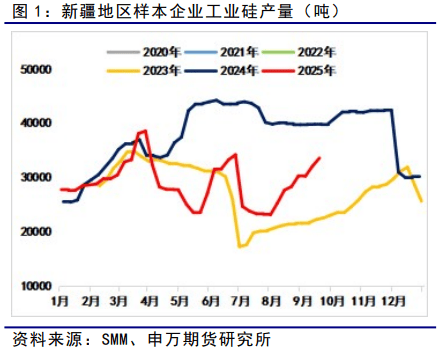
Core Viewpoint - The industrial silicon market is experiencing a short-term high-level fluctuation due to increased production in Xinjiang and strong coal prices providing cost support, despite overall inventory levels being high [3]. Supply - In Xinjiang, the weekly industrial silicon production increased by 0.15 million tons to 33.6 thousand tons, with the operating rate rising by 3.1% to 69.36% [2]. - In Yunnan, production slightly increased by 50 tons to 7,565 tons, while Sichuan's production remained stable at 2,135 tons [2]. Demand - The operating rates for recycled and primary aluminum alloys remained stable week-on-week, with a slight decrease in aluminum alloy spot prices [2]. - The weekly production of organic silicon DMC saw a minor increase, while spot prices remained stable; however, the production of polysilicon decreased by 200 tons to 31,000 tons, still at a high level [2]. Inventory - Social inventory of industrial silicon increased by 0.4 million tons to 543 thousand tons, remaining at a high level compared to the same period last year [2]. - Downstream industrial silicon inventory was stable at 221.5 thousand tons, and registered warehouse receipts totaled 49,874 hands, also stable week-on-week [2]. Price and Profit - As of September 19, the price in East China was 9,600 yuan/ton, up 100 yuan/ton week-on-week, with a basis of -1,705 yuan/ton, down 460 yuan/ton [2]. - The price of silicon coal in Xinjiang increased by 200 yuan/ton to 1,500 yuan/ton, leading to a decrease in industrial silicon production profits week-on-week [2].

盘面受政策预期扰动 螺纹钢短期或维持区间运行
Jin Tou Wang· 2025-09-19 07:05
Core Viewpoint - The rebar futures market is experiencing slight upward movement, with the main contract showing a 0.48% increase, indicating a potential stabilization in the market [1][2]. Group 1: Market Analysis - Rebar futures reached a peak of 3175.00 yuan, currently trading at 3164.00 yuan, reflecting a modest increase [1]. - The market is influenced by various factors, including inventory data and stock market performance, which have not led to a strong rebound despite positive inventory data [2]. - The demand for rebar is showing signs of recovery, particularly in the construction sector, while the automotive sector is experiencing a decline in demand for flat steel products [2]. Group 2: Institutional Perspectives - Zhengxin Futures suggests focusing on short-selling opportunities in the rebar-iron ore ratio, indicating a cautious approach to market movements [2]. - Guotou Anxin Futures notes that there is still support for rebar prices, despite a decline in real estate investment and a slowdown in infrastructure and manufacturing growth [3]. - Zhonghui Futures anticipates that the rebar market may remain within a range due to high overall supply levels and limited demand improvements from the real estate and infrastructure sectors [4].
政策预期升温,股指震荡反弹
Bao Cheng Qi Huo· 2025-09-17 10:35
1. Report Industry Investment Rating - No relevant content provided 2. Core Viewpoints - Today, all stock indices fluctuated and rebounded. The total trading volume of the Shanghai, Shenzhen, and Beijing stock markets throughout the day was 2402.9 billion yuan, showing an increase of 35.9 billion yuan compared to the previous day [3]. - The Ministry of Commerce and eight other departments recently issued the "Several Policy Measures for Expanding Service Consumption," proposing 19 specific measures in five aspects to boost consumption demand. Promoting the development of service consumption can create new service - related jobs and stimulate household consumption, thus promoting a positive economic cycle on both the supply and demand sides [3]. - In August, credit and inflation data were weak, and the consumption growth rate slowed down, indicating weak demand from the real - sector. There is a strong expectation for the introduction of policies to stabilize demand in the future, with the key window period for policy introduction expected to be in October [3]. - In July and August, non - bank deposits increased significantly, and the margin trading balance remained at a high level, indicating that the stock market has continuously attracted incremental capital inflows. However, due to the significant increase in the valuations of some stocks previously, there is still a willingness among profit - taking funds to lock in profits, which also leads to short - term technical adjustment pressure on the stock indices. In the future, attention should be paid to the game between the profit - taking rhythm of funds and the fermentation of policy expectations [3]. - In general, the stock indices are expected to experience wide - range fluctuations in the short term [3]. - Currently, the implied volatility of options is within the normal range. Considering the long - and medium - term upward trend of the stock indices, investors can continue to hold bull spreads or ratio spreads [3]. 3. Summary by Related Catalogs 3.1 Option Indicators - On September 17, 2025, the 50ETF rose 0.19% to close at 3.088; the 300ETF (Shanghai Stock Exchange) rose 0.71% to close at 4.653; the 300ETF (Shenzhen Stock Exchange) rose 0.73% to close at 4.800; the CSI 300 Index rose 0.61% to close at 4551.02; the CSI 1000 Index rose 0.95% to close at 7554.81; the 500ETF (Shanghai Stock Exchange) rose 1.03% to close at 7.357; the 500ETF (Shenzhen Stock Exchange) rose 1.27% to close at 2.944; the ChiNext ETF rose 1.96% to close at 3.119; the Shenzhen 100ETF rose 1.36% to close at 3.497; the SSE 50 Index rose 0.17% to close at 2952.78; the STAR 50ETF rose 0.98% to close at 1.44; and the E Fund STAR 50ETF rose 0.86% to close at 1.41 [5]. - For option volume PCR and position PCR, specific values for different options on September 17, 2025, and the previous trading day are provided, such as the 50ETF option volume PCR being 87.34 (previous day: 98.00) and position PCR being 79.25 (previous day: 78.16) [6]. - For the implied volatility of at - the - money options and the 30 - day historical volatility of the underlying assets, specific values for different options are provided, such as the 50ETF option's 2025 September at - the - money option implied volatility being 18.05% and the 30 - day historical volatility of the underlying asset being 15.12% [7]. 3.2 Related Charts - The report provides various charts for different options, including the price trends, volatility, volume PCR, position PCR, implied volatility curves, and at - the - money implied volatility of different terms for options such as the 50ETF option, 300ETF option (Shanghai and Shenzhen Stock Exchanges), CSI 1000 index option, 500ETF option (Shanghai and Shenzhen Stock Exchanges), ChiNext ETF option, Shenzhen 100ETF option, SSE 50 index option, STAR 50ETF option, and E Fund STAR 50ETF option [9][21][34]
政策预期不变 后期菜籽粕价格依然有上行波动基础
Jin Tou Wang· 2025-09-17 09:08
Group 1 - The core viewpoint indicates that there is an increased pricing power among enterprises, leading to a slight rise in the spot price of rapeseed meal [1] - As of September 16, the spot price of ordinary rapeseed meal in coastal areas ranges from 2590 to 2700 CNY/ton, reflecting an increase of 20 to 30 CNY/ton compared to the previous trading day and an increase of 0 to 20 CNY/ton compared to the same period last week [1] - On September 17, the futures market shows the main contract for rapeseed meal closing at 2460.00 CNY/ton, with a decline of 2.26%, and a trading volume of 394,731 contracts [2] Group 2 - The inventory of rapeseed meal is high, but there is still pressure on circulation; however, low rapeseed inventory and fewer distant ship purchases provide a basis for potential upward fluctuations in the future [4] - On September 17, the number of rapeseed meal futures warehouse receipts was 10,119, a decrease of 110 from the previous trading day [3] - Canadian canola oil prices remained stable, with October shipment at 1080 USD/ton and December shipment at 1060 USD/ton [3]
宝城期货螺纹钢早报-20250916
Bao Cheng Qi Huo· 2025-09-16 01:05
Group 1: Report Industry Investment Rating There is no information provided in the content about the report industry investment rating. Group 2: Core Viewpoints of the Report - The short - term, medium - term, and intraday views of rebar 2601 are oscillatory, oscillatory, and oscillatory and weak respectively, and attention should be paid to the support at the MA5 line. The core logic is that policy expectations are fermenting, leading to an oscillatory rebound in steel prices [2]. - The rebar futures price oscillated higher due to the enhanced policy expectations from the downward economic data in August and the strong boost from coking coal and coke. However, the supply - demand pattern of rebar remained weak. Although the weekly output decreased, the reduction during the peak season was not strong, and inventory continued to increase, with limited relief of supply pressure. Meanwhile, the demand was poor, with high - frequency indicators running at a low level and no improvement in downstream industries, resulting in insufficient peak - season demand. Currently, steel prices rebounded oscillatory due to policy expectations and strong raw materials, but the fundamentals did not improve in the situation of weak supply and demand, and the sustainability of the upward drive needed to be tracked. In the short - term, steel prices maintained an oscillatory and stable state under the dominance of optimistic sentiment, and attention should be paid to the demand performance [3]. Group 3: Summaries Based on Related Catalogs Variety Viewpoint Reference - For rebar 2601, the short - term, medium - term, and intraday views are oscillatory, oscillatory, and oscillatory and weak respectively. The reference is to focus on the support at the MA5 line, and the core logic is the fermentation of policy expectations leading to an oscillatory rebound in steel prices [2]. Market Driving Logic - The economic data in August declined, enhancing policy expectations. Coupled with the strong boost from coking coal and coke, the rebar futures price oscillated higher. The supply - demand pattern of rebar was weak, with limited relief of supply pressure and poor demand, insufficient peak - season demand. Currently, steel prices rebounded oscillatory, but the fundamentals did not improve, and the sustainability of the upward drive needed to be tracked. In the short - term, steel prices were stable and oscillatory, and attention should be paid to the demand [3].
研究你的基本面吧!老登
Datayes· 2025-09-15 12:55
Core Viewpoint - The article discusses the current state of the A-share market, highlighting a lack of direction and the recent weak economic data for August, particularly in infrastructure investment and consumer spending [1][2][4]. Economic Data Summary - August economic data shows a significant decline in infrastructure investment, with a year-on-year decrease expanding [1]. - Consumer spending on durable goods continues to decline, and overall retail sales are weaker than expected [2]. - Industrial production remains weak, with industrial added value falling short of expectations [4]. - Exports are under pressure, particularly to the U.S., with a notable increase in the decline rate [3]. Investment and Policy Outlook - Morgan Stanley predicts that economic growth will slow to around 4.5% in Q3 and Q4, which may trigger additional policy support, including a stimulus package of 0.5 to 1 trillion yuan [6]. - The focus remains on structural reforms to achieve sustainable recovery, as indicated by the signals from the 20th Central Committee's Fourth Plenary Session [6]. Market Performance - On September 15, A-shares showed mixed performance, with the Shanghai Composite Index down 0.26% and the Shenzhen Component Index up 0.63% [12]. - The automotive sector saw significant gains due to new policies aimed at boosting sales, including subsidies for car purchases [12]. - The gaming sector experienced fluctuations, with companies like Xinghui Entertainment and Perfect World seeing notable stock movements [13]. Sector Analysis - The automotive sector is expected to benefit from government support, with a target of achieving approximately 32.3 million vehicle sales by 2025 [12]. - The agricultural sector, particularly pig farming, is under regulatory focus to manage production capacity effectively [13]. - The energy storage sector is projected to grow significantly, with a target of 180 GW of new storage capacity by 2027, leading to substantial investment opportunities [13]. Capital Flow and Market Sentiment - There was a net outflow of 41.49 billion yuan from major funds, with the non-ferrous metals sector experiencing the largest outflow [22]. - The overall sentiment in the market remains cautious, with some sectors showing signs of early bubble characteristics, particularly in technology [10][11].




基本?改善叠加政策预期,助?板块阶段性企稳
Zhong Xin Qi Huo· 2025-09-11 05:10
Report Industry Investment Rating - The mid - term outlook for the black building materials industry is "oscillation" [7] Core Viewpoints - The improvement of fundamentals and policy expectations help the sector stabilize periodically. The rapid recovery of hot metal output after the parade boosts the demand for furnace materials, supporting steel prices. Steel enterprises' rapid resumption of production and frequent policy expectations on the supply - side jointly lead to the price stabilization of sector varieties [2]. - The short - term prices of most varieties in the black building materials sector are expected to oscillate. Although there are some supporting factors, there are also limitations and uncertainties in demand and supply [3][7][8] Summary by Related Catalogs 1. Overall Situation of the Black Building Materials Sector - The main futures prices of the sector oscillated strongly yesterday, and the night - session prices oscillated. The statements in the NDRC report triggered small fluctuations in the market. The resumption of production by steel enterprises and policy expectations on the supply - side led to the price stabilization of sector varieties [2] 2. Raw Material Analysis Iron Element - In terms of iron ore, port maintenance led to a significant decline in Brazilian shipments, but the impact on annual shipments is expected to be small. The current demand has returned to the level before the parade restrictions, supporting iron ore demand. However, the peak - season demand for finished products needs to be continuously verified, limiting the upside space of iron ore. It is expected that the short - term iron ore price will oscillate. For scrap steel, the fundamental contradictions are not prominent. The pressure on finished product prices leads to low electric - furnace profits, but resources are still tight, and the short - term price is expected to oscillate [3] Carbon Element - The recovery of steel mills' imported ore consumption to the pre - parade level indicates the recovery of hot metal production. Steel mills still have restocking demand before the National Day, and the short - term price is expected to remain oscillating. The recovery of coal mines is slower than that of downstream hot metal, and safety accidents continue to disrupt the coal - mine production increase rhythm. Under this supply - demand pattern, coal - mine inventories are being depleted at a low level, and there is still restocking expectation downstream before the National Day, so the coking coal price is expected to be supported [3] Alloys - For manganese silicon, a new round of steel tenders has started, and the market is waiting and seeing. The first - round inquiry price in September decreased by 400 yuan/ton month - on - month. The fundamentals lack upward drivers. In the short term, the cost side and peak - season expectations support the futures price, but the medium - and long - term price has a large downward pressure. For ferrosilicon, the first - round inquiry price in September decreased by 330 yuan/ton month - on - month. The short - term cost side still supports the price, and the downward space of the futures price may be limited in the peak - season expectation, but the medium - and long - term price center will tend to decline [4] 3. Individual Product Analysis Steel - The spot market trading volume of steel is average, and the inventory is at a moderately high level. The fundamentals are weak, especially for building materials. Although the cost side has support and there is restocking demand during the peak season, it is expected that the performance of rebar will be weaker than that of hot - rolled coils [8] Iron Ore - The overseas mine shipments and arrivals at 45 ports decreased month - on - month, mainly due to port maintenance in Brazil. The demand has support in the short term as the small - sample hot metal output has recovered. The overall inventory level is moderate. The demand is expected to recover, and steel enterprises' inventories are at a low level, but the peak - season demand for finished products has not been verified, so the short - term price is expected to oscillate [8][9] Scrap Steel - The arrival volume of scrap steel decreased this week. The pressure on finished product prices led to low electric - furnace profits, and the total daily consumption of scrap steel in both long - and short - flow processes decreased. The factory inventory decreased slightly, and the inventory - available days are at a low level. The short - term price is expected to oscillate [10] Coke - The first - round price cut has been implemented, but the coking profit is still considerable, and the supply has basically returned to normal. After the parade, steel mills' production enthusiasm is high, and they maintain on - demand procurement. The coke supply will gradually become loose. With the support of high hot - metal production, steel mills still have restocking demand, and the short - term price is expected to oscillate [11] Coking Coal - Coal mines have basically resumed production, and Mongolian coal imports remain high. The downstream steel and coking enterprises' procurement is cautious, and the upstream inventory is accumulating, but the overall inventory pressure is not prominent. After the parade, the production of coking coal and coke will gradually recover, and the downstream restocking on - demand will support the coking coal price [11] Glass - The actual demand is weak, but there are peak - season and policy expectations. After the mid - stream destocking, there may be another wave of oscillations. In the medium and long term, market - oriented capacity reduction is needed, and if the price returns to fundamental trading, it is expected to oscillate downward [12] Soda Ash - The supply - surplus pattern remains unchanged. After the futures price decline, the spot - futures trading volume increased slightly. It is expected to oscillate widely in the future. In the long term, the price center will decline to promote capacity reduction [15] Manganese Silicon - A new round of steel tenders has started, and the market is waiting and seeing. The first - round inquiry price in September decreased by 400 yuan/ton month - on - month. The fundamentals lack upward drivers. In the short term, the cost side and peak - season expectations support the futures price, but the medium - and long - term price has a large downward pressure [16] Ferrosilicon - The first - round inquiry price in September decreased by 330 yuan/ton month - on - month. The short - term cost side still supports the price, and the downward space of the futures price may be limited in the peak - season expectation, but the medium - and long - term price center will tend to decline [17] 4. Index Information - On September 10, 2025, the comprehensive index of CITIC Futures commodities was 2222.49, down 0.11%; the commodity 20 index was 2487.89, down 0.16%; the industrial products index was 2232.18, up 0.10%. The steel industry chain index was 1999.51, with a daily decline of 0.18%, a 5 - day increase of 1.04%, a 1 - month decline of 4.05%, and a year - to - date decline of 5.16% [100][102]