
经济复苏

Search documents
金融期货早班车-20260113
Zhao Shang Qi Huo· 2026-01-13 07:47
金融研究 2026年1月13日 星期二 金融期货早班车 招商期货有限公司 市场表现:1 月 12 日,A 股四大股指继续上行,其中上证指数上涨 1.09%,报收 4165.29 点;深成 指上涨 1.75%,报收 14366.91 点;创业板指上涨 1.82%,报收 3388.34 点;科创 50 指数上涨 2.43%, 报收 1511.84 点。市场成交 36,446 亿元,较前日增加 4,922 亿元。行业板块方面,传媒(+7.8%), 计算机(+7.26%),国防军工(+5.66%)涨幅居前;石油石化(-1%),煤炭(-0.47%),房地产(-0.29%)跌 幅居前。从市场强弱看,IM>IC>IF>IH,个股涨/平/跌数分别为 4,141/144/1,179。沪深两市,机构、 主力、大户、散户全天资金分别净流入 53、-266、-85、298 亿元,分别变动+70、+15、+13、-98 亿元。 股指期货 基差:IM、IC、IF、IH 次月合约基差分别为 2.61、-9.07、9.32 与 4.34 点,基差年化收益率分别为 -0.3%、1.06%、-1.87%与-1.33%,三年期历史分位数分别为 9 ...
泰人民党欲恢复“亚洲第五虎”荣光
Xin Lang Cai Jing· 2026-01-13 03:17
据彭博社报道,人民党此次提出的改革重点包括整顿官僚体系与监管规则以打击腐败、推动基础设施建 设,并重组执法与司法系统;在产业政策上,主张转向半导体等技术相关零部件制造,同时振兴传统产 业。人民党承诺在执政首个100天填补"经济黑洞",并估算假冒产品、倾销和非法竞争等导致泰国每年 损失高达1万亿泰铢(约合2233亿元人民币)。人民党总理候选人之一威拉育警告称,若未来五年经济 仍无法复苏,"'第五虎'的称号将永远成为历史传说"。 民调显示经济议题对选情影响突出。川登喜大学民调显示,超过半数受访者将经济与民生政策列为主要 考量,人民党在政党票与选区票意向中均居首位。泰国国立发展管理学院民调亦显示人民党党魁、总理 候选人纳塔蓬在总理人选支持度上领先,看守总理、泰自豪党党魁阿努廷紧随其后。 本报驻泰国特约记者 奚之淼 泰国将于今年2月8日举行大选。1月11日,民意支持率领先的泰国人民党公布12项核心议程,提出若上 台将组成"变革政府",以一揽子改革重振疲软的经济、恢复昔日"亚洲第五虎"地位。 ...
公布12项核心议程、提出“变革政府”,泰国人民党欲恢复“亚洲第五虎”荣光
Huan Qiu Shi Bao· 2026-01-12 22:48
【环球时报驻泰国特约记者 奚之淼】泰国将于今年2月8日举行大选。1月11日,民意支持率领先的泰国 人民党公布12项核心议程,提出若上台将组成"变革政府",以一揽子改革重振疲软的经济、恢复昔 日"亚洲第五虎"地位。 民调显示经济议题对选情影响突出。川登喜大学民调显示,超过半数受访者将经济与民生政策列为主要 考量,人民党在政党票与选区票意向中均居首位。泰国国立发展管理学院民调亦显示人民党党魁、总理 候选人纳塔蓬在总理人选支持度上领先,看守总理、泰自豪党党魁阿努廷紧随其后。 据彭博社报道,人民党此次提出的改革重点包括整顿官僚体系与监管规则以打击腐败、推动基础设施建 设,并重组执法与司法系统;在产业政策上,主张转向半导体等技术相关零部件制造,同时振兴传统产 业。人民党承诺在执政首个100天填补"经济黑洞",并估算假冒产品、倾销和非法竞争等导致泰国每年 损失高达1万亿泰铢(约合2233亿元人民币)。人民党总理候选人之一威拉育警告称,若未来五年经济 仍无法复苏,"'第五虎'的称号将永远成为历史传说"。 ...
出口下滑似“自由落体”,德国经济复苏靠谁?
Huan Qiu Shi Bao· 2026-01-12 22:41
Core Insights - Germany's export data for November 2025 shows a significant decline of 2.5% month-on-month, raising concerns about the country's economic recovery in 2026 [1][2] - The decline in exports is attributed to multiple pressures, including weak overseas demand, geopolitical risks, and increasing competitive pressures [2][3] - Despite some positive signals in domestic production, the overall economic recovery remains uncertain, with industrial production expected to decline for the fourth consecutive time [3][4] Export Performance - In November 2025, Germany's exports to the United States fell by 4.2% to €10.8 billion, with a year-on-year decrease of nearly 23% [2] - Exports to EU countries also decreased by 4.2%, totaling approximately €73.1 billion, with specific declines of 3.9% to Eurozone countries and 4.8% to non-Eurozone EU members [2] - The trade surplus of Germany is narrowing, indicating that the export sector may have passed its peak [2] Economic Outlook - The German economy is facing a slow recovery, with growth forecasts for 2026 being revised down to 0.6% by the Deutsche Bundesbank and 0.8% by the Ifo Institute [4] - Structural transformation is occurring at a high cost, with challenges in unemployment, productivity, and growth persisting [4] - Some economists remain cautiously optimistic, citing government investments in defense and infrastructure as potential growth drivers [3][4] Trade Relations with China - In November 2025, Germany's exports to China increased by 3.4% to €6.5 billion, while imports from China rose by 8.0% to €14.9 billion [5][6] - China has regained its status as Germany's most important trading partner, providing a glimmer of hope amid declining exports to other markets [5][6] - Future trade prospects between Germany and China are viewed positively, with expectations for continued demand in various industrial sectors and expanding technological cooperation [6]
金融期货早班车-20260112
Zhao Shang Qi Huo· 2026-01-12 02:49
Report Summary 1. Report Industry Investment Rating No information regarding the industry investment rating is provided in the report. 2. Core Viewpoints - For stock index futures, the report maintains a long - term bullish view on the economy. It suggests that using stock indices as a long - position substitute can yield certain excess returns, and recommends buying long - term contracts of various varieties on dips [2]. - For treasury bond futures, considering the upward trend in risk appetite and the expectation of economic recovery in the medium and long term, it is advised to conduct hedging operations on T and TL contracts when prices are high [2]. 3. Summary by Relevant Catalogs (1) Stock Index Futures Spot and Futures Market Performance - **Market Performance**: On January 9, A - share major indices rose. The Shanghai Composite Index rose 0.92%, the Shenzhen Component Index rose 1.15%, the ChiNext Index rose 0.77%, and the STAR 50 Index rose 1.43%. Market turnover was 31,524 billion yuan, an increase of 3,261 billion yuan from the previous day. In terms of sectors, media, comprehensive, and national defense and military industries led the gains, while banks, non - bank finance, and building materials led the losses. In terms of market strength, IC>IM>IF>IH, with 3,918 stocks rising, 201 flat, and 1,344 falling. Institutional, main force, large - scale, and retail investors' net capital inflows were - 17 billion, - 281 billion, - 97 billion, and 395 billion yuan respectively, with changes of + 128 billion, - 52 billion, - 120 billion, and + 43 billion yuan respectively [2]. - **Basis and Annualized Yield**: The basis of IM, IC, IF, and IH next - month contracts were 30.38, - 1.51, 5.72, and 1.52 points respectively, with annualized basis yields of - 3.46%, 0.17%, - 1.11%, and - 0.45%, and three - year historical quantiles of 79%, 88%, 54%, and 44% respectively [2]. - **Contract - Specific Data**: Details of various stock index futures contracts (such as IC2601 - IC2606, IF2601 - IF2606, IH2601 - IH2606, IM2601 - IM2606) including their names, price changes, current prices, trading volumes, open interests, basis, and annualized basis yields are provided [4]. (2) Treasury Bond Futures Spot and Futures Market Performance - **Market Performance**: On January 9, interest - rate bonds weakened slightly. Among active contracts, TS fell 0.03%, TF fell 0.03%, T fell 0.02%, and TL fell 0.07% [2]. - **Cash Bond Data**: For the current active 2603 contract, the CTD bonds, yield changes, corresponding net basis, and IRR for 2 - year, 5 - year, 10 - year, and 30 - year treasury bond futures are provided. The central bank's open - market operations had a net injection of 340 billion yuan [2]. - **Contract - Specific Data**: Details of various treasury bond futures contracts (such as TS2603 - TS2609, TF2603 - TF2609, T2603 - T2609, TL2603 - TL2609) including their names, price changes, current prices, trading volumes, open interests, net basis, and CTD bond implicit interest rates are provided [5]. (3) Economic Data High - frequency data shows that the prosperity of manufacturing, import and export, and social activities is currently lower than in previous periods, while the prosperity of infrastructure and real estate is similar to previous levels [8].
新年首周风险情绪持续“沸腾”,华尔街跨资产狂欢毫无降温迹象
智通财经网· 2026-01-10 01:05
智通财经APP获悉,2026年首个完整交易周,华尔街的风险情绪正再度沸腾。一场从谜因股、高收益债 券到小型公司股票的跨资产同步上涨行情,丝毫没有放缓迹象。 美股以创纪录高点收官,为新年伊始注入一剂强心针。新的经济动能迹象、生产率提升以及温和的通胀 前景共同推动了这轮上涨。在此背景下,周期性板块、大宗商品及投机性资产均全线走高。 此番行情并非由单一事件触发,而是一系列强于预期的数据逐渐塑造出经济环境正在改善的共识。野村 证券国际等机构的策略师呼应了这一观点,他们指出就业韧性、航运费率上升以及稳健的汽车需求等因 素共同驱动了市场风格的切换。投资者正从去年的避险选择及科技巨头中撤出,转向那些通常在早期经 济复苏阶段领先的市场风险领域。 尽管在特朗普时代关税政策及美联储下一步行动等重大政策问题上仍缺乏明确信号,但本周市场仍大幅 走强。与工业增长相关的股票跃升,金属价格上涨。用于汽车、家电和工厂设备的半导体需求保持强 劲,这都显示出广泛的经济活力。 投资者对风险的渴求已全面显现。本周标普500指数上涨1.6%,罗素2000指数飙升4.6%。Vanguard标普 500 ETF(VOO)在短短数日内吸引了100亿美元资金 ...

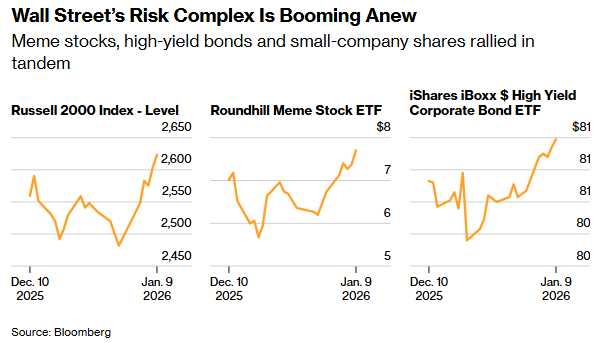
“15连阳”下分化加剧 A股短期何去何从?
Xin Lang Cai Jing· 2026-01-08 16:56
Market Overview - The A-share market showed a mixed performance on Thursday, with the Shanghai Composite Index experiencing a slight decline of 0.07% to close at 4082.98 points, while the Shenzhen Component and ChiNext Index fell by 0.51% and 0.82%, closing at 13959.48 points and 3302.31 points respectively [1] - The total trading volume in the Shanghai and Shenzhen markets reached 28.265 billion yuan, a decrease of 55.2 billion yuan compared to Wednesday [1] - Despite the overall decline, over 3700 stocks rose, with more than 110 stocks hitting the daily limit [1] Market Sentiment - The market is experiencing increased divergence, with the Shanghai Composite Index managing to maintain a "15 consecutive days of gains" despite fluctuations, leading to heightened discussions about the sustainability of this trend and potential short-term technical adjustments [1][2] - The combination of market divergence and shrinking trading volume has amplified cautious sentiment among investors [2] Economic Data Impact - January is traditionally a "data verification period" for the A-share market, with upcoming releases of key macroeconomic data such as PMI, social financing, and consumption expected to influence market volatility [2] - If the economic data underperforms, it may exacerbate short-term fluctuations and trigger technical adjustments; conversely, better-than-expected data could provide new momentum for the ongoing rally [2] Technical Analysis - The market is currently in a phase of adjustment, with all three major indices showing slight declines, yet still maintaining a trading volume above 2.8 trillion yuan [3] - There is a notable divergence between large-cap and small-cap stocks, with significant activity in sectors like commercial aerospace, brain-computer interfaces, and AI applications, while large financials and materials sectors are facing corrections [3] Investment Strategy - Investors are advised to manage their positions carefully and respond rationally to market conditions, rather than engaging in panic selling or chasing high-flying stocks [3] - A recommended strategy is to maintain a position size of around 50-60%, reducing leverage and exposure to high-volatility stocks to mitigate potential risks [3]
日本央行称地区经济温和复苏,企业有意愿继续加薪
Xin Lang Cai Jing· 2026-01-08 06:35
日本央行还表示,受企业利润高企和劳动力市场趋紧影响,许多企业认为在2026财年有必要以与2025年 大致相同的节奏继续加薪。 日本央行周四表示,日本各地区经济正在逐步复苏,许多企业认为有必要继续提高工资,显示出央行对 经济前景的乐观判断,这种判断可能为进一步加息提供依据。 在与各地分支机构负责人举行的会议上,日本央行维持了与三个月前相比对全国九个地区的经济评估, 称各地区经济正在改善或逐步复苏。 调查还显示,许多地区的企业仍在通过提价来转嫁原材料、劳动力和物流成本上升的压力,其中一些企 业表示,正考虑将近期日元贬值带来的更高成本纳入价格之中。(新华财经) 不过一些地区指出,中小企业担忧其在2026财年可能难以像2025年那样大幅提高工资。 ...
日本央行称地区经济温和复苏 企业有意愿继续加薪
Xin Hua Cai Jing· 2026-01-08 06:18
日本央行还表示,受企业利润高企和劳动力市场趋紧影响,许多企业认为在2026财年有必要以与2025年 大致相同的节奏继续加薪。 不过一些地区指出,中小企业担忧其在2026财年可能难以像2025年那样大幅提高工资。 调查还显示,许多地区的企业仍在通过提价来转嫁原材料、劳动力和物流成本上升的压力,其中一些企 业表示,正考虑将近期日元贬值带来的更高成本纳入价格之中。 日本央行周四表示,日本各地区经济正在逐步复苏,许多企业认为有必要继续提高工资,显示出央行对 经济前景的乐观判断,这种判断可能为进一步加息提供依据。 (文章来源:新华财经) 在与各地分支机构负责人举行的会议上,日本央行维持了与三个月前相比对全国九个地区的经济评估, 称各地区经济正在改善或逐步复苏。 ...
金融期货早班车-20260108
Zhao Shang Qi Huo· 2026-01-08 02:07
1. Report Industry Investment Rating - Not provided in the content 2. Core Viewpoints of the Report - For stock index futures, the report maintains a long - term bullish view on the economy and suggests buying long - term contracts of various varieties on dips [3]. - For bond futures, considering the upward risk appetite and economic recovery expectations in the medium and long term, it is recommended to hedge T and TL contracts on rallies [3]. 3. Summary by Relevant Catalogs 3.1 Stock Index Futures and Spot Market Performance - On January 7th, the four major A - share stock indexes all rose, with the Shanghai Composite Index up 0.05% (4085.77 points), the Shenzhen Component Index up 0.06% (14030.56 points), the ChiNext Index up 0.31% (3329.69 points), and the STAR 50 Index up 0.99% (1443.39 points). Market turnover was 28,816 billion yuan, an increase of 493 billion yuan from the previous day [2]. - In terms of industry sectors, non - ferrous metals (+0.3%), non - bank finance (- 1.13%), and basic chemicals (+0.28%) had significant changes. From a market strength perspective, IC>IM>IF>IH. The number of rising, flat, and falling stocks was 2,164, 107, and 3,188 respectively. Institutional, main, large - scale, and retail investors' net inflows of funds in the Shanghai and Shenzhen stock markets were - 214, - 258, 71, and 401 billion yuan respectively, with changes of - 247, - 48, +121, and +174 billion yuan [2]. - The basis of the next - month contracts of IM, IC, IF, and IH were 91.22, 43.68, 15.67, and 2.92 points respectively, and the annualized basis yields were - 9.95%, - 4.78%, - 2.83%, and - 0.8% respectively, with three - year historical quantiles of 42%, 53%, 38%, and 40% respectively [3]. - The report provides detailed data on the performance of various stock index futures contracts such as IC2601, IF2601, etc., including price, trading volume, open interest, basis, and annualized basis yield [5]. 3.2 Treasury Bond Futures and Spot Market Performance - On January 7th, interest - rate bonds weakened. Among the active contracts, TS fell 0.03%, TF fell 0.06%, T fell 0.08%, and TL fell 0.44% [3]. - For the current active 2603 contract, the CTD bond information of 2 - year, 5 - year, 10 - year, and 30 - year treasury bond futures is provided, including yield changes, net basis, and IRR [3]. - In terms of the money supply, the central bank's currency injection was 286 billion yuan, currency withdrawal was 5,288 billion yuan, and the net withdrawal was 5,002 billion yuan [3]. - The report also presents detailed data on the performance of various treasury bond futures contracts such as TS2603, TF2603, etc., including price, trading volume, open interest, net basis, and CTD bond implicit interest rate [6]. 3.3 Economic Data - High - frequency data shows that the prosperity of manufacturing, real estate, import and export, and social activities is currently lower than in the past, while the prosperity of infrastructure is similar to that in the past [9].