
GDP增速

Search documents
【环球财经】巴西央行《焦点报告》:对通胀、GDP增速、利率和汇率预期保持稳定
Xin Hua Cai Jing· 2025-09-26 08:11
Core Insights - The Brazilian Central Bank's latest Focus Report indicates stable market expectations for inflation, economic growth, interest rates, and exchange rates for 2025 [1][3] Inflation - The market predicts a 2025 inflation rate of 4.83%, consistent with the previous week and slightly lower than the 4.86% forecast four weeks ago [1] - For 2026 and 2027, inflation expectations are 4.29% and 3.90%, respectively [1] - In August, Brazil experienced its first deflation since August 2024, with the Consumer Price Index (CPI) decreasing by 0.11% month-on-month, and the National Consumer Price Index (INPC) dropping by 0.21% [1] Economic Growth - The expected GDP growth for Brazil in 2025 is 2.16%, unchanged from the previous week and slightly lower than the 2.18% forecast four weeks ago [1] - Growth expectations for 2026 and 2027 are 1.80% and 1.90%, respectively [1] Interest Rates - The market anticipates that the benchmark interest rate (Selic) will remain at 15% in 2025, marking the 13th consecutive week without change [1] - Expected interest rates for 2026 and 2027 are 12.25% and 10.50%, respectively [1] Exchange Rates - The market forecasts the USD/BRL exchange rate to be 5.50 by the end of 2025, slightly lower than the previous forecast of 5.59 [2] - Predictions for 2026 and 2027 remain at 5.60 [2] - The current spot exchange rate is approximately 5.32 [2] Market Sentiment - The Focus Report reflects market confidence in the economy, with the Central Bank's monetary policy committee noting increased risks for emerging markets due to global economic slowdown, U.S. policy uncertainty, and geopolitical tensions [1][3]
铜:美元持续回升,限制价格上涨
Guo Tai Jun An Qi Huo· 2025-09-26 02:00
Report Summary 1. Report Industry Investment Rating - Not provided in the content 2. Core View of the Report - The continuous rise of the US dollar restricts the upward movement of copper prices. The strong US economic data increases the uncertainty of the Fed's future interest - rate cut path, and the market's expectation of a rate cut in October has cooled [1]. 3. Summary According to Related Catalogs 3.1 Copper Fundamental Data - **Futures Prices**: The closing price of the Shanghai copper main contract was 82,710 with a daily increase of 3.44%, and the night - session closing price was 82,380 with a decrease of 0.40%. The LME copper 3M electronic disk was at 10,276 with a decrease of 0.43% [1]. - **Trading Volume and Open Interest**: The trading volume of the Shanghai copper main contract was 334,893, an increase of 283,166 from the previous day, and the open interest was 238,523, an increase of 66,079. The trading volume of the LME copper 3M electronic disk was 42,366, a decrease of 4,722, and the open interest was 296,000, an increase of 6,048 [1]. - **Futures Inventory**: The Shanghai copper inventory was 27,662, an increase of 243, and the LME copper inventory was 144,425, a decrease of 350. The LME copper注销仓单 ratio was 7.89%, a decrease of 0.24% [1]. - **Spreads**: The LME copper spread decreased by 0.18, the保税 - zone warehouse receipt premium decreased by 4, and the Shanghai 1 bright copper price increased by 1,300. Many other spreads also showed different degrees of change [1]. 3.2 Macro and Industry News - **Macro**: The US second - quarter GDP growth was revised up to 3.8%, the highest in nearly two years, and the PCE price index was 2.6%. The strong data increased the uncertainty of the Fed's future interest - rate cut path [1]. - **Industry**: In August, China's refined copper imports were 30.72 tons, a month - on - month decrease of 8.17% and a year - on - year increase of 11.14%. Congo was the largest supplier. Freeport declared force majeure at its Indonesian Grasberg mine, and its comprehensive sales in Q3 2025 are expected to be about 4% lower for copper and 6% lower for gold than the July 2025 estimate [1][3]. 3.3 Trend Intensity - The copper trend intensity is 0, indicating a neutral view [3]
【环球财经】瑞士央行维持利率不变 仍有可能采取负利率政策
Xin Hua Cai Jing· 2025-09-25 13:46
Core Viewpoint - The Swiss National Bank (SNB) has decided to maintain its policy interest rate at 0%, indicating readiness to intervene in the foreign exchange market if necessary. This decision aligns with market expectations, but there are concerns about the impact of high U.S. tariffs on Swiss economic growth, which may lead to potential rate cuts in the future [1][2]. Group 1: Monetary Policy and Economic Outlook - The SNB's current monetary policy is described as expansionary, with a higher threshold for entering negative interest rates compared to normal rate cuts. The bank is prepared to use all available tools if needed [1][3]. - The chief economist at Syz Bank believes that the current robust monetary policy is reasonable given the economic and political landscape, with the main concern being uncertainty surrounding the export sector [1]. - UBS economists highlight that tariffs pose the greatest downside risk to Swiss economic growth in the short term, and even a reduction in rates to negative territory may not effectively counteract the impact of tariffs [1]. Group 2: Economic Growth and Inflation Projections - Swiss GDP growth is expected to slow to 0.5% by the second quarter of 2025, with high U.S. tariffs likely to suppress exports and investments, particularly in the machinery and watchmaking sectors. However, the service sector remains resilient [2]. - The SNB forecasts moderate economic growth, with GDP growth expectations of 1% to 1.5% for 2025, slowing to nearly 1% in 2026, and an anticipated rise in the unemployment rate [2]. - Current inflation pressures are mild, with the Swiss inflation rate rising to 0.2% in August, driven mainly by the tourism sector and imported goods. The SNB projects inflation rates of 0.2% for 2025, 0.5% for 2026, and 0.7% for 2027 if the policy rate remains at 0% [2].
瑞典国家经济研究所发布9月《瑞典经济报告》
Shang Wu Bu Wang Zhan· 2025-09-25 02:28
Core Insights - The Swedish National Economic Institute's report indicates that household consumption has increased for four consecutive quarters, with an improving outlook on the economy during the summer [1] - Household spending is expected to be a significant driver of ongoing economic recovery, with GDP growth in the second half of the year projected to exceed that of the first half [1] - The report forecasts that economic growth will accelerate further next year, primarily due to expansionary budget measures boosting household income [1] Economic Indicators - The report predicts that inflation will be significantly lower than 2% next year, attributed to temporary reductions in food VAT and electricity taxes [1] - Despite the anticipated low inflation, the central bank is not expected to lower interest rates further [1] - The government is projected to have negative net lending for several years due to large-scale debt financing for defense spending [1]
股指期货将偏强震荡,黄金、铜、原油期货将偏弱震荡
Guo Tai Jun An Qi Huo· 2025-09-18 03:36
Report Industry Investment Rating No relevant content provided. Core View Through macro - fundamental and technical analysis, the report predicts the price trends of various futures on September 18, 2025, including股指期货,国债期货, metal futures, energy futures, and chemical futures [2][3][4]. Summary by Related Catalogs Futures Market Outlook - **Stock Index Futures**: Expected to be strongly volatile on September 18. IF2509 has resistance at 4580 and 4600 points, support at 4542 and 4497 points; IH2509 has resistance at 2976 and 2990 points, support at 2940 and 2924 points; IC2509 has resistance at 7300 and 7350 points, support at 7235 and 7165 points; IM2509 has resistance at 7600 and 7650 points, support at 7525 and 7462 points [2][20]. - **Ten - year Treasury Bond Futures**: The T2512 contract is likely to be strongly and widely volatile on September 18, with resistance at 108.26 and 108.32 yuan, support at 107.97 and 107.91 yuan [2][38]. - **Thirty - year Treasury Bond Futures**: The TL2512 contract is expected to be strongly and widely volatile on September 18, with resistance at 116.1 and 116.5 yuan, support at 115.2 and 115.0 yuan [2][42]. - **Gold Futures**: The AU2512 contract is likely to be weakly volatile on September 18, with support at 829.0 and 824.9 yuan/gram, resistance at 845.9 and 850.0 yuan/gram [3][43]. - **Silver Futures**: The AG2512 contract is expected to be widely volatile on September 18, with resistance at 10000 and 10090 yuan/kilogram, support at 9800 and 9710 yuan/kilogram [3][50]. - **Copper Futures**: The CU2511 contract is likely to be weakly volatile on September 18, and will test support at 79500 and 79000 yuan/ton, with resistance at 80000 and 80300 yuan/ton [3][54]. - **Aluminum Futures**: The AL2511 contract is expected to be weakly volatile on September 18, and will test support at 20650 and 20600 yuan/ton, with resistance at 20920 and 21000 yuan/ton [3][60]. - **Alumina Futures**: The AO2601 contract is likely to be strongly volatile on September 18, and will attack resistance at 2989 and 3021 yuan/ton, with support at 2919 and 2900 yuan/ton [3][63]. - **Lithium Carbonate Futures**: The LC2511 contract is expected to be widely volatile on September 18, with resistance at 74800 and 75600 yuan/ton, support at 72700 and 72000 yuan/ton [3][66]. - **Rebar Futures**: The RB2601 contract is likely to fluctuate and consolidate on September 18, with support at 3144 and 3127 yuan/ton, resistance at 3180 and 3200 yuan/ton [4][71]. - **Hot - rolled Coil Futures**: The HC2601 contract is expected to fluctuate and consolidate on September 18, with support at 3370 and 3355 yuan/ton, resistance at 3410 and 3420 yuan/ton [4][77]. - **Iron Ore Futures**: The I2601 contract is likely to be strongly volatile on September 18, with resistance at 812 and 815 yuan/ton, support at 796 and 793 yuan/ton [4][79]. - **Coking Coal Futures**: The JM2601 contract is expected to be weakly volatile on September 18, with support at 1215 and 1201 yuan/ton, resistance at 1241 and 1259 yuan/ton [4][85]. - **Glass Futures**: The FG601 contract is likely to fluctuate and consolidate on September 18, with resistance at 1250 and 1270 yuan/ton, support at 1226 and 1212 yuan/ton [4][88]. - **Soda Ash Futures**: The SA601 contract is expected to fluctuate and consolidate on September 18, with resistance at 1347 and 1358 yuan/ton, support at 1325 and 1314 yuan/ton [4][95]. - **Crude Oil Futures**: The SC2511 contract is likely to be weakly volatile on September 18, with support at 493 and 490 yuan/barrel, resistance at 503 and 504 yuan/barrel [4][99]. - **PTA Futures**: The TA601 contract is expected to be strongly volatile on September 18, with resistance at 4750 and 4778 yuan/ton, support at 4694 and 4682 yuan/ton [4][103]. - **PVC Futures**: The V2601 contract is likely to be weakly volatile on September 18, and will test support at 4934 and 4921 yuan/ton, with resistance at 5000 and 5036 yuan/ton [4][105]. - **Natural Rubber Futures**: The RU2601 contract is expected to be weakly volatile on September 18, and will test support at 15590 and 15500 yuan/ton, with resistance at 15880 and 15910 yuan/ton [6][107]. Macro - news and Trading Tips - **Fed Policy**: The Fed cut the federal funds rate by 25 basis points to 4.00% - 4.25%, the first cut this year. The Fed also cut the excess reserve rate and the reserve rate by 25 basis points. The FOMC statement shows concerns about employment and inflation. The dot - plot indicates different expectations for future rate cuts among Fed officials [7][8]. - **Domestic Policies and Data**: China will select about 50 pilot cities for new consumption models, introduce a series of policies for service consumption, and carry out over 25,000 cultural and tourism consumption activities during the consumption month, issuing over 330 million yuan in consumption subsidies. In the first eight months, China's general public budget revenue was 14.82 trillion yuan, up 0.3% year - on - year, and the general public budget expenditure was 17.93 trillion yuan, up 3.1% year - on - year [10][11]. - **International News**: Canada's central bank cut interest rates by 25 basis points to 2.5%. Japan's central bank is expected to keep interest rates unchanged. UK's CPI in August was flat at 3.8% year - on - year [12][13]. Commodity Futures - related Information - **Gold Market**: Hong Kong will take five measures to establish an international gold trading market, including expanding gold storage and establishing a central clearing system [13]. - **International Futures Market**: On September 17, international precious metal futures generally fell, international oil prices slightly declined, and most London base metals fell [14].
美联储利率决议:如期降息25个基点,白宫声音刺眼亮相点阵图
Feng Huang Wang· 2025-09-17 22:19
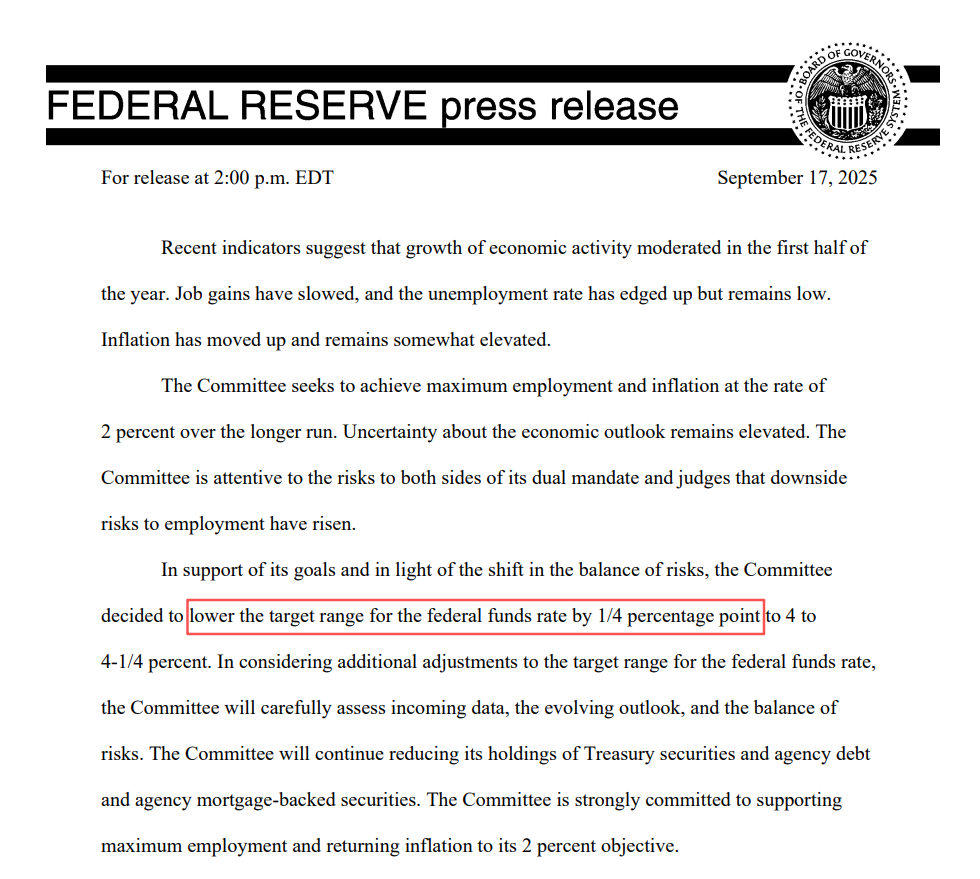
Core Points - The Federal Open Market Committee (FOMC) has lowered the federal funds rate target range by 25 basis points to 4.00%-4.25%, aligning with market expectations [1] - The decision reflects concerns about the risks in the U.S. labor market and the challenges posed by rising inflation [3] - Recent indicators show a slowdown in economic activity growth during the first half of the year, with a slight increase in the unemployment rate, although it remains low [3] Economic Projections - The median projections from the dot plot indicate that FOMC officials expect two additional rate cuts of 25 basis points each in 2025 [4][7] - Economic growth expectations have been slightly raised, with GDP growth projected at 1.6% for 2025 and 1.8% for 2026, compared to previous estimates [9] - Inflation expectations have been adjusted upward, with the PCE inflation forecast for 2026 raised to 2.6% [9][10]

8月经济数据点评:供需分化的三个结果
Soochow Securities· 2025-09-15 10:33
Supply and Demand Analysis - In August, industrial added value grew by 5.2% year-on-year, down from 5.7% in July, while the service production index increased by 5.6%, down from 5.8%[4] - External demand weakened with exports growing by 4.4% year-on-year, down from 7.2% in July, and below the expected 5.9%[4] - Domestic demand also declined, with retail sales growing by 3.4%, unchanged from July, and below the expected 3.8%[4] - Fixed asset investment (FAI) showed a cumulative growth of 0.5%, down from 1.6% in July, with monthly growth dropping from -5.2% to -6.3%[6] Economic Outlook - The divergence between supply and demand is expected to lead to three outcomes: GDP growth will align more closely with supply data, with Q3 GDP growth projected around 5%[4] - Strong supply relative to weak demand may increase price pressures, necessitating stronger policy support for price recovery[4] - Historically, if demand does not strengthen, supply will follow suit, indicating greater pressure on Q4 GDP compared to Q3[4] Sector Performance - High-tech manufacturing remains a key driver of production resilience, with its added value growing by 9.3% year-on-year in August[4] - The restaurant sector showed a rebound in consumption, with retail sales in this category growing by 2.1%, up from 1.1% in July[5] - Fixed asset investment in infrastructure and real estate continued to decline, with infrastructure investment dropping from -1.9% to -6.4% and real estate investment from -17.2% to -19.4%[6]
巴西经济增长放缓,第二季度增长0.4%
Shang Wu Bu Wang Zhan· 2025-09-06 17:51
Core Insights - Brazil's GDP reached 3.2 trillion reais (approximately 583.6 billion USD) in Q2, with a quarter-on-quarter growth of 0.4% and a year-on-year growth of 2.2%, slightly above expectations [1] Economic Performance - The value added by the services sector was 1.9 trillion reais, with a quarter-on-quarter growth of 0.6% and a year-on-year growth of 2% [1] - The industrial sector's value added was 638 billion reais, showing a quarter-on-quarter growth of 0.5% and a year-on-year growth of 1.1% [1] - The agricultural sector's value added was 239.1 billion reais, with a quarter-on-quarter decline of 0.1% but a year-on-year growth of 10.1% [1] Consumption and Investment - Household consumption expenditure increased by 2.2% year-on-year, while government consumption expenditure grew by 0.7% [1] - Gross fixed capital formation saw a year-on-year increase of 6.6% [1] Trade Dynamics - Exports and imports of goods and services grew by 1.6% and 9% year-on-year, respectively [1] Economic Challenges - Analysts attribute the weak GDP growth in Q2 to high interest rates and a slowdown in agricultural growth, with federal government fiscal stimulus measures beginning to lose effectiveness [1]
中国经济小结——2025篇
Hu Xiu· 2025-09-02 09:04
Core Viewpoint - China's GDP growth rate for the first half of 2025 reached 5.3%, which appears satisfactory, yet public sentiment does not reflect this positivity, indicating a disparity between economic indicators and personal experiences [1] Economic Focus - The article aims to analyze key directions of China's economy this year, highlighting significant issues and proposed responses [1] Key Issues - There is a noticeable contrast between the reported GDP growth and the general public's perception of economic conditions, suggesting underlying challenges that may not be captured by aggregate data [1] Proposed Responses - The article discusses potential strategies that may be implemented to address the economic concerns and improve public sentiment towards the economy [1]
亚特兰大联储GDPNow模型预计美国第三季度GDP增速为3.5%
Di Yi Cai Jing· 2025-08-29 15:02
Core Insights - The Atlanta Federal Reserve's GDPNow model has revised its forecast for the U.S. GDP growth rate in the third quarter to 3.5%, up from a previous estimate of 2.2% [1] Economic Indicators - The updated GDP growth forecast indicates a significant increase of 1.3 percentage points from the earlier estimate [1]