
国产替代

Search documents
资本大迁徙:五年前后,2025年中国创投11大高增长赛道深度解析
3 6 Ke· 2026-01-20 11:01
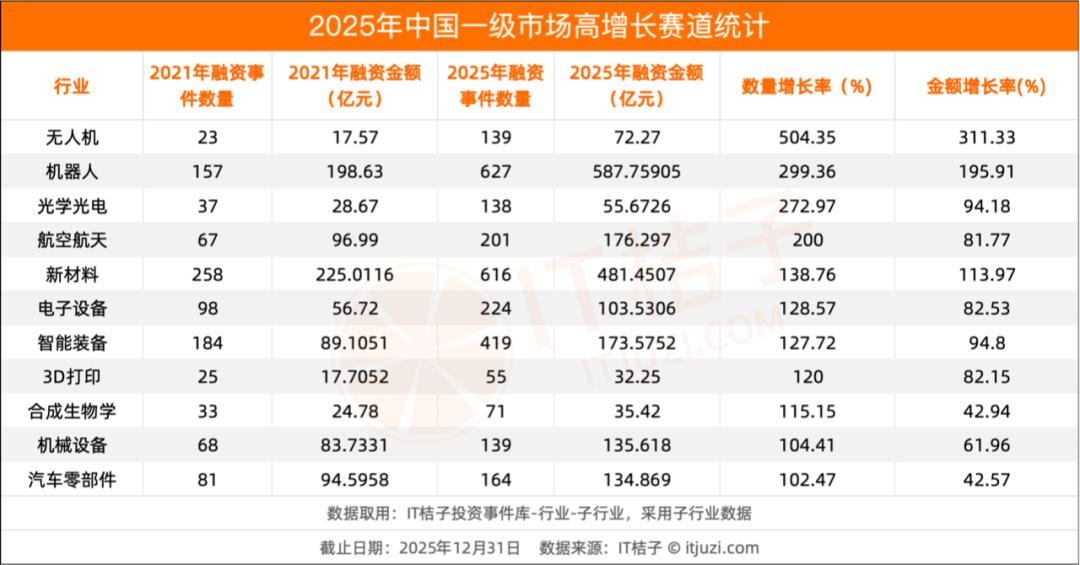
Core Insights - The Chinese venture capital market is experiencing a significant shift from consumer-driven sectors to hard technology sectors, with funding for hard tech such as drones, robotics, and new materials increasing dramatically while consumer sectors like second-hand e-commerce and local logistics see funding drop by over 95% [1][15] Funding Growth by Sector - Drones: Funding events increased from 23 in 2021 to 139 in 2025, with total funding rising from 1.757 billion to 7.227 billion yuan, marking a growth rate of 504.35% in event numbers and 311.33% in funding amount [2][3] - Robotics: Funding events surged from 157 to 627, with total funding jumping from 19.863 billion to 58.776 billion yuan, reflecting a growth rate of 299.36% in event numbers and 195.91% in funding amount [2][3] - New Materials: Increased from 258 events and 22.50116 billion yuan in 2021 to 616 events and 48.14507 billion yuan in 2025, showing a growth rate of 138.76% in event numbers and 113.97% in funding amount [2][4] High-Growth Sectors - Aerospace: Funding events grew from 67 to 201, with total funding increasing from 9.699 billion to 17.6297 billion yuan, achieving a growth rate of 200% in event numbers and 81.77% in funding amount [2][4] - Optical and Photonic: Events increased from 37 to 138, with funding rising from 2.867 billion to 5.56726 billion yuan, reflecting a growth rate of 272.97% in event numbers and 94.18% in funding amount [2][4] Key Drivers of Growth - The rise of drones is driven by the transition from consumer to industrial applications, supported by national policies promoting low-altitude economy [7] - Robotics growth is fueled by advancements in AI and the emergence of "embodied intelligence," leading to increased investment in humanoid robots and automation [8] - The push for domestic alternatives and self-sufficiency in sectors like new materials and aerospace is a significant driver of investment, particularly in response to external technology restrictions [9][10] Strategic Insights - The shift towards hard technology represents a fundamental change in investment paradigms, moving from short-term gains to long-term value creation [15] - The demand for automation in manufacturing due to rising labor costs and the need for efficiency is driving investments in robotics and smart equipment [11] - Continuous policy support, including tax incentives and funding for high-tech industries, is crucial for sustaining growth in hard technology sectors [12]

AI与国产化双轮驱动!半导体设备EFT怎么选?
市值风云· 2026-01-20 10:12
Core Viewpoint - The semiconductor equipment sector is currently attracting significant investment interest, driven by macroeconomic growth points and strong policy support, making it a key area for potential investment opportunities [4][7]. Group 1: Market Performance - The semiconductor equipment sector has shown remarkable performance in the A-share market, with the top three indices tracking semiconductor equipment themes performing the best year-to-date [5]. - The leading indices include the Semiconductor Materials Equipment Index, which has increased by 27.71%, and the Sci-Tech Innovation Board Semiconductor Materials Index, which has risen by 26.35% [6]. Group 2: Investment Logic - The investment logic in semiconductor equipment is driven by a dual-cycle resonance and the trend of domestic substitution, positioning these companies to benefit from the overall industry growth [8][16]. - The current industry cycle is characterized by a recovery in traditional demand and a surge in new demand driven by AI, with healthy inventory levels in consumer electronics and automotive sectors [12]. - The domestic semiconductor equipment localization rate is low, at approximately 25% for 2024, indicating significant room for growth in domestic production capabilities [14]. Group 3: ETF Landscape - Several ETFs have emerged to capitalize on the semiconductor equipment sector, with returns exceeding 20% this year, although performance varies based on the indices they track [19]. - The largest ETF, the Semiconductor Equipment ETF (159516.SZ), tracks the Semiconductor Materials Equipment Index, which includes 40 leading companies in the sector, with a weight of 86.5% in semiconductor equipment and materials [21]. - The Sci-Tech Semiconductor ETF (588170.SH) focuses on the Sci-Tech Innovation Board, offering higher volatility and potential returns due to its concentrated investment strategy [23]. Group 4: Investment Strategies - For investors seeking a balanced approach, the Semiconductor Materials Equipment ETF provides a diversified solution, while aggressive investors may prefer ETFs focused on the Sci-Tech Board for higher potential returns [30][32]. - Investors looking to capture gains across the entire semiconductor value chain, including design and manufacturing, may find the Zhongzheng Semiconductor Industry ETF to be a suitable option [33].
深圳中微,进军Nor Flash
半导体芯闻· 2026-01-20 10:05
Group 1 - The article highlights that a company is set to launch its first 4M bit low-power SPI NOR Flash chip, filling a gap in its product line within the Flash sector. This product features low cost, low power consumption, high-speed read/write capabilities, and non-volatile memory, catering to small storage needs. This marks a significant step for the company, which primarily focuses on microcontrollers (MCUs), into the high-demand storage chip market [1][2] - The company, Zhongwei Semiconductor, is a platform-based chip design enterprise specializing in mixed-signal chip design centered around MCUs, providing "MCU + supporting chip" solutions widely used in smart home appliances, consumer electronics, and industrial control. It holds a leading market share in the domestic smart home appliance MCU chip sector and is one of the major MCU suppliers in China [1][2] - The current surge in the storage chip market is attributed to a profound adjustment in global supply and demand dynamics, driven by the rapid growth of artificial intelligence infrastructure, leading to unprecedented demand for high-end memory. Major international companies like Micron Technology have warned of ongoing shortages [1][2] Group 2 - TrendForce forecasts a significant quarter-on-quarter increase in contract prices for DRAM and NAND Flash in Q1 2026. This context has led downstream customers to increasingly seek supply chain diversification and stability, presenting a rare market entry opportunity for domestic chip companies [2] - Zhongwei Semiconductor's extension from its core MCU field into storage chips reflects the domestic semiconductor industry's efforts to seize industry upturn opportunities and enhance supply chain autonomy and competitiveness. If this strategic attempt succeeds, it could strengthen the company's influence in critical chip sectors during the domestic substitution process [2] - However, the storage industry is characterized by strong cyclical fluctuations, indicating that the current AI-driven high demand may face turning points due to supply and demand changes. For new entrants like Zhongwei Semiconductor, the ability to manage technology, market dynamics, and cyclical challenges will be crucial for success in this competitive landscape [2]


注册资本1亿元!沐曦股份在上海成立数智科技公司
Ju Chao Zi Xun· 2026-01-20 09:49
Core Viewpoint - The establishment of Muxi Smart (Shanghai) Technology Co., Ltd. marks a significant step in the domestic GPU industry, with a focus on integrated circuit design and sales, indicating a strategic move towards enhancing China's capabilities in high-performance computing and AI applications [1][3]. Company Overview - Muxi Co., Ltd. specializes in the independent research and development of high-performance GPU chips and computing platforms, covering areas such as AI training and inference, general computing, and graphics rendering [3]. - The company aims to provide high-performance GPU chips and related software stack and computing platform solutions, contributing to the development of digital economy [3]. Market Context - The GPU market has traditionally been dominated by foreign manufacturers, but there is significant potential for domestic alternatives, especially in light of geopolitical tensions and the rise of new AI technologies [4]. - Muxi Co., Ltd. is positioned as a leading domestic GPU enterprise, actively investing in product research and technological breakthroughs to break foreign monopolies and increase market share [4]. Technological Advancements - The company has built a core R&D team with global vision and expertise in top-tier GPU technology, focusing on achieving self-sufficiency in the smart computing industry chain [4]. - Muxi has developed capabilities in the research, design, and mass production of high-performance GPU chips and foundational system software, overcoming key technological bottlenecks [4]. Product Offerings - Muxi's product lineup includes the Xisi N series GPU for AI inference, the Xiyun C series GPU for integrated training and general computing, and the upcoming Xicai G series GPU for graphics rendering [5]. - The products are based on self-developed GPU IP and a unified architecture, showcasing significant advantages in versatility, single-card performance, cluster stability, and ecosystem compatibility [5]. Industry Collaboration - The company actively promotes industry collaboration, having completed extensive adaptations with upstream and downstream partners in server systems, operating systems, AI frameworks, and large models [5]. - Muxi provides domestic computing power support for distributed inference of leading large models, facilitating the transition from technological breakthroughs to commercial applications in the "domestic computing power + large model industry" [5].

洁美科技(002859) - 2026年1月16日至1月20日投资者关系活动记录表
2026-01-20 09:48
Group 1: Company Overview - The company aims to become a one-stop service provider for electronic component packaging materials and solutions, focusing on electronic-grade film materials and related fields [4] - The company has developed proprietary production technology for thin carrier paper, breaking the market monopoly held by foreign companies, and currently leads the global market share for paper carrier tape [4] - The company is expanding its product range to include electronic-grade film materials and has achieved mass production of products such as release films and composite conductive fluids [4] Group 2: Industry Insights - The current industry climate is favorable, with core products in electronic packaging materials operating at full capacity, and the utilization rate of electronic-grade film materials is gradually increasing [4] - The demand for electronic components is driven by the acceleration of global digitalization, "new infrastructure" policies, and the growing markets for 5G, cloud computing, and electric vehicles [4][5] - Recent price increases from downstream clients indicate a robust demand for electronic components, prompting the company to consider adjusting its product prices accordingly [5] Group 3: Product Development and Client Engagement - The company has successfully transitioned to stable bulk supply of release films for MLCC to major clients, including Yageo and Walsin Technology, and has completed product validation for Korean clients [6] - The Tianjin production base is currently in the equipment debugging phase, with trial production expected to start in the first quarter of 2026, enhancing supply capabilities for strategic clients [6] - The company is actively developing high-end release films and has established strategic supply agreements with multiple clients in the polarizer film sector [6] Group 4: Technological Advancements - The company has expertise in the preparation of ultra-thin film materials, which positions it well for producing HVLP copper foil and PCB carrier copper foil [8] - The design capacity for copper foil products is set at 5 million square meters annually, with a short delivery cycle for production equipment, allowing for rapid expansion [8]

美德乐:自研掌握覆盖智能输送系统方案设计等多个核心技术体系 产品在负载能力、输送速度等技术指标方面处于行业领先水平
Quan Jing Wang· 2026-01-20 09:35
Core Viewpoint - Meidel is a leading domestic supplier of intelligent conveyor systems, focusing on the research, design, manufacturing, and sales of intelligent manufacturing equipment, with a strong emphasis on technological innovation and market demand growth [2][4]. Group 1: Company Overview - Founded in July 2009, Meidel specializes in intelligent manufacturing equipment, with core products including modular conveyor systems and industrial components [2]. - The company has established a comprehensive core technology system covering the entire process from design to delivery of intelligent conveyor systems, which gives it a competitive edge in the industry [1][2]. Group 2: Technological Advantages - Meidel possesses advanced technologies in various areas, including intelligent control, modular assembly, and electromagnetic drive technology, which have been recognized as internationally advanced, particularly in the context of new energy battery production [2][3]. - The company has a strong R&D team and facilities, enabling it to maintain a leading position in technical indicators such as load capacity, conveyor speed, and positioning accuracy [1][2]. Group 3: Market Position and Clientele - Meidel has built a stable customer base, including well-known companies in various sectors such as BYD and CATL, enhancing its market recognition and brand value [3]. - The company’s products are widely used in industries like new energy, automotive parts, electronics, and logistics, indicating a broad application scope [2][3]. Group 4: Financial Performance - Meidel has demonstrated strong operational resilience and growth potential, with projected revenues of 1.3 billion to 1.4 billion yuan in 2025, reflecting a year-on-year growth of 14.26% to 23.05% [4]. - The company’s gross profit margins have remained robust, with figures of 36.63%, 33.04%, 33.41%, and 37.24% across different reporting periods [4]. Group 5: Fundraising and Future Plans - Meidel plans to raise approximately 645 million yuan through its public offering, with funds allocated to projects aimed at capacity expansion and technological upgrades [5][6]. - The company aims to enhance its production capabilities and solidify its leading position in high-end intelligent manufacturing solutions [6].
A股集体收跌,黄金概念崛起,半导体板块强势
Zheng Quan Shi Bao· 2026-01-20 09:27
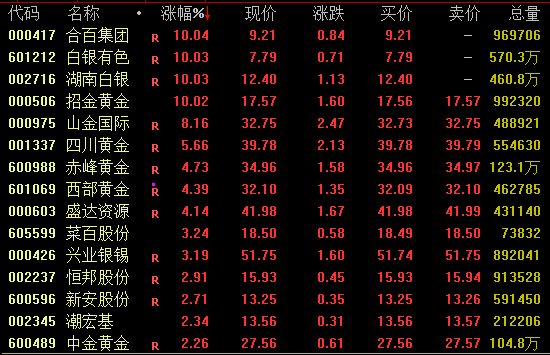
Group 1: Gold Market - Spot gold prices surpassed $4,700 per ounce, setting a new historical high, which led to significant gains in gold-related stocks [1][6][5] - Notable gold stocks that reached their daily limit include He Bai Group (000417), Silver Color (601212), Hunan Silver (002716), and Zhaojin Gold (000506) [5][6] - Analysts expect continued price increases for gold and silver due to easing dollar liquidity and escalating global geopolitical conflicts [6][7] Group 2: Semiconductor Sector - The semiconductor sector showed strong performance, with stocks like Zhongwei Semiconductor (688380) hitting a 20% limit up, and others like Yingji Chip and Blue Arrow Electronics rising over 12% [9][10] - Zhongwei Semiconductor announced the launch of its first non-volatile memory chip, marking a significant step into the storage market [10] - TSMC projected a revenue of $122 billion for 2025, a 35.9% year-on-year increase, driven by strong demand for AI computing and advanced process technologies [11] Group 3: Military and Aerospace Sector - The military and aerospace sector experienced a downturn, with stocks like West Test (301306) and Super捷股份 (301005) dropping over 10% [13][14] - Shenjian Co. (002361) has faced four consecutive trading days of limit down, with no significant changes in its operational environment reported [14][15] - Aerospace Power (航天动力) also faced consecutive trading halts, clarifying that its main business does not involve commercial aerospace [15]
2025年化工产品涨跌榜
Zhong Guo Hua Gong Bao· 2026-01-20 09:26
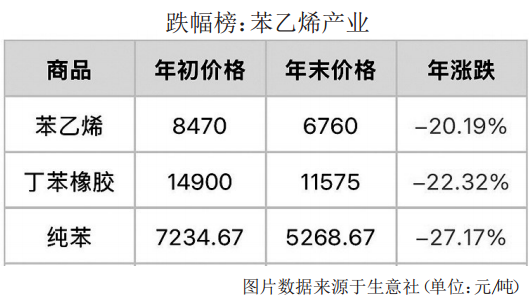
Group 1: Overall Market Trends - In 2025, the chemical industry experienced significant structural differentiation, moving away from uniform price fluctuations, with 71 out of 314 monitored chemical products showing price increases, while 236 products saw declines [1] - The overall market exhibited a "more drops than rises" pattern, with a notable 36.6% of products stabilizing within a 5% price change range by the fourth quarter [15][17] Group 2: Specific Product Performance - Styrene prices fell by 20.19% from 8,470 to 6,760 yuan, reflecting a broader downward trend across the industry due to supply pressures and weak demand [3][6] - Pure benzene saw a significant decline of 27.17%, with prices dropping from 7,234.67 to 5,268.67 yuan, driven by an imbalance in supply and demand [5][3] - The market for ABS experienced a dramatic 30.31% drop, with prices falling from 11,837.5 to 8,250 yuan, primarily due to increased supply and weak domestic demand [12][3] Group 3: Key Drivers of Price Changes - The rise in inorganic chemical products, particularly sulfur and sulfuric acid, was attributed to strong demand from agriculture and new energy sectors, with sulfur prices increasing by 116.5% [16][23] - The decline in organic chemical products was largely due to structural demand shrinkage and oversupply, with refrigerants like R22 dropping by 49.22% [16][27] - The lithium battery sector saw substantial growth, with lithium hydroxide and industrial-grade lithium carbonate prices rising by 59.11% and 53.18%, respectively, driven by strong downstream demand and supply constraints [17][18][20] Group 4: Future Outlook - The chemical industry is expected to continue facing a supply-demand imbalance, particularly in the organic sector, while inorganic products may benefit from ongoing structural upgrades and policy support [14][24] - The lithium market is projected to transition from a resource-driven cycle to a demand-driven cycle, with price fluctuations influenced by seasonal production and actual demand realization [21][19]
长鑫存储,未来已来
新财富· 2026-01-20 08:06
Core Viewpoint - The article highlights the rapid rise of Changxin Technology as a significant player in the DRAM market, emphasizing its potential to challenge established giants like Samsung, SK Hynix, and Micron, while also addressing the strategic importance of domestic semiconductor production for China's economic security [2][30]. Group 1: Company Overview - Changxin Technology, founded in 2016 in Hefei, has quickly become China's largest and most advanced DRAM manufacturer, aiming to raise 29.5 billion yuan through its IPO on the STAR Market in 2026 [2][30]. - The company is projected to achieve revenues of 55 to 58 billion yuan in 2025, representing a growth of approximately 128% to 140% compared to 2024, with a potential net profit of 2 to 3.5 billion yuan [2][30]. Group 2: Key Players and Support - The establishment of Changxin was significantly influenced by Zhu Yiming, founder of Zhaoyi Innovation, who recognized the need for an IDM model in DRAM production to build competitive advantages [4]. - Hefei's local government played a crucial role by providing substantial financial support and attracting national-level investment funds, which helped alleviate initial funding pressures for Changxin [4][5]. Group 3: Technological Advancements - Changxin's strategy involved legally acquiring a vast array of technologies and patents from the bankrupt German chipmaker Qimonda, which provided a foundational technology base for its DRAM production [9]. - The company made a bold decision to skip several technology generations and focus on the 19nm process, achieving mass production of 8GB DDR4 chips in 2019, marking a historic breakthrough for Chinese enterprises in the DRAM market [9][10]. Group 4: Production Capacity and Market Strategy - Following the successful launch of the 19nm process, Changxin advanced to the 17nm node and then directly to the 16nm process for DDR5 products, showcasing its rapid technological progression [12][16]. - By 2026, Changxin's production capacity is expected to exceed 300,000 wafers per month, solidifying its position as the largest DRAM manufacturer in China and the fourth globally [13][30]. Group 5: Financial Performance and Challenges - Despite impressive revenue growth from 8.1 billion yuan in 2022 to 23.9 billion yuan in 2024, Changxin has faced strategic losses, accumulating 41.5 billion yuan in losses due to high fixed asset depreciation and significant R&D investments [23][24]. - The company’s R&D expenditure from 2022 to 2025 is projected to reach 19 billion yuan, accounting for over 33% of its cumulative revenue, significantly higher than industry averages [23][24]. Group 6: Future Outlook - Changxin aims to capture a 10% market share in the DRAM sector by 2026, positioning itself among the top four global players alongside Samsung, SK Hynix, and Micron [30]. - The company is also planning to enter the HBM market, with expectations to start mass production of HBM3 products in 2026, which could further enhance its competitive edge [16][30].
纳思达“减负”后遗症: 2025年预亏 三季度营收“膝盖斩” 6.89亿美元索赔悬顶
Xin Lang Cai Jing· 2026-01-20 08:00
Core Viewpoint - Nasda's 2025 performance forecast indicates a negative net profit attributable to shareholders, primarily due to significant asset sales and industry policy adjustments [1][6] Group 1: Company Performance and Historical Context - Since its listing in 2007, Nasda has only reported net profit losses in 2023 and the first three quarters of 2025, amounting to losses of 6.185 billion yuan and 35.5 million yuan respectively, both linked to its subsidiary, Lexmark International [1][6] - The acquisition of Lexmark in 2016, when Nasda was still known as Aipak, involved a significant investment of $2.7 billion, despite the vast disparity in asset sizes between the two companies [1][6] - Following the acquisition, Nasda's revenue surged from 5.8 billion yuan to 21.3 billion yuan within a year, with net profit increasing from 61 million yuan to 949 million yuan [1][6] Group 2: Financial Pressure and Challenges - The acquisition led to a dramatic increase in debt, with the debt ratio rising from 37.53% to 91.55%, and although it has since decreased, it has remained above 70% [2][7] - Nasda's goodwill increased from 3.8 million yuan to 18.81 billion yuan, leading to significant impairment pressures [2][7] - In 2023, Nasda reported a goodwill impairment loss of 9.383 billion yuan, which reduced its net profit by 6.087 billion yuan, indicating that the company would still have incurred losses even without the impairment [2][7] Group 3: Market Conditions and Future Outlook - The recovery of the post-pandemic printer market has been hindered by various short-term factors, leading to a decline in demand from both consumer and enterprise sectors [3][8] - IDC data shows that global printer shipments are expected to decline by 8% in 2024 and 3% in the first half of 2025, with domestic shipments declining by 12% and 11% respectively [3][8] - Nasda's revenue fluctuated significantly from 2023 to the first three quarters of 2025, with figures of 24.015 billion yuan, 26.415 billion yuan, and 14.504 billion yuan, reflecting year-on-year changes of -6.94%, 9.78%, and -25.21% [3][8] Group 4: Strategic Decisions and Implications - In July 2025, Nasda decided to sell Lexmark to alleviate debt pressure, resulting in a significant reduction in the debt ratio from 72.23% to 44.35% [4][9] - The sale of Lexmark raised concerns about a potential $689 million claim from a former partner, which could impact Nasda's financial stability [4][9] - The long-term growth potential in the domestic printer market remains, with low household penetration rates compared to developed countries and a clear demand for domestic alternatives in the B2B sector [10]
