
产业升级

Search documents
资管一线 | “AI泡沫”实为产业升级催化剂?机构布局现分歧
Xin Hua Cai Jing· 2025-11-20 11:12
新华财经上海11月20日(记者魏雨田)三季度全球资本市场波动加剧,随着美股机构投资者三季度13F 报告披露陆续收官,头部投资机构的调仓路径正式浮出水面。从调仓逻辑来看,科技与消费龙头成为机 构加仓的核心标的,而英伟达则在机构间引发分歧。当前市场围绕"AI泡沫"的争论愈演愈烈,不过机构 普遍认为,当下AI领域的高预期实为产业升级的重要催化剂,且技术商业化进程已实质性启动,具备 核心优势的头部平台将持续受益。 加仓聚焦核心标的科技消费龙头获青睐 三季度以来,全球资本市场波动加剧,多家头部投资机构将加仓重心明确指向科技及消费领域的龙头企 业。 从知名投资人段永平旗下H&H International Investment公布的13F文件来看,尽管该机构对苹果进行了小 幅减持,但这一动作并未动摇苹果的核心持仓地位。截至三季度末,苹果依旧是其第一大重仓股,持仓 占比达60.42%,对应持仓市值约88.69亿美元。在减持苹果的同时,段永平三季度对伯克希尔·哈撒韦进 行了幅度超53%的增持,目前持仓占比为17.78%,持仓市值为26.1亿美元,展现出段永平对伯克希尔·哈 撒韦投资逻辑的坚定信心。 机构持仓分歧凸显 AI龙头 ...

2025搜狐财经年度论坛即将举办,吴晓求、刘纪鹏、阎学通、吴向东等20余位嘉宾共探中国经济韧性
Sou Hu Cai Jing· 2025-11-20 10:21
Core Insights - The Sohu Finance Annual Forum will be held on November 27, 2025, in Beijing, featuring over twenty experts from academia, industry, and investment sectors discussing key topics such as macro policies, industrial upgrades, corporate internationalization, capital market reforms, and international dynamics [2][6] - The forum aims to address the challenges of restoring consumer confidence and enhancing economic resilience amid global geopolitical shifts and domestic structural transformations [2][3] Industry Insights - The morning session will focus on practical insights from industry experts regarding policy guidance, market mechanisms, and corporate strategies, particularly addressing the "involution and efficiency trap" [3] - The real estate sector is transitioning from high-leverage expansion to high-quality operations, with discussions on industry breakthroughs and future trends led by prominent figures from major real estate companies [3][4] - In the consumer sector, companies like Xiaobuxiang will share strategies for achieving growth through product innovation and organizational change despite price competition and weak demand [4] Financial Sector Insights - The financial investment segment will feature seasoned professionals discussing asset allocation, pharmaceutical and biotechnology sectors, chip technology, and gold as a hedge against uncertainty [4] - The afternoon session will delve into macroeconomic resilience and strategic directions, with discussions on the evolution of the global macroeconomic landscape and the transformation of China's capital market towards a more regulated and transparent wealth management system [5] - Experts will also explore new consumption drivers and the potential of emerging trends like concerts and IP blind boxes to stimulate significant consumer spending [5] Forum Impact - The Sohu Finance Annual Forum has evolved into a significant high-end financial dialogue platform, aiming to break down information barriers, promote cross-sector collaboration, and connect policies with market dynamics, which is crucial for China's economic development [6]

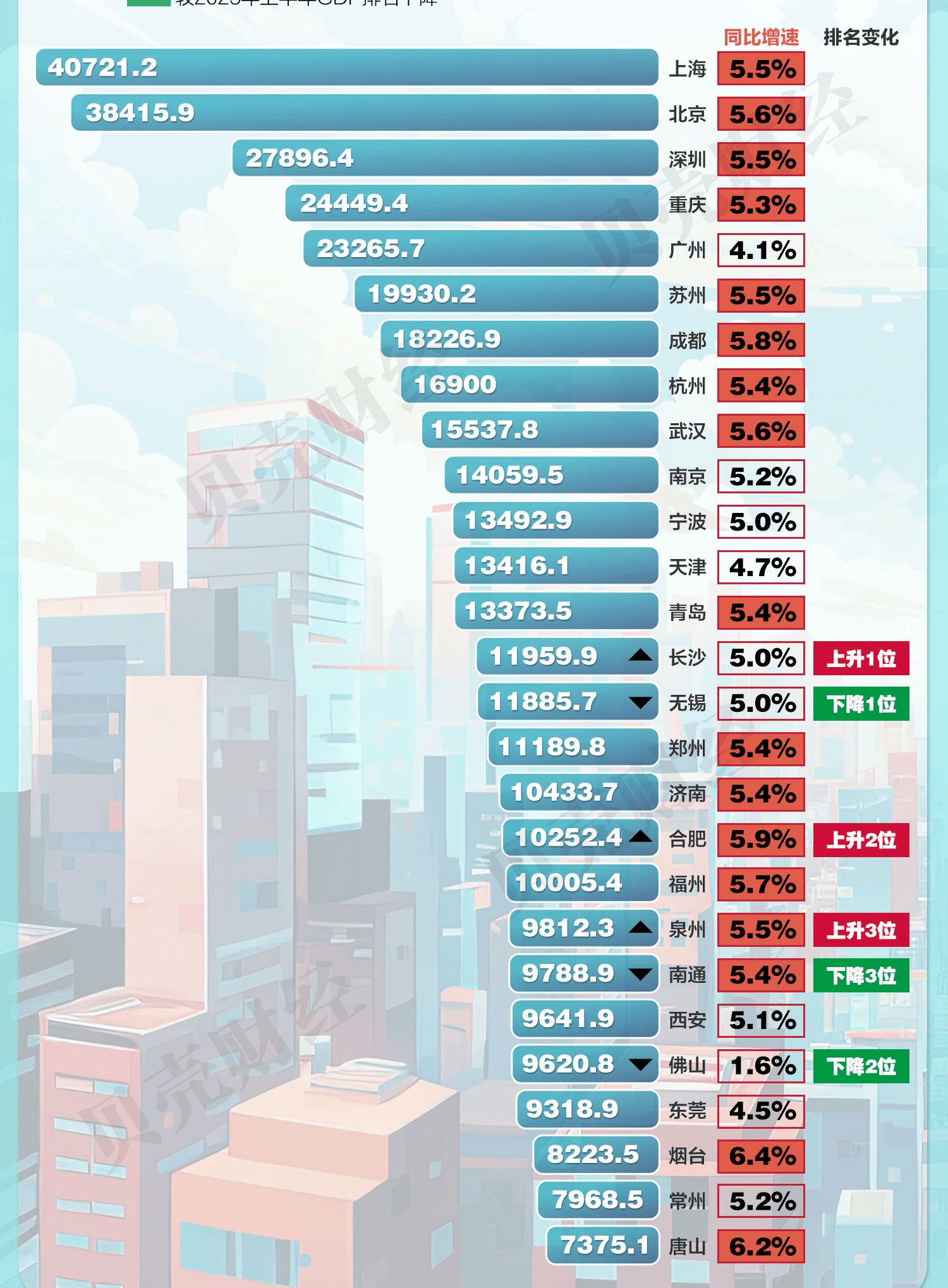
万亿城市大洗牌!泉州逆袭重返20强,南通佛山“掉队”,合肥烟台狂飙!
Sou Hu Cai Jing· 2025-11-20 09:16
Core Insights - The economic performance of China's trillion-yuan cities has been revealed, with 27 cities reporting their GDP data for the first three quarters, showing a reshuffling in the economic landscape as 17 cities outpaced the national average growth rate [1] Economic Growth - Yantai leads with a GDP growth rate of 6.4%, followed closely by Tangshan at 6.2% and Hefei at 5.9%, indicating a trend where stronger cities continue to thrive [5] - Cities like Quanzhou, Jinan, and Dongguan also reported growth rates exceeding 5%, forming a "second tier" of economic performers [5] City Rankings - Quanzhou has made a significant comeback, re-entering the top 20 after surpassing Nantong, driven by a recovery in manufacturing and foreign trade [7] - Nantong has dropped out of the top 20 due to slowed growth, impacted by real estate and infrastructure investment challenges [7] - Hefei has risen to 18th place, benefiting from technological innovation and policy support, becoming a new growth engine in the Yangtze River Delta [7] Economic Scale - Shanghai has become the first city to exceed 4 trillion yuan in GDP, followed by Beijing with over 3.8 trillion yuan, while Shenzhen, Chongqing, and Guangzhou have surpassed 2 trillion yuan [8] - A total of 19 cities have now entered the "trillion-yuan club," indicating a strong economic foundation among these urban centers [8] Competitive Trends - The shifts in the rankings of trillion-yuan cities are attributed to technological empowerment and industrial upgrades, with Hefei excelling in integrated circuits and new energy sectors [9] - Yantai is transforming traditional industries like marine economy and green chemicals, while Quanzhou is leveraging its manufacturing strengths in textiles and home goods [9] - In contrast, Foshan is facing challenges due to a slowdown in traditional industries such as home appliances and ceramics, highlighting the need for new growth drivers [9] Conclusion - The competition among trillion-yuan cities is intensifying, with Shanghai and Beijing leading, while cities in the Yangtze River Delta and Pearl River Delta are in fierce competition [10] - The economic landscape is evolving, with cities needing to innovate and transform to avoid stagnation, as evidenced by the varying fortunes of Quanzhou, Nantong, and Hefei [10][11]
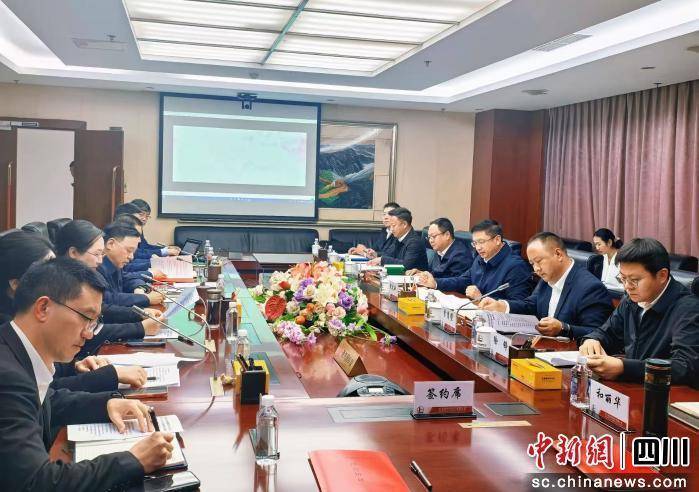
政企携手通力合作 川贝母产业项目投资协议在蓉签订
Sou Hu Cai Jing· 2025-11-20 08:59
Core Viewpoint - The signing of the investment agreement between Sinopec Sichuan Sales Company and the Shangri-La Municipal Government marks the beginning of a comprehensive and diversified strategic cooperation in the traditional Chinese medicine industry, specifically focusing on the development of the Fritillaria (川贝母) industry, which aims to promote local economic growth and rural revitalization [1][3][5]. Group 1: Investment Agreement and Strategic Cooperation - The investment agreement aims to integrate resources and establish a full-chain development system for the Fritillaria industry, including the construction of a seedling planting base, a modern processing industrial park, and a research and innovation center [7]. - The project includes the establishment of a seedling base capable of producing 50 tons of raw materials and 1 billion seedlings annually, alongside a modern processing facility and a national-level Fritillaria industry park [7]. - The cooperation is expected to enhance the brand "Xiangyunbei" and expand its market presence both domestically and internationally [7]. Group 2: Company Background and Market Potential - Sinopec Sichuan Sales Company has developed a business model that includes both oil and non-oil products, achieving strategic partnerships with 16 local governments in Sichuan [4]. - The company emphasizes the significant medicinal value and market demand for Fritillaria, indicating a promising future for the industry [5]. - The collaboration is seen as a responsibility to support rural revitalization and improve local economic quality and efficiency [5].

海尔成功主办全国家电标委会智能家电等四个分委会换届暨全体委员工作会议
Quan Jing Wang· 2025-11-20 08:51
Core Insights - The meeting held from November 18 to 20 in Wuhan focused on the standardization development of the home appliance industry in China, with over 150 participants from various sectors [1][2] - The meeting highlighted the achievements of the previous committees in key standard formulation and international cooperation, receiving high praise from leaders [1] - The new committees are expected to align with national strategies and industry trends, emphasizing innovation and internationalization in standard development [1][3] Group 1 - The four sub-committees reviewed the new committee charter and work guidelines, discussing plans for seven national standards and the review of six existing standards [2] - Haier Group, as the secretariat for the four sub-committees, plays a crucial role in supporting the home appliance industry's upgrade, covering product quality and cutting-edge technology [2] - A total of over 60 national standards have been formulated or revised by the four sub-committees, with 51 published and 16 under development [2] Group 2 - The sub-committees aim to enhance the standard system that supports high-quality development and focus on tackling key core technologies [3] - The goal is to lead the quality upgrade of the home appliance industry through standard enhancements, contributing to the global competitiveness and influence of the industry [3]


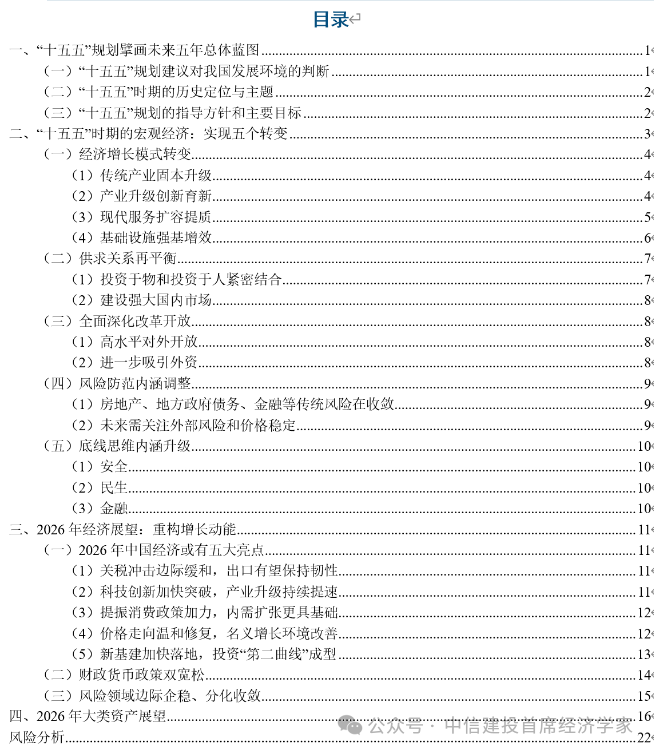
黄文涛:重构增长动能——“十五五”视角下的中国经济展望
Sou Hu Cai Jing· 2025-11-20 08:38
Core Viewpoints - The "15th Five-Year Plan" period will achieve five transformations in macroeconomic growth models, supply-demand relationships, reform and opening up, risk prevention, and bottom-line thinking [1][4]. Group 1: Economic Transformations - The economic growth model will shift towards high-quality development, emphasizing innovation and modernization of industries [29]. - Supply-demand relationships will be rebalanced, focusing on expanding domestic demand and integrating investments in both physical and human capital [42]. - Comprehensive deepening of reform and opening up will be prioritized, with a focus on high-level external openness and attracting foreign investment [48][49]. - Risk prevention will adjust its focus, with traditional risks in real estate and local government debt converging, while external risks and price stability will be monitored [51][53]. - The concept of bottom-line thinking will be upgraded, emphasizing safety, livelihood, and financial stability [56]. Group 2: 2026 Economic Outlook - The year 2026 is expected to be a year of transformation and upgrading, with a focus on boosting domestic demand and risk mitigation [2]. - Key highlights for 2026 include a gradual easing of tariff impacts, allowing exports to maintain resilience [58]. - Accelerated breakthroughs in technological innovation will drive industrial upgrades, enhancing overall productivity and corporate profitability [63]. - Policies aimed at boosting consumption will be strengthened, creating a more robust foundation for domestic demand [66]. - A moderate recovery in prices is anticipated, with CPI expected to rise above 0.5% and PPI narrowing its decline [69]. - The new infrastructure initiative will gain momentum, providing mid-term support for growth through significant project implementations [71].
方向已然明确
Qi Huo Ri Bao· 2025-11-20 01:33
Core Viewpoint - The domestic glass industry is undergoing a significant transformation in its fuel structure, shifting towards a diversified model dominated by natural gas, with petroleum coke and coal gasification as important supplements [1][2] Fuel Structure - As of mid-2025, 59.38% of the national float glass production capacity will utilize natural gas, particularly dominant in North and East China [1] - Petroleum coke accounts for 20.77% of the fuel mix, concentrated in Central and South China, while coal gasification holds an 18.00% share, mainly in North, Northwest, and Northeast China [1] Driving Forces - The primary driver of this fuel structure change is environmental policy, particularly the "Energy Conservation and Carbon Reduction Action Plan," which promotes the replacement of traditional fuels with cleaner energy sources [2] - Fuel costs, which constitute 30% to 40% of total production costs, significantly influence companies' fuel choices [2] - Despite natural gas being the mainstream choice, high gas prices have led to losses for companies using it, while those using coal gasification have seen better profits due to lower coal prices [2] Industry Dynamics - The competition between old and new production capacities is reshaping the industry landscape, with older natural gas-fired facilities being the most affected by recent shutdowns [2] - A structural contradiction exists where the push for natural gas due to environmental policies is challenged by the high costs that older facilities cannot sustain [2] Future Outlook - Regional policies are accelerating the transition, such as Hubei's timeline for converting petroleum coke to natural gas, which will significantly alter the fuel composition in Central and South China [3] - The industry is exploring advanced low-carbon technologies, including all-electric melting technology for daily glass and all-oxygen combustion technology for float glass, which has been adopted as industry standards [3] - Hydrogen technology is in the research and demonstration phase, representing a long-term direction towards zero-carbon manufacturing [3] Local Initiatives - In Hebei's Shahe glass industry, the energy transition is not a straightforward switch from coal to natural gas but involves a mixed replacement strategy centered on coal gasification, supplemented by pipeline natural gas [4] - The Zhengkang Clean Gas Project, funded by local enterprises, is a key player in this energy transition, having commenced operations in March 2025 [3][4] Economic Considerations - The choice of coal gasification as a core path is based on multiple factors, including cost advantages and resource endowments, making it more economically viable than relying solely on natural gas [4] - The transition to cleaner energy sources is expected to increase production costs, leading companies to face tough decisions on whether to invest in upgrades or temporarily shut down older lines [4] Industry Collaboration - Industry chain collaboration is becoming a core trend, with companies building upstream and downstream relationships to enhance operational efficiency [5] - Financial capital is increasingly integrated into the industry, with government initiatives supporting credit for industrial upgrades [5] - Collaborative efforts between government, universities, and enterprises are focused on overcoming technical challenges and nurturing talent for innovation [5] Competitive Landscape - The industry is shifting from homogeneous competition to product differentiation, with leading companies moving towards high-value specialty glass sectors [5] - Despite the focus on high-end products, price wars remain intense, with some manufacturers resorting to price cuts to recover cash flow, leading to market price distortions [5] - Operational efficiency is becoming crucial, with companies utilizing innovative inventory management strategies to enhance cost control [5] Overall Industry Direction - The future development path of the Shahe glass industry is clearly oriented towards high-end, intelligent, green, and financialized operations, with collaboration aimed at resource aggregation and competition driving firms towards high-value sectors [6]
河南西峡 培育壮大特色产业 推动实现民富县强
Ren Min Wang· 2025-11-20 01:21
Core Viewpoint - The article emphasizes the development strategy of Xixia County in Nanyang, Henan Province, focusing on high-quality industrial growth and employment generation to enhance the wealth and strength of the county during the 14th Five-Year Plan period [3][4]. Industrial Development - Xixia County aims to achieve an industrial economic total exceeding 80 billion yuan in 2024, marking a 64% increase from the end of the 13th Five-Year Plan, with industrial added value growing by 77% and industrial tax revenue increasing by 60% [3]. - The county's industrial economy contributed 62% to the regional GDP, 79% to fiscal revenue, and 42% to employment in the first half of the year [3]. Key Industries and Projects - The county has identified and is cultivating key industries, including special steel materials, with the Henan Longcheng Group as a representative enterprise [5]. - Xixia County's special steel materials industry cluster was included in the Ministry of Industry and Information Technology's list of characteristic industrial clusters for small and medium-sized enterprises [5]. - The county has developed a comprehensive industrial cluster that includes special steel production, iron ore and graphite mining, metallurgy, and green construction [5][6]. Innovation and Technology - Xixia County is focusing on innovation as a key driver for industrial upgrading, with a high coverage rate of R&D activities among industrial enterprises [8]. - The county has established 13 smart factories and is promoting digital transformation across manufacturing enterprises [8]. Green Development - The county is committed to green and low-carbon development, prohibiting the addition of new production capacity in certain industries and promoting green upgrades in steel and metallurgy [9]. - Xixia County has established several national and provincial-level green factories and is actively promoting green supply chain management [9]. Business Environment - The county is enhancing its business environment through administrative reforms, reducing project approval times by over 15%, and implementing a "one-stop" service model [11]. - Xixia County has created a tailored policy package for enterprises and established a system for supporting key enterprises [12]. Future Outlook - Looking ahead to the 15th Five-Year Plan, Xixia County plans to continue nurturing its characteristic industries and accelerate industrial transformation to contribute to high-quality economic development [12].


持续夯实高质量发展安全根基
Jing Ji Ri Bao· 2025-11-20 00:41
Group 1: Innovation and Technology - The current technological revolution and industrial transformation are characterized by unprecedented levels of innovation, particularly in fields like artificial intelligence and quantum communication, which are reshaping global order and development patterns [2] - China's original innovation capabilities remain relatively weak, especially in critical core technologies, leading to risks in certain industrial sectors [2] - There is a need to enhance security guarantees while promoting innovation and industrial upgrading, ensuring that core technologies are firmly in national control [2] Group 2: Economic Coordination and Development - Long-standing issues of uncoordinated development in China manifest as imbalances in industrial growth and regional disparities [3] - Emphasis on supply-side structural reforms is crucial to maintain the stability of industrial and supply chains while fostering new industries and upgrading traditional sectors [3] - Regional coordination and urban-rural integration are essential for optimizing productivity distribution and reducing disparities [3] Group 3: Ecological and Energy Security - Respecting and protecting nature is vital for building a modern socialist country, necessitating a focus on ecological and energy security [4] - Continuous improvement of environmental quality and a transition to green, low-carbon development are prioritized to enhance ecological resilience [4] - A multi-faceted energy supply system that includes traditional, renewable, and new energy sources is essential for ensuring energy security [4] Group 4: Open Economy and Security - Increased openness in China's economy necessitates a heightened focus on security, particularly in foreign trade and investment [5] - Diversifying trade partnerships and aligning with high-standard international economic rules are critical to mitigate risks associated with over-reliance on single partners [5] - As Chinese enterprises expand globally, there is a need for robust policy guidance and emergency management systems to protect overseas interests [5] Group 5: Shared Development and Social Equity - Shared development aims to address social equity issues, ensuring that economic growth benefits all citizens and fosters social stability [6] - Enhancing public services in education, healthcare, and social security is essential for improving the quality of life and ensuring equitable access [6] - Promoting high-quality employment is fundamental to achieving social stability and ensuring that laborers share in the economic development outcomes [6]
周绍东:持续夯实高质量发展安全根基
Jing Ji Ri Bao· 2025-11-20 00:40
Group 1: Innovation and Technology - The current technological revolution and industrial transformation are characterized by unprecedented levels of innovation, particularly in fields like artificial intelligence and quantum communication, which are reshaping global order and development patterns [2] - China's original innovation capabilities remain relatively weak, especially in critical core technologies, leading to risks in certain industrial sectors [2] - There is a need to enhance security guarantees while promoting innovation and industrial upgrades, focusing on mastering core technologies to ensure national economic security [2] Group 2: Economic Coordination and Development - Long-standing issues of uncoordinated development in China manifest in industrial and regional disparities, necessitating a focus on supply chain stability and the promotion of new industries [3] - The strategy for regional coordination and urban-rural integration aims to optimize productivity distribution and reduce urban-rural gaps [3] Group 3: Ecological and Energy Security - Emphasizing the importance of ecological and energy security, there is a call for a green and low-carbon transformation of development methods, alongside improving ecological environment quality [4] - The establishment of a multi-faceted energy supply system that includes traditional fossil fuels, new energy, and renewable energy is crucial for ensuring energy security [4] Group 4: Open Economy and Security - Increased openness in China's economy necessitates a focus on security, particularly in foreign trade and investment, to avoid over-reliance on single trade partners [5] - The "Belt and Road" initiative and other international collaborations require robust policy guidance and emergency management to protect overseas interests [5] Group 5: Shared Development and Social Equity - Shared development aims to address social equity issues, ensuring that development benefits are distributed fairly among the population [6] - Enhancing public services in education, healthcare, and social security is essential for improving the overall well-being and stability of society [6]