
扩大内需

Search documents
热点问答丨2026年信贷资源,将重点流向哪里?
Sou Hu Cai Jing· 2026-02-05 13:44
Key Points - The People's Bank of China (PBOC) has outlined its credit market work for 2026, focusing on supporting key areas such as expanding domestic demand, technological innovation, and small and micro enterprises [1] - The PBOC aims to enhance financial support for technological innovation, small and micro enterprises, and regional collaboration, while promoting high-quality development of inclusive finance [1][2] - The chief economist of Zhaolian, Dong Ximiao, stated that monetary policy will act as an "irrigation channel," ensuring that financial institutions effectively utilize credit support and risk mitigation provided by fiscal policies to direct funds to key areas [1] Credit Support Areas - In the technological innovation sector, the PBOC plans to increase the re-lending quota for technological innovation and technological transformation by 400 billion yuan, raising the total quota to 1.2 trillion yuan [3] - The policy support will also expand to include private small and medium enterprises with high R&D investment levels starting in 2026 [4] - In the green development sector, projects with direct carbon reduction effects, such as energy-saving renovations and green upgrades, will be included in the carbon reduction support tool, with an annual operation volume not exceeding 800 billion yuan [4][5] Expanding Domestic Demand - The PBOC will continue to implement a moderately loose monetary policy to create a favorable financial environment for boosting consumption and expanding domestic demand [6] - The PBOC plans to enhance the effectiveness of financial support for consumption by expanding the support areas for re-lending related to consumption and elderly care, including the health industry once recognized by relevant authorities [6] - Financial institutions will be encouraged to increase credit supply in the consumption sector through re-lending at preferential rates, focusing on industries closely related to people's livelihoods such as accommodation, catering, cultural tourism, sports entertainment, elderly care, and domestic services [6]


焦点访谈|从地方两会看开局之年 各地确保实现“开好头、起好步”
Yang Shi Wang· 2026-02-05 13:40
央视网消息(焦点访谈):近日,全国各省市自治区陆续召开地方两会。在"十五五"开局的关键节点,各地聚焦未来五年发展蓝图 和2026年全年重点目标任务,精准谋划部署。其中,挖掘有效需求潜力、强化科技创新支撑引领、构建现代化产业体系,成为了今 年各地政策的核心着力点。"十五五"开局之年,各地如何锚定目标、精准发力,确保实现"开好头、起好步"? "十五五"开局第一年,"扩内需"是一个关键词。去年年底召开的中央经济工作会议将"坚持内需主导,建设强大的国内市场"放在 2026年重点经济工作之首。在地方召开的两会上,各地纷纷提出具体政策举措。其中,着力推动消费转型升级、释放服务消费潜 力、培育消费新增长点成为重要发力方向。 北京将加大教育、健康、养老、托育等服务消费政策支持,促进文商旅体展深度融合,延伸大型活动消费供给链条,推出更多休 闲、时尚、冰雪等消费新场景。 北京市人大代表、国家体育场有限公司党委书记、董事长相军:"我们下大力气在落实扩大内需、增加大型活动消费供给链条的要 求。未来将在北京市文旅局以及体育局的支持下,引入或打造更多国际性商业活动,助力北京演艺之都和国际赛事名城的建设。" 河南在2026年重点工作安排中 ...
2026年信贷资源,将重点流向哪里?
Zhong Guo Zheng Quan Bao· 2026-02-05 13:21
Group 1 - The People's Bank of China (PBOC) has outlined key areas for credit allocation in 2026, focusing on expanding domestic demand, supporting technological innovation, and aiding small and micro enterprises [1] - The PBOC aims to enhance financial support for technology innovation, small and micro enterprises, and regional collaboration, while promoting high-quality development of inclusive finance [1] - Chief economist Dong Xiemiao emphasizes that monetary policy will act as an "irrigation channel," ensuring precise funding allocation to key sectors and weak links, integrating investments in both human and physical capital [1] Group 2 - In the technology innovation sector, the PBOC plans to increase the quota for re-lending for technological innovation and technological transformation by 400 billion yuan, raising the total to 1.2 trillion yuan [2] - The PBOC will expand policy support to include private small and micro enterprises with high R&D investment levels starting in 2026 [2] - For green development, projects with direct carbon reduction effects will be included in the carbon reduction support tool, with an annual operation volume not exceeding 800 billion yuan [2] Group 3 - The PBOC will continue to implement a moderately loose monetary policy to create a favorable financial environment for boosting consumption and expanding domestic demand [3] - The PBOC plans to enhance financial support for service consumption and pension re-lending, with potential inclusion of the health industry once standards are established [3] - Incentives will be provided through preferential interest rates on re-lending to encourage financial institutions to increase credit in the consumption sector, focusing on industries closely related to people's livelihoods [3]
海南政府采购制度设计应统筹处理好七大关系
Xin Lang Cai Jing· 2026-02-05 13:06
(来源:中国政府采购报) 海南政府采购制度设计不能是封闭的"独角戏",而应是服务国家战略全局的"协奏曲"。笔者认为,应统 筹处理好七大关系。 一是保护国家核心利益与借鉴先进经验的关系。大胆引进国际先进的采购程序与工具,但在涉及国家安 全、核心技术的实体判断上,建立跨部门联合审查机制,确保清单化管理、透明化操作。换言之,坚持 程序借鉴,但实体审慎。 二是改革开放与扩大内需的关系。以开放促升级,利用全球竞争提升国内产品服务质量。同时,通过设 定创新、绿色等绩效标准,在"物有所值"框架下支持本国创新产品,培育其国际竞争力。 三是助力高质量发展与增强民众/企业获得感的关系。通过统一平台平抑物价,通过全球比价丰富选 择,通过简化流程和合同融资创造更多机会,将获得感作为检验改革成效的"试金石"。 四是自贸港建设与"一带一路"倡议的关系。海南在政府采购规则上率先与《全面与进步跨太平洋伙伴关 系协定》(CPTPP)等高标准国际经贸协定对接,所形成的成熟经验(如原产地规则、争议解决机 制),可为我国与"一带一路"国家升级双边投资贸易协定提供"中国方案"的实践范本。同时,利用中国 国际消费品博览会等平台,设立 "一带一路"政府采 ...
从能消费到敢消费,浙江小城跑出社零增速黑马
2 1 Shi Ji Jing Ji Bao Dao· 2026-02-05 12:55
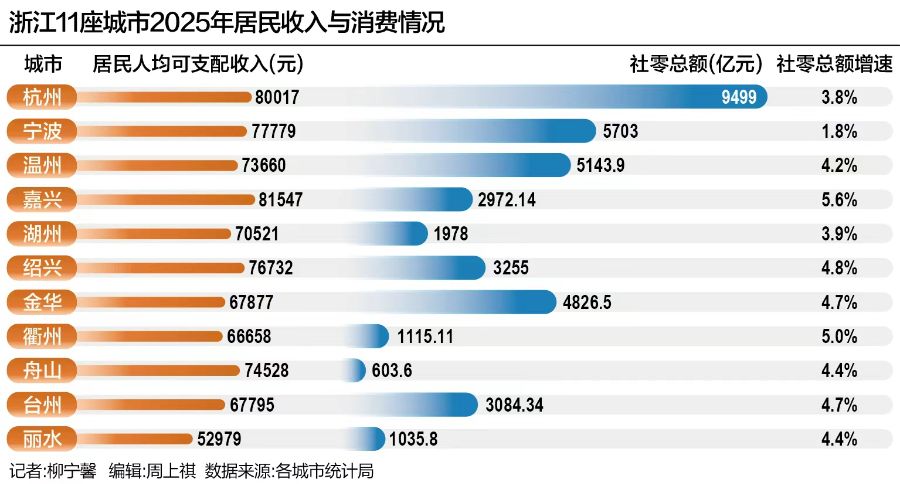
近期,"增收"被列入国务院多个部门今年的工作重点。1月20日,国家发展改革委在国新办发布会上表示,有关方面正在研究制 定稳岗扩容提质行动和城乡居民增收计划,目的就是增强居民的消费能力,优化消费供给。 消费是就业和收入的函数。日前,浙江全年经济数据公布,2025年浙江居民人均收入突破7万元,在浙江高质量发展建设共同富 裕示范区背景下,收入和消费正在发生什么变化? 21世纪经济报道梳理发现,浙江居民人均收入领先全国,但城市之间消费节奏出现分化。2025年,浙江"整体富"的特征更加明 显,除丽水外,10座城市居民人均收入在6.5万元以上,同期全国居民可支配收入为4.3万元。收入基础扎实,这是浙江消费持续 扩容的基础条件。 数据的另一端,浙江11座城市在消费方面正在分化。高收入不等于高社零增速,例如2025年宁波居民人均收入在全省前三,社 零增速却垫底。衢州、金华等浙西、浙中城市居民人均收入不拔尖,社零增速却跑在前列,这些城市生活成本较低,工作、生 活节奏适中,居民消费意愿和消费弹性正在释放。 从浙江的实践来看,提高居民收入只是释放消费潜力的第一步,更关键的是形成收入增长、预期改善、消费释放的良性循环。 这也为全国层 ...
瑞达期货沪镍产业日报-20260205
Rui Da Qi Huo· 2026-02-05 08:59
Group 1: Report Industry Investment Rating - No relevant content Group 2: Core Viewpoints of the Report - It is expected that Shanghai nickel will fluctuate and adjust in the short - term, and attention should be paid to the 130,000 - 140,000 yuan/ton range [4] Group 3: Summary by Relevant Catalogs 1. Futures Market - The closing price of the main futures contract of Shanghai nickel was 134,430 yuan/ton, a decrease of 3,250 yuan; the price difference between the 03 - 04 contracts of Shanghai nickel was - 300 yuan/ton, a decrease of 20 yuan; LME 3 - month nickel was 17,330 US dollars/ton, a decrease of 65 US dollars; the position volume of the main contract of Shanghai nickel was 93,478 lots, a decrease of 5,975 lots; the net long position of the top 20 futures holders of Shanghai nickel was - 42,420 lots, an increase of 2,105 lots; LME nickel inventory was 286,314 tons, an increase of 786 tons; the inventory of nickel in the Shanghai Futures Exchange was 55,396 tons, an increase of 4,602 tons; the LME nickel cancelled warrants totaled 11,148 tons, unchanged; the warrant quantity of Shanghai nickel was 50,464 tons, an increase of 2,392 tons [3] 2. Spot Market - The SMM 1 nickel spot price was 139,850 yuan/ton, a decrease of 1,750 yuan; the spot average price of 1 nickel plate in the Yangtze River was 139,850 yuan/ton, a decrease of 1,950 yuan; the CIF (bill of lading) price of Shanghai electrolytic nickel was 210 US dollars/ton, unchanged; the bonded warehouse (warrant) price of Shanghai electrolytic nickel was 210 US dollars/ton, unchanged; the average price of battery - grade nickel sulfate was 33,750 yuan/ton, unchanged; the basis of the NI main contract was 5,420 yuan/ton, an increase of 1,500 yuan; the LME nickel (spot/three - month) premium was - 222 US dollars/ton, a decrease of 5.08 US dollars [3] 3. Upstream Situation - The monthly import volume of nickel ore was 199.28 million tons, a decrease of 134.67 million tons; the total port inventory of nickel ore was 1,172.34 million tons, a decrease of 56.28 million tons; the average monthly import unit price of nickel ore was 75.53 US dollars/ton, an increase of 3.36 US dollars; the tax - included price of Indonesian laterite nickel ore with 1.8% Ni was 41.71 US dollars/wet ton, unchanged [3] 4. Industry Situation - The monthly output of electrolytic nickel was 29,430 tons, an increase of 1,120 tons; the total monthly output of ferronickel was 21,400 metal tons, a decrease of 700 metal tons [3] 5. Downstream Situation - The monthly import volume of refined nickel and alloys was 23,861.23 tons, an increase of 11,020.74 tons; the monthly output of 300 - series stainless steel was 174.72 million tons; the total weekly inventory of 300 - series stainless steel was 99.61 million tons, an increase of 10.07 million tons; the monthly import volume of ferronickel was 54.9 million tons, an increase of 0.97 million tons [3] 6. Industry News - The People's Bank of China focuses on supporting key areas such as expanding domestic demand, technological innovation, and small and medium - sized enterprises; the US ADP employment data in January was significantly lower than expected, with only 22,000 new jobs added, highlighting the weakening momentum of the labor market at the beginning of the year; the US ISM services PMI index in January was 53.8, remaining at the highest level since October 2024, better than expected [3] 7. Viewpoint Summary - In the macro - aspect, the People's Bank of China focuses on supporting key areas. In the fundamental aspect, the Philippines has entered the rainy season, and the import volume of nickel ore is in a downward trend; Indonesia plans to significantly cut the RKAB quota to 250 - 260 million tons next year, but the quota for the first quarter will be postponed, and the raw material contraction is expected to be transmitted in the second quarter. In the smelting end, the production of Indonesian ferronickel remains high, and the quantity flowing back to China is expected to increase; domestic refined nickel production capacity is large, and with the recent rise in nickel prices, there is a profit space for production, and the output of refined nickel is expected to rise again. In the demand end, the profit of stainless steel plants has improved, and the production volume is expected to be high; the production and sales of new energy vehicles continue to climb, and ternary batteries contribute a small incremental demand. Domestic nickel inventory is growing faster, the market mainly buys on dips, and the spot premium has declined; overseas LME inventory continues to increase, and the spot premium has been lowered. Technically, the position is stable and the price is adjusted, and the market sentiment is recovering [3] 8. Key Concerns - There is no news today [3]

宏观金融类:文字早评2026/02/05星期四-20260205
Wu Kuang Qi Huo· 2026-02-05 03:22
Report Summary 1. Investment Rating The provided document does not mention the industry investment rating. 2. Core Viewpoints - **Stock Index**: In the short - term, the market rotation is accelerating, hot - plate persistence is poor, and trading volume is falling before the Spring Festival. In the long - term, policy support for the capital market remains unchanged. The strategy is to buy on dips [4]. - **Treasury Bonds**: The economic recovery foundation is not solid, and there is still room for RRR and interest rate cuts. The central bank maintains an attitude of protecting funds, and bond market trading is expected to be stable. However, it is necessary to pay attention to the suppression of the stock market, government bond supply, and inflation expectations, and the market is expected to fluctuate [8]. - **Precious Metals**: The market is in a cautious short - covering and position - rebuilding stage after a technical oversold. It is recommended to wait and see, with the Shanghai gold main contract in the range of 1050 - 1300 yuan/gram and Shanghai silver in the range of 22000 - 25000 yuan/kilogram [11]. - **Non - ferrous Metals**: Most non - ferrous metals are expected to fluctuate, with some having upward or downward trends based on supply - demand, policy, and cost factors [14][16][21]. - **Black Building Materials**: The black - building materials sector is in a bottom - game stage with multiple factors at play. It is expected to fluctuate in the short - term, and it is necessary to track inventory changes, demand recovery, and policy adjustments [34]. - **Energy Chemicals**: Different energy - chemical products have different trends. For example, crude oil is recommended to take profits on rallies, and some products are affected by supply - demand, cost, and geopolitical factors [64][66]. - **Agricultural Products**: Different agricultural products have different trends. For example, the short - term outlook for live pigs is pessimistic, while the long - term outlook for cotton is positive [87][102]. 3. Summary by Category Macro - financial - **Stock Index** - **Market Information**: The President of China had a phone call with the US President; a new satellite testing and launching technology plant was established; the Ministry of Industry and Information Technology aims to break through key technologies; the central bank focuses on credit market work [2]. - **Basis Annualized Ratio**: Different contracts of IF, IC, IM, and IH have corresponding basis annualized ratios [3]. - **Strategy**: Buy on dips in the short - term [4]. - **Treasury Bonds** - **Market Information**: Contract prices changed on Wednesday; the central bank held a credit market meeting; the Reserve Bank of Australia raised interest rates [5]. - **Liquidity**: The central bank conducted 750 billion yuan of 7 - day reverse repurchase operations, with a net withdrawal of 302.5 billion yuan [6][7]. - **Strategy**: The bond market is expected to fluctuate, and it is necessary to pay attention to multiple factors [8]. - **Precious Metals** - **Market Information**: Gold and silver prices rose; the US ADP data indicated a slowdown in the labor market; the US Treasury's refinancing statement affected the bond market [9][10]. - **Strategy**: Wait and see, with reference price ranges for Shanghai gold and silver [11]. Non - ferrous Metals - **Copper** - **Market Information**: Copper prices fluctuated, LME copper inventory increased, and domestic spot was at a discount [13]. - **Strategy**: The price is expected to fluctuate strongly, with reference price ranges for Shanghai and LME copper [14]. - **Aluminum** - **Market Information**: Aluminum prices declined, and inventory and trading conditions changed [15]. - **Strategy**: If concerns about the US AI narrative ease, prices are expected to stabilize and rise, with reference price ranges [16]. - **Zinc** - **Market Information**: Zinc prices fluctuated, and inventory and basis data changed [17][18]. - **Strategy**: The price is following the sector to make up for the macro - attribute. The trading center may return to the industrial logic [18]. - **Lead** - **Market Information**: Lead prices declined, and inventory and basis data changed [19]. - **Strategy**: The industry situation is weak, and the panic sentiment has eased to some extent [19]. - **Nickel** - **Market Information**: Nickel prices rebounded, and cost and supply - demand factors changed [20]. - **Strategy**: It is expected to fluctuate widely in the short - term, with reference price ranges [21]. - **Tin** - **Market Information**: Tin prices fluctuated, and supply, demand, and inventory factors changed [22]. - **Strategy**: It is expected to fluctuate widely in the short - term, and it is recommended to wait and see [23]. - **Lithium Carbonate** - **Market Information**: The spot index rose, and the futures contract price declined [24]. - **Strategy**: It is recommended to wait and see or take a small - position attempt, with a reference price range for the futures contract [25]. - **Alumina** - **Market Information**: The index rose, and inventory and basis data changed [26][27]. - **Strategy**: It is recommended to wait and see, with a reference price range and key factors to watch [28]. - **Stainless Steel** - **Market Information**: The futures price rose, and spot and inventory data changed [29]. - **Strategy**: Maintain a bullish view, with a reference price range [29]. - **Cast Aluminum Alloy** - **Market Information**: The price rebounded, and inventory and trading volume data changed [30]. - **Strategy**: The price is supported in the short - term [31]. Black Building Materials - **Steel** - **Market Information**: Rebar and hot - rolled coil prices rose slightly, and inventory and trading volume data changed [33]. - **Strategy**: It is expected to fluctuate in the short - term, and it is necessary to track multiple factors [34]. - **Iron Ore** - **Market Information**: The futures price rose, and spot and inventory data changed [35]. - **Strategy**: It is expected to fluctuate weakly in the short - term, and it is necessary to pay attention to steel mill restocking and iron - making rhythms [36][37]. - **Coking Coal and Coke** - **Market Information**: Prices rose, and spot and basis data changed [38]. - **Strategy**: It is expected to fluctuate in the short - term, and it is necessary to pay attention to market sentiment and high - volatility risks [40][42]. - **Glass and Soda Ash** - **Glass** - **Market Information**: The futures price rose, and inventory and trading volume data changed [43]. - **Strategy**: It is expected to fluctuate strongly in the short - term, with a reference price range [44]. - **Soda Ash** - **Market Information**: The futures price rose, and inventory and trading volume data changed [45]. - **Strategy**: It is expected to fluctuate weakly and stably in the short - term, with a reference price range [46]. - **Manganese Silicon and Ferrosilicon** - **Market Information**: Prices rose slightly, and spot and basis data changed [47]. - **Strategy**: The market is affected by overall sentiment and cost factors. It is recommended to pay attention to manganese ore and "dual - carbon" policies [49][50]. - **Industrial Silicon and Polysilicon** - **Industrial Silicon** - **Market Information**: The futures price rose, and spot and inventory data changed [51]. - **Strategy**: The price is expected to fluctuate, and it is necessary to pay attention to production cuts and downstream adjustments [54]. - **Polysilicon** - **Market Information**: The futures price rose, and spot and inventory data changed [55]. - **Strategy**: The price is expected to fluctuate, and it is necessary to pay attention to meetings and spot transactions [56]. Energy Chemicals - **Rubber** - **Market Information**: The price is determined by funds, and there are different views on supply and demand [58]. - **Strategy**: Trade short - term on the disk, set stop - losses, and consider a spread trading strategy [62]. - **Crude Oil** - **Market Information**: Futures prices rose [63]. - **Strategy**: Take profits on rallies and focus on medium - term layout [64]. - **Methanol** - **Market Information**: Spot and futures prices changed [65]. - **Strategy**: The price has priced in most geopolitical premiums, and there is pressure on the upside [66]. - **Urea** - **Market Information**: Spot and futures prices changed [68]. - **Strategy**: Short - sell on rallies due to expected negative fundamentals [69]. - **Pure Benzene and Styrene** - **Market Information**: Prices rose, and supply - demand and inventory data changed [70]. - **Strategy**: The non - integrated profit of styrene has been repaired, and it is advisable to take profits gradually [70]. - **PVC** - **Market Information**: The futures price rose, and supply - demand, cost, and inventory data changed [71]. - **Strategy**: The domestic supply is strong and demand is weak. Pay attention to production capacity and start - up changes [72][73]. - **Ethylene Glycol** - **Market Information**: The futures price rose, and supply - demand, cost, and inventory data changed [74]. - **Strategy**: There is an expectation of further profit compression and load reduction in the medium - term, but there is a risk of rebound in the short - term [75]. - **PTA** - **Market Information**: The futures price rose, and supply - demand, cost, and inventory data changed [76]. - **Strategy**: It enters the Spring Festival inventory - accumulation stage. Be cautious of processing - fee corrections in the short - term and look for long - entry opportunities after the Spring Festival [77]. - **Para - xylene** - **Market Information**: The futures price rose, and supply - demand, cost, and inventory data changed [78]. - **Strategy**: It is expected to accumulate inventory before the maintenance season. Look for long - entry opportunities following crude oil in the medium - term [79]. - **Polyethylene (PE)** - **Market Information**: The futures price rose, and supply - demand and inventory data changed [80]. - **Strategy**: The oil price may have bottomed out. The price is supported by reduced inventory, but the demand is in the off - season [81]. - **Polypropylene (PP)** - **Market Information**: The futures price rose, and supply - demand and inventory data changed [82]. - **Strategy**: The supply pressure is relieved, and the price may bottom out in the first quarter of next year. Consider going long on the PP5 - 9 spread on dips [84]. Agricultural Products - **Live Pigs** - **Market Information**: Pig prices fell, and supply - demand factors changed [86]. - **Strategy**: Short on rallies in the short - term, and pay attention to long - term support [87]. - **Eggs** - **Market Information**: Egg prices mostly fell, and supply - demand factors changed [88]. - **Strategy**: Short - sell in the near - term and long - term, with different logics [89]. - **Soybean and Rapeseed Meal** - **Market Information**: Futures prices fell slightly, and supply - demand data changed [90][91]. - **Strategy**: The short - term fundamentals are improving, and the price may be bottoming out [92]. - **Oils and Fats** - **Market Information**: Futures prices fluctuated, and supply - demand data changed [93][94]. - **Strategy**: The price may have bottomed out. Wait for a pull - back to go long [94]. - **Sugar** - **Market Information**: The futures price rebounded slightly, and supply - demand data changed [95][98]. - **Strategy**: Wait for the northern hemisphere to finish the harvest in February. The domestic price may have limited downside, and it is advisable to wait and see [99]. - **Cotton** - **Market Information**: The futures price fluctuated, and supply - demand data changed [100][101]. - **Strategy**: It fluctuates widely in the short - term and may rise in the long - term. Look for low - entry opportunities before the Spring Festival [102].
央行重磅会议,明确信贷资源重点流向
21世纪经济报道· 2026-02-05 02:44
近日,中国人民银行召开2026年信贷市场工作会议。会议总结2025年信贷市场工作,分析当 前形势,部署2026年工作。分管信贷市场司的中国人民银行党委委员、副行长朱鹤新出席会议 并讲话。 中欧国际工商学院教授、中国首席经济学家论坛研究院院长盛松成解读称,我国经济发展中老 问题、新挑战仍然不少,更需要结构性政策发挥作用。一方面,财政政策可以直接介入经济活 动,以促进经济的结构调整;另一方面,结构性货币政策通过加大对商业银行的激励力度,也 有助于增强财政政策落地效能,发挥政策集成作用,激发经济内生增长动力。 记者丨 唐婧 编辑丨肖嘉 备受关注的是,1月20日,财政部网站连续发布5项政策文件,对个人消费贷款、设备更新贷 款、中小微企业贷款、服务业经营主体贷款贴息政策以及民间投资专项担保计划进行优化实施 与部署,旨在加力提振消费、扩大内需、降低融资成本、激发民间投资活力。 强化消费领域金融支持 除了金融"五篇大文章",强化消费领域金融支持也是2026年信贷市场工作的重点之一。我国有 14亿多人口,是全球最大、最具潜力的消费市场之一,但是居民消费率相对偏低,居民消费不 足已经成为制约内需持续扩大的重要原因。 会议明确, ...
财政部新设、优化一揽子贷款贴息政策——贷款贴息“红包”更大了
Sou Hu Cai Jing· 2026-02-05 02:40
Core Viewpoint - The recent upgrades to loan interest subsidy policies aim to enhance consumer and business access to financing, thereby stimulating domestic demand and supporting the real economy [1][2]. Group 1: Consumer Loan Subsidy Policies - The upgraded consumer loan subsidy policies provide a 1% interest subsidy on personal consumption loans and loans for service industry operators, benefiting both consumers and businesses [2][3]. - The policies have been optimized to extend the subsidy period until December 31, 2026, enhancing convenience for consumers who can automatically apply the new subsidy terms to existing agreements [2][9]. - The inclusion of credit card installment payments in the subsidy scope has been well-received, allowing more consumers to benefit from the interest subsidy [3][4]. Group 2: Support for Small and Micro Enterprises - A new loan interest subsidy policy for small and micro enterprises addresses the challenges of high financing costs, offering a subsidy of 1.5% on loans for up to two years, with a maximum loan amount of 50 million yuan [6][8]. - The policy targets key industries such as new energy vehicles, industrial robots, and medical equipment, aiming to reduce financing costs and enhance investment capacity for enterprises [6][7]. - The expansion of the equipment update loan subsidy policy includes more sectors, providing additional support for businesses in upgrading their facilities [6][7]. Group 3: Policy Implementation and Efficiency - The government emphasizes the need for efficient policy implementation, aiming for a seamless connection between loan interest payments and subsidies, with a focus on simplifying processes for consumers and businesses [9][10]. - The goal is to ensure that consumers and businesses can easily access the benefits of the subsidy without complex application procedures, enhancing the overall effectiveness of the policy [10].
成材:关注周度基本面变化,钢价盘整运行-20260205
Hua Bao Qi Huo· 2026-02-05 02:26
Report Industry Investment Rating - The report gives an investment rating of "Oscillating operation" for the industry [2] Core Viewpoints - The steel market is expected to oscillate. The positive news from the coking coal sector has not spread to other black - series products. Steel is operating in a context of weak supply and demand. With the approaching Spring Festival, the spot market is gradually on holiday, and the futures price is likely to oscillate [1][2] Summary by Related Information Macroeconomic Information - The People's Bank of China held the 2026 credit market work conference, aiming to build a multi - level financial service system and support key areas such as expanding domestic demand, technological innovation, and small and medium - sized enterprises [1] - In January 2026, the US ADP added 22,000 jobs, far lower than the market expectation of 48,000, and the previous value was revised down from 41,000 to 37,000, indicating a continuous slowdown in the US labor market at the beginning of 2026 [1] - The Eurozone's CPI in January 2026 increased by only 1.7% year - on - year, the lowest level since September 2024. The core CPI dropped to 2.2%, the lowest since October 2021 [1] Industry Data - In January 2026, China's heavy - truck market sold about 1 million vehicles (wholesale, including exports and new - energy vehicles), which was basically flat compared with December 2025 and increased by about 39% compared with 722,000 vehicles in the same period of the previous year [1]