量化宽松(QE)

Search documents
高地集团:当黄金站上4233美元:一场全球财富迁移的序幕
Sou Hu Cai Jing· 2025-10-17 03:37
Core Viewpoint - The current surge in gold prices is not just a market trend but signifies a new global consensus on the asset's value [1] Group 1: Gold Price Dynamics - Gold prices have reached $4200 per ounce, marking a new high, with market sentiment showing divergence between bearish and bullish perspectives [3] - The current market fluctuation is seen as a "digesting" phase rather than a reversal, supported by ongoing global inflation pressures, central bank gold purchases, low real interest rates, and weakening dollar attractiveness [3][5] - Structural factors ensure a robust long-term upward trend for gold, with short-term volatility unlikely to alter this trajectory [3] Group 2: Trading Structure - In the international gold market, the dynamics between long and short positions are asymmetric, with long positions incurring lower costs compared to short positions that face higher borrowing costs [4] - The expectation of Federal Reserve rate cuts is increasing the cost of short positions, thereby pushing more capital towards long positions and driving gold prices higher [5][6] Group 3: Institutional Consensus - Major financial institutions are uniformly bullish on gold, with Morgan Stanley, UBS, and Goldman Sachs projecting significant price increases, with Goldman Sachs raising its 12-month target to $4600 per ounce [7] - The World Gold Council notes that central banks in Asia and the Middle East continue to increase their gold reserves, indicating stable demand [7] Group 4: Federal Reserve Rate Cut Expectations - The probability of the Federal Reserve cutting rates in the next 15 days is as high as 96.7%, with expectations of multiple rate cuts in upcoming meetings [8] - Recent signals from Fed Chairman Jerome Powell suggest a potential end to quantitative tightening and a shift towards quantitative easing, which would enhance liquidity and favor gold and other inflation-hedged assets [8] Group 5: Conclusion - The current price level of $4200 per ounce is seen as a new starting point, with short-term fluctuations viewed as part of the market rhythm rather than risks [10] - The long-term bullish logic remains intact due to unresolved inflation pressures, an impending rate cut cycle, ongoing central bank purchases, and rising demand for safe-haven assets [10]


鲍威尔暗示缩表即将落幕,恐成为股市下跌前奏?
Jin Shi Shu Ju· 2025-10-17 02:12
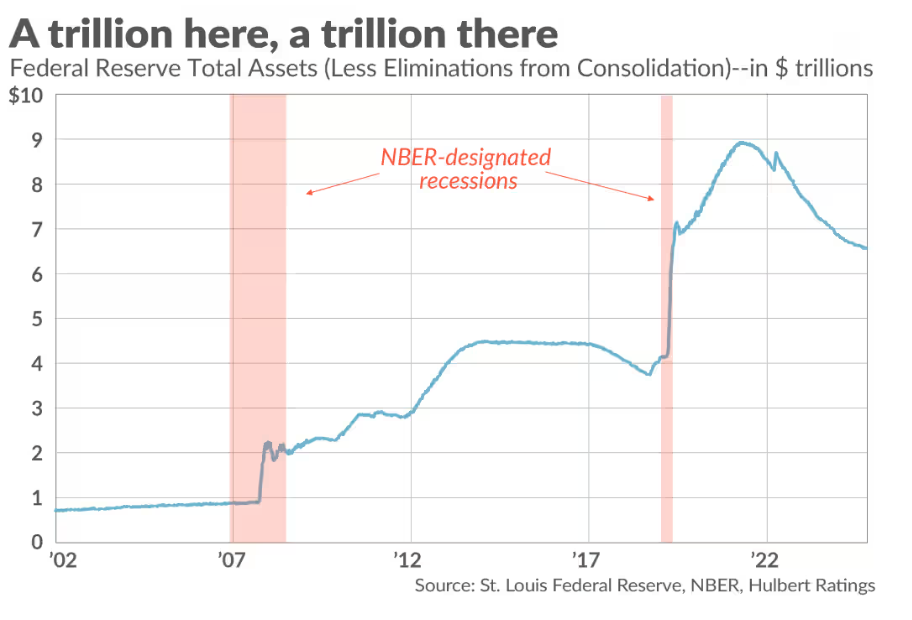
Core Viewpoint - The Federal Reserve's decision to end its quantitative tightening (QT) may not be as beneficial for the stock market as most investors believe, despite the significant implications of this policy shift [1]. Group 1: Federal Reserve's Actions - The Federal Reserve has reduced its balance sheet by $2.2 trillion since June 2022, which has been a major obstacle for the stock market [1]. - Historically, the stock market has performed better during periods of quantitative tightening than during quantitative easing (QE) [1][2]. Group 2: Stock Market Performance - During the recent QT phase, the S&P 500 index had an annualized total return of 20.9%, approximately double its historical average [1]. - Since 2003, during the 12-month periods of balance sheet contraction, the S&P 500 has averaged a gain of 16.9%, compared to only 10.3% during periods of balance sheet expansion [1]. Group 3: Economic Context - The negative correlation between the Fed's balance sheet size and the stock market is linked to the economic conditions when the Fed decides to expand or contract its balance sheet [2]. - The recent QT was possible due to a strong economy, suggesting that the announcement to end QT may indicate an impending economic downturn [5].
QT接近尾声 鲍威尔“鸽声”一锤定音 10月降息几成定局
2 1 Shi Ji Jing Ji Bao Dao· 2025-10-15 23:41
Group 1 - The Federal Reserve, led by Chairman Powell, is signaling a potential interest rate cut in October due to signs of a cooling labor market [1][7] - Powell indicated that the quantitative tightening (QT) program may be nearing its end, as the financial system's liquidity conditions are tightening [1][3] - The Fed's balance sheet has decreased from over $9 trillion to $6.6 trillion since mid-2022 due to QT measures [3] Group 2 - The end of QT is seen as a way to balance market sentiment, control inflation, and adjust liquidity conditions, with the timing differing from the cessation of interest rate hikes [4][5] - Analysts predict that ending QT could improve market liquidity, alleviate pressure on the bond market, and enhance expectations for monetary policy easing [5][6] Group 3 - Market expectations for a rate cut have increased, with concerns about the labor market overshadowing inflation risks [7][8] - The anticipated rate cut is expected to lower the 10-year U.S. Treasury yield, reflecting the impact of easing monetary policy on asset prices [9][10] Group 4 - A preventive rate cut is likely to benefit U.S. equities by enhancing market liquidity and reducing financing costs for companies [11] - The expected decline in U.S. Treasury yields may improve global financial market conditions and attract capital to emerging markets [11][12]
Fed's beige book: Economic activity little changed from previous report
Youtube· 2025-10-15 18:52
Economic Activity - The Federal Reserve's Beige Book indicates that economic activity changed little from the prior report, with three districts reporting modest growth, five districts showing no change, and five experiencing slight softening [2] - Consumer spending on retail goods has decreased, with significant differences noted across income groups [2][3] Sector Performance - Demand for electric vehicles has increased due to auto sales, while leisure and hospitality sectors have seen a decline in international traveler spending [3] - Manufacturing has been negatively impacted by higher tariffs and waning demand, with agriculture, energy, and transportation sectors also generally down [4] Employment Trends - Employment levels remain stable, but labor demand is muted, with many employers reducing headcounts through layoffs and attrition [5] - There is a strain in labor supply across hospitality, agriculture, construction, and manufacturing sectors, potentially due to recent immigration policies [5] Wage and Inflation Dynamics - Wages are growing at a moderate pace, but health insurance expenses are driving up overall labor costs [6] - Prices have continued to increase, with input costs rising at a faster pace, and there is variability in how businesses pass on tariff costs to final prices [6][7] Federal Reserve Policy - The Fed is considering ending quantitative tightening and is focused on finding the right level of reserves in the system, with no current plans to revert to quantitative easing [8][9]
鲍威尔“鸽声”一锤定音:QT接近尾声,10月降息几成定局
2 1 Shi Ji Jing Ji Bao Dao· 2025-10-15 12:55
Core Viewpoint - The Federal Reserve, led by Chairman Powell, is signaling a potential interest rate cut in October due to signs of a cooling labor market and tightening liquidity conditions [1][7]. Group 1: Federal Reserve's Monetary Policy - Powell's recent statements indicate a cautious approach to monetary policy, with a focus on avoiding past market pressures experienced in September 2019 [1][3]. - The end of the quantitative tightening (QT) program is anticipated, which has been in place since mid-2022 to absorb excess liquidity injected during the pandemic [2][4]. - The timing of ending QT is seen as a strategy to balance market sentiment and control inflation while adjusting the Fed's balance sheet [4][10]. Group 2: Market Reactions and Implications - The market is responding positively to the prospect of ending QT, which is expected to support U.S. equities, particularly growth and technology stocks [5][9]. - The cessation of QT will alleviate selling pressure in the bond market, potentially lowering long-term yields and enhancing expectations for monetary easing [4][5]. - A significant drop in the 10-year U.S. Treasury yield below 4% reflects market anticipation of rate cuts and the subsequent impact on asset prices [9][10]. Group 3: Economic Indicators and Future Outlook - Concerns about the labor market are overshadowing inflation risks, with Powell emphasizing the need for caution in policy adjustments [7][8]. - The upcoming data releases, including employment and inflation figures, are critical for shaping future monetary policy decisions [7][10]. - The potential for a "soft landing" in the economy could lead to a bullish scenario for both stocks and bonds, while persistent inflation or a sharp decline in employment could increase market volatility [10].
9月央行各项工具净投放9268亿元
Mei Ri Jing Ji Xin Wen· 2025-10-13 13:51
Core Viewpoint - The People's Bank of China (PBOC) has significantly increased liquidity net injection in September, indicating a potential for further monetary easing in the fourth quarter, including possible reserve requirement ratio (RRR) cuts and interest rate reductions [1][2]. Group 1: Liquidity Injection and Monetary Policy - In September, the PBOC's liquidity tools achieved a net injection of 926.8 billion yuan, a substantial increase from the previous month [1]. - The net injection included 19 million yuan from the Standing Lending Facility (SLF), 300 billion yuan from the Medium-term Lending Facility (MLF), and 3.9 trillion yuan from short-term reverse repos [2]. - The current market liquidity remains ample, with funding rates stable around policy rates, and there is significant operational space for both quantity-based tools like RRR cuts and price-based tools like interest rate cuts [2][3]. Group 2: New Policy Financial Tools - The introduction of 500 billion yuan in new policy financial tools is expected to be a crucial pathway for stimulating investment, with the effectiveness of these tools being key to their impact [2][5]. - These new tools are anticipated to work in conjunction with existing structural monetary policy tools like the PSL to lower project financing costs and enhance financial leverage [5][6]. - The new policy financial tools are aimed at promoting emerging industries such as digital economy and artificial intelligence, as well as improving infrastructure in consumption sectors like education and healthcare [5]. Group 3: Economic Context and Future Outlook - The macroeconomic environment is currently in a recovery phase, with external shocks and insufficient domestic demand posing challenges [3][7]. - The PBOC's monetary policy is expected to remain moderately accommodative to counteract economic downturn pressures and external uncertainties [7][8]. - The anticipated release of new investments from policy financial tools in the fourth quarter could lead to an increase in total demand and stabilize credit growth, supporting economic recovery efforts [5][6].
贝森特完成美联储主席候选人首轮面试,严厉质询聚焦利率和QE问题
Jin Shi Shu Ju· 2025-10-09 06:02
Core Viewpoint - The Trump administration is actively seeking to replace Federal Reserve Chairman Jerome Powell, with Treasury Secretary Scott Bessent conducting rigorous interviews with 11 candidates regarding their views on interest rates and the exit from crisis-era stimulus policies [1][2]. Group 1: Candidate Selection Process - The interview process for the candidates lasted several weeks and concluded recently, with some candidates reporting that Bessent and other Treasury officials questioned them for up to two hours [1]. - Candidates were asked about their governance strategies for the Federal Reserve, which Bessent criticized for "mission creep" [2]. - Bessent has expressed a desire to find candidates who are "open-minded" and "forward-looking" [2]. Group 2: Bessent's Critique of the Federal Reserve - Bessent published a nearly 6,000-word article criticizing the Federal Reserve's performance, arguing that its expanded balance sheet reflects overreach of power and advocating for reduced intervention in the Treasury market [3]. - The article has drawn ire from senior Federal Reserve officials involved in asset purchase programs, who argue that without such policies, unemployment could have surged, disproportionately affecting the poorest [5]. Group 3: Trump's Influence and Agenda - Trump has indicated that he prefers candidates willing to significantly lower interest rates, which raises concerns about the independence of the Federal Reserve [6]. - The administration's agenda appears to diverge from Bessent's focus on the balance sheet and the side effects of quantitative easing (QE) [6]. - Trump's allies have criticized the Federal Reserve's spending, including a $2.5 billion renovation project, labeling it as extravagant [6].
黄金储备估值已超万亿,美国何时“用金化债”,相当于9900亿美元的QE?
华尔街见闻· 2025-09-30 10:53
Core Viewpoint - The market speculation regarding the potential revaluation of the U.S. gold reserves has been reignited as the value of these reserves has surpassed $1 trillion for the first time, following a 45% increase in gold prices this year [1][2]. Group 1: U.S. Gold Reserves and Market Implications - The U.S. Treasury holds gold reserves directly, unlike most countries that store gold in central banks, with the Federal Reserve holding corresponding gold certificates [4]. - A revaluation of the gold reserves at current market prices could inject approximately $990 billion into the Treasury, significantly reducing the need for new debt issuance this year [5][9]. - This revaluation would directly impact the balance sheets of both the U.S. Treasury and the Federal Reserve, increasing the Treasury's assets and liabilities simultaneously [6][7]. Group 2: Economic and Policy Considerations - The process of revaluing gold reserves could resemble unconventional monetary policy tools like quantitative easing, expanding the Federal Reserve's balance sheet without traditional market operations [8][10]. - Historically, the U.S. has refrained from revaluing its gold reserves to avoid volatility in the Treasury and Federal Reserve's balance sheets and to maintain the independence of fiscal and monetary authorities [11]. - Other countries, such as Germany, Italy, and South Africa, have previously revalued their gold reserves, indicating that this action is not without precedent [12]. Group 3: Potential Risks and Market Reactions - Analysts have raised concerns that revaluing gold reserves could stimulate economic activity, trigger inflation risks, and inject excess liquidity into the banking system [13][14]. - The revaluation could also lead to increased prices for gold, Bitcoin, and other assets that may be considered for "remonetization" [15]. - The likelihood of implementation remains low unless Treasury Secretary Yellen provides credible details on how to "monetize the asset side of the U.S. balance sheet," despite rising speculation due to the unconventional approach of the Trump administration [16].

央行不只是印钱!降息、当最后贷款人,都是它救经济的招
Sou Hu Cai Jing· 2025-09-26 06:54
Economic Situation - The local economy is experiencing a significant downturn, with businesses like tea shops seeing a drastic drop in sales and factories operating at reduced capacity [1] - There is a noticeable lack of consumer demand, leading to a halt in production and a rise in unemployment [4][6] Policy Responses - The central bank and finance ministry have opted for Keynesian policies to stimulate demand, emphasizing the need for government intervention to avoid prolonged high unemployment [6] - The central bank has implemented a 50 basis point interest rate cut, which has led to a positive market response, encouraging investments and consumer spending [11] Banking Sector Challenges - There is a concerning trend of increased bank deposits as residents choose to save rather than spend, which could lead to a vicious cycle of reduced consumption and further economic decline [7] - The banking sector is facing operational difficulties due to low loan demand, impacting their ability to generate profits [7] Monetary Tools - The central bank is utilizing various monetary tools, including interest rate cuts and open market operations, to inject liquidity into the economy and stabilize banking operations [12][14] - The reserve requirement ratio is highlighted as a critical tool for managing the money supply, with potential adjustments having significant implications for market liquidity [14] Long-term Strategies - The central bank is cautious about using unconventional tools like quantitative easing, recognizing the potential long-term risks associated with excessive liquidity [17] - It is acknowledged that while monetary policy can address immediate liquidity issues, fiscal policy is essential for directly boosting consumer demand and economic activity [20]

英国国债风暴未完结? 首席经济学家力挺英国央行加速缩表
智通财经网· 2025-09-23 12:18
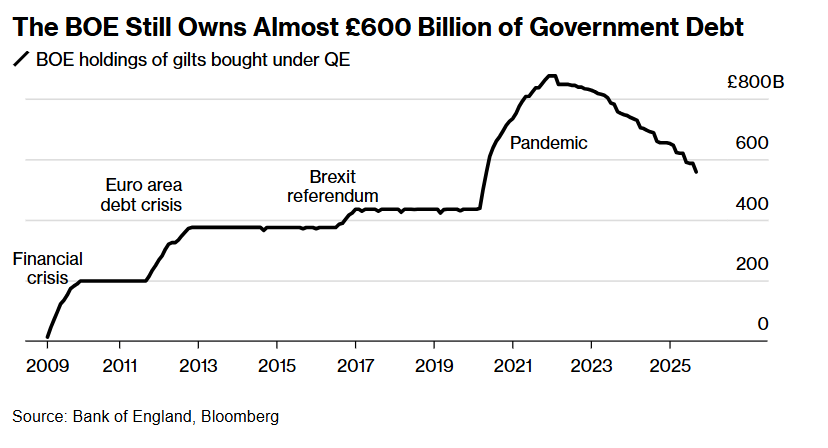
Core Viewpoint - The Bank of England's Chief Economist Huw Pill advocates for a faster reduction of the central bank's large bond balance sheet accumulated under quantitative easing (QE), suggesting that the market is stronger than previously thought and that the central bank has robust tools to support it in case of market stress [1][2][5] Group 1: Market Dynamics - The current "UK bond storm" is primarily due to the loss of the Bank of England as a major buyer, leading to increased volatility and weaker demand for long-dated gilt bonds, particularly the 30-year bonds, which saw yields rise to a new high of 5.7% in early September [2][5] - Pill expressed dissent against the Monetary Policy Committee's (MPC) decision to slow the pace of quantitative tightening (QT) from £100 billion to £70 billion, arguing that market demand is stronger than other officials believe [2][5] Group 2: Quantitative Easing and Financial Impact - The Bank of England still holds nearly £600 billion in UK government bonds, despite ongoing QT efforts, which include actively selling bonds and not reinvesting the principal of maturing bonds [5][6] - Since the Bank of England raised the base rate above 2%, its asset portfolio has incurred losses of approximately £93 billion, erasing most of the £124 billion profit gained since 2009, and is projected to result in taxpayer losses exceeding £100 billion over the project's lifecycle [6][10] Group 3: Policy and Governance - Pill emphasized the need for well-designed government fiscal rules to address the large capital flows resulting from past QE decisions, indicating that the complexities arising from QE are not the central bank's responsibility [6][10] - The UK Treasury has lost 75% of the profits previously gained through QE, highlighting the significant financial implications of the current monetary policy environment [9]