去美元化

Search documents
全球资本“迁徙”进行时
Jing Ji Wang· 2026-01-20 06:17
Group 1 - Global capital is shifting towards non-US assets, particularly in Asia, as the Federal Reserve enters a rate-cutting phase, reducing the attractiveness of dollar-denominated assets [1][3] - Asian technology stocks are becoming a focal point for global capital diversification, with significant investor confidence in the region as a growth engine, especially in the context of the AI supply chain [3][6] - Emerging markets, including Asia, are expected to outperform developed markets in 2026, driven by favorable capital market reforms and increased market risk appetite [2][3] Group 2 - Foreign investment in Chinese assets is transitioning from a cautious approach to a more proactive strategy, with an increasing interest in "long only" investment strategies [4][5] - The number of mainland private equity firms holding Hong Kong licenses has reached 133, indicating a growing trend of private equity firms seeking to connect with overseas capital [5] - Foreign institutions are particularly interested in China's technology sector, viewing undervalued Chinese tech stocks as attractive investment opportunities compared to their US counterparts [6][7]
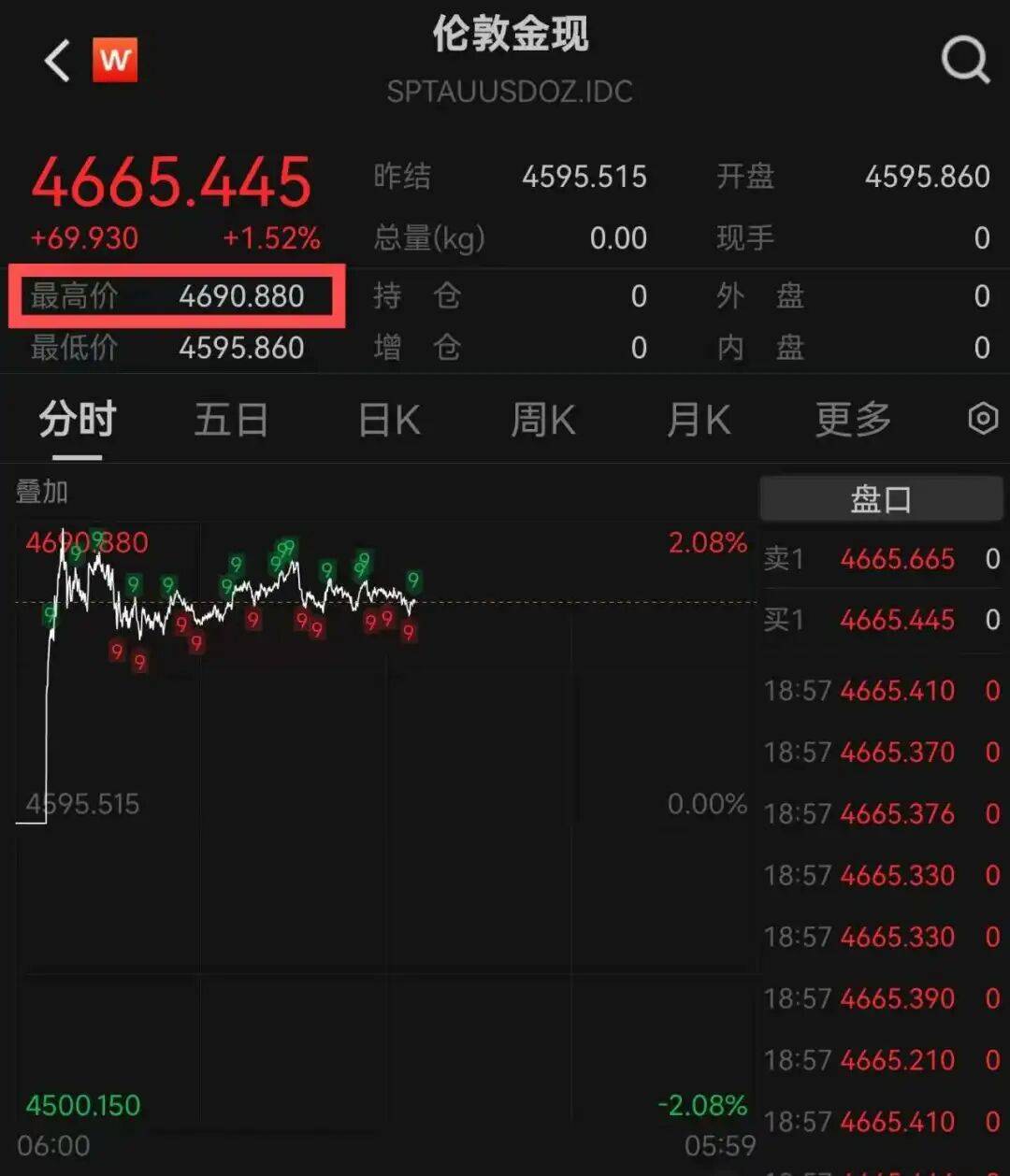
黄金现货突破4700美元关口,黄金基金ETF(518800)涨超0.6%,近20日资金净流入超17亿元
Mei Ri Jing Ji Xin Wen· 2026-01-20 06:12
Core Viewpoint - The price of spot gold has surpassed $4,700, with gold ETF (518800) rising over 0.6%, indicating strong demand for gold as a safe asset amid challenges to the dollar credit system and increasing geopolitical tensions [1] Group 1: Market Dynamics - Recent data shows a net inflow of over 1.7 billion yuan into gold funds over the past 20 days, reflecting growing investor interest [1] - The backdrop of excessive money supply and monetization of fiscal deficits is putting pressure on the dollar credit system, leading to a shift towards gold as a reserve asset [1] Group 2: Investment Outlook - The combination of a Federal Reserve rate cut cycle, increasing overseas uncertainties, and a global trend of de-dollarization is expected to support gold prices [1] - Mid to long-term, the price of gold is anticipated to rise, suggesting that investors may consider accumulating positions during price corrections [1] - Recommended investment options include direct investment in physical gold, tax-exempt gold ETF (518800), and gold stock ETF (517400) that covers the entire gold industry chain [1]
黄金点评:格陵兰岛局势升级,金价继续冲高
Xin Lang Cai Jing· 2026-01-20 06:10
Core Viewpoint - The article discusses the recent increase in gold prices due to rising geopolitical tensions and potential trade conflicts between the U.S. and Europe, particularly following President Trump's announcement of tariffs on European countries opposing the acquisition of Greenland [2][5]. Group 1: Gold Market - On January 19, COMEX gold opened high and closed at $4,676.7 per ounce, with an increase of 1.77%. The domestic SHFE gold night market also rose, closing at 1,053.46 yuan per gram, up by 1.35% [2][5]. - The market is experiencing heightened risk aversion, with geopolitical issues expected to remain a short-term focus, suggesting that the demand for gold may continue to be strong [2][5]. Group 2: U.S.-Europe Trade Relations - President Trump announced a 10% tariff on eight European countries opposing the Greenland acquisition, set to increase to 25% starting June 1, 2026. This has prompted European officials to consider retaliatory measures, including potential tariffs on approximately €93 billion worth of U.S. goods [2][5]. - The escalation of trade tensions has led the market to reassess the risk of a prolonged conflict between the U.S. and Europe [2][5]. Group 3: Currency Market Dynamics - The currency market is showing signs of "de-dollarization," with the dollar index falling by 0.3% while the euro and pound strengthened. The ten-year U.S. Treasury yield reached 4.26%, and U.S. stock futures declined during the market closure [2][5]. - The weak dollar environment is contributing to the upward trend in gold prices, indicating a continued bullish outlook in the short term [2][5].


特朗普没想到,中加签下重要合同,对华能源策略被卡尼瓦解?
Sou Hu Cai Jing· 2026-01-20 05:35
Group 1 - Canada and China signed eight agreements during a recent visit, including a cooperation order for 49,000 electric vehicles, indicating a shift in Canada's foreign policy towards China [1][3] - The agreements cover eight major areas and 28 specific measures, including energy, agriculture, and green trade, with the cancellation of the 100% tariff on electric vehicles [3] - A currency swap agreement worth 200 billion RMB was signed, allowing trade between Canada and China to bypass the US dollar, which is significant for China's de-dollarization strategy [3][5] Group 2 - The joint statement from both countries emphasized mutual benefit and cooperation, serving as a counter to US energy strategies and reflecting Canada's unease with US policies under Trump [5] - Canadian officials expressed that cooperation with China is more stable and predictable compared to the unpredictable nature of US policies, highlighting a need for Canada to seek new avenues for survival and development [5]
2026开年洞察:全球资产重估与政策博弈下的投资新坐标
Sou Hu Cai Jing· 2026-01-20 04:06
Macro Changes - The market's rise at the beginning of 2026 is fundamentally a continuation of the global "easing consensus" from 2025, but three marginal changes are disrupting this trend [3] - The U.S. political cycle is intensifying the clash with monetary policy, as Trump pressures the Federal Reserve to lower interest rates, leading to heightened market expectations for a rate cut [3][7] - The expansion of "shadow banking" in the U.S. has shifted from a hidden concern to a significant variable, with money market funds and private credit rapidly growing, which could amplify liquidity and asset bubbles [4] Policy Dynamics - The Federal Reserve faces three constraints: persistent inflation, political pressure, and the balance between shrinking and expanding its balance sheet [7] - The European Central Bank and other global central banks are signaling potential policy shifts in response to U.S. monetary policy changes, indicating a global interconnectedness in policy decisions [8] Asset Implications - U.S. Treasury yields may steepen if rate cuts occur, but long-term rates could remain suppressed due to fiscal deficits [9] - The U.S. stock market is supported by liquidity expectations, but shadow banking could increase volatility through retail leverage [9] - Gold prices are expected to rise due to declining real interest rates and increased demand for safe-haven assets [9] Investment Shifts - China's "deposit migration" reflects a shift in asset allocation from risk-free to risk-return matching, impacting A-shares, Hong Kong stocks, and the bond market [11] - A-shares are transitioning from "stock game" to "incremental drive," with significant capital moving into equity markets, benefiting high-dividend and growth sectors [11] - Hong Kong stocks are experiencing dual elasticity, attracting both domestic and foreign investments due to improving fundamentals and lower financing costs [12] Conclusion - The global market in 2026 represents a struggle between normalized policy interventions and spontaneous market dynamics, with shadow banking and deposit migration indicating a new era for emerging market assets [13] - Investors should focus on policy-sensitive assets, growth-oriented investments, and safe-haven assets to navigate the evolving landscape [13]


RT曝光:美国最大的敌人不是中国,中国只需坐着看美国作死就行?
Sou Hu Cai Jing· 2026-01-20 03:12
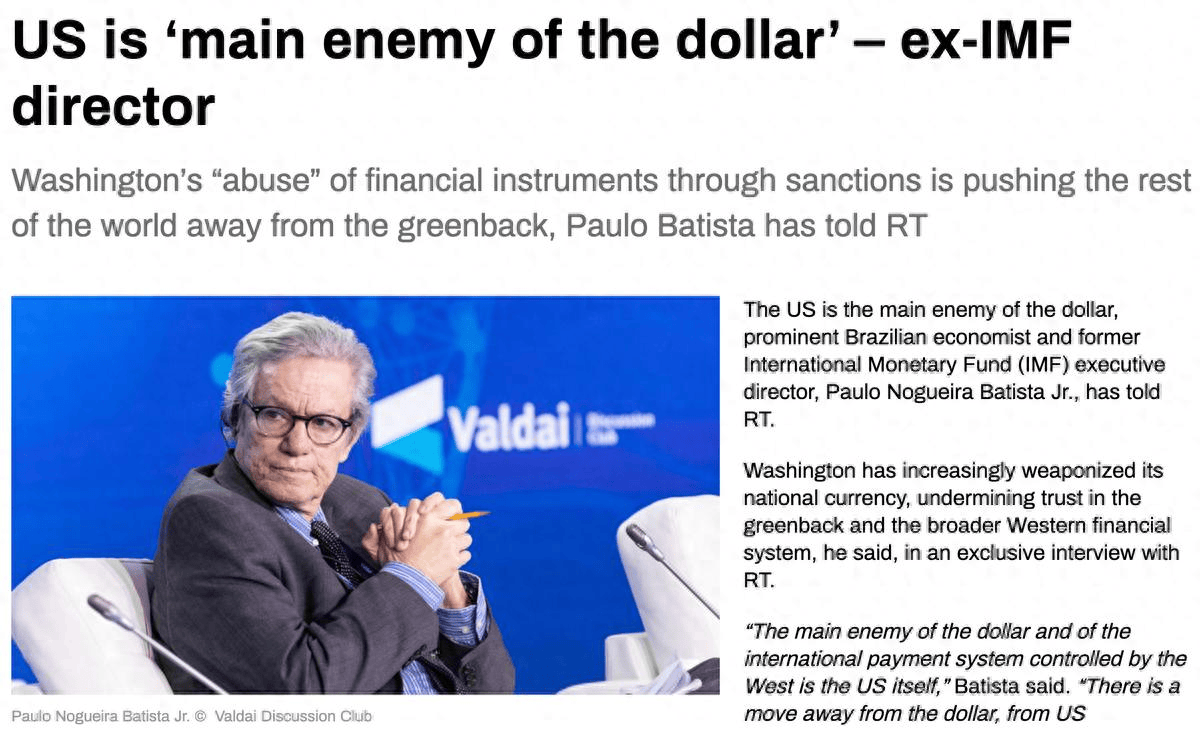
当今世界,关于美元的讨论已跳出经济学家与金融专家的圈层,普通民众也愈发关注这一全球货币霸主的地位动摇。美国政客频频将中国视作"头号敌人", 妄图通过对抗维系金融霸权,却忽视了一个核心事实:真正威胁美元根基的,正是美国自身的短视与越界行为。 在巴蒂斯塔看来,靠恐惧维系的霸权注定脆弱。当SWIFT丧失中立性、沦为地缘政治工具,其在全球金融体系中的合法性便大幅削弱。全球贸易迫切需要一 种不受政治干预、不会随意"断网"的支付保障,而美国显然无法提供这种确定性,各国加速搭建替代支付网络,本质上是对美元信用破产的集体回应。 作为全球核心储备货币,美元的地位建立在"中立性"与"安全性"的隐性承诺之上,而美国早已突破这一底线。2022年,美国联合盟友冻结俄罗斯央行约3000 亿美元海外储备,这不仅是对俄罗斯的精准经济打击,更是对国际金融规则的公然践踏。这笔储备并非私人财富,而是俄罗斯凭借资源出口与劳动创造积累 的合法主权资产,依据传统金融契约精神,央行储备享有绝对主权豁免权,美西方的举动无疑沦为赤裸裸的"国家抢劫",彻底击碎了各国对美元资产安全的 信任。 信任一旦崩塌便难以修复,各国为规避潜在风险,纷纷加速探索美元替代方案, ...
聚焦美联储独立性裁决 黄金震荡回调
Jin Tou Wang· 2026-01-20 03:04
Group 1: Gold Market Analysis - The latest spot gold price is reported at 1044.47 CNY per gram, showing a decrease of 0.52 CNY, or 0.05%, from the previous trading day, indicating a downward trend during the day [1] - The opening price for the day was 1045.44 CNY per gram, with a daily high of 1046.78 CNY and a low of 1042.74 CNY [1] Group 2: Federal Reserve Independence Case - The U.S. Supreme Court is set to hear a critical case regarding the independence of the Federal Reserve, focusing on whether President Trump can dismiss Fed Governor Lisa Cook on grounds of "alleged mortgage fraud" [2] - The case raises concerns about the definition of "just cause" for dismissing Fed officials, which could potentially undermine the Fed's independence and allow for political interference in monetary policy [2][3] - Legal and academic experts express worries that even if Cook remains, a lack of strict standards for "just cause" could open the door for presidential intervention, threatening the Fed's credibility in managing inflation [2][3] Group 3: Market Implications of the Court Ruling - The outcome of the Supreme Court ruling will have direct implications for the U.S. dollar and gold prices, with any signals weakening the Fed's independence likely to trigger a sell-off of the dollar [3] - If the Fed's independence is significantly eroded, the "excess privilege" of the dollar may be challenged, impacting global capital flows and asset pricing [3] - Gold is positioned as a key asset for "de-dollarization" and inflation hedging, gaining upward momentum due to the risks associated with the court case [3]
美指回调政策博弈信用扰动
Jin Tou Wang· 2026-01-20 02:48
Core Viewpoint - The US dollar index is experiencing a significant decline due to policy uncertainties and credit concerns, with a notable drop of 0.84% to 98.02, reflecting a loss of confidence in the dollar [1] Group 1: Dollar Index Movement - The dollar index fell sharply by 1.19% in a single day, marking its largest daily decline recently, as non-US currencies strengthened [1] - The dollar index has been on a rapid downward trend since January 20, with a trading range of 97.95 to 98.21 [1] - The market's confidence in the dollar is wavering, influenced by the "Powell investigation" which raises concerns about the independence of the Federal Reserve [1] Group 2: Federal Reserve Policy Uncertainty - There is a growing uncertainty regarding the Federal Reserve's policy path, with expectations of continued easing into 2026, including a predicted 50 basis points cut in the first half of the year [2] - The core PCE price index remains above the 2% target, limiting the scope for easing, while internal divisions within the Federal Reserve are becoming more public [2] - The upcoming Federal Reserve meeting on January 27-28 is highly anticipated for potential policy signals, with concerns that aggressive easing expectations may be revised [2] Group 3: Global Monetary Policy Divergence - The divergence in global central bank policies, particularly with the Bank of Japan entering a rate hike cycle, is exerting downward pressure on the dollar [2] - The European Central Bank is cautious about rate cuts, which may lead to capital outflows from dollar assets [2] - Central banks are increasingly accumulating gold to hedge against dollar risks, with gold prices expected to rise significantly, reflecting a trend of "de-dollarization" [2] Group 4: Technical Analysis of Dollar Index - The dollar index shows a clear short-term downtrend, with bearish momentum dominating the market [3] - Key support levels are identified around 97.80-97.90, while resistance is concentrated at 98.50-98.60, indicating potential further declines if resistance is not overcome [3] - The overall outlook for the dollar index in 2026 is expected to be "generally weak with intermittent rebounds," driven by factors such as Federal Reserve easing and narrowing interest rate differentials [3]
华安基金:全球局势变数加大,金价再创历史新高
Xin Lang Cai Jing· 2026-01-20 02:44
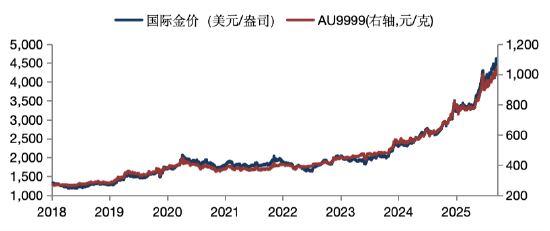
Group 1: Gold Market Overview - Gold prices have recently reached historical highs, with London spot gold closing at $4,599 per ounce (up 2.0% week-on-week) and domestic AU9999 gold at 1,033 yuan per gram (up 3.0% week-on-week) [1][6] - Geopolitical uncertainties are increasing, leading to a potential influx of safe-haven funds into gold. Notably, the dispute over Greenland's ownership and tensions surrounding Iran are contributing factors [1][6] - The European Union is considering imposing tariffs on $93 billion worth of goods imported from the U.S. in response to proposed U.S. tariffs on imports from several European countries [1][6] Group 2: U.S. Economic Indicators - The U.S. December CPI was lower than expected at 2.7% year-on-year, with core CPI at 2.6%, the lowest since March 2021, which has increased market speculation for an early interest rate cut by the Federal Reserve [2][7] - The Federal Reserve's independence is under scrutiny, with ongoing investigations into Chairman Powell, while major central bank leaders and Wall Street figures have expressed support for him [2][7] - The outlook suggests that if a dovish chairman is appointed, the pace of interest rate cuts may accelerate, which could be favorable for gold [2][7] Group 3: Future Signals for Gold ETF - Key signals to watch for the upcoming week regarding the gold ETF include U.S. Q3 GDP and PCE data, as well as changes in geopolitical situations [3][8] Group 4: Comparison of Gold Prices - A comparison of gold priced in RMB and international gold prices is noted, with data sourced from Wind and Huaan Fund as of January 18, 2026 [4][10]
国际金价、银价,再创历史新高!现在还能上车吗?
Sou Hu Cai Jing· 2026-01-20 02:34
银价格,又爆了! 昨天,随着国际金价和银价一路飙升并双双再度创下历史新高,贵金属再次成为市场的焦点。 那么,本轮贵金属"牛市"背后的深层逻辑是什么?2026年是"盛宴的尾声"还是新周期的起点呢?下面我们就一起来看看。 去年以来,贵金属市场可以说是"牛气冲天"——黄金领涨,白银后来居上,上演了一场"接力赛"。 2025年,纽约期金和伦敦金现货累计上涨超70%,沪金期货上涨近65%;纽约期银及伦敦银现货累计上涨超170%,沪银期货上涨超155%。 而今年开年以来,金银价格的走势也持续强劲。 昨天(1月19日),国际黄金期货价格一度飙升至每盎司4698美元的历史最高点,现货黄金也站上4690美元。 02宽松货币政策的催化 比黄金更为耀眼的是白银的涨幅。伦敦现货白银价格一举突破每盎司94美元,自今年开年以来已累计飙升31%,创下自1983年以来最强劲的新年开局。 | < 白 | | | 伦敦银现 | | | | | | --- | --- | --- | --- | --- | --- | --- | --- | | | SPTAGUSDOZ.IDC | | | | | | | | 93,131 | | 昨结 | 9 ...