关税

Search documents
特朗普临时讨价还价?日美贸易协议细节藏猫腻:关税、投资都改了
Jin Shi Shu Ju· 2025-07-24 03:50
Group 1 - The core of the news revolves around a "massive" trade agreement between the U.S. and Japan, announced by President Trump, which includes a 15% tariff rate and a $550 billion investment commitment from Japan [1][2] - There are inconsistencies in the details of the agreement, particularly regarding the tariff rates and the total investment amount, leading to confusion among analysts and officials [1][2] - The U.S. Secretary of Commerce suggested that the agreement's terms were influenced by innovative financing mechanisms offered by Japan, which allowed for the 15% tariff rate on automotive exports [2][3] Group 2 - The investment amount mentioned by Trump in his social media post is $550 billion, which is $50 billion higher than the modified figure on the card presented during negotiations [2] - Analysts express skepticism about the investment commitment, noting that Japanese officials view the $550 billion as a ceiling that may include government loan guarantees [3] - There are concerns that Japan may delay investments that do not align with its economic interests, as they feel pressured into making this commitment [3]
方正中期期货有色金属日度策略-20250724
Fang Zheng Zhong Qi Qi Huo· 2025-07-24 03:21
Report Summary 1. Report Industry Investment Rating No industry investment rating is provided in the report. 2. Core Views - The non - ferrous metals sector continued the general rebound trend from last weekend, with its performance strengthening compared to the previous period. The impact of trade negotiations and tariffs was temporarily alleviated. The market was focusing on changes in interest - rate cut expectations. The US economic data was resilient, and the Fed's decision - making independence led to changes in interest - rate cut expectations. In China, policies were introduced to promote stable growth in key industrial sectors, and major infrastructure projects were launched, which drove the non - ferrous metals sector to follow the upward trend, but the sustainability was average. The non - ferrous metals market showed an oscillatory and strengthening trend. Future operations should be cautiously bullish in the short - term, but avoid over - chasing the rise [11][12]. - Different non - ferrous metal varieties had different supply - demand situations and price trends. For example, copper was expected to show a situation of weak supply and strong demand, with inventory depletion likely to continue; zinc was in a state of increasing supply and weak demand, with an oscillatory and strengthening trend in the short - term and a bearish outlook in the medium - term; aluminum and its related products in the industry had different trends in cost, supply, and demand, and corresponding investment strategies were recommended [3][4][5]. 3. Summary by Directory 3.1 First Part: Non - Ferrous Metals Operation Logic and Investment Suggestions - **Macro Logic**: The non - ferrous metals sector rebounded. Trade and tariff impacts were temporarily alleviated. The market focused on interest - rate cut expectations. China's policies promoted industrial growth, driving the non - ferrous metals sector. The sustainability of the upward trend was limited. Future operations should be short - term cautiously bullish, and attention should be paid to the resonance between supply - demand fundamentals and the macro - environment [11][12]. - **Variety - Specific Analysis** - **Copper**: Social inventory decreased, supply was expected to decline, and demand was expected to increase. It was expected to stop falling and rebound, with support at 78000 - 79000 yuan/ton and resistance at 80000 - 82000 yuan/ton. The strategy was to buy on dips [3][14]. - **Zinc**: Supply increased, demand was weak, but it was oscillatory and strengthening in the short - term. Support was at 21600 - 21800 yuan/ton, resistance was at 22800 - 23000 yuan/ton. Short - term long positions were recommended, and short positions were considered in the medium - term [4][14]. - **Aluminum and Related Products**: In the aluminum industry chain, different products had different trends in cost, supply, and demand. For example, for aluminum, 09 contract had resistance at 21000 - 21200 yuan/ton and support at 20000 - 20200 yuan/ton; for alumina, 09 contract had resistance at 3700 - 3900 yuan/ton and support at 2800 - 3000 yuan/ton. Strategies such as reducing long positions and buying out - of - the - money put options were recommended [5][16]. - **Tin**: The fundamentals were weak in both supply and demand. It was recommended to wait and see, reduce long positions, with resistance at 270000 - 290000 yuan/ton and support at 250000 - 255000 yuan/ton. Buying out - of - the - money put options was considered [6]. - **Lead**: It followed the sector to rebound and then consolidated. Supply was expected to increase, and demand needed to be further restored. Support was at 16800 - 17000 yuan/ton, resistance was at 17200 - 17400 yuan/ton. Selling out - of - the - money put options on dips was recommended [7]. - **Nickel and Stainless Steel**: Nickel had an overall oversupply situation, with short - term bullish and medium - term bearish trends. Stainless steel had a situation of weak supply and demand, with support at 12300 - 12400 yuan/ton and resistance at 12800 - 13000 yuan/ton [8][17]. 3.2 Second Part: Non - Ferrous Metals Market Review The closing prices and price changes of various non - ferrous metals futures were provided. For example, copper closed at 79590 yuan/ton, down 0.19%; zinc closed at 22975 yuan/ton, up 0.13% [18]. 3.3 Third Part: Non - Ferrous Metals Position Analysis The latest position analysis of the non - ferrous metals sector was presented, including the net long - short strength comparison, net long - short position differences, changes in net long and net short positions, and influencing factors of different varieties such as polysilicon, silver, gold, zinc, etc [20]. 3.4 Fourth Part: Non - Ferrous Metals Spot Market The spot prices and price changes of various non - ferrous metals were provided, such as the Yangtze River spot price of copper was 79930 yuan/ton, up 0.13%; the Yangtze River spot average price of 0 zinc was 22830 yuan/ton, up 0.26% [21][23]. 3.5 Fifth Part: Non - Ferrous Metals Industry Chain Graphs related to the industry chain of various non - ferrous metals were presented, including inventory changes, processing fees, and price trends of copper, zinc, aluminum, alumina, tin, lead, nickel, and stainless steel [24][28][30][35][41][44][49][56]. 3.6 Sixth Part: Non - Ferrous Metals Arbitrage Graphs related to arbitrage of various non - ferrous metals were presented, including the comparison of domestic and foreign price ratios, basis differences, and price differences between different contract months of copper, zinc, aluminum, alumina, tin, lead, nickel, and stainless steel [57][61][62][66][69][71]. 3.7 Seventh Part: Non - Ferrous Metals Options Graphs related to options of various non - ferrous metals were presented, including historical volatility, implied volatility, trading volume, and open - interest ratio of copper, zinc, and aluminum options [75][78][81].
欧美贸易谈判风险仍存黄金开启跌势
Jin Tou Wang· 2025-07-24 02:44
【最新伦敦金行情解析】 在昨晚的美盘时段,一则关于欧美关税协议接近达成的消息重磅出炉,瞬间引发市场避险情绪大幅降 温。受此影响,黄金价格迅速跳水式下跌,且在美盘期间反弹乏力。最终,黄金日线以一根醒目的大阴 线收官,呈现出典型的"乌云盖顶"形态。 从1小时级别来看,黄金的均线已自高位开始拐头向下,在消息面的冲击下,多头动能明显受挫。与此 同时,黄金短线走势已然构筑出头肩顶结构。倘若后续反弹未能强势突破3400关口,则意味着右肩成 型,短期顶部结构——头肩顶将正式确立,届时空头力量将全面爆发,开启下行趋势。 【要闻速递】 美日达成贸易协议,美方对日本实施的对等关税为15%,同时欧美贸易谈判进展顺利,大多数产品税率 或为15%,贸易协议进展给推升市场风险偏好,贵金属小幅回落。 不过,值得注意的是,欧盟仍在准备一项报复性关税方案,以防在8月1日前无法达成协议,欧美贸易谈 判风险仍存。 摘要今日周四(7月24日)亚盘时段,伦敦金目前交投于3383.90美元附近,截至发稿,伦敦金暂报 3386.65美元/盎司,跌幅0.01%,最高上探3393.09美元/盎司,最低触及3383.90美元/盎司。目前来看, 伦敦金短线偏向看 ...
没得选、被迫贵、忍受差 关税正在偷走美国人的购物自由
Xin Hua She· 2025-07-24 02:05
Core Viewpoint - The article discusses the implications of President Trump's tariffs on American consumers, highlighting that while the administration claims these tariffs support domestic industries, they may actually harm consumers through increased prices, reduced choices, and lower quality products [1][4][5]. Group 1: Impact on Consumer Choices - Tariffs have led to a reduction in the variety of products available to American consumers, forcing them to settle for less preferred domestic brands due to fewer imported options [4]. - The imposition of tariffs has resulted in a lack of alternatives for essential goods, such as coffee, which is primarily imported and faces significant tariff threats, potentially leading to a decrease in domestic consumption [4]. Group 2: Quality and Cost Implications - The quality of products may decline as manufacturers are compelled to source from less optimal suppliers due to tariffs, resulting in consumers paying the same price for inferior goods [4]. - The financial burden of tariffs disproportionately affects low-income households, which spend a larger portion of their income on essential goods that are subject to higher tariffs compared to luxury items [5]. Group 3: Long-term Consequences - Over time, the negative effects of tariffs manifest as fewer choices, lower quality, and increased costs for consumers, ultimately harming ordinary American families the most [5].

永安期货:金融科技早报-20250724
Xin Yong An Guo Ji Zheng Quan· 2025-07-24 02:03
Market Performance - A-shares experienced a slight increase, with the Shanghai Composite Index up 0.01% to 3582.3 points, while the Shenzhen Component fell by 0.37%[1] - The Hong Kong Hang Seng Index closed up 1.62% at 25538.07 points, with the Hang Seng Tech Index rising 2.48% and the Hang Seng China Enterprises Index increasing by 1.82%[1] - The total trading volume in Hong Kong surged to 3330.666 million HKD[1] Trade and Tariff Developments - Trump indicated that the reciprocal tariff rates would range from 15% to 50%, with most EU products expected to have a tariff rate set at 15%[1][15] - The EU and the US are reportedly moving towards a trade agreement, with a proposed 15% tariff on most products[15] Corporate Earnings and Forecasts - Tesla reported a 12% decline in revenue to 22.5 billion USD, marking the largest quarterly drop in at least a decade, with adjusted earnings per share at 0.40 USD, slightly below analyst expectations[15] - Tesla's gross margin remains above average expectations, indicating resilience in profitability despite revenue challenges[15] International Relations - Xi Jinping is scheduled to meet with EU leaders in Beijing, with discussions expected to focus on climate cooperation, although no joint statement is planned[15] - The meeting highlights ongoing tensions and divisions between China and the EU, despite previous signs of thawing relations[15]






新西兰联储首席经济学家Conway:关税料将意味着出口需求更加疲软。CPI数据与新西兰联储的预期相符。预计通胀在2026年年初来到2%左右。委员会预计2025年年中通胀率在3%左右。如果物价压力缓解,有降息空间。准备好在必要时调整现金利率。关税对新西兰经济是一个负面冲击。美国关税将压低新西兰出口价格。
news flash· 2025-07-24 01:53
Group 1 - The chief economist of the Reserve Bank of New Zealand, Conway, indicates that tariffs are expected to lead to weaker export demand [1] - CPI data aligns with the expectations of the Reserve Bank of New Zealand [1] - Inflation is projected to reach around 2% by early 2026, with an expected inflation rate of approximately 3% by mid-2025 [1] Group 2 - There is potential for interest rate cuts if price pressures ease, with readiness to adjust the cash rate as necessary [2] - Tariffs are viewed as a negative shock to the New Zealand economy [2] - U.S. tariffs are expected to lower export prices from New Zealand [2]
新西兰联储首席经济学家:关税将导致全球经济和全球需求疲软。
news flash· 2025-07-24 01:38
Core Viewpoint - The Chief Economist of the Reserve Bank of New Zealand indicates that tariffs will lead to a slowdown in the global economy and global demand [1] Group 1 - Tariffs are expected to negatively impact global economic growth [1] - The slowdown in global demand is a significant concern for various industries [1] - The implications of tariffs may affect trade relationships and economic stability worldwide [1]
研究所晨会观点精萃-20250724
Dong Hai Qi Huo· 2025-07-24 01:12
Report Industry Investment Rating No relevant content provided. Core Viewpoints of the Report - Overseas, the US has reached trade agreements with Japan and is likely to reach one with the EU, leading to a decline in market risk - aversion and a continued rise in global risk appetite. Domestically, China's economic growth in H1 was higher than expected, but consumption and investment slowed in June. Policy measures are expected to boost domestic risk appetite. [2] - Different asset classes have different short - term trends: stocks are expected to be slightly stronger in the short - term; bonds may experience a high - level correction; commodities in different sectors have different trends, with some being slightly stronger and some being volatile. [2] Summary by Related Catalogs Macro - finance - **Macro situation**: Overseas, the US - Japan trade agreement sets a 15% tariff rate on Japan, and the probability of the US - EU trade agreement has increased. Market risk appetite has risen, and the US dollar index is weak. Domestically, H1 economic growth was higher than expected, but June consumption and investment slowed. Policy measures aim to boost domestic risk appetite. [2] - **Asset trends**: Stocks are expected to be slightly stronger in the short - term and it's advisable to be cautiously long; bonds are expected to correct at a high level and it's advisable to wait and see; for commodities, black metals may have increased short - term fluctuations and it's advisable to be cautiously long; non - ferrous metals may rebound with short - term fluctuations and it's advisable to be cautiously long; energy and chemicals may fluctuate and it's advisable to wait and see; precious metals may be volatile at a high level and it's advisable to be cautiously long. [2] Stock Index - The domestic stock market continued to rise, driven by sectors such as hydropower, securities, insurance, and kitchen and bathroom appliances. The short - term macro upward drive has strengthened, and attention should be paid to the progress of Sino - US trade negotiations and the implementation of domestic incremental policies. It's advisable to be cautiously long in the short - term. [3] Precious Metals - The precious metals market declined on Wednesday. With the approaching tariff deadline on August 1st, market risk appetite has recovered, putting pressure on precious metals. The Fed's interest - rate cut expectation has slowed. In the short - term, precious metals are expected to be volatile at a high level, and gold still has strategic allocation value in the long - term. [3] Black Metals - **Steel**: Steel futures and spot prices continued to rebound. The "anti - involution" policy supports the cost of steel, and the actual demand is okay. The supply increase space is limited in the short - term. It's advisable to view the steel market as slightly stronger with fluctuations in the short - term. [4][5] - **Iron ore**: Iron ore futures and spot prices weakened on Wednesday. The iron - water output is at a high level with limited upward space. The supply and demand situation is complex, and it's advisable to view the price as range - bound in the short - term. [5] - **Silicon manganese/silicon iron**: The prices of silicon manganese and silicon iron may rebound following coal prices. The production situation of silicon manganese is relatively stable, and the mentality of silicon - iron merchants is positive. [6] Chemicals - **Soda ash**: The soda ash futures contract was weak on Wednesday. The supply is still in an oversupply situation, the demand is weak, and the profit has declined. The "anti - involution" policy supports the bottom price, but the long - term price is still under pressure. [7] - **Glass**: The glass futures contract was weak on Wednesday. The supply pressure is increasing, the demand is weak, and the profit has increased. The "anti - involution" policy supports the price. [8] Non - ferrous Metals and New Energy - **Copper**: The US - Japan trade agreement has an impact on the market. The short - term sentiment is boosted by the industrial policy, but the future copper price depends on the tariff implementation time. [9] - **Aluminum**: The aluminum price fell, following the alumina trend. The fundamental situation is weak, and the policy impact is limited. It's not advisable to short for now. [9] - **Aluminum alloy**: The supply of scrap aluminum is tight, and the demand is in the off - season. The short - term price is expected to be slightly stronger with fluctuations, but the upward space is limited. [10] - **Tin**: The supply is recovering, the demand is weak, and the price is expected to be volatile in the short - term, with upward pressure in the medium - term. [10] - **Lithium carbonate**: The lithium carbonate futures price fell. The production has increased, and the inventory is accumulating. The short - term price is expected to be slightly stronger with fluctuations due to the "anti - involution" policy. [11] - **Industrial silicon**: The industrial silicon futures price rose. The "anti - involution" policy drives the price, and it's expected to be slightly stronger with fluctuations in the short - term. [11][12] - **Polysilicon**: The polysilicon futures price rose significantly. The short - term price is expected to be slightly stronger with fluctuations, and attention should be paid to market feedback and capital changes. [12] Energy and Chemicals - **Crude oil**: The news of possible progress in US - EU trade negotiations has offset the impact of weak spot markets. However, the increase in Cushing crude oil inventory and upcoming Sino - US trade negotiations bring uncertainties. The oil price is expected to be mainly volatile. [13] - **Asphalt**: The asphalt price has回调. The demand in the peak season is average, and the inventory is not being effectively reduced. The short - term price will follow the crude oil price but may be weak with fluctuations. [13] - **PX**: The PX price is in a slightly stronger range - bound situation. The supply is tight, but the upward space is limited. [14] - **PTA**: The PTA price is expected to be volatile. The demand is in the off - season, and the processing fee is low, with a risk of production reduction. [14] - **Ethylene glycol**: The ethylene glycol price is oscillating at the support level. The inventory is slightly decreasing, and the price is expected to be volatile. [14] - **Methanol**: The methanol price is short - term strong but limited by the fundamentals. The inventory has increased, and attention should be paid to capital flow. [16] - **PP**: The PP price has risen due to policy expectations, but the supply pressure is increasing, and the demand is in the off - season. The long - term price is under pressure. [17] - **PL**: The PL price has limited upward drivers due to supply pressure and weak demand. The price may be volatile due to new listing and policy impact. [17] - **LLDPE**: The LLDPE price has adjusted. The import arbitrage window is open, and the demand is weak. The short - term price may rebound but has limited space, and the long - term price may decline. [18] - **Urea**: The urea price has risen due to market sentiment, but the demand is weakening, and the supply is abundant. The price is expected to be weak with fluctuations. [18][19] Agricultural Products - **US soybeans**: The price of US soybeans has been affected by weather. The expected rainfall may limit crop pressure. [20] - **Soybean and rapeseed meal**: It's advisable to increase long positions in US soybeans above 1000. The short - term price of soybean meal is still strong, but the upward space is limited. [20] - **Soybean and rapeseed oil**: The inventory pressure of soybean oil is high, and the demand is in the off - season. The price of rapeseed oil may decline if palm oil corrects. The soybean - palm oil spread may widen. [21] - **Palm oil**: It's a short - term bull market for palm oil, but the upward resistance is increasing. It's advisable to be cautious when chasing orders. [21] - **Pigs**: The supply of pigs is increasing, and the demand is weak. The short - term price is testing the support level. Policy rumors have affected the futures price, but the long - term price increase is limited. [22] - **Corn**: The corn price has slightly rebounded. The supply is gradually tightening, but the demand is in the off - season. The price is expected to be in a narrow - range oscillation in the short - term. [22][23]
金属普涨 期铜升至逾两周最高,受助于美日达成贸易协议【7月23日LME收盘】
Wen Hua Cai Jing· 2025-07-24 00:20
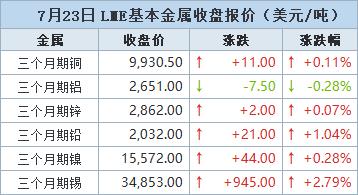
Group 1 - LME copper prices reached a two-week high, supported by a trade agreement between the US and Japan, with prices closing at $9,930.5 per ton, up $11 or 0.11% [1] - COMEX copper prices increased by 1.84% to $5.8265 per pound, with a record high of $5.93 earlier, driven by the anticipation of a 50% tariff on imported copper by the US starting August 1 [3] - The market sentiment improved following the US-Japan trade agreement, contributing to a rise in global stock markets and increasing investor interest in potential US-China trade agreements [3] Group 2 - Concerns over copper supply surplus persisted, with a reported surplus of 272,000 tons in the first five months of the year, leading to pressure on the market [4] - LME three-month aluminum prices fell by $7.5 or 0.28%, closing at $2,651.0 per ton, marking the worst performance among base metals on that day [4] - LME three-month tin prices rose by $945 or 2.79%, closing at $34,853.0 per ton, indicating strong demand despite overall market pressures [5]