人工智能

Search documents
2026年春季北交所AI医疗投资策略:AI重塑医疗价值链,把握优质细分赛道机会
Shenwan Hongyuan Securities· 2026-03-17 05:12
Group 1 - The report highlights that AI is progressively reshaping the medical value chain, addressing the widening gap in medical resources by enhancing productivity in drug development and diagnostics [2][12][19] - The global generative AI market in healthcare is projected to reach $22 billion by 2027, with a CAGR of 85% from 2023 to 2027, outpacing other sectors like finance and retail [2][11][28] - Key areas for investment include AI in drug development, medical imaging, assisted diagnosis, personalized treatment, and health management, with a focus on sectors with high technological maturity and clear business models [2][37][50] Group 2 - AI in drug development is expected to significantly reduce research time by approximately 25% and improve clinical trial efficiency by 20-30% through automation [13][43] - The AI medical imaging market is evolving from being an auxiliary tool to a diagnostic partner, with multi-modal models enhancing the ability to process diverse medical data [50][51][60] - The report identifies key companies in the North Exchange, such as Jinbo Bio and Baiying Bio, which are focusing on AI-driven drug development and diagnostics [2][29][31] Group 3 - The report emphasizes the importance of identifying structural opportunities in the healthcare sector, particularly in high-potential areas like AI-assisted drug development and medical imaging [37][38] - The investment landscape is becoming more rational, with a focus on diagnostics and drug development, as evidenced by the increasing number of financing events in these sectors [29][31] - The report outlines the government's supportive policies aimed at promoting AI in healthcare, transitioning from pilot projects to large-scale implementations by 2027 and 2030 [25][28]
每日市场观察-20260317
Caida Securities· 2026-03-17 05:11
Market Overview - On March 16, the Shanghai Composite Index fell by 0.26%, while the Shenzhen Component Index rose by 0.19% and the ChiNext Index increased by 1.41%[4] - The total trading volume on March 16 was 2.34 trillion yuan, a decrease of approximately 80 billion yuan from the previous trading day[1] Sector Performance - The semiconductor sector, particularly power semiconductors, showed strong performance, with price increases expected from major foundries starting in April[2] - The food and beverage, electronics, and social services sectors saw gains, while steel, non-ferrous metals, construction, chemicals, and coal sectors experienced declines[1] Geopolitical Impact - The geopolitical situation in the Strait of Hormuz is affecting global energy markets and suppressing risk appetite in financial markets[1] - Despite short-term impacts, China's assets are expected to become a safe haven due to strong manufacturing supply chains and ample market liquidity[1] Fund Flows - On March 16, net outflow from the Shanghai Stock Exchange was 4.645 billion yuan, while the Shenzhen Stock Exchange saw a net inflow of 11.407 billion yuan[5] - The semiconductor, components, and communication equipment sectors attracted the most capital inflows, while power, infrastructure, and photovoltaic equipment sectors faced the largest outflows[5] Economic Indicators - In January-February 2026, the manufacturing value added in the computer, communication, and other electronic equipment sectors grew by 14.2% year-on-year[9] - The electricity and heat production and supply sector's value added increased by 5.1% year-on-year, accelerating by 4 percentage points compared to December 2025[10] Real Estate Market - In February 2026, the sales prices of new residential properties in 70 large and medium-sized cities continued to narrow their month-on-month decline, with first-tier cities showing signs of stabilization[12][13] Hydrogen Energy Development - By 2030, the number of fuel cell vehicles in China is expected to double compared to 2025, aiming to reach 100,000 vehicles[14] Fund Management Trends - Public funds have purchased over 1 billion yuan of their own funds this year, with equity funds accounting for nearly 90% of the total[16]
吉宏股份(002803):AI全链条赋能降本增效,自有品牌开启第二增长曲线
AVIC Securities· 2026-03-17 05:02
Investment Rating - The investment rating for the company is "Buy" with an expected return exceeding 10% relative to the CSI 300 index over the next six months [28]. Core Insights - The company leverages AI technology across its entire business chain, significantly reducing costs and improving efficiency. Its self-developed Giikin AI system enhances operational capabilities and market positioning, driving high-quality growth [5][7]. - The company has established a dual-driven growth model through e-commerce and packaging, with a strong presence in both domestic and international markets. It aims to expand its self-owned brands, which are expected to contribute to a second growth curve [6][9]. - The company reported a robust performance in 2025, with a projected net profit attributable to shareholders ranging from 273 to 291 million yuan, reflecting a year-on-year increase of 50% to 60% [6][15]. Financial Performance - In 2025, the company achieved revenue of 14.77 billion yuan in Q1, 17.56 billion yuan in Q2, and 18.05 billion yuan in Q3, with year-on-year growth rates of 11.55%, 55.54%, and 25.04% respectively [6]. - The gross profit margin for the first three quarters of 2025 was 46.52%, an increase of 3.64 percentage points year-on-year, driven by improvements in the gross margins of its core businesses [6][15]. - The company’s net profit margin for the first three quarters of 2025 was 5.13%, up 1.75 percentage points year-on-year [6]. Business Segmentation - The e-commerce segment generated revenue of 21.16 billion yuan in the first half of 2025, marking a year-on-year increase of 52.91%, attributed to increased investment in AI and a shift from digitalization to intelligentization [6][10]. - The packaging business holds the leading market share in the domestic paper packaging sector, with a focus on high-quality, green, and intelligent packaging solutions [10]. - The company is expanding its overseas operations, including the establishment of a packaging production base in the UAE, to support its global growth strategy [10].

“AI牛市叙事”再掀巨浪! 黄仁勋抛出万亿美元AI宏图 英伟达(NVDA.US)扬帆起航冲6万亿美元市值
智通财经网· 2026-03-17 05:00
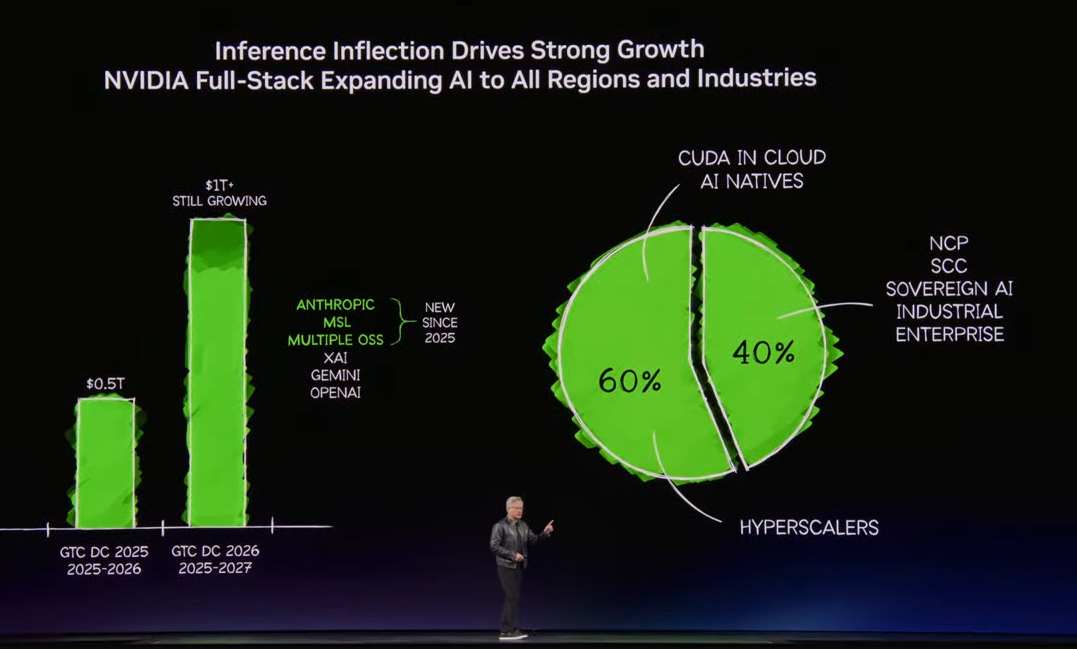
Core Viewpoint - NVIDIA's CEO Jensen Huang announced at the GTC conference that the company's future revenue in the AI chip sector could reach at least $1 trillion by 2027, significantly higher than the previous estimate of $500 billion by 2026, driven by strong demand for the Blackwell architecture GPUs and the upcoming Vera Rubin architecture [1][16] Group 1: AI Infrastructure and Market Position - Analysts from Goldman Sachs, Wedbush, and Morgan Stanley are optimistic about NVIDIA's stock price, predicting that the company's market value will surpass $5 trillion again and potentially reach historical highs [1] - The average target price from Wall Street analysts suggests NVIDIA's market value could exceed $6 trillion within the next 12 months, with the most optimistic estimates reaching as high as $8.8 trillion [1] - Huang emphasized that the AI infrastructure market is transitioning from a focus on training to inference, indicating a shift in how the company defines its competitive landscape [6][14] Group 2: Technological Advancements - NVIDIA introduced a new data center-level CPU and a set of AI inference infrastructure systems based on Groq's exclusive architecture, showcasing its commitment to enhancing its position in the inference computing space [3][4] - The company is integrating various components, including CPU, GPU, LPU, DPU, and networking technologies, into a unified platform, which is expected to enhance performance and efficiency [8][9] - Huang highlighted that the Vera Rubin platform could achieve up to 10 times the inference throughput per watt compared to the Blackwell platform, indicating significant advancements in energy efficiency and cost-effectiveness [7][9] Group 3: Market Dynamics and Future Outlook - The demand for AI inference is expected to rise, with Huang stating that the "AI inference era has arrived," which aligns with the broader market trend towards AI deployment [5][14] - The integration of AI infrastructure into a comprehensive system is seen as a strategic move to redefine the economics of AI, focusing on metrics such as tokens per watt and cost per token [7][12] - Analysts believe that NVIDIA's strong positioning in the AI infrastructure market will continue to attract investment, alleviating concerns about the sustainability of capital expenditures in the tech sector [13][18]


招银国际每日投资策略-20260317
Zhao Yin Guo Ji· 2026-03-17 04:35
Macro Commentary - The Chinese economy started well in 2026, with retail sales, fixed asset investment, and industrial output strengthening due to factors like post-Spring Festival consumption, new fiscal funds, and a surge in exports [2] - However, the real estate market continues to decline, and durable goods consumption, such as automobiles, has significantly shrunk, raising doubts about the sustainability of the early recovery [2] - Energy price increases may alleviate deflation by raising upstream and input costs, but this is more cost-driven than demand-driven, potentially squeezing downstream profits and weakening household purchasing power [2] Industry Commentary - The automotive industry is seeing a structural optimization driven by new hydrogen energy policies, with significant subsidies for high-power heavy-duty trucks, indicating a shift towards "self-sustaining" models [5] - The policy aims to reduce hydrogen prices to 25 RMB/kg by 2030, which is crucial for the total cost of ownership (TCO) of fuel cell vehicles, suggesting a transition from reliance on government subsidies to market-driven growth [5] Company Commentary - Leap Motor (9863 HK) reported a 56% year-on-year revenue increase to RMB 21 billion in Q4 2025, with a gross margin expanding to a historical high of 15.1%, meeting expectations [6] - The D series models are expected to be key for 2026, with a projected sales volume of 900,000 units, contributing significantly to gross margin improvements despite rising component prices [6][7] - Beike (BEKE US) experienced a 28.7% year-on-year revenue decline to RMB 22.2 billion in Q4 2025, but is expected to recover in 2026 due to cost optimization and improved profitability in new business segments [8] - Qutai Technology (1478 HK) reported a 29% year-on-year revenue increase and a 435% net profit increase in FY25, driven by non-mobile camera modules and improved operations [9]
现代起亚将在部分车型中采用英伟达自动驾驶技术
Xin Lang Cai Jing· 2026-03-17 04:32
Core Viewpoint - Hyundai Motor and its subsidiary Kia Motors announced a partnership with Nvidia to integrate advanced autonomous driving technology into select vehicle models, enhancing their collaboration in future mobility solutions [1][2]. Group 1: Partnership Details - The partnership will involve the integration of Hyundai and Kia's software-defined vehicle (SDV) technology with Nvidia's L2+ level autonomous driving capabilities to jointly develop next-generation autonomous driving systems [1][2]. - The collaboration will leverage Nvidia's data platform and artificial intelligence (AI) technology, systematically integrating accumulated data into a unified learning process [1][2]. Group 2: Autonomous Driving Levels - L2 level autonomous driving systems require drivers to remain fully attentive, continuously monitoring the environment and ready to take control of the vehicle [2][4]. - L3 level vehicles can perform certain driving tasks, such as lane changes, without driver intervention under specific conditions [2][4]. - L4 vehicles can operate autonomously in limited environments but cannot function if necessary conditions are not met [2][4]. - L5 vehicles are capable of fully autonomous driving in all conditions without human intervention [2][4]. Group 3: Future Mobility Vision - The expansion of collaboration with Nvidia marks a significant step for Hyundai Motor Group in achieving a vision of safe and reliable autonomous driving technology [3]. - The company aims to enhance its technological competitiveness through a unified group collaboration framework, progressing from L2 and above autonomous driving systems to L4 level driverless taxi services [3]. - The integrated autonomous driving architecture will be built on Nvidia's Drive Hyperion platform, scalable from L2 to L4 levels [3].
晶方科技:车规CIS与光学器件双轮驱动业绩跃升-20260317
China Post Securities· 2026-03-17 04:30
Investment Rating - The investment rating for the company is "Buy" and it is maintained [1] Core Insights - The company focuses on the smart sensor market, leading in advanced packaging technologies such as WLCSP and TSV. It aims to enhance its technical advantages and business scale in the automotive CIS field while expanding its market share in security monitoring, IoT, AI glasses, and smartphones [4] - The company has acquired the Dutch company ANTERYON, enhancing its capabilities in optical device design and manufacturing, which are widely used in semiconductor equipment and automotive applications. It is also developing SIL optical technology to capitalize on the rapid growth of AI [5] - The company is actively expanding its high-power GaN technology and is progressing with its global layout, including the construction of a production base in Penang, Malaysia, to better meet overseas customer needs [6] Financial Projections - The company is projected to achieve revenues of 2.027 billion, 2.590 billion, and 3.281 billion yuan for the years 2026, 2027, and 2028, respectively, with corresponding net profits of 545 million, 706 million, and 904 million yuan [8] - For the year 2025, the company expects to generate revenue of 1.474 billion yuan, reflecting a growth rate of 30.44% [10] - The company's net profit for 2025 is projected to be 370 million yuan, with a growth rate of 46.23% [10]

英伟达在GTC大会推出多项AI相关新产品
Xin Hua She· 2026-03-17 04:16
Group 1 - The core event is the annual GTC conference held by Nvidia, where the company introduced several AI-related products, including the software stack "NemoClaw" to support the development and deployment of OpenClaw agents [1] - Nvidia announced the release of the next-generation AI graphics rendering technology DLSS 5, which aims to enhance image realism while reducing computational resource consumption [1] - The company unveiled a new AI computing platform named "Vera Rubin," expected to achieve 10 times the performance per watt compared to the previous generation [1] Group 2 - Nvidia introduced the next-generation Grok 3 language processing unit (LPU) chip, along with a rack system capable of housing 256 LPUs, which will work in conjunction with the "Vera Rubin" platform to improve token generation efficiency by approximately 35 times per watt [1] - In the autonomous driving sector, Nvidia announced a collaboration with Uber, which plans to deploy a fleet of self-driving taxis powered by Nvidia's software in Los Angeles and San Francisco starting in 2027, with plans to expand to 28 cities globally by 2028 [2] - The demand for AI computing power is rapidly increasing as AI applications evolve from chatbots to autonomous AI agents, with companies needing more computational capacity to generate additional tokens and enhance revenue [2]
英伟达GTC 2026:算力革命、万亿预期与中美AI芯片新格局
Tai Mei Ti A P P· 2026-03-17 04:10
Core Insights - The AI industry competition is shifting from model and algorithm development to a focus on computing power, efficiency, and commercialization [1] - NVIDIA's GTC 2026 conference highlighted the transition of AI from "training" to "inference" as the core of AI commercialization, with a projected global AI infrastructure investment increase from $500 billion to $1 trillion [2][4] - The introduction of the "AI factory" concept and "Token economics" redefines the profitability and development path of AI, emphasizing the importance of inference power [2][3] Investment Outlook - NVIDIA's CEO Huang Renxun projected that the revenue from AI chips could reach at least $1 trillion by 2027, which significantly boosted NVIDIA's stock price and market capitalization [4][5] - The demand for inference is not just a prediction but a current reality, with over 60% of AI companies' costs attributed to inference, necessitating cost reductions [5][6] - NVIDIA's ecosystem, including its CUDA platform, creates a strong barrier to entry for competitors, ensuring its dominance in the general computing power market [6][8] Technological Advancements - The release of the Rubin and Feynman architectures marks a generational leap in AI chip technology, widening the gap between the US and China in AI computing capabilities [7][8] - The advancements in manufacturing processes, such as the transition to 3nm and 1.6nm technologies, highlight the challenges faced by Chinese chip manufacturers due to supply chain restrictions [7][8] Industry Dynamics - The global AI industry is moving towards a "dual-track" model, with the US leading in high-end AI capabilities while China focuses on domestic applications [9][10] - The shift in AI commercialization will allow smaller companies to access AI technologies, promoting widespread adoption across various industries [10][11] - The competition in the AI sector is not limited to individual components but encompasses the entire industry chain, emphasizing the need for strategic adaptation in response to technological and market changes [11]
事关存储芯片,SK集团董事长最新发声
财联社· 2026-03-17 04:10
Core Viewpoint - The global memory chip shortage is expected to persist until 2030 due to systemic production bottlenecks in the semiconductor industry [1][5]. Group 1: Chip Shortage and Price Trends - The shortage of various memory chips, including DRAM, NAND, and HBM, is anticipated to lead to sustained price increases over an extended period [2]. - The current shortage rate for AI storage chips has exceeded 30%, indicating significant demand pressures [3]. - The increasing demand for AI is contributing to the ongoing semiconductor shortage, which is likely to continue for several years [4]. Group 2: Company Insights and Market Reactions - SK Hynix, one of the largest memory chip manufacturers globally, is a key supplier of HBM chips to NVIDIA [6]. - The chairman of SK Group, Choi Tae-won, mentioned that the company requires at least four to five years to increase wafer production capacity to meet the high demand for HBM chips driven by the AI sector [7]. - SK Hynix is considering measures to stabilize DRAM chip prices and is exploring the possibility of issuing American Depositary Receipts (ADRs) to broaden its global investor base, which could help reassess the company's value [8]. Group 3: Market Performance - Following the NVIDIA GTC conference, South Korean semiconductor stocks experienced strong performance, with Samsung Electronics' stock rising over 4% and SK Hynix's stock increasing by more than 2.5%, reaching the 1 million KRW mark for the first time in 11 trading days [9].