关税政策

Search documents
特朗普宣布11月起对输美中型和重型卡车征收25%关税
Zhong Guo Xin Wen Wang· 2025-10-07 22:36
Core Points - The U.S. President Trump announced a 25% tariff on medium and heavy trucks imported to the U.S. starting November 1 [1] - This tariff follows a previous announcement on September 25 regarding a 25% tariff on imported heavy trucks, which was delayed due to opposition from major U.S. automakers [1] - Additional tariffs were announced on various products, including a 100% tariff on imported brand-name or patented drugs, a 50% tariff on kitchen and bathroom cabinets, and a 30% tariff on upholstered furniture [1] - The U.S. Supreme Court is set to hear oral arguments in the first week of November regarding the legality of many tariffs imposed by the Trump administration [1]
巴西9月对美出口继续大幅下降
Xin Hua She· 2025-10-07 11:10
巴西总统府6日发布公告说,巴西总统卢拉当地时间6日上午同美国总统特朗普通电话,再次要求美国撤 销对巴西输美产品加征的关税。 数据还显示,9月巴西对美进口额43.5亿美元,同比增长14.3%;该月巴西对美贸易逆差扩大至17.7亿美 元。尽管对美出口承压,巴西9月出口总额305.3亿美元,同比增长7.2%;进口总额275.4亿美元,同比 增长17.7%。其中,对中国和阿根廷出口同比分别增长14.7%和24.9%。 近期,美方对巴西输美产品加征40%关税,大部分巴西输美产品面临的关税税率高达50%,8月巴西对 美出口同比下降18.5%。 新华社圣保罗10月7日电(记者杨家和)巴西发展、工业与贸易部6日发布的数据显示,受美国关税政策 影响,9月巴西对美出口额为25.8亿美元,同比下降20.3%。 (文章来源:新华社) ...
特朗普宣布对进口中型和重型卡车征收25%关税
Sou Hu Cai Jing· 2025-10-07 06:24
Core Viewpoint - Starting from November 1, 2025, a 25% tariff will be imposed on all medium and heavy trucks imported into the United States from other countries and regions [2] Group 1 - On September 25, it was announced that a 25% tariff on all imported heavy trucks would take effect from October 1 [2]

美国卡车关税政策生变:范围扩大至中型卡车,生效日期推迟至11月1日
智通财经网· 2025-10-07 02:16
Core Viewpoint - The U.S. government, under President Trump, will impose a 25% tariff on all imported medium and heavy trucks starting November 1, expanding the previously announced tariff that was set to begin on October 1, which only targeted heavy trucks [1] Group 1: Tariff Details - The new tariff applies to medium and heavy trucks weighing over 10,000 pounds and their components [1] - The measure provides a buffer for U.S. automakers importing parts from overseas [1] - It remains unclear whether the tariff will affect vehicles protected under the USMCA (United States-Mexico-Canada Agreement) [1] Group 2: Industry Impact - The U.S. Department of Commerce has classified the truck manufacturing industry as "critical to national security" [1] - Following the announcement, shares of truck manufacturer PACCAR (PCAR.US) experienced a slight increase [1] - Ford Motor Company (F.US), which produces the F-series trucks, also saw a minor boost in its stock price [1]


关税突发!特朗普宣布:11月1日起生效!
Zheng Quan Shi Bao· 2025-10-06 23:19
Group 1 - The U.S. will impose a 25% tariff on all medium and heavy trucks imported from other countries starting November 1, 2025, as announced by President Trump [1] - The U.S. Chamber of Commerce has opposed the new tariffs, highlighting that the top five sources of heavy truck imports are allies or close partners of the U.S. [1] - In the previous year, the U.S. imported nearly 245,000 medium and heavy trucks, with a trade value exceeding $20 billion [1] Group 2 - International Automotive LLC is highly dependent on imports, with approximately 98% of its trucks sold in the U.S. produced in Mexico, while Daimler follows with about 83% [1] - In contrast, PACCAR and Volvo manufacture nearly all of their trucks sold in the U.S. domestically [1] - The new truck tariffs will be added to a list of existing tariffs imposed by the Trump administration on various goods, including steel, aluminum, and automotive parts [1]
金十数据全球财经早餐 | 2025年10月7日
Jin Shi Shu Ju· 2025-10-06 23:10
男生普通话版 下载mp3 女声普通话版 下载mp3 粤语版 下载mp3 西南方言版 下载mp3 东北话版 下载mp3 上海话版 下载mp3 今日优选 美参议院未通过两党所提拨款法案 特朗普宣布对进口中型和重型卡车征收25%关税 特朗普取消与委内瑞拉达成外交协议的努力 上任不足一个月,法国总理勒科尔尼闪辞 哈马斯代表团:与以色列间接谈判取得积极进展 AMD与OpenAI签订芯片供应协议 市场盘点 周一,美元指数呈现倒V走势,最高触及98.5,随后急转直下,抹去日内全部涨幅,最终收跌0.005%,报98.11。基准的10年期美债收益率收报4.152%,对美 联储政策利率敏感的2年期美债收益率收报3.597%。 受美联储本月降息预期升温以及美国、法国和日本经济和政治不确定性的推动,现货黄金大涨近75美元,将历史新高刷新至3970美元关口上方,最终收涨 1.91%,收报3961.05美元/盎司;现货白银跟随黄金走高,最终收涨1.1%,报48.52美元/盎司。 由于欧佩克+温和增产缓解了交易员对供应过剩的担忧,国际原油跳空高开。WTI原油重回61美元关口上方,最终收涨1.69%,报61.52美元/桶;布伦特原油 最终收 ...

纳指、标普500再创新高 AMD(AMD.US)暴涨超23%
Zhi Tong Cai Jing· 2025-10-06 23:03
周一,三大指数涨跌不一。AMD暴涨推动纳指与标普500指数再创收盘历史新高,盘中,纳指最高上涨 至22991.72点,再创盘中历史新高。 【美股】截至收盘,道指跌63.31点,跌幅为0.14%,报46694.97点;纳指涨161.16点,涨幅为0.71%,报 22941.67点;标普500指数涨24.49点,涨幅为0.36%,报6740.28点。英伟达(NVDA.US)跌1%,特斯拉 (TSLA.US)涨超5%,AMD(AMD.US)涨23.7%。纳斯达克中国金龙指数收涨1%,小牛电动(NIU.US)涨超 20%,百度(BIDU.US)涨2%。 【欧股】德国DAX30指数收盘下跌13.25点,跌幅0.05%,报24373.06点;英国富时100指数收盘下跌 13.90点,跌幅0.15%,报9477.35点;法国CAC40指数下跌109.76点,跌幅1.36%,报7971.78点;欧洲斯 托克50指数下跌24.46点,跌幅0.43%,报5627.25点;西班牙IBEX35指数下跌52.22点,跌幅0.33%,报 15548.08点;意大利富时MIB指数下跌126.11点,跌幅0.29%,报43132.00点。 ...

特朗普经济政策依赖人工智能投资,专家警告风险加剧
Sou Hu Cai Jing· 2025-10-06 15:24
Core Viewpoint - The article argues that the U.S. economy under Trump's administration is overly reliant on artificial intelligence (AI) investments, while neglecting other economic sectors, leading to potential long-term risks [1][3]. Economic Performance - Despite high-risk policies, the U.S. economy has shown resilience, with stock markets reaching new highs this year [2]. - AI investment is projected to account for 2% of GDP by 2025, up from less than 0.1% in 2022, indicating a significant shift in economic focus [3][4]. AI Investment Impact - Average investment in AI per person in the U.S. is approximately $1,800 this year, which has contributed to a potential economic growth rate of nearly double the expected 1% without these investments [4]. - Nearly 60% of the S&P 500 index's gains this year have come from seven large tech companies, highlighting the concentration of economic growth in the AI sector [4]. Economic Disparities - Non-AI sectors are under pressure, with tariffs increasing inflation and hindering growth, leading to a youth unemployment rate of 10.5%, close to a decade-high [4][5]. - The construction of AI data centers requires substantial investment, but the operational workforce is minimal, potentially stifling growth in other industries [4]. Historical Context - The current situation mirrors the 1990s internet boom, where funding was heavily directed towards tech companies, leaving traditional manufacturing struggling for capital [5]. - Economic forces are pulling in opposite directions, with trade wars and immigration slowdowns contributing to investor caution and economic fragility [5][6]. Long-term Economic Outlook - While AI may offset some negative impacts of current policies, historical patterns suggest that technological revolutions can lead to economic instability [6]. - The potential for large-scale job displacement due to automation raises concerns about increasing global inequality and the risk of a financial crisis, reminiscent of past economic bubbles [6].
ACCA:67%企业主管料其贸易额未来三到五年或“大幅”增长
Zhi Tong Cai Jing· 2025-10-06 06:01
Core Insights - Despite 85% of respondents expressing concerns about tariffs impacting their businesses, a significant portion of executives remain optimistic about future global trade growth, with 38% and 29% expecting "substantial" and "slight" growth respectively [1] - The primary opportunity identified by half of the respondents is leveraging technology, such as artificial intelligence, to enhance global trade, followed by diversifying production, investment, or supplier locations, and acquiring new technologies [1] - Major risks identified include geopolitical tensions, international or domestic conflicts/war, and protectionist policies in advanced economies [1] Business Costs - Approximately 35% of respondents anticipate that changes in global trade will increase their business costs by over 10% in the coming years, while 46% expect costs to rise by up to 10%, and only 6% foresee a decrease [1] - The fragmentation of the trade system is likely to elevate price risks [1] Corporate Actions - Due to significant changes in U.S. trade policy, 60% of companies have already relocated some production, investment, or supplier locations in recent years, with 61% indicating potential future relocations [1] Survey Demographics - The survey included 631 respondents from over 50 countries, with nearly 40% being CEOs and CFOs, and 56% from the highest management levels [2] - The majority of responses came from the UK and China, with approximately 240 and 60 replies respectively [2]
全球媒体聚焦 | 《金融时报》:美国关税政策对消费品价格的影响开始显现
Sou Hu Cai Jing· 2025-10-06 05:27
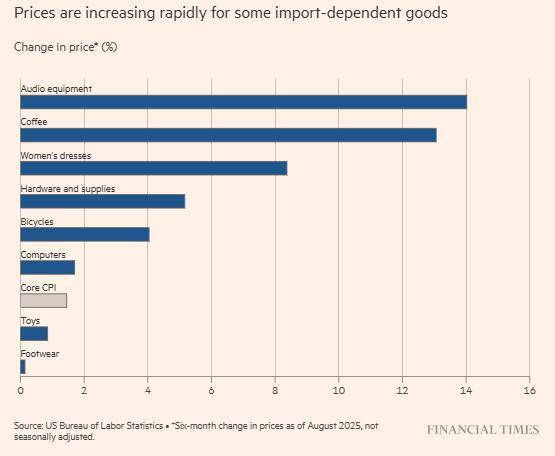
Group 1 - The article highlights that despite a moderate rise in overall inflation in the U.S., the tariff policies of the Trump administration are beginning to push up consumer prices across various goods, from canned products to auto parts [1] - Official data and corporate statements indicate that as companies deplete inventories and pass on tariff costs to consumers, prices of trade-dependent goods are accelerating. For instance, audio equipment prices increased by 14%, women's clothing by 8%, and tools and hardware by 5% over the past six months [1] - The article notes that following Trump's announcement of "reciprocal tariffs" six months ago, retailers rushed to import goods before the tariffs took effect, while other companies raised prices on specific items to protect their profit margins [1] Group 2 - A report tracking imported goods reveals that since April, 11 out of 29 "softline products" (like T-shirts and shoes), 12 out of 18 "hardline products" (such as bicycles and dishwashers), and 5 out of 16 sports goods have seen price increases by retailers, indicating the impact of tariffs [3] - Ashley Furniture, the world's largest furniture manufacturer, announced price increases of 3.5% to 12% on most of its products starting October 5, with the CEO stating that the ongoing tariff situation poses significant cost challenges for the entire industry [3] - AutoZone's CEO mentioned that as the effects of tariffs become more apparent, price increases may be even larger, reflecting concerns across various sectors including food service, construction, and utilities regarding the impact of tariffs [3] Group 3 - According to Citigroup's global chief economist, currently, U.S. consumers bear 30% to 40% of the tariff costs, with about two-thirds absorbed by companies. However, it is predicted that in the coming months, the consumer burden will rise to 60%, indicating that consumers will face more impacts [4]