
反内卷

Search documents
A股午评 | 指数走势分化 商业航天概念再度爆发 大消费板块持续走高
智通财经网· 2025-12-18 03:46
Market Overview - The market showed mixed performance with over 3,600 stocks gaining, and a half-day trading volume of 1 trillion, an increase of 21.2 billion compared to the previous day. The Shanghai Composite Index rose by 0.16%, while the Shenzhen Component Index and the ChiNext Index fell by 0.85% and 1.81%, respectively [1] Key Sectors Commercial Aerospace - The commercial aerospace sector experienced a strong surge, with multiple stocks including China Satellite hitting the daily limit. Other notable gainers included Tianyin Machinery, Beimo High-tech, and West Materials [2] - The sector's momentum is supported by the upcoming "14th Five-Year Plan" focusing on commercial aerospace, alongside significant IPO developments from SpaceX [2] Pharmaceutical Sector - The pharmaceutical sector showed repeated activity, with stocks like Luyuan Pharmaceutical and Huaren Health reaching the daily limit. The demand for related medications has increased due to rising flu activity across the country [3] - The surge in downloads for Ant Group's "AI Family Doctor" application, which has over 15 million active users, indicates a growing digital health management demand [3] Consumer Sector - The consumer sector continued to rise, particularly in retail, apparel, and food and beverage, with stocks like Central Plaza and Shanghai Jiubai hitting the daily limit. The Central Economic Work Conference emphasized expanding domestic demand as a top priority for the coming year [4] - Analysts suggest that the focus should be on structural changes in consumption to stimulate growth [4] Institutional Insights Everbright Securities - Everbright Securities anticipates a favorable cross-year market for A-shares, driven by new policy deployments and sustained economic growth, which will bolster market confidence and attract capital inflows [5] - Historical trends indicate that A-share markets typically perform well in the opening years of the 13th and 14th Five-Year Plans, suggesting a similar positive outlook for 2026 [5] Huachuang Securities - Huachuang Securities notes that the emergence of spring market activity may depend on resolving real estate risks, as current market pullbacks are largely influenced by real estate and domestic demand issues [6] - The focus remains on technology and strong performers, while caution is advised regarding the real estate sector [6] Zhongyin Securities - Zhongyin Securities believes that A-shares are currently in a "bull market continuation" phase, with a stable macroeconomic environment fostering market growth. The transition from policy-driven momentum to profit-driven growth is expected [8] - The firm highlights the importance of focusing on technology and "anti-involution" themes for future investments, as geopolitical risks ease and U.S.-China policy expectations stabilize [8]
汇丰:外资目前对中国资产的配置比例较低,未来预计将有更多资金流入
Zhong Guo Jing Ying Bao· 2025-12-18 03:42
Group 1 - HSBC's 2026 Q1 global investment outlook emphasizes China's focus on technological self-reliance, innovation, and high-quality development as part of the "14th Five-Year Plan" [1] - The bank anticipates continued economic stimulus policies in China aimed at boosting consumption, improving livelihoods, and stabilizing the real estate market, with "anti-involution" policies expected to enhance corporate profit margins [1] - HSBC's investment strategy for A-shares involves a "barbell strategy," balancing investments in high-tech growth sectors and high-dividend quality stocks to mitigate potential volatility from overseas markets [1] Group 2 - In the Hong Kong market, strong capital inflows, particularly from wealth management, and a recovering IPO market are identified as key drivers [2] - The supportive policies for AI and other innovative sectors are attracting more corporate investments, contributing to signs of stabilization in the local residential real estate market [2]

煤炭股逆势上涨 易大宗涨超2% 机构指“反内卷”重塑煤炭核心价值
Ge Long Hui· 2025-12-18 02:40
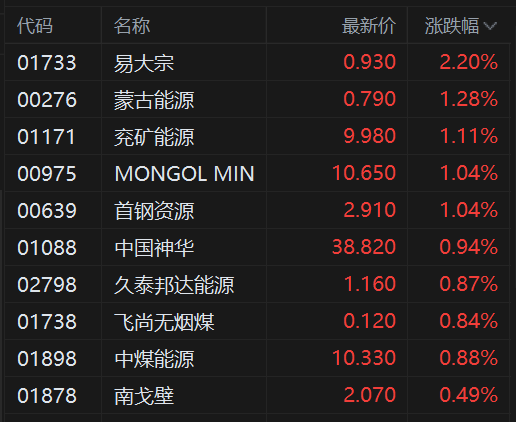
Group 1 - The coal sector in Hong Kong experienced a rally, with notable increases in stock prices for companies such as Yida Zong (up 2.20%), Yanzhou Coal (up 1.11%), and Mongolia Energy (up 1.28%) [1][2] - The National Development and Reform Commission, along with five other departments, released the "Key Areas for Clean and Efficient Utilization of Coal Benchmark Levels and Baseline Levels (2025 Edition)" [1] - According to Cinda Securities, the coal sector is characterized by "anti-involution" properties and has not fully reflected profit recovery expectations, indicating a strategic investment opportunity in high-quality coal companies [1] Group 2 - The coal sector is supported by high dividend safety margins and potential for price increases and valuation recovery, suggesting medium to long-term investment opportunities [1] - Open Source Securities believes that the "anti-involution" trend is reshaping the core value of coal, balancing both cyclical and dividend advantages [1]

综合晨报-20251218
Guo Tou Qi Huo· 2025-12-18 02:17
gtaxinstitute@essence.com.cn 综合晨报 2025年12月18日 【原油】 夜盘油价继续反弹。EIA数据显示尽管上周原油库存下降,但汽油和馏分油超预期累库。特朗普不断 升级对马杜罗政府施压行为,宣布对进出委内瑞拉的受美国制裁油轮突施"全面彻底"封锁,但要 考虑使用受制裁船只来完成委内瑞拉原油出口的数量较为有限这一事实。美委局势可能带来阶段性 风险溢价,然全球原油供需愈发宽松背景下,和谈取得进展导致市场担忧达成协议后俄油供应释放 进一步增大供应压力。短期市场多空消息面博弈,油价波动加剧。 (责金属) 本周美国非农等数据验证经济降温轨迹。美联储理事沃勒称货币政策处于限制性区间,仍有降息空 间。黄金偏强运行逼近历史高点,如果实现突破则贵金属强势表现有望延续。 【铜】 隔夜沪铜增仓震荡,测试短期均线支撑强度。私鲁延长一年现有非法采矿政策。铜市整体持仓高, 昨日上海贴水150元,广东升水75元。2026年供应环境前紧后松,跨年多配冲高潜力仍在。 隔夜沪铝再次站上22000元。迈期铝社库窄幅波动,表观消费尚可,沪铝中期震荡偏强趋势未改, 短期多头背靠40日线位置持有,跌破则考虑离场观望。 【铸造 ...
ETF盘中资讯 | “绿通胀、反内卷、降息潮”,三条主线或推升有色金属价格!有色龙头ETF(159876)逆市摸高0.77%
Sou Hu Cai Jing· 2025-12-18 02:13
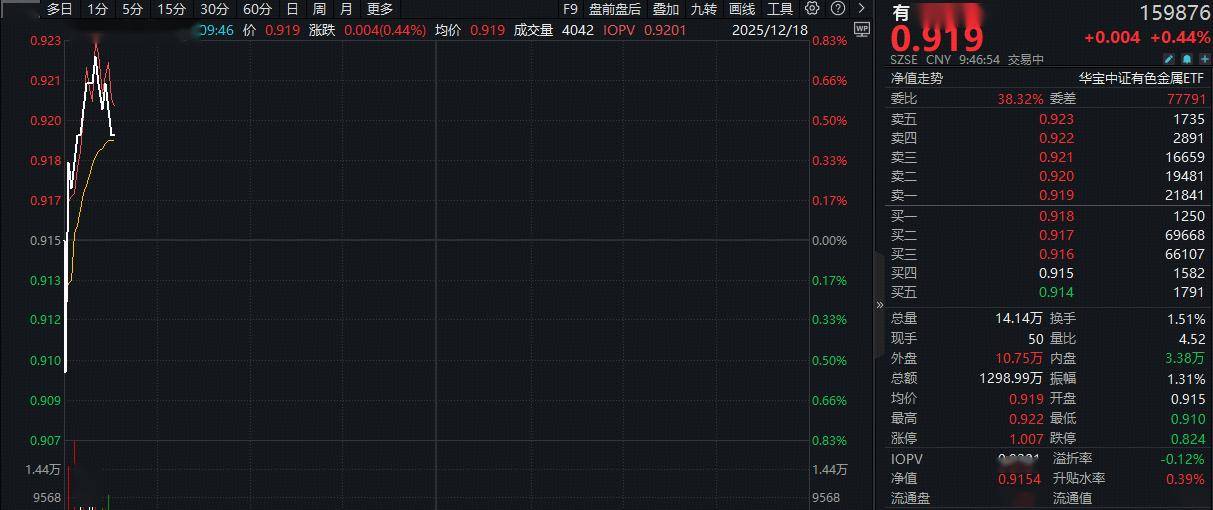
Core Viewpoint - The market is currently experiencing consolidation, with A-shares showing a downward trend, while the non-ferrous metal sector, particularly the non-ferrous metal leader ETF (159876), is performing well, indicating strong technical momentum [1] Group 1: Market Performance - The non-ferrous metal leader ETF (159876) has seen an intraday high increase of 0.77% and is currently up 0.44%, remaining above all moving averages, suggesting strong technical momentum [1] - Major stocks in the non-ferrous sector include Huayou Cobalt, which rose over 4%, and several others like Baotai Co., Huaxi Nonferrous, and Xiyang Co. that increased by more than 3% [1] Group 2: Future Outlook - The macroeconomic environment is expected to influence the commodity market, with three main lines projected to drive the rise in non-ferrous metal prices: "green inflation" related to basic metals, "anti-involution" policies affecting lithium and other new energy metals, and a potential "interest rate cut wave" benefiting precious metals like gold [2][3] - The "green inflation" narrative suggests that demand for copper and aluminum will continue to rise due to the growth of new industries such as AI and renewable energy, with expectations of price increases driven by supply shortages [2] - The "anti-involution" aspect indicates that lithium prices may rise as excess capacity is cleared and costs increase, with projections for lithium carbonate prices to reach 90,000-100,000, potentially rising to 120,000 by 2026 [3] - The anticipated acceleration of the Federal Reserve's interest rate cuts could enhance gold's appeal as a non-replaceable monetary asset, providing opportunities for investment in precious metals [3] Group 3: Investment Strategy - The non-ferrous metal sector is expected to continue its bullish trend, with various institutions expressing optimism about the ongoing bull market [4] - A diversified investment approach through the non-ferrous metal leader ETF (159876) is recommended, as it covers a wide range of metals including copper, aluminum, gold, rare earths, and lithium, thus mitigating risks associated with investing in single metal sectors [5] - As of December 16, the non-ferrous leader ETF (159876) has a total scale of 840 million, making it the largest ETF tracking the same index in the market [7]
港股异动丨煤炭股逆势上涨 易大宗涨超2% 机构指“反内卷”重塑煤炭核心价值
Ge Long Hui· 2025-12-18 02:08
Group 1 - The coal sector in Hong Kong has experienced a rally, with companies like Yida Zong rising over 2%, and Yancoal Energy, Mongolian Energy, and Shougang Resources increasing by more than 1% [1] - The National Development and Reform Commission, along with five other departments, has released the "Key Benchmark Levels and Baseline Levels for Clean and Efficient Utilization of Coal (2025 Edition)" [1] - According to Cinda Securities, the coal sector has a "reverse involution" characteristic and is not fully reflecting profit recovery expectations, indicating a strategic investment opportunity in the medium to long term [1] Group 2 - The stock performance of various coal companies includes: Yida Zong at 0.930 with a 2.20% increase, Mongolian Energy at 0.790 with a 1.28% increase, and Yancoal Energy at 9.980 with a 1.11% increase [2] - Other notable performances include Shougang Resources at 2.910 with a 1.04% increase, China Shenhua at 38.820 with a 0.94% increase, and Zhongmei Energy at 10.330 with a 0.88% increase [2] - The overall market sentiment is supported by ample liquidity and an adjustment in risk premiums, which enhances the attractiveness of the coal sector [1]

“绿通胀、反内卷、降息潮”,三条主线或推升有色金属价格!有色龙头ETF(159876)逆市摸高0.77%
Xin Lang Cai Jing· 2025-12-18 02:04
Core Viewpoint - The A-share market is experiencing a consolidation phase, with all three major indices in the red, while the non-ferrous metal sector's leading ETF (159876) is showing resilience and positive momentum, indicating strong technical performance [1][9]. Market Performance - The non-ferrous metal leading ETF (159876) reached a peak intraday increase of 0.77% and is currently up 0.44%, trading above all moving averages, suggesting strong upward momentum [1][9]. - Major constituents of the ETF include Huayou Cobalt, which rose over 4%, and other companies like Baotai Co., Huaxi Nonferrous, and Xiyang Co. which saw increases of over 3% [1][10]. Future Outlook - According to Huabao Fund, three main themes are expected to drive non-ferrous metal prices upward through 2026: 1. "Green Inflation" related to basic metals like copper and aluminum, driven by the growth of new economies such as AI and renewable energy, is anticipated to create a demand-supply imbalance, supporting price increases [3][11]. 2. "Anti-Overcapacity" policies in sectors like lithium and coal are expected to stabilize supply and demand, with lithium prices projected to rise from a bottom of 90,000-100,000 to 120,000 [3][11]. 3. A potential "Interest Rate Cut Wave" could enhance gold's appeal as a monetary asset, with expectations of price increases for precious metals like gold, silver, platinum, and palladium [4][12]. Investment Strategy - The non-ferrous metal sector is expected to continue its bullish trend, with institutions like Zhongtai Securities and CITIC Securities expressing optimism about the ongoing bull market [4][12]. - The non-ferrous leading ETF (159876) and its linked funds are recommended for investors seeking diversified exposure across various metals, including copper, aluminum, gold, rare earths, and lithium, which can help mitigate risks compared to investing in single metal sectors [5][14]. ETF Details - As of December 16, the non-ferrous leading ETF (159876) has a total size of 840 million yuan, making it the largest ETF tracking the same index in the market [7][16].
五矿期货黑色建材日报-20251218
Wu Kuang Qi Huo· 2025-12-18 02:04
1. Report Industry Investment Rating No relevant content provided. 2. Core Viewpoints of the Report - The overall sentiment in the commodity market was weak yesterday, and the prices of finished steel products oscillated at the bottom. The supply - demand structure of rebar was relatively balanced, while hot - rolled coils faced inventory pressure. Steel prices are expected to maintain bottom - range oscillations, and the export license management policy may put short - term pressure on prices but is expected to be gradually digested [2]. - Iron ore prices are estimated to operate within an oscillating range. Supply shows an increasing trend in overseas shipments, while demand has declined with a drop in daily pig iron production. The overall inventory is rising, and the impact of the export license management policy needs further observation [5]. - For manganese silicon and ferrosilicon, the report remains relatively optimistic about the black sector and domestic policies. Future market trends will be led by the direction of the black sector and cost increases due to factors such as manganese ore and electricity prices [9][10]. - Industrial silicon prices are expected to fluctuate following the market, with short - term rebounds after touching support levels. The supply reduction has encountered a bottleneck, and demand is weakening [13]. - Polysilicon prices saw a significant increase yesterday. Although production is expected to decline in December, the pressure of inventory accumulation before the Spring Festival is difficult to alleviate. The market shows a differentiation between expectations and reality, and short - term fluctuations are expected to increase [16]. - The float glass market maintains a weak supply - demand balance, and prices are expected to show narrow - range oscillations in the short term due to high inventory and weak demand [19]. - Soda ash prices are expected to continue to decline under pressure in the short term due to increasing supply and weak demand. Attention should be paid to enterprise maintenance schedules and inventory changes [21]. 3. Summary by Categories Steel Products Rebar - **Market Information**: The closing price of the rebar main contract was 3084 yuan/ton, up 3 yuan/ton (0.097%) compared to the previous trading day. The registered warehouse receipts were 57057 tons, unchanged. The open interest of the main contract decreased by 10413 lots to 1.604729 million lots. The Tianjin aggregate price was 3160 yuan/ton, up 10 yuan/ton, and the Shanghai aggregate price was 3280 yuan/ton, unchanged [1]. - **Strategy Viewpoint**: This week, rebar production decreased significantly, inventory continued to decline, and the supply - demand structure was relatively balanced, showing a neutral - stable performance [2]. Hot - Rolled Coil - **Market Information**: The closing price of the hot - rolled coil main contract was 3245 yuan/ton, down 1 yuan/ton (- 0.03%). The registered warehouse receipts were 103404 tons, unchanged. The open interest of the main contract decreased by 6813 lots to 1.199948 million lots. The Lecong and Shanghai aggregate prices were unchanged [1]. - **Strategy Viewpoint**: Hot - rolled coil production continued to decline, apparent demand slightly decreased, and inventory reduction became more difficult. Factory inventory has shown a phased accumulation this week [2]. Iron Ore - **Market Information**: The main contract (I2605) of iron ore closed at 768.00 yuan/ton, up 0.92% (+7.00). The open interest increased by 9427 lots to 489,000 lots. The weighted open interest was 884,300 lots. The spot price of PB fines at Qingdao Port was 787 yuan/wet ton, with a basis of 67.93 yuan/ton and a basis rate of 8.13% [4]. - **Strategy Viewpoint**: Overseas iron ore shipments continued to increase. The daily pig iron production fell below 2.292 million tons. Port inventory continued to rise, and steel mill inventory was at a low level. Iron ore prices are estimated to operate within an oscillating range [5]. Manganese Silicon and Ferrosilicon - **Market Information**: On December 17, the main contract of manganese silicon (SM601) rose 0.38% to close at 5758 yuan/ton. The Tianjin 6517 manganese silicon spot price was 5700 yuan/ton, with a premium of 132 yuan/ton over the futures. The main contract of ferrosilicon (SF603) rose 1.17% to close at 5546 yuan/ton. The Tianjin 72 ferrosilicon spot price was 5600 yuan/ton, up 50 yuan/ton, with a premium of 54 yuan/ton over the futures [8]. - **Strategy Viewpoint**: The report is relatively optimistic about the black sector and domestic policies. The future market trends of manganese silicon and ferrosilicon will be affected by the direction of the black sector and cost increases caused by factors such as manganese ore and electricity prices [9][10]. Industrial Silicon and Polysilicon Industrial Silicon - **Market Information**: The closing price of the main contract (SI2605) of industrial silicon was 8470 yuan/ton, up 1.26% (+105). The weighted open interest decreased by 6191 lots to 425,093 lots. The spot price of East China non - oxygen 553 was 9200 yuan/ton, unchanged, with a basis of 730 yuan/ton for the main contract; the 421 spot price was 9650 yuan/ton, unchanged, with a basis of 380 yuan/ton after conversion [12]. - **Strategy Viewpoint**: The industrial silicon price rebounded slightly after touching the support level. Supply reduction has encountered a bottleneck, and demand is weakening. It is expected to fluctuate following the market [13]. Polysilicon - **Market Information**: The main contract (PS2605) of polysilicon closed at 61,595 yuan/ton, up 5.11% (+2995). The weighted open interest decreased by 1463 lots to 275,506 lots. The average spot prices of N - type granular silicon, N - type dense material, and N - type re - feed material were unchanged, with a basis of - 9295 yuan/ton for the main contract [15]. - **Strategy Viewpoint**: The polysilicon price rose by over 5% yesterday. Although production is expected to decline in December, the pressure of inventory accumulation before the Spring Festival is difficult to alleviate. The market shows a differentiation between expectations and reality, and short - term fluctuations are expected to increase [16]. Glass and Soda Ash Glass - **Market Information**: The main contract of glass closed at 1038 yuan/ton on Wednesday afternoon, unchanged. The North China large - plate price was 1040 yuan, and the Central China price was 1080 yuan, both unchanged. The weekly inventory of float glass sample enterprises decreased by 1.215 million boxes (- 2.04%) to 58.227 million boxes. The top 20 long - position holders reduced their positions by 30,888 lots, and the top 20 short - position holders reduced their positions by 23,121 lots [18]. - **Strategy Viewpoint**: The supply side saw some production lines cold - repaired, and daily melting volume declined, but high inventory and weak terminal demand restricted upward price movement. The market is expected to show narrow - range oscillations in the short term [19]. Soda Ash - **Market Information**: The main contract of soda ash closed at 1170 yuan/ton on Wednesday afternoon, unchanged. The Shahe heavy - soda price was 1137 yuan, down 6 yuan. The weekly inventory of soda ash sample enterprises decreased by 443,000 tons (- 2.04%) to 1.4943 million tons, with heavy - soda and light - soda inventories both decreasing [20]. - **Strategy Viewpoint**: With the resumption of production of maintenance enterprises and the expected release of new capacity in Alxa, supply pressure is increasing. Demand remains weak, and prices are expected to continue to decline under pressure in the short term [21].
11月:煤价环比上涨,反内卷初心未变 | 投研报告
Zhong Guo Neng Yuan Wang· 2025-12-18 02:03
山西证券近日发布煤炭月度供需数据点评:2025年1-11月,原煤累计产量实现44.02亿吨,同比增 1.4%,同比增速边际下滑。11月当月实现4.27亿吨,同比降0.5%,环比增4.93%。25年1-11月固定资产 投资同比降2.6%,其中制造业投资增1.9%、基建投资降1.1%、房地产投资降15.9%。25年1-11月火电累 计增速实现-0.7%;焦炭累计增速实现3.2%;生铁累计增速实现-2.3%;水泥累计增速实现-6.9%;11月 火电增速实现4.2%;焦炭增速实现2.3%;生铁增速实现-8.7%;水泥增速实现-8.2%。 价格:11月煤炭价格环比超预期上涨。25年以来虽然山西优混5500动力煤、京唐港主焦煤、天津港二级 冶金焦均价有所调整,但11月当月三个品种均价环比均有不同程度上涨。11月各品种环比增幅动力煤> 焦炭炼>焦煤。 点评与投资建议: 11月煤价由涨转跌。11月大部分时间煤价延续10月份的上涨趋势,核心逻辑为电厂补库。在下游电厂完 成补库后,煤价旺季有所回落。从价格季节分布来看,2025年和2024年以及2023年的煤价季节性走势规 律一致,均呈现出"淡季不淡"和"旺季不旺"。前期价格超预 ...
持续关注反内卷进展 | 投研报告
Sou Hu Cai Jing· 2025-12-18 02:01
Group 1 - The petrochemical industry index performed poorly this week, declining by 3.52% compared to last week, while the engineering services sector within petrochemicals showed the best performance with a decline of 1.75% [1] - Crude oil prices have decreased, with U.S. crude oil inventories falling and gasoline inventories rising [1] - The polyester market saw stable prices for polyester filament yarn, but price spreads have decreased, and the operating rates of weaving machines have declined [1] Group 2 - The report highlights the importance of monitoring OPEC+ future policies and the progress of PTA anti-involution, as well as the elimination and upgrading of outdated facilities in the petrochemical industry [1] - If demand improves and there is progress in eliminating outdated production capacity, it would benefit the midstream refining sector [2] - The progress of PTA anti-involution is crucial, as successful developments would positively impact polyester filament yarn [3]