即时零售

Search documents
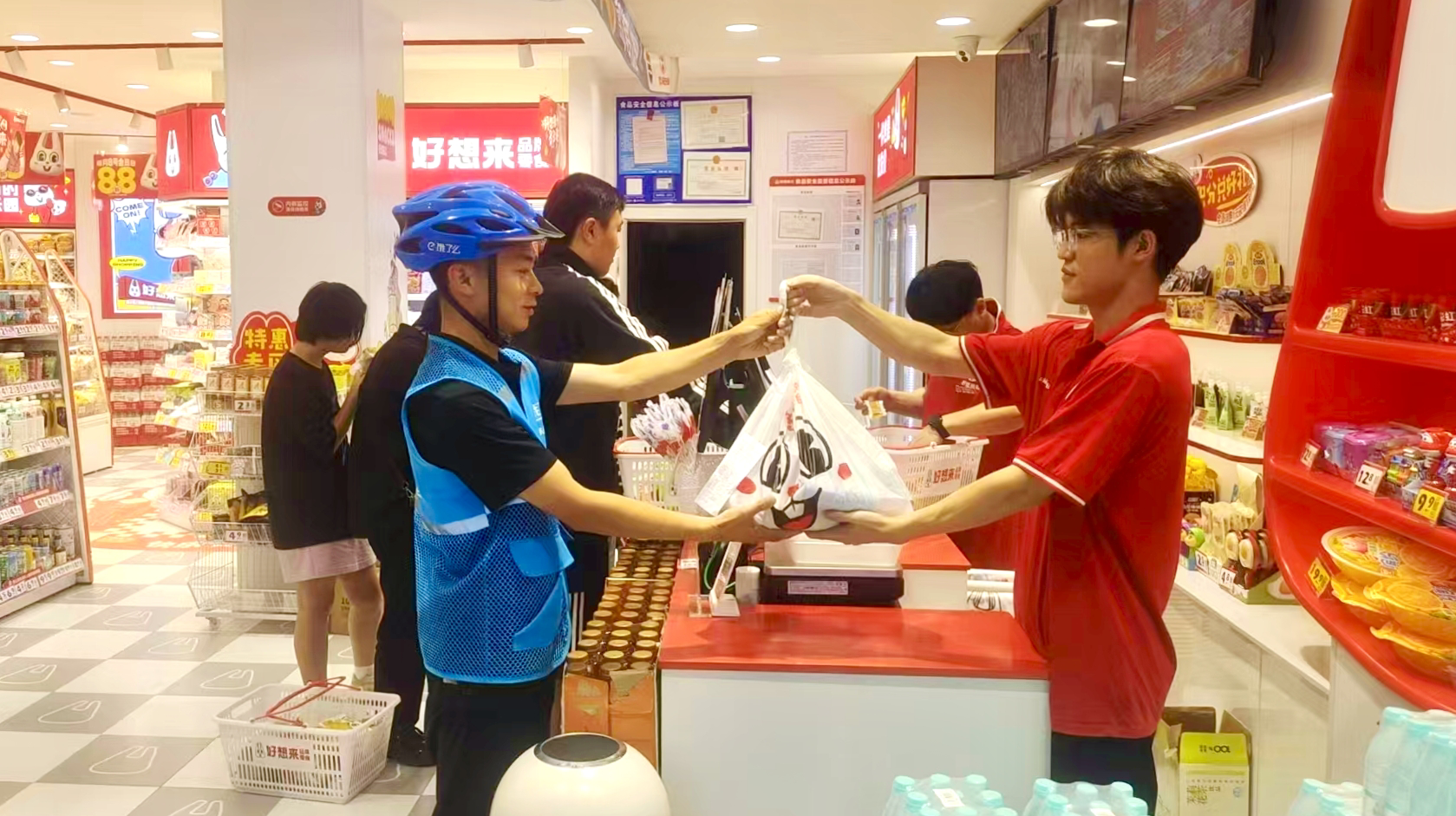
门店辐射半径扩大两倍 好想来接入淘宝闪购2个月登上零食品类第一
Yang Guang Wang· 2025-08-15 08:41
Core Insights - The leading snack brand, Hao Xiang Lai, has successfully entered the Taobao Flash Purchase platform, significantly increasing its market reach and sales volume [1][4] - The brand has experienced over 200% growth in order volume for three consecutive months, with online sales of various snack categories reaching new highs [1][4] - The expansion into the 3-5 kilometer market has allowed Hao Xiang Lai to tap into new customer segments, with over 90% of online customers being new users [1][3] Group 1 - Hao Xiang Lai's entry into Taobao Flash Purchase has led to nearly 5,000 stores being connected by the end of July [1] - The brand has optimized its product structure and warehousing strategies to match the instant retail consumption characteristics, with each store offering an average of 1,500 to 2,000 SKUs [3] - Seasonal promotions and scenario-based product combinations have been introduced, such as summer drink packages and autumn snack gift boxes, enhancing conversion rates and brand recognition [3] Group 2 - The rapid development of Taobao Flash Purchase has created significant growth opportunities for brands, with plans for over 15,000 stores to join the platform, covering a wider range of snack categories [4] - The collective entry of snack brands into Taobao Flash Purchase has stimulated demand for leisure snacks, with July seeing triple-digit growth in various snack categories [4] - Since its launch in May, Taobao Flash Purchase has driven a significant upgrade in the consumer platform, with 395 non-food brands achieving over one million in monthly transactions [4]

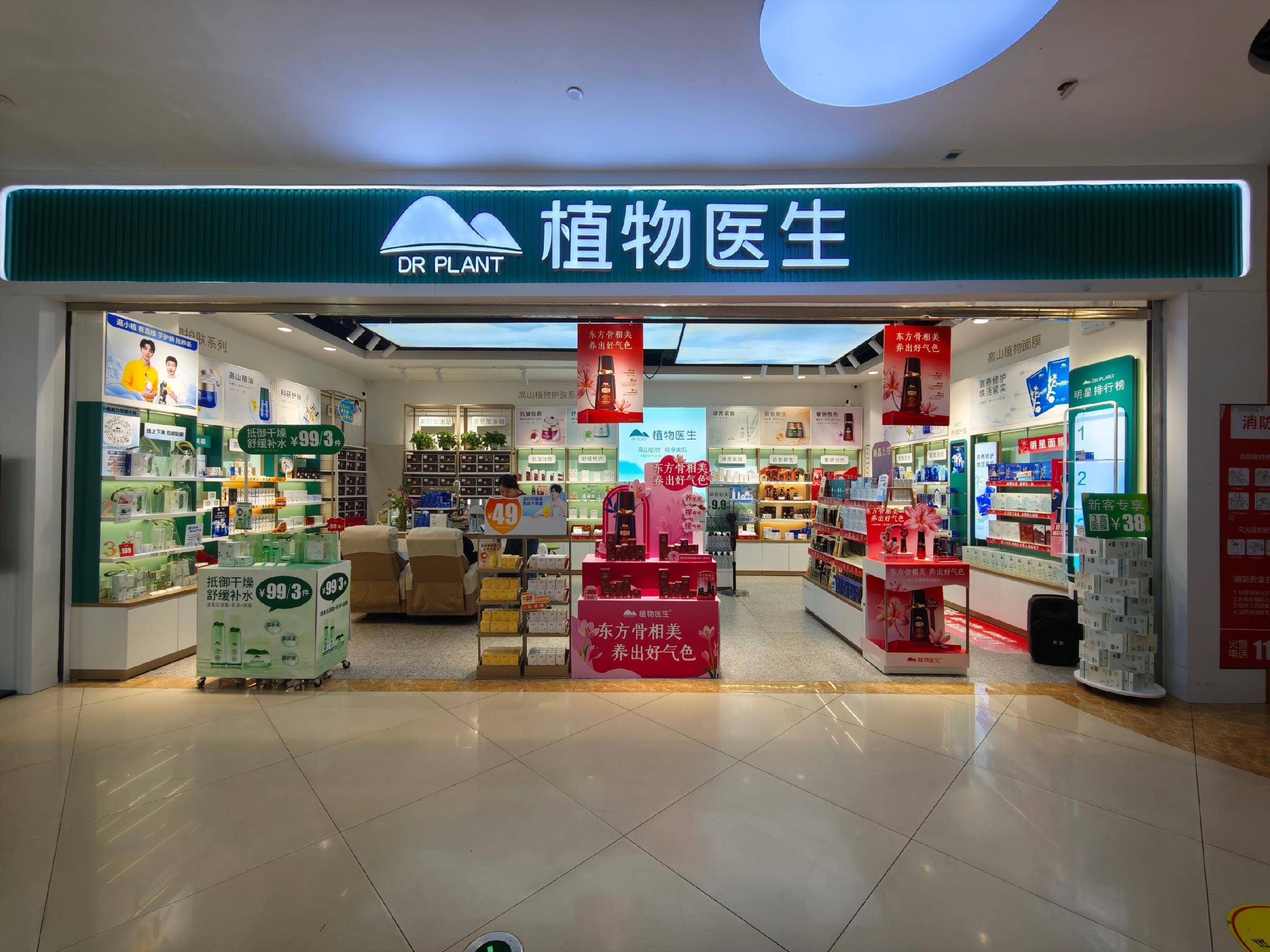
从线下筑基到线上提速,植物医生入驻美团闪购和京东秒送,布局即时零售万亿市场
Sou Hu Cai Jing· 2025-08-15 06:55
DR PLANT 示到 高山精油 科研护肤 型氧力量图片 , 20 曲 d 线上下单 回顾 9/3 半导 | 0 115 ATTLES 抵御干燥 舒缓补水 ¥99/34 深补水 高保证 GSF-9 当 "即买即得" 成为线上消费的新趋势,被重塑的购物速度与体验让即时零售下半场的硝烟,逐步蔓延至更广泛的品类。笔者获悉,坐拥4328家线下连锁门 店的国产化妆品品牌植物医生近期已在美团闪购、京东秒送平台上线,目前涵盖北京、深圳、湖北逾百家门店。 密集门店+高效调度,即时零售下半场的胜负手 即时零售的核心竞争力,在于 "快" 与 "全",而这背后离不开线下货品的充足储备与高效调度。拥有密集门店网络的非食品类头部品牌,被认为是即时零售 下半场的胜负手。 植物医生是继蕉下、名创优品后,又一位拥抱即时零售的重量级玩家。资料显示,植物医生正在冲刺"A股美妆单品牌店第一股",旗下有4328家线下连锁门 店,门店数量在化妆品企业中排名鳌头,且位置多在城市商圈、旅游区域附近。 植物医生官方视频号"小植说美妆"发布的视频称,植物医生已上线美团闪购,可实现30分钟极速达。笔者打开美团闪购,输入"植物医生",出现多家植物医 生店铺,配送 ...

京东集团-SW(09618):零售板块稳健增长带动收入超预期
HTSC· 2025-08-15 06:39
Investment Rating - The report maintains a "Buy" rating for the company [6][22]. Core Insights - The company's revenue for Q2 2025 reached 356.7 billion RMB, representing a year-on-year growth of 22.4%, exceeding both consensus expectations and previous forecasts [1][11]. - Non-GAAP net profit for Q2 2025 was 7.4 billion RMB, a decline of 48.9% year-on-year, but still better than expected [1][11]. - The retail segment's operational profit exceeded expectations, contributing significantly to the overall performance [1][4]. Revenue and Profitability - The total revenue for JD's retail segment in Q2 2025 was 310.1 billion RMB, with a year-on-year increase of 20.6% [2][21]. - The operating profit for the retail segment was 13.9 billion RMB, reflecting a year-on-year growth of 37.9% [2][11]. - The number of active buyers in the retail segment grew by over 40% year-on-year, marking the seventh consecutive quarter of double-digit growth [2][21]. Business Development and Strategy - The report highlights the rapid development of JD's food delivery business, with peak daily orders exceeding 25 million during Q2 2025 [3][21]. - Management aims to enhance the synergy between the food delivery and retail businesses, focusing on improving core system capabilities and optimizing order algorithms [3][21]. - The company is expected to enter an efficiency optimization phase for its delivery business starting Q3 2025, influenced by the overall growth in order volume [1][3]. Financial Forecasts and Valuation - The report revises the non-GAAP net profit forecasts for 2025-2027 upwards by 25.7%, 9.8%, and 7.1% to 278 billion RMB, 455 billion RMB, and 590 billion RMB respectively [4][19]. - The target price based on SOTP valuation is set at 46.35 USD per ADS and 181.94 HKD per ordinary share, reflecting an increase from previous estimates [4][22]. - The company is currently trading at adjusted PE ratios of 13.3x, 8.1x, and 6.3x for 2025-2027 [4][22].

零食领军品牌好想来入驻淘宝闪购,订单量连续3个月保持200%以上增速
Guan Cha Zhe Wang· 2025-08-15 05:32
Core Insights - The leading brand in the bulk snack industry, "好想来," has successfully entered the Taobao Flash Purchase platform, significantly increasing its market reach and sales volume [1][4] - The brand has experienced over 200% growth in order volume for three consecutive months since joining the platform, with online new customer acquisition exceeding 90% [1][4] Group 1: Market Expansion - "好想来" has integrated nearly 5,000 stores into Taobao Flash Purchase by the end of July, effectively tapping into a new market within a 3-5 kilometer radius [1][3] - The platform has allowed "好想来" to reach new users beyond the traditional 1-2 kilometer range, enhancing customer base expansion and channel upgrades [3][4] Group 2: Product Strategy - The company has optimized its product structure and warehousing strategy to align with instant retail consumption patterns, offering an average of 1,500-2,000 SKUs per store [3][4] - Seasonal and scenario-based product offerings have been introduced, such as summer ice cream combinations and autumn snack gift boxes, which have boosted conversion rates and brand recognition [3][4] Group 3: Sales Performance - Since the launch of Taobao Flash Purchase, there has been a three-digit growth in orders for various snack categories, including processed foods, snacks, and desserts [4] - The platform has enabled 395 non-food brands to achieve monthly sales exceeding one million, with 66 brands surpassing ten million, indicating a robust growth environment for snack brands [4]

中经酒业周报∣7月酒类价格同比下降1.9%,《黄酒酒庄》团标立项、《凤香型白酒》国标发布,贵州茅台发布半年报
Xin Hua Cai Jing· 2025-08-15 03:27
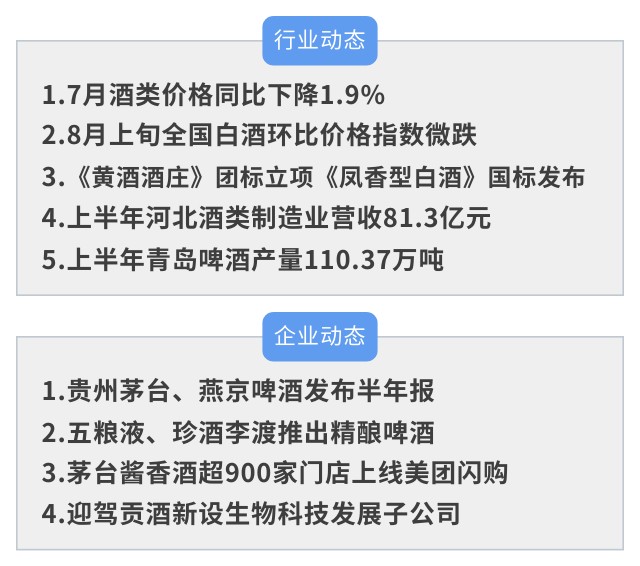
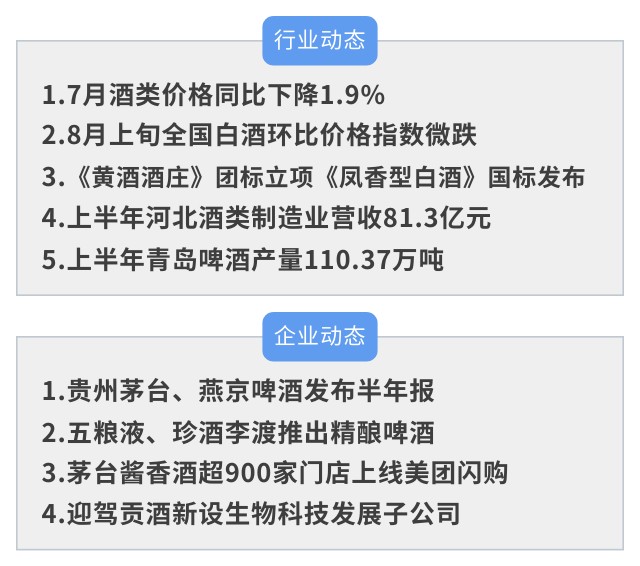
Industry Dynamics - In July, the price of alcoholic beverages decreased by 1.9% year-on-year, while the overall consumer price index remained flat [1] - In early August, the national white liquor price index slightly fell by 0.18%, with famous liquor down by 0.20% and local liquor down by 0.24% [1] - The China Alcoholic Drinks Association has initiated the drafting of a group standard for "Yellow Wine Winery" and approved the national standard for "Fengxiang Type Baijiu," effective from August 1, 2026 [1] Company Performance - In the first half of 2025, Hebei's liquor manufacturing industry reported revenues of 8.13 billion yuan, with a profit of 1.07 billion yuan, showing a year-on-year revenue decline of 2.8% but a profit increase of 54.2% [2] - Qingdao's beer production reached 1.1037 million kiloliters in the first half of 2025, marking a 2.8% year-on-year increase [2] - Guizhou Moutai reported total revenue of 91.094 billion yuan and a net profit of 45.403 billion yuan for the first half of 2025, with a year-on-year revenue growth of 9.16% [2] - Yanjing Beer achieved revenue of 8.558 billion yuan and a net profit of 1.103 billion yuan in the same period, with a profit increase of 45.45% [2] New Product Launches - Wuliangye launched a new craft beer named "Fenghuolun," emphasizing a unique grain flavor, priced at 19.5 yuan per can [3] - Zhenjiu Liduo introduced its first high-end craft beer "Niushi News," packaged in a 375ml aluminum bottle, priced at 88 yuan [3] - The craft beer sector is experiencing explosive growth, prompting traditional liquor companies to diversify into this market [3] Strategic Initiatives - Moutai has partnered with Meituan to launch over 900 experience centers for Moutai sauce-flavored liquor, enhancing its presence in the instant retail market [4] - Yingjia Gongjiu established a subsidiary focused on biotechnology development, expanding its business scope into biological feed and organic fertilizers [4]

酒业周报∣7月酒类价格同比下降1.9%,《黄酒酒庄》团标立项、《凤香型白酒》国标发布,贵州茅台发布半年报
Xin Hua Cai Jing· 2025-08-15 03:07
Industry Dynamics - In July, the price of alcoholic beverages decreased by 1.9% year-on-year, while the overall consumer price index remained flat [4] - In early August, the national white wine price index slightly fell by 0.18%, with famous wines down by 0.20% and local wines down by 0.24% [4] - The China Alcoholic Drinks Association has initiated the drafting of a group standard for "Yellow Wine Winery" and approved the national standard for "Fengxiang Type Baijiu," effective from August 1, 2026 [4] Company Dynamics - In the first half of 2025, Hebei's liquor manufacturing industry reported revenues of 8.13 billion yuan, with a profit of 1.07 billion yuan, showing a year-on-year revenue decline of 2.8% but a profit increase of 54.2% [5] - Guizhou Moutai reported a total revenue of 91.094 billion yuan in the first half of 2025, a year-on-year increase of 9.16%, with net profit reaching 45.403 billion yuan, up 8.89% [6] - Yanjing Beer achieved a revenue of 8.558 billion yuan in the first half of 2025, with a net profit of 1.103 billion yuan, reflecting a revenue growth of 6.37% and a profit increase of 45.45% [6] - New craft beers have been launched by Wuliangye and Zhenjiu Liudu, indicating a trend of traditional liquor companies entering the craft beer market to diversify their product offerings [6] - Moutai's partnership with Meituan Shanguo has led to over 900 stores offering instant purchase options for Moutai's products, enhancing its retail strategy [7] - Yingjia Gongjiu has established a subsidiary focused on biotechnology development, indicating a diversification into biological feed and organic fertilizers [7]



外卖等新业务亏损147.77亿元,京东CEO许冉:带来了显著的流量和用户增长|直击业绩会
Sou Hu Cai Jing· 2025-08-15 01:58
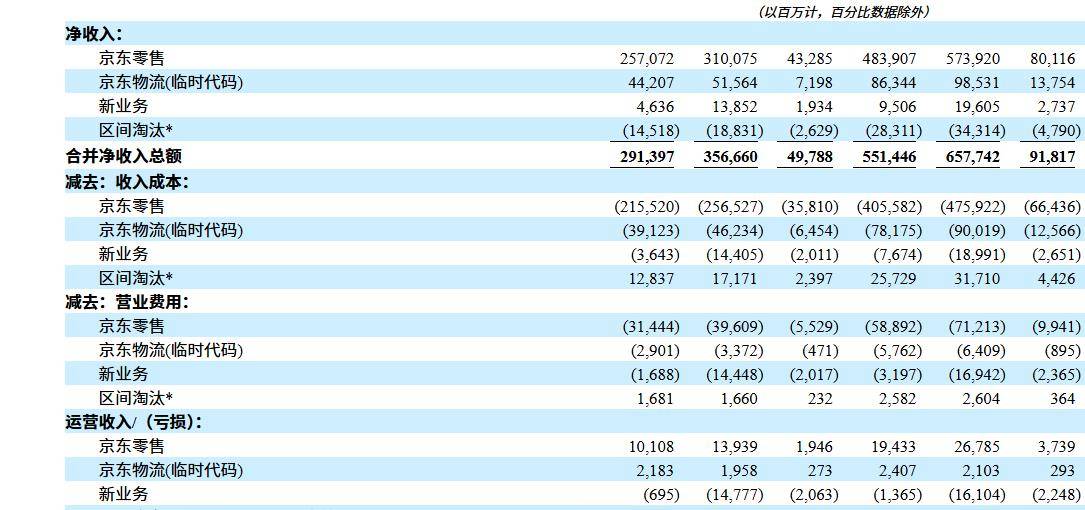
Core Insights - JD Group reported strong revenue growth in Q2 2025, with total revenue reaching 356.7 billion yuan, a year-on-year increase of 22.4%. However, net profit attributable to ordinary shareholders fell to 6.2 billion yuan, down 51% from 12.6 billion yuan in the same period last year due to significant investments in the food delivery business [1][2][5]. Revenue Breakdown - JD Retail generated revenue of 310.1 billion yuan in Q2, up from 257.1 billion yuan year-on-year [2][3]. - JD Logistics reported revenue of 51.6 billion yuan, compared to 44.2 billion yuan in the previous year [2][3]. - New business revenue, including food delivery, surged by 198.8% year-on-year to 13.9 billion yuan, but the operating loss for this segment expanded dramatically to 14.8 billion yuan, with an operating margin of -106.7% [2][3]. Marketing and Investment - Marketing expenses increased significantly to 27 billion yuan, a 127.6% rise from 11.9 billion yuan year-on-year, primarily due to promotional spending for new business initiatives [3][4]. - The company aims to leverage new business investments to overcome growth bottlenecks and create long-term value, despite short-term impacts on profit margins [5]. Food Delivery Business - During the 618 shopping festival, JD's food delivery service achieved over 25 million daily orders, with more than 1.5 million quality merchants onboard and a workforce of over 150,000 full-time delivery riders [4]. - JD plans to open 10,000 new stores under the "Seven Fresh Kitchen" initiative over the next three years, although currently, only one store is operational in Beijing [4]. Global Expansion - JD Logistics has accelerated its internationalization efforts, managing over 130 bonded and overseas warehouses across 23 countries and regions [6][7]. - The company has launched its self-operated delivery brand "JoyExpress" in Saudi Arabia, establishing a complete logistics network for efficient delivery services [7]. Acquisition Strategy - JD has made a public acquisition offer to Ceconomy shareholders, with plans to complete the acquisition by mid-2026, emphasizing its focus on supply chain capabilities in international markets [8][9]. Technology and Innovation - The company is actively integrating new technologies, including AI and automation, into its operations, with significant investments in R&D exceeding 150 billion yuan since 2017 [10][11].
外卖等新业务亏损147.77亿元,京东CEO许冉:带来了显著的流量和用户增长
Feng Huang Wang· 2025-08-15 00:50
Core Viewpoint - JD Group reported strong revenue growth in Q2 2025, with revenue reaching 356.7 billion yuan, a year-on-year increase of 22.4%. However, net profit attributable to ordinary shareholders fell by 51% to 6.2 billion yuan due to significant investments in the food delivery business [1][2]. Financial Performance - JD Retail achieved revenue of 310.1 billion yuan in Q2, up from 257.1 billion yuan in the same period last year [2][3]. - JD Logistics reported revenue of 51.6 billion yuan, compared to 44.2 billion yuan in the previous year [2][3]. - New business revenue, including food delivery, surged by 198.8% year-on-year to 13.9 billion yuan, but the operating loss for this segment expanded dramatically to 14.8 billion yuan, with an operating margin of -106.7% [2][3]. Marketing and Expenses - Marketing expenses increased significantly to 27 billion yuan, a 127.6% rise from 11.9 billion yuan in the previous year, with the marketing expense ratio climbing from 4.1% to 7.6% [3]. Business Expansion and Strategy - JD's food delivery business saw daily orders exceed 25 million during the 618 shopping festival, with over 1.5 million quality merchants onboard and a full-time rider workforce exceeding 150,000 [4]. - The company plans to open 10,000 new stores over the next three years under the "Seven Fresh Kitchen" initiative, although currently only one store is operational in Beijing [4]. - JD's CEO emphasized that the food delivery sector is a long-term strategic focus, aiming to enhance operational efficiency and system capabilities [4][5]. Globalization Efforts - JD Logistics has expanded its international presence, managing over 130 bonded and overseas warehouses across 23 countries, and launched its self-operated delivery brand "JoyExpress" in Saudi Arabia [6][7]. - The company is pursuing a strategic acquisition of Ceconomy, aiming to enhance its supply chain capabilities and brand presence in Europe [7][8]. Technological Innovation - JD is actively integrating new technologies across its operations, including AI applications in retail and automated logistics solutions [9][10]. - The company has invested over 150 billion yuan in R&D since 2017, with a supply chain infrastructure asset scale nearing 170 billion yuan [10].
京东Q2电话会实录:核心零售稳健增长,重申“品质外卖”长期战略,不打价格战聚焦用户体验
美股IPO· 2025-08-14 23:29
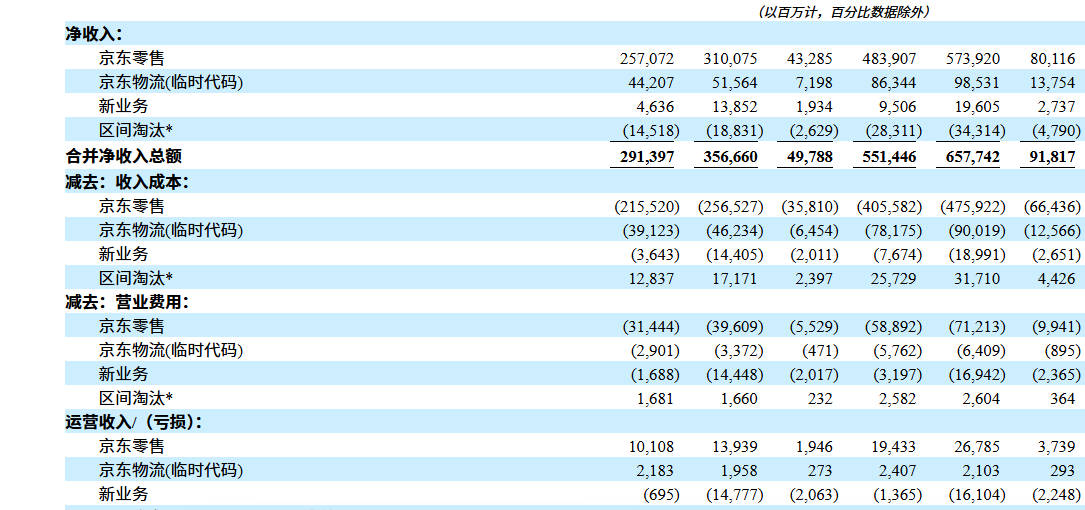
Core Views - The company reaffirms its commitment to investing in new businesses such as food delivery and instant retail, focusing on "quality delivery" without engaging in price wars, and highlighting the synergy between new and core retail businesses [1][3] - Despite short-term impacts on profit margins from new business investments, the long-term growth potential is emphasized [3][5] Financial Performance - In Q2, the company reported revenue of 356.7 billion yuan, a year-on-year increase of 22.4%, but net profit declined significantly [3][12] - New business revenue surged by 198.8%, primarily driven by food delivery, although operational losses in this segment expanded from 700 million yuan to 14.8 billion yuan [3][15] - The core retail business showed resilience with a 38% increase in non-GAAP operating profit, reaching 13.9 billion yuan, and an operating profit margin improvement from 3.9% to 4.5% [5][11] Business Strategy - The management emphasizes a long-term strategy for food delivery and instant retail, aiming for sustainable business models over short-term gains [3][23] - The company focuses on enhancing its platform systems and user experience rather than engaging in unsustainable competitive practices [3][22] - The core retail business continues to grow, with electronic and home appliance revenues increasing by over 20% year-on-year, supported by strong supply chain capabilities [4][12] User Engagement - Active user growth and shopping frequency have significantly increased, with a more than 40% year-on-year rise in active users and over 50% for JD Plus members [6][32] - The food delivery service has contributed to user growth and cross-selling opportunities, enhancing overall user engagement [8][22] International Expansion - The company is actively pursuing international expansion, focusing on localizing operations and enhancing supply chain collaboration, including the acquisition of Ceconomy to strengthen its presence in Europe [4][10][35] - The international strategy aims to leverage the company's unique advantages in supply chain and technology to establish a global retail network [9][35] Shareholder Returns - The company has committed to shareholder returns, completing a $1.5 billion buyback in the first half of 2024 and distributing $1.44 billion in dividends [4][27] - Future plans include maintaining annual dividends and buybacks while pursuing new growth opportunities [27]

即时零售“卷”向高端白酒 价格体系巨震
Nan Fang Du Shi Bao· 2025-08-14 23:21
Core Insights - The white liquor market is experiencing a price decline across various brands, with significant adjustments in retail pricing due to the introduction of new sales channels and promotional strategies [5][15][17] - Instant retail platforms are contributing to lower average prices, with many high-end products being sold at prices significantly below traditional retail channels [6][9][10] Price Trends - The average price of Feitian Moutai has dropped to approximately 2134.43 yuan, down from 2367 yuan in the previous period, with online prices as low as 1890 yuan on certain platforms [6][7] - The average price of Wuliangye's eighth generation has decreased to 953.1 yuan, down from 1054 yuan, reflecting a decline of 9.57% [16] - The average price of Guojiao 1573 has also seen a reduction, with current prices around 982.61 yuan, indicating a downward trend in the high-end liquor segment [10][12] Market Adjustments - The introduction of new retail channels, particularly instant retail platforms, has led to a more accurate reflection of market prices, with many products seeing a significant drop in their average prices [5][17] - The inclusion of Foshan in the pricing statistics has highlighted its status as a key market for liquor consumption, with average prices for high-end products like Feitian Moutai reaching around 2320.94 yuan [12][13] Product-Specific Changes - The average price of Dream Blue M6+ is reported at 708.46 yuan, with online prices being lower than offline prices, indicating a shift in consumer purchasing behavior [10][11] - The average price of the ancient well liquor, Gu 20, has decreased to 597 yuan, down from 660 yuan, showing a notable price adjustment in the mid-range segment [7][16] Consumer Behavior - The shift towards instant retail platforms is changing consumer purchasing patterns, with many consumers opting for lower-priced options available online [6][17] - The overall market dynamics are being influenced by promotional activities and discounts offered by instant retail platforms, leading to a more competitive pricing environment [5][15]