反内卷

Search documents
华安证券:积极把握化工周期反转机会 关注反内卷政策与国产替代两大主线
智通财经网· 2025-12-17 05:01
Group 1 - The global macro environment faces significant uncertainty by 2026, with a reshaping of global trade patterns and a slowdown in chemical capital expenditure, leading to a focus on two high-certainty investment themes: anti-involution and domestic substitution [1] - The price index of Chinese chemical products has declined to a low level due to the drop in upstream bulk energy prices and pressure on supply and demand for chemical products in 2025 [1] - The domestic capacity for organic silicon has peaked, with overseas manufacturers continuing to exit, allowing leading companies to drive industry recovery; the expansion phase of PTA capacity is nearing completion, and the polyester chain's prosperity is expected to rebound [1] Group 2 - The domestic production of bio-based materials is strongly supported by national policies, with companies accelerating technological breakthroughs and industrialization, forming a domestic ecological chain from bio-based monomers to composite products [2] - Domestic companies in lubricant additives are accelerating technological breakthroughs, with several high-end products passing international certification, leading to a reversal in import-export structure and rapid domestic substitution [2] - The global display panel market is experiencing stable growth, with domestic companies accelerating material upgrades and research and development, significantly speeding up the process of domestic substitution [2]

华安证券:化工行业反内卷推动周期复苏 国产替代引领成长主线
智通财经网· 2025-12-17 04:08
Core Viewpoint - The report from Huazhong Securities highlights the peak of domestic silicon production capacity, the exit of overseas manufacturers, and the potential recovery of the polyester chain's prosperity due to concentrated production capacity in the polyester filament sector [1][3]. Group 1: Industry Trends - Domestic silicon production capacity has reached its peak, while leading companies are driving industry recovery as overseas manufacturers continue to exit [1][3]. - The PTA production capacity expansion is nearing its end, leading to a concentration in polyester filament production capacity, which is expected to improve the prosperity of the polyester chain [1][3]. - The price of caprolactam has dropped to a low point, prompting the industry to initiate self-driven anti-involution measures [3]. - The raw material price index has rebounded after hitting a bottom, with frequent safety incidents causing significant risks to the global supply chain of key pesticides [3]. - The price of spandex has remained below the cost line, leading to widespread industry losses, but a slowdown in new capacity releases may optimize the supply structure and drive price recovery [3]. - The vitamin market is expected to see significant price increases in 2024 due to a tightening global supply [3]. Group 2: Investment Opportunities - The report emphasizes two main investment themes: anti-involution and domestic substitution, particularly in the context of global macroeconomic uncertainties and a slowdown in chemical capital expenditures [2][4]. - The biobased materials sector is receiving strong support from national policies, with companies accelerating technological breakthroughs and industrialization [4][6]. - The lubricating oil additive sector is witnessing rapid technological advancements among domestic companies, with several high-end products achieving international certification [4][6]. - The electronic ceramics market is seeing strong demand driven by AI and automotive sectors, with domestic manufacturers making breakthroughs in MLCC production [4][6]. - The exit of 3M from the fluorinated liquids market is reshaping the competitive landscape, with domestic manufacturers expected to increase their market share [4][6]. - The explosive growth of AI servers is driving demand for electronic-grade polyphenylene ether, with domestic manufacturers achieving technological breakthroughs and entering key supply chains [4][6].
山西证券:关注煤炭板块盈利修复 股价下跌可逢低配置
智通财经网· 2025-12-17 03:28
Core Viewpoint - The report from Shanxi Securities highlights a focus on the recovery of coal profitability, noting a shift in coal prices from rising to falling in November, with seasonal price trends consistent across 2023, 2024, and 2025, indicating "not a dull off-season" and "not a strong peak season" [1][5]. Supply - From January to November 2025, the cumulative output of raw coal reached 4.402 billion tons, a year-on-year increase of 1.4%, but the growth rate is marginally declining. In November alone, the output was 427 million tons, a year-on-year decrease of 0.5% but a month-on-month increase of 4.93% [1]. Demand - The terminal demand has been on a downward trend from January to November 2025, with fixed asset investment decreasing by 2.6% year-on-year. Specific sectors showed varied performance: manufacturing investment increased by 1.9%, infrastructure investment decreased by 1.1%, and real estate investment fell by 15.9%. Cumulative growth rates for electricity generation, coke, pig iron, and cement were -0.7%, 3.2%, -2.3%, and -6.9% respectively [2]. Imports - Coal imports saw a month-on-month decline in November, maintaining a contraction trend from January to November 2025, with cumulative imports at 432 million tons, down 12.0% year-on-year. November's imports were 44.05 million tons, a year-on-year decrease of 19.88% but a month-on-month increase of 5.55% [3]. Prices - In November, coal prices unexpectedly increased month-on-month. Despite adjustments in average prices for Shanxi mixed 5500 thermal coal, Jingtang port coking coal, and Tianjin port secondary metallurgical coke since the beginning of 2025, all three categories saw month-on-month price increases in November [4]. Commentary - Coal prices shifted from rising to falling in November, primarily due to power plants completing their inventory replenishment. The seasonal price trends for 2023, 2024, and 2025 show similar patterns, indicating a need for mean reversion after previous price surges. The report emphasizes that the core macro goal of reversing deflation remains unchanged, suggesting that a balanced approach to supply control in the short term and demand recovery in the medium to long term is necessary. The recent rapid decline in coal prices has raised market concerns, but the ongoing focus on reversing deflation is expected to influence future policy directions positively [5].

化工行业2026年度投资策略:周期破晓,关注反内卷政策与国产替代两大主线
Huaan Securities· 2025-12-17 02:53
Investment Strategy Overview - The report emphasizes two main investment themes for the chemical industry: anti-involution policies and domestic substitution, which are expected to drive recovery and growth in the sector [4][5][6] Anti-Involution and Cycle Recovery - The report suggests that the chemical industry is at a turning point, with anti-involution measures leading to a recovery in the cycle. Key areas include the peak of new capacity in organic silicon, the end of PTA capacity expansion, and a rebound in prices for certain chemicals due to supply chain disruptions [4][5] - The China Chemical Product Price Index (CCPI) has decreased significantly, dropping to 3865 points by November 30, 2025, down 16.37% from early 2024 and 10.71% from the beginning of 2025 [4][20] Domestic Substitution as a Growth Driver - Domestic substitution is highlighted as a key growth driver, with significant support from national policies for bio-based materials and advancements in technology leading to a more robust domestic supply chain [4][6] - The report identifies several companies positioned to benefit from these trends, including KaiSai Bio and RuiFeng New Materials, which are making strides in bio-based materials and lubricant additives, respectively [5][6] Market Dynamics and Price Recovery - The report notes that while the chemical market is experiencing a downturn, certain segments are expected to see price recovery due to improved supply-demand dynamics and reduced capacity expansion [4][22] - Specific chemical products have shown varied price movements, with some experiencing significant declines while others are stabilizing or recovering [22] Manufacturing Sector Recovery - The manufacturing sector is showing signs of recovery, which is anticipated to support the chemical industry. The report mentions that the real estate market is stabilizing, and automotive production has increased, indicating a potential uptick in demand for chemical products [25][33] Capital Expenditure Trends - Capital expenditure growth in the chemical industry is slowing, with a notable decline in new projects. The report indicates that the total construction in progress for the chemical sector was 327.57 billion yuan in Q3 2025, down 17.64% year-on-year [34][39] Inventory and Consumption Trends - High inventory levels in the chemical sector are being addressed as consumer demand begins to recover. The report suggests that the inventory-to-revenue ratio for the basic chemical industry was 0.62 in Q3 2025, indicating a slight increase from the previous year [41][42] Profitability and Financial Performance - The report highlights a recovery in profitability for the chemical industry, with gross margins and return on equity (ROE) showing improvement in Q3 2025 compared to previous periods [56][60] - Specific sub-sectors, such as agrochemicals and fluorochemicals, have demonstrated significant profit growth, with some exceeding 100% year-on-year increases [55][56]


中银晨会聚焦-20251217
Bank of China Securities· 2025-12-17 02:44
Key Insights - The report highlights a focus on investment opportunities in various sectors, including real estate, chemicals, and electronics, with specific stock recommendations for December 2025 [1] - The macroeconomic outlook for 2026 predicts a real GDP growth of 4.7% and a nominal growth of 4.9%, with a preference for asset allocation favoring stocks over commodities, bonds, and cash [6][7] - The chemical industry is experiencing a cyclical downturn, with a significant portion of chemical products at historical low prices, but signs of stabilization are emerging in 2025 [12][14] - The real estate market is under pressure, with significant declines in sales and investment, indicating a challenging environment for property developers [27][28] Group 1: Macroeconomic Outlook - The expected GDP growth for China in 2026 is 4.7% in real terms and 4.9% nominally, with a ranking of asset classes as stocks > commodities > bonds > cash [6][7] - Global economic growth is anticipated to remain moderate, influenced by trade uncertainties and divergent monetary policies among major economies [6][7] Group 2: Chemical Industry Analysis - The chemical industry is facing a prolonged period of negative PPI growth, with 37 consecutive months of year-on-year declines as of October 2025 [12] - A significant portion of tracked chemical products is priced below historical averages, with 26.89% of products in the lowest price decile [12] - The industry is expected to stabilize in 2025 after three consecutive years of declining net profits from 2022 to 2024 [12][14] Group 3: Real Estate Market Insights - In November 2025, new home prices in 70 major cities decreased by 0.4%, while second-hand home prices fell by 0.7%, marking a continued downward trend [19][20] - The total sales area for November was 67.2 million square meters, reflecting a year-on-year decline of 17.3%, with investment in real estate development down by 30.3% [27][28] - The report suggests that the real estate market is under significant pressure, with expectations of policy adjustments in early 2026 to stabilize the sector [33][34] Group 4: Electronics Sector Developments - The report discusses the investment plans of a specific electronics company, which includes a significant investment of 4.297 billion RMB in a Thai production facility to enhance its AI product capabilities [36] - The company has seen a 14.34% increase in revenue year-on-year for the first three quarters of 2025, with a notable growth in its automotive and AI-related product lines [38][39] - Future revenue projections for the company are optimistic, with expected revenues of 411.55 billion RMB in 2025, growing to 591.50 billion RMB by 2027 [39]
聚焦高成长,突围反内卷——2026年电新行业投资策略
2025-12-17 02:27
Summary of Key Points from the Conference Call Industry Focus - The conference call primarily discusses the **electric power and new energy industry** with a focus on various segments such as **hydrogen ammonia**, **AIDC power**, **energy storage**, **solid-state batteries**, **lithium batteries**, **wind power**, and **photovoltaics** [1][2][21]. Core Insights and Arguments High Growth and Anti-Competition Strategies - The investment strategy for 2026 emphasizes **high growth** and **anti-competition** as the main themes. Key areas of focus include: - **Hydrogen ammonia** and **AIDC power** are highlighted for their high market potential but low expectations, especially with upcoming policies like the 15th Five-Year Plan and EU carbon tariffs [2][21]. - **Energy storage** is expected to maintain good bidding conditions in the domestic market, with projections of **150 GWh** for 2025 and **250-300 GWh** for 2026 [11]. - **Solid-state batteries** are anticipated to remain relevant until **2027-2028**, with emphasis on R&D and cost reduction [1][2]. Lithium Battery and Wind Power - The **lithium battery** sector is showing positive trends in the second half of the year, but future expectations need monitoring [2]. - The **wind power** market, particularly in Europe, is performing well, with domestic profitability recovering. However, demand growth is slower compared to lithium batteries [7][15]. Photovoltaic Industry Challenges - The **photovoltaic industry** faces challenges such as supply surplus, leading to a cautious outlook. Demand is projected to be between **150-180 GW** for 2026, with a low expectation of exceeding **200 GW** [8][9][18]. - Companies like **LONGi** that are involved in energy storage are noted for their potential growth opportunities [9]. Additional Important Insights Energy Storage Market Dynamics - The **peak-valley price difference** in energy storage is currently around **0.2 to 0.4 yuan**, with regional variations. The eastern region shows a peak-valley price difference of about **0.2 yuan**, while the western region can reach **0.3-0.4 yuan** [4][10]. - The **capacity price** varies by region, with Inner Mongolia offering aggressive subsidies and Gansu adopting a more rational approach [10]. Lithium Resource Outlook - The outlook for **lithium resources** remains optimistic, with a focus on overseas storage demand and domestic bidding volumes. Monitoring data in December and January is crucial for future trends [6][21]. Risks and Opportunities - The main risks across sectors stem from demand uncertainty and potential policy changes affecting the anti-competition strategy. The need for a clear understanding of new power systems and tracking overseas data is emphasized [19][20]. - Despite challenges, there are investment opportunities in sectors like hydrogen ammonia, AIDC power, and lithium resources, particularly in regions with low expectations [21][22]. Recommendations - Companies in the **solid-state transformer (SFT)** sector such as **Sungrow Power**, **Jinpan**, **Xinte Energy**, and **Sifang Shenghong** are recommended for their technological and market advantages [5]. - In the **anti-competition sector**, lithium and wind power are prioritized, while photovoltaic companies with new growth logic are also recommended [22].
国投期货综合晨报-20251217
Guo Tou Qi Huo· 2025-12-17 02:23
Group 1: Energy and Metals Oil and Gas - Brent crude oil fell below $60/barrel at night. API data showed a significant 9.322 million - barrel drop in US crude oil inventory, but it didn't boost oil prices. Positive progress in US - Ukraine talks led to concerns about increased Russian oil supply, pressuring oil prices [1] Precious Metals - US economic data verified an economic slowdown. The market maintains the expectation of two interest rate cuts in 2026. Gold is approaching its historical high, and if it breaks through, the strong performance of precious metals may continue [2] Base Metals - Copper prices oscillated around the MA10. The probability of a January interest - rate cut slightly increased to 30%. The market is waiting for inflation indicators. It's advisable to wait and see [3] - Aluminum prices had a narrow - range fluctuation. The social inventory of the aluminum market fluctuated slightly. The medium - term upward trend of Shanghai aluminum remains unchanged. Long positions can be held with the 40 - day line as support [4] - Alumina has a high operating capacity, an oversupply situation, and rising inventory. Before large - scale production cuts, the upside of the futures price is limited, and the spot price is more likely to fall [5] - The price of casting aluminum alloy ADC12 dropped by 100 yuan to 21,000 yuan. With tight scrap aluminum supply and unclear tax policies, it lags behind Shanghai aluminum in price increase [6] - The term structure of LME zinc changed from contango to backwardation. The price of LME zinc fell, and long positions in Shanghai zinc should be reduced on rallies. There is a cross - market arbitrage opportunity, and Shanghai zinc is expected to decline less than the outer market [7] - Short positions in lead increased, and the price continued to fall. The cost provides some support, and the downside support is seen at 16,800 yuan/ton [8] - Tin prices temporarily held above the MA10. The market is waiting for domestic tin concentrate import data and the situation in Africa. Options strategies should be adjusted according to position and volume changes [9] Ferrous Metals - Steel prices oscillated narrowly at night. The demand and supply of rebar and hot - rolled coils both decreased. The supply pressure is gradually easing, but the downstream demand is weak. The market is stabilizing, but it may still fluctuate in the short term [12] - Iron ore prices rose slightly at night. Supply is increasing, and demand is weakening seasonally. The market sentiment has cooled, and the price is expected to oscillate downward [13] - Coke prices oscillated upward. Coking profits are average, and inventory decreased slightly. The price may oscillate in a narrow range [14] - Coking coal prices oscillated upward. The production of coking coal mines decreased slightly, and inventory increased. The price may oscillate in a narrow range [15] - Manganese silicon prices oscillated downward. Manganese ore prices rose slightly. The demand for semi - carbonate ore may increase. The inventory of silicon manganese is increasing [16] - Silicon iron prices oscillated upward. There are expectations of lower power and coking coal prices. Demand is still resilient, and supply has decreased slightly [17] Chemicals - The shipping index (European line) contracts generally declined. The supply - demand structure may improve marginally in January. The 02 contract is expected to oscillate in the short term, and short positions can be considered for far - month contracts [18] - High - sulfur fuel oil: Geopolitical factors affect supply, but the overall supply is still abundant. Demand may increase in the short term, but high inventory will limit the upside in the medium term [19] - Low - sulfur fuel oil: Production is expected to shrink in December, and there may be seasonal consumption support. However, it is expected to remain weak in the medium term [19] - Asphalt prices may fall at the opening due to the sharp drop in oil prices. The demand is divided between the north and the south, and the market is under pressure [20] - Urea production remains high, and the supply - demand pattern is loose. The price will oscillate within a range [21] - Methanol port inventory is decreasing, but it may increase significantly if the unloading speed recovers. The short - term supply - demand pattern is difficult to improve significantly [22] - Pure benzene prices weakened slightly. The import pressure has decreased, and the supply - demand pressure may ease. Consider long - short spreads in the medium term [23] - Styrene supply and demand are expected to increase, but there is an inventory build - up expectation, which is not conducive to price increases [24] - Polypropylene, polyethylene, and propylene: The supply - demand fundamentals are weak, and the market is in a weak state [25] - PVC supply remains high, and demand is weak. It is expected to fluctuate with the macro - sentiment in the short term [26] - Caustic soda supply is under pressure, and demand is mainly for rigid replenishment. It is expected to fluctuate with the macro - sentiment [26] - PX and PTA prices fell at night. PX is expected to be strong in the medium term, and PTA processing margins are expected to recover [27] - Ethylene glycol supply may shrink, but there is an inventory build - up expectation around the Spring Festival. It is under pressure in the new year [28] - Short - fiber and bottle - chip: Short - fiber supply and demand are seasonally weak, and bottle - chip demand is weakening. They are mainly driven by cost [29] - Glass is in a weak state. The inventory is decreasing, but the sales are weakening. It is advisable to wait and see in the short term [30] Rubber - Natural rubber supply is entering the low - production period, and the demand is stable. The inventory is increasing. Consider rebound and cross - variety arbitrage opportunities [31] Others - Soda ash prices rose slightly. Inventory increased on Monday. Supply pressure is large, and it is expected to fluctuate with the macro - sentiment [32] Group 2: Agricultural Products Grains and Oils - Soybean and soybean meal: South American weather has improved. Dalian soybean meal follows the US soybean. Wait for weather changes and consider long positions on dips [33] - Soybean oil and palm oil: The prices of both have broken through the lower limit of the range. Pay attention to the downward pressure in the short term. The weather in South American soybean - producing areas is the key factor in the medium term [34] - Rapeseed meal and rapeseed oil: The supply side is the main concern. The expectation of a loose supply pattern is pressuring the prices [35] - Domestic soybeans: The price fell. The policy is increasing supply in the short term. Pay attention to policy and fundamentals [36] - Corn: The spot price in the Northeast and North ports is weakening. The supply - demand mismatch is gradually easing. The 03 contract may oscillate weakly, and the 05 contract can be observed [37] Livestock and Poultry - Hogs: The price fluctuated narrowly. Supply is abundant, and the price may oscillate weakly. A second bottom may form in the first half of next year [38] - Eggs: Futures prices fell, and far - month contracts continued to decline. The industry is at a turning point. Pay attention to chick replenishment and old - hen culling [39] Others - Cotton: The price adjusted. The commercial inventory is basically the same as last year, and the sales progress is fast. The demand is stable. Consider hedging opportunities [40] - Sugar: International sugar supply is sufficient, and domestic production progress in Guangxi is slow. Pay attention to subsequent production [41] - Apples: The price fell. Demand is in the off - season, and the market sentiment is bearish. Adopt a bearish strategy [42] - Wood: The price is at a low level. Supply is decreasing, demand in the off - season is okay, and low inventory provides support. Wait and see [43] - Pulp: The price fell significantly. The inventory decreased slightly. The new - year contract has less pressure from warehouse receipts. Observe or conduct short - term operations [44] Group 3: Financial Products Stock Index - A - shares and stock index futures fell. The market will focus on the marginal signals from the Bank of Japan's interest - rate meeting. A - shares are expected to oscillate strongly in the current macro - environment [45] Treasury Bonds - Treasury bond futures oscillated. The market expects the Bank of Japan to raise interest rates. The bond market sentiment has improved, but risks should still be noted [46]
期现融合成为光伏行业发展新趋势
Qi Huo Ri Bao Wang· 2025-12-17 02:12
Group 1 - The establishment of Beijing Guanghe Qiancheng Technology Co., Ltd. marks the official launch of a long-awaited "polysilicon capacity integration acquisition platform" in the photovoltaic industry, indicating a significant turning point towards standardized development in the sector [1] - The photovoltaic industry is transitioning from a "price war" to a "value war," with innovation as the core driving force for transformation, as the industry seeks to stabilize and achieve high-quality development [2][3] - The current photovoltaic market is experiencing a recovery in confidence, with the average transaction price of N-type raw materials rising from 35,400 CNY/ton in early July to 53,600 CNY/ton by late November [2] Group 2 - The photovoltaic industry faces multiple challenges, including a lack of synergy between upstream and downstream sectors, with the overall revenue of manufacturers declining due to weak demand [2] - The integration of futures and spot markets has become essential for the photovoltaic industry to escape the oversupply dilemma, providing a mechanism for price discovery and risk hedging [4][6] - Futures tools have become a stabilizing force for enterprises, with a significant increase in hedging announcements among A-share listed companies, particularly in the renewable energy sector, indicating a growing reliance on these financial instruments [5] Group 3 - The "Chengdu Declaration" emphasizes the importance of focusing on technological innovation and building a collaborative development ecosystem to promote high-quality international expansion of the entire industry chain [3] - The integration of futures and spot markets is seen as a new approach to stabilize production and optimize resource allocation in the renewable energy sector, addressing challenges such as price volatility and global trade complexities [6] - Industry experts believe that the integration of futures and spot markets will provide robust support for the high-quality development of the photovoltaic industry, helping it to gradually move away from price wars and enter a new cycle of profitability and quality improvement [6]
ETF盘中资讯| 政策东风催化,化工板块猛攻!化工ETF(516020)上探1.8%,机构:龙头企业有望实现盈利估值双提
Sou Hu Cai Jing· 2025-12-17 02:11
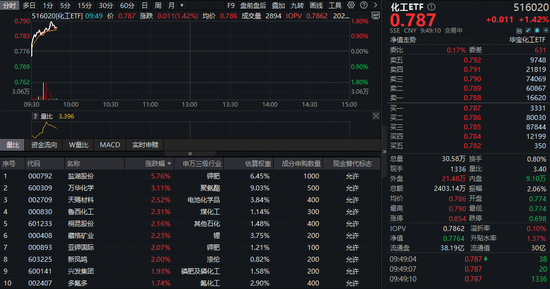
Group 1 - The chemical sector experienced a significant rally on December 17, with the chemical ETF (516020) opening strong and reaching an intraday high of 1.8% before closing up 1.42% [1] - Key stocks in the sector included potassium fertilizers, polyurethane, and lithium batteries, with Salt Lake Co. surging over 5%, Wanhua Chemical rising over 3%, and several others gaining more than 2% [1] - An important meeting held last week outlined key development tasks for the upcoming year, emphasizing "comprehensive rectification of 'involutionary' competition," "promoting high-quality development," and "dual carbon leadership," which may provide ongoing momentum for optimizing the chemical industry landscape [1] Group 2 - According to Dongfang Securities, the focus on "anti-involution" and "high-quality development" will strengthen industry competition order governance, accelerate the exit of outdated capacity, and shift the industry from "quantity-based pricing" to "quality-based competition" [3] - The current valuation of the chemical sector is attractive, with the chemical ETF (516020) index price-to-book ratio at 2.33, positioned at a relatively low level within the past decade [3] - The chemical industry is at the bottom of the cycle, and the "anti-involution" trend is expected to enhance the competitive landscape, leading to improved profitability and valuation for leading companies [3] Group 3 - The chemical ETF (516020) tracks the CSI segmented chemical industry theme index, covering various sub-sectors, with nearly 50% of its holdings in large-cap leading stocks like Wanhua Chemical and Salt Lake Co. [4] - Investors can also access the chemical sector through the chemical ETF linked funds (Class A 012537/Class C 012538) for efficient exposure [4]




政策东风催化,化工板块猛攻!化工ETF(516020)上探1.8%,机构:龙头企业有望实现盈利估值双提升
Xin Lang Cai Jing· 2025-12-17 02:07
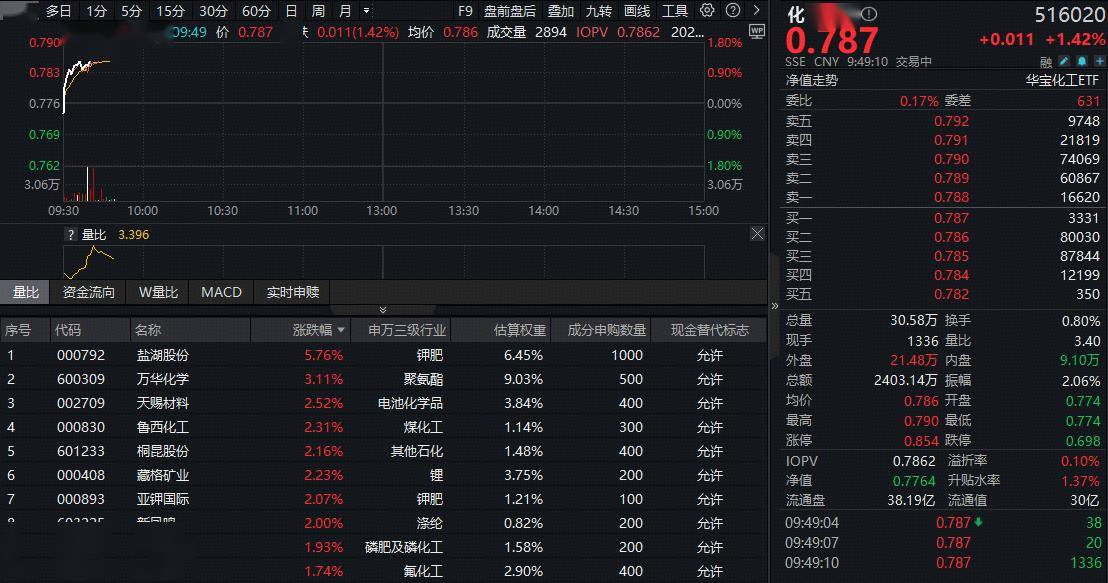
Group 1 - The chemical sector experienced a significant rally on December 17, with the chemical ETF (516020) opening strong and reaching a maximum intraday increase of 1.8%, closing with a gain of 1.42% [1][8] - Key stocks in the sector included Salt Lake Co., which surged over 5%, and Wanhu Chemical, which rose over 3%, along with several others like Tianqi Materials and Luxi Chemical, which increased by more than 2% [1][8] Group 2 - An important meeting held last week outlined major development tasks for the upcoming year, emphasizing "comprehensive governance of 'involutionary' competition," "promoting high-quality development," and "leading green transformation," which may provide ongoing momentum for optimizing the chemical industry landscape [9][10] - According to Dongfang Securities, the focus on "anti-involution" and "high-quality development" will enhance industry competition order, accelerate the exit of outdated capacity, and shift the industry from "quantity-based pricing" to "quality-based competition" [9][10] - The current valuation of the chemical sector is attractive, with the chemical ETF's underlying index price-to-book ratio at 2.33, positioned at the 39.92 percentile relative to the past decade, indicating a favorable long-term investment opportunity [10] Group 3 - Looking ahead, Zhongyin Securities noted that the chemical products' downstream applications span various industries, including real estate, automotive, home appliances, textiles, and agriculture, with expectations for good growth in chemical product demand driven by policies aimed at expanding domestic demand and the rapid development of downstream industries like new energy and AI [11] - The chemical industry is currently at the bottom of the cycle, and the "anti-involution" trend is expected to accelerate the optimization of the competitive landscape, potentially improving profitability and valuations for leading companies [11] - The chemical ETF (516020) tracks the CSI segmented chemical industry theme index, covering various sub-sectors, with nearly 50% of its holdings in large-cap leading stocks, such as Wanhu Chemical and Salt Lake Co., providing an efficient way to capitalize on the rebound in the chemical sector [11][12]