去产能

Search documents
《黑色》日报-20250707
Guang Fa Qi Huo· 2025-07-07 12:10
| 产业期现日报 | 投资咨询业务资格:证监许可 【2011】1292号 | 周敏波 | 20010559 | | | | | | | | | | --- | --- | --- | --- | --- | --- | --- | --- | --- | --- | --- | --- | | 2025年7月7日 | | | | | | | | | | | | | 钢材价格及价差 | 其差 | 品种 | 现值 | 涨跌 | 单位 | 前值 | | | | | | | 螺纹钢现货(华东) | 3170 | 3150 | 20 | 77 | 螺纹钢现货(华北) | 3170 | 3160 | 11 | 10 | | | | 螺纹钢现货(华南) | 3230 | 3220 | 10 | 137 | 螺纹钢05合约 | 3098 | 300dd | -1 | 72 | | | | 螺纹钢10合约 | 3072 | 3076 | -4 | ರಿ8 | 螺纹钢01合约 | 77 | 3093 | 3090 | 3 | | | | 元/吨 | 热卷现货(华东) | 3250 | 3250 | 0 | 40 | | | | ...
煤焦:供需压力稍有缓解,盘面震荡加剧
Hua Bao Qi Huo· 2025-07-07 05:37
晨报 煤焦 原材料: 冯艳成 从业资格号:F3059529 投资咨询号:Z0018932 电话:010-62688516 有色金属:于梦雪 从业资格号:F03127144 投资咨询号:Z0020161 电话:021-20857653 成文时间: 2025 年 7 月 7 日 逻辑:上周,安全生产月结束,叠加督导组完成为期一个月的进驻巡 视,部分区域煤矿逐步复产,影响市场多头情绪降温,但周二会议提出反 内卷和去产能,虽然主要针对的产业是电动汽车和光伏,但因煤炭市场供 给较为过剩,再次对市场情绪形成扰动,促使煤焦价格震荡加剧。后续关 注具体政策措施的落地。 证监许可【2011】1452 号 煤焦:供需压力稍有缓解 盘面震荡加剧 投资咨询业务资格: 负责人:赵 毅 从业资格号:F3059924 投资咨询号:Z0002978 电话:010-62688526 成 材:武秋婷 从业资格号:F3078638 投资咨询号:Z0018248 电话:010-62688555 从业资格号:F3038114 投资咨询号:Z0014834 电话:010-62688541 后期关注/风险因素:关注钢厂高炉开工变化、进口煤通关情况。 重要 ...
黑色建材日报-20250707
Wu Kuang Qi Huo· 2025-07-07 03:11
钢材 黑色建材组 陈张滢 从业资格号:F03098415 交易咨询号:Z0020771 0755-23375161 chenzy@wkqh.cn 郎志杰 从业资格号:F3030112 0755-23375125 langzj@wkqh.cn 万林新 从业资格号:F03133967 0755-23375162 wanlx@wkqh.cn 黑色建材日报 2025-07-07 赵 航 从业资格号:F03133652 0755-23375155 zhao3@wkqh.cn 螺纹钢主力合约下午收盘价为 3072 元/吨, 较上一交易日跌 4 元/吨(-0.13%)。当日注册仓单 29168 吨, 环比增加 2095 吨。主力合约持仓量为 223.85 万手,环比增加 1338 手。现货市场方面, 螺纹钢天津汇总 价格为 3170 元/吨, 环比增加 10/吨; 上海汇总价格为 3170 元/吨, 环比增加 20 元/吨。 热轧板卷主力合 约收盘价为 3201 元/吨, 较上一交易日跌 7 元/吨(-0.21%)。 当日注册仓单 64587 吨, 环比减少 1491 吨。主力合约持仓量为 158.08 万手,环比减少 1 ...
钢材期货行情展望:淡季需求有韧性 “去产能”预期影响期货上涨
Jin Tou Wang· 2025-07-07 02:06
Group 1: Price and Basis - The market sentiment has improved due to expectations of "capacity reduction and anti-involution," leading to a significant increase in futures prices and a weakening basis, with rebar futures trading at a premium to spot prices and hot-rolled coil futures at a discount [1] Group 2: Costs and Profits - On the cost side, the resumption of production in Shanxi's coking coal is expected to increase supply; iron ore shipments in June have surged, leading to a slight increase in iron ore inventory [1] - Current profit margins are shrinking, with the order of profitability from high to low being billet > hot-rolled coil > rebar > cold-rolled coil [1] Group 3: Supply - Overall production is showing a slight decline, with June iron element production decreasing by 65,000 tons compared to May, including a drop of 45,000 tons in pig iron and 20,000 tons in scrap steel [1] - The production of the five major materials increased by 40,000 tons to 8.85 million tons, with rebar production up by 33,000 tons to 2.21 million tons and hot-rolled coil production up by 9,000 tons to 3.28 million tons [1] Group 4: Demand - The apparent demand for the five major materials has stabilized at a high level, with a slight increase of 54,000 tons to 8.85 million tons; however, the production of these materials has decreased by 1.3% year-on-year [2] - Domestic demand remains weak despite export growth, and inventory levels are at seasonal lows, with June steel supply and demand being roughly balanced [2] Group 5: Inventory - Current inventory levels are at seasonal lows, with a year-on-year decrease; the five major materials inventory decreased slightly by 1,000 tons to 13.4 million tons [2] - Rebar inventory decreased by 40,000 tons to 5.45 million tons, while hot-rolled coil inventory increased by 40,000 tons to 3.45 million tons [2] Group 6: Market Outlook - The market sentiment has improved following the sixth Central Financial Committee's mention of "anti-involution," with expectations of supply-side reforms reminiscent of 2015-2018 [2] - Short-term steel supply and demand are balanced, with manageable inventory pressure; despite expectations of weaker demand in the second half of the year, supply contraction expectations are likely to dominate market sentiment [2] - Steel prices are expected to return to the previous fluctuation range, with hot-rolled coil futures projected to fluctuate between 3,150 and 3,300, and rebar between 3,050 and 3,150 [2]
【申万宏源策略】周度研究成果(6.30-7.6)
申万宏源研究· 2025-07-07 01:27
Group 1 - The article emphasizes the importance of "capacity reduction," which is reflected in the decline of capital expenditure, the abandonment of existing projects, and the guidance for the survival of the fittest among existing enterprises. This capacity reduction is a slow variable that will elevate the long-term profitability capability [3] - The current strong performance of the A-share market suggests a growing focus on long-term positive factors, although the current fundamental expectations and profit-making effects are not yet at bull market levels. The company's market outlook remains unchanged, predicting that 2026-27 will be the core period of the bull market, with signs of index improvement starting in Q4 2025 [3] - The article notes that the capital expenditure of internet platforms may improve, serving as a driving force for stock prices in the domestic AI computing power industry chain. In the short term, the market is highly focused on sectors such as electric equipment, steel, and building materials [3] Group 2 - Service consumption is recovering, with a notable expansion in the price decline of white liquor and pork. Year-on-year growth rates have been continuously rising since the beginning of the year [6]


周末!利好!
中国基金报· 2025-07-06 14:40
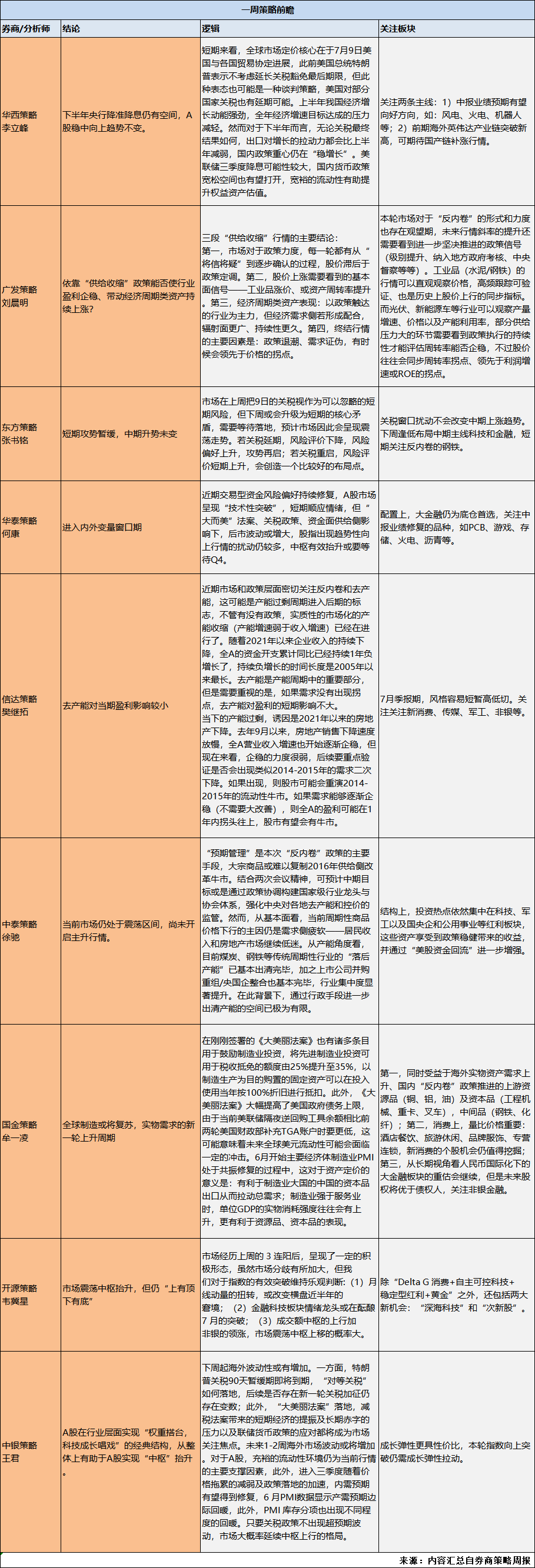
Key Points - The article discusses significant recent developments in the market, including new policies and strategies from various financial institutions and analysts regarding investment opportunities and risks in the current economic environment [1][10]. Group 1: Market Developments - Shenzhen has introduced ten measures to promote the high-quality development of the semiconductor and integrated circuit industry, including a total fund of 5 billion RMB to support the entire industry chain [3]. - The Ministry of Finance has announced measures for government procurement of medical devices imported from the EU, which will take effect on July 6, 2025, impacting procurement budgets over 45 million RMB [4]. - The People's Bank of China is seeking public opinion on the draft rules for the Renminbi Cross-Border Payment System, indicating ongoing improvements in financial infrastructure [5]. - The Shanghai Stock Exchange has approved the merger of China Shipbuilding and China Shipbuilding Industry Corporation, marking a significant consolidation in the industry [6]. Group 2: U.S. Economic Policies - President Trump signed the "Big and Beautiful" tax and spending bill, which has faced criticism for its impact on federal aid and long-term debt [7]. - Trump announced new tariffs set to take effect on August 1, with rates potentially reaching up to 70%, as part of ongoing trade negotiations [8]. Group 3: Brokerage Insights - CITIC Securities notes that the current market environment resembles late 2014, with improving investor sentiment and a focus on sectors like AI and innovative pharmaceuticals [11]. - CITIC Jiantou suggests that the market's upward trend may continue, with a focus on high-growth sectors such as electronics and new consumption [13][14]. - Huatai Securities raises concerns about external risks affecting the "anti-involution" trend, while still highlighting opportunities in banking and insurance [15]. - Guotai Junan emphasizes a shift towards real assets and the potential for improved capital returns in the context of global economic recovery [16]. - China Merchants Securities identifies "anti-involution" and AI as key drivers for market growth, with significant gains in sectors like steel and new energy [17]. - Bank of China anticipates increased volatility in overseas markets but maintains a positive outlook for A-shares due to ample liquidity [18][19]. - Shenwan Hongyuan differentiates between "de-capital expenditure," "de-capacity," and "de-output," suggesting a gradual shift in market dynamics [20]. - Cinda Securities highlights the limited short-term impact of de-capacity on profits, emphasizing the need for demand recovery to drive market performance [26].



A股分析师前瞻:贸易协定进展是下周的关注焦点
Xuan Gu Bao· 2025-07-06 13:56
Group 1 - The focus of the brokerage strategy discussions this week is on the upcoming trade agreement progress and the sustainability of the "anti-involution" sector [1][2] - The Huaxi strategy team indicates that the core pricing in the global market is centered around the trade agreement progress on July 9, with potential tariff extensions being a negotiation tactic [1][3] - The A-share market is expected to maintain an upward trend, with two main lines of focus: positive mid-term performance expectations in sectors like wind power, thermal power, and robotics, and the potential for domestic chains to catch up following Nvidia's overseas breakthroughs [1][3] Group 2 - The Dongfang strategy team notes that the market previously viewed the July 9 tariff as a negligible short-term risk, but it may escalate into a core issue next week, leading to a volatile market [1][3] - The Zhongyin strategy team emphasizes that the current liquidity environment supports the market, and as the third quarter progresses, domestic demand expectations may improve if tariff policies do not experience unexpected fluctuations [1][3] - The Xuch team's analysis suggests that "expectation management" is a key tool in the "anti-involution" policy, with limited space for further capacity clearance in traditional cyclical industries like coal and steel due to already high industry concentration [2][4] Group 3 - The market is currently in a state of fluctuation, with the potential for increased volatility in the coming weeks due to the expiration of the 90-day tariff grace period and the implications of the "Great Beautiful Act" [5] - The overall sentiment in the A-share market is that the liquidity environment remains a primary support factor, with expectations for recovery in domestic demand as price pressures ease and policies are implemented [5] - The current cycle of capacity reduction is crucial, but its short-term impact on profitability may be limited if demand does not show signs of recovery [4][5]
策略周报:去产能对当期盈利影响较小-20250706
Xinda Securities· 2025-07-06 12:03
Group 1 - The core conclusion indicates that recent market and policy focus on de-capacity and anti-involution may signify the late stage of the overcapacity cycle, with market-driven capacity reduction already underway, regardless of policy [2][10][11] - Since 2021, the continuous decline in corporate revenue has led to a cumulative year-on-year negative growth in capital expenditure across the entire A-share market, marking the longest period of negative growth since 2005 [10][11] - De-capacity is a crucial part of the capacity cycle, but its short-term impact on profitability is limited if demand does not show a turning point; supply policies mainly affect the height of future price reversals rather than the direction of prices [10][11] Group 2 - The process of de-capacity typically follows three steps: declining revenue and profits lead to reduced capital expenditure, which subsequently results in a decrease in capacity growth [3][11] - The effects of de-capacity are often only visible when demand improves; during periods of declining industry prices, the supply-demand balance tends to be in a low-cost zone, meaning most companies are losing money [15][17] - The current overcapacity is primarily driven by the decline in the real estate sector since 2021, with a need to monitor whether a second demand decline similar to 2014-2015 will occur [18][21] Group 3 - The current judgment suggests a strategic outlook similar to 2013 and 2019, with a high probability of developing into a comprehensive bull market, although tactical indicators may require time to break through the recent trading range [23][24] - The market is expected to experience fluctuations in July, but a return to a bull market is anticipated in the latter part of Q3 or Q4, contingent on either earnings or policy turning optimistic [23][24] - Recent configuration suggestions include a focus on value in the short term, with potential increases in exposure to elastic industries after Q3 [26][29]

周末政策新动向:聊聊“去产能“、汽车和芯片
Hu Xiu· 2025-07-06 11:56
这个周末发生了许多重要消息。一起来梳理一下这两天国内政策层面上对几个行业出现的变化苗头。我 们先来说第一个,关于新能源汽车。刚刚官方代表的一些渠道对外吹风,点评了中国商务部对欧盟白兰 地的反倾销调查。这件事情最终的结果是认定欧盟的白兰地对中国的销售存在着倾销问题。 本篇评级为★★★,主要围绕以下内容展开: 如有疑问请以音频内容为准,添加妙妙子微信huxiuvip302,入群有机会与董小姐进一步交流。 新闻解读评级说明:五星重磅,四星重要,三星级以下大家选择听。 1、明着罚,暗中缓,汽车行业的两个推力 1、明着罚,暗中缓,汽车行业的两个推力 2、"去产能"行业推力超预期,聊聊新能源和煤炭 3、芯片赛道的外部刺激,又出现了 这条消息表面上看起来是一条坏消息,似乎意味着中国和欧盟的关系出现了短期的紧张。但实际上,如 果仔细剖析,它是一个大缓和的信号。因为在此次反倾销调查中,虽然表面上认定了倾销行为,但实际 上豁免了34家欧洲最重要的相关企业,这意味着给它们免除了罚单。所以,表面上是制裁,背地里其实 是通融。 中国的这家代表官方的媒体渠道也直白地点评了出来,说你看中国商务部对欧盟相关产业的这种处理方 式,是不是也能给 ...
大涨近30%!301345火了,一天迎超100家机构调研!
中国基金报· 2025-07-06 00:28
Core Viewpoint - The A-share market shows a recovery in capital sentiment, with significant gains in various sectors, particularly in steel and photovoltaic industries, driven by a new wave of "de-involution" and capacity reduction initiatives from the government [2]. Group 1: Market Performance - During the week of June 30 to July 4, the Shanghai Composite Index rose by 1.40% to close at 3472.32 points, while the Shenzhen Component Index increased by 1.25% and the ChiNext Index by 1.50% [2]. - The steel and photovoltaic sectors experienced a surge, with photovoltaic glass prices rising over 10% during the week [2]. Group 2: Institutional Research - A total of 158 listed companies disclosed institutional research minutes, with over 70% of the researched stocks achieving positive returns [2]. - Taotao Automotive was the most favored stock by institutions, achieving a remarkable gain of 29.82% during the week [3]. Group 3: Company Highlights - Taotao Automotive, a leader in the North American leisure vehicle market, reported an expected net profit of 310 million to 360 million yuan for the first half of 2025, representing a year-on-year growth of 70.34% to 97.81% [3]. - Shunwang Technology, a core supplier in the esports service sector, discussed its multi-layered computing power service system and AI computing power platform during institutional interactions [4]. - Xinjie Electric, focused on industrial automation, highlighted its advancements in core components for humanoid robots, including hollow cup motors and high-performance optical encoders [5]. - Xiamen Tungsten New Energy is developing new profit growth points, including high-stability lithium supplement materials and a new structure cathode material with improved energy density and performance [6].