
核心CPI

Search documents
核心CPI向上 物价拐点何时到来
Jing Ji Guan Cha Wang· 2025-11-15 06:19
Group 1 - The core viewpoint of the articles indicates that China's economic growth is facing challenges, with a decline in social retail sales and an increase in core CPI, suggesting a complex economic environment [2][3][12] - In October, the social retail sales total increased by 2.9% year-on-year, marking a continuous decline for five months, while the core CPI rose by 1.2%, indicating a potential turning point in consumer demand [2][8] - Experts highlight a "supply-demand imbalance" in the economy, emphasizing the need for enhanced consumer demand to address the declining retail sales growth [2][12] Group 2 - The increase in core CPI is attributed to factors such as the consumption stimulus from the National Day and Mid-Autumn Festival holidays, as well as rising gold prices, with service prices also showing a recovery [7][8] - The core CPI's growth reflects improvements in terminal consumer demand, but it also indicates underlying pressures on food and energy prices, which remain low [13][14] - The overall CPI has been operating at low levels, with experts suggesting that while the core CPI's increase is a positive sign, it is not sufficient to confirm a definitive turning point in the economy [11][12]

核心CPI连涨6个月 服务价格的回升发出什么信号
Hua Xia Shi Bao· 2025-11-15 01:20
Core Insights - The inflation level in October has drawn market attention, with the core CPI rising for six consecutive months, showing a year-on-year increase of 1.2% [1] - The October CPI increased by 0.2% year-on-year and month-on-month, primarily driven by the core CPI [1] - The core CPI, which excludes volatile food and energy prices, reflects long-term price trends and is crucial for assessing current economic conditions and future inflation [1] CPI Components - In October, six out of seven major price categories in the core CPI increased year-on-year, with notable rises in other goods and services (12.8%), personal care (1.9%), and clothing (1.7%) [1] - Healthcare, education, and housing prices rose by 1.4%, 0.9%, and 0.1% respectively, while transportation and communication prices decreased by 1.5% [1] - Month-on-month, other goods and services surged by 3.8%, contributing significantly to the core CPI increase [1] Other Goods and Services - Other goods and services, which include jewelry, watches, and funeral services, accounted for 3.0% of per capita consumption expenditure in the first three quarters of 2025, with a growth rate of 10.3% [2] - The price of gold jewelry and platinum increased by 50.3% and 46.1% year-on-year, respectively, indicating a strong correlation between gold prices and the CPI [2] Service Prices - Service prices have been gradually increasing since March, with a 0.8% rise in October, marking a 0.2 percentage point increase from the previous month [3] - The service sector's value added reached 592,955 billion yuan in the first three quarters, growing by 5.4% year-on-year and contributing 60.7% to national economic growth [3] Factors Influencing Service Prices - The growth in service demand and prices is attributed to the application of new technologies and the digital transformation of traditional services, which increases operational costs [4] - Demographic factors, such as an aging population and a decrease in young labor force, are leading to increased demand for healthcare, education, and high-quality services, driving up prices [5] - Despite economic pressures, there remains potential for further growth in service demand, indicating that the current price increase trend is still in its early stages [5]
2025年10月物价数据点评:CPI回正,PPI连续改善
Shanghai Securities· 2025-11-14 09:21
Group 1: CPI Analysis - In October 2025, the national consumer price index (CPI) increased by 0.2% year-on-year, with urban areas rising by 0.3% and rural areas declining by 0.2%[12] - Food prices decreased by 2.9%, while non-food prices increased by 0.9%[12] - Core CPI rose by 1.2%, marking the highest increase since March 2024, indicating steady demand growth[15] Group 2: PPI Trends - The producer price index (PPI) fell by 2.1% year-on-year in October 2025, but the decline narrowed by 0.2 percentage points compared to the previous month[14] - PPI showed a month-on-month increase of 0.1%, marking the first rise in 2025[20] - Key industries such as black metal mining and coal mining saw price declines narrow or recover, indicating ongoing improvement in PPI[22] Group 3: Policy Implications - The low CPI and PPI levels create room for more aggressive macroeconomic policies, including proactive fiscal measures and moderate monetary easing[5] - Continuous improvement in industrial product prices suggests a stable economic recovery trend[30] Group 4: Risks - Potential risks include worsening geopolitical events, changes in international financial conditions, and unexpected shifts in China-U.S. policies[6]
核心CPI连续六个月涨幅扩大,国家统计局解读
Sou Hu Cai Jing· 2025-11-14 05:08
Group 1 - The core consumer price index (CPI) in October increased by 0.2% year-on-year, reversing the previous month's decline of 0.3%, and also rose by 0.2% month-on-month [3] - The increase in CPI month-on-month was primarily driven by expanded consumption during the National Day and Mid-Autumn Festival holidays, as well as rising prices of industrial consumer goods [3] - Service prices rose by 0.2% month-on-month, contributing 0.07 percentage points to the CPI increase, with hotel accommodation, flight tickets, and travel prices rising by 8.6%, 4.5%, and 2.5% respectively [3] Group 2 - The core CPI, excluding food and energy, rose by 1.2% year-on-year, with the growth rate expanding by 0.2 percentage points compared to the previous month, marking six consecutive months of growth [4] - The reversal of the year-on-year decline in consumer prices was attributed to improved domestic supply and demand relationships, along with a rebound in service and industrial consumer goods prices [4] - The government aims to continue expanding domestic demand and optimizing the market competition environment to promote reasonable price recovery [4]
武汉消费活力持续释放,核心CPI同比上涨1.0%
Chang Jiang Ri Bao· 2025-11-14 01:02
Core Insights - The consumer price index (CPI) in Wuhan increased by 0.1% year-on-year in October, with the core CPI (excluding food and energy) rising by 1.0%, indicating a dual drive of consumption upgrade and policy effects on market vitality [1][2] Group 1: Consumer Trends - The robust growth of core CPI is attributed to the dual pull from services and industrial consumer goods [2] - Wuhan has remained one of the top ten popular tourist destinations in China since the National Day holiday, with post-holiday travel still thriving [2] - Prices for air tickets and accommodations increased by 4.4% and 4.0% year-on-year, respectively, in mid to late October [2] - Prices for cultural and entertainment smart devices, such as tablets and wearable devices, rose by 4.3% year-on-year [2] - The rise in prices for maternal and infant care services by 3.2% year-on-year reflects the growing scientific parenting concepts among the new generation of parents [2] Group 2: Consumer Goods and Policies - Policies aimed at reducing "involution" are beginning to show results, with a notable shift in consumer preferences towards quality and technology in vehicles [2] - The price decline for fuel vehicles and new energy vehicles narrowed by 3.4 and 1.3 percentage points year-on-year, respectively, while sales saw a significant increase [2] - The "national subsidy" policy has diversified consumer demand, leading to a 2.8% year-on-year price increase for aesthetically pleasing and functional small appliances [2] Group 3: Price Changes and Economic Impact - In October, the prices of essential goods such as pork and fresh vegetables decreased by 19.5% and 7.7% year-on-year, respectively, contributing to lower living costs for residents [6] - The price of gasoline and diesel fell by 5.6% and 5.9%, respectively, further reducing household expenses [6] - The core CPI's upward trend indicates a shift in consumption towards service-oriented and improvement-focused sectors [6] - Among eight categories of goods and services, six experienced price increases, with "other goods and services" seeing a significant rise of 12.9% year-on-year [6] - The current consumer market in Wuhan is transitioning from "recovery growth" to "structural upgrade," driven by ongoing policy effects and the emergence of new business formats [6]
四川10月电力、热力生产和供应业价格环比下降
Si Chuan Ri Bao· 2025-11-13 02:51
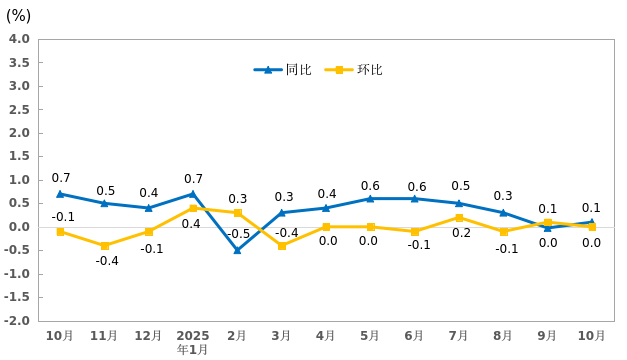
Group 1: CPI Trends - In October, Sichuan's Consumer Price Index (CPI) decreased by 0.6% year-on-year, with a narrowing decline of 0.3 percentage points compared to the previous month, and a month-on-month increase of 0.4% [1][2] - The average CPI from January to October in Sichuan fell by 0.4% compared to the same period last year [1] Group 2: Price Movements - Fresh vegetable and fruit prices increased by 5.7% and 2.2% month-on-month in October, primarily due to seasonal factors and the demand surge during the National Day and Mid-Autumn Festival [2][3] - Pork prices continued to decline, with a month-on-month decrease of 1.9% and a year-on-year drop of 20.2%, attributed to sufficient market supply and the timing of seasonal consumption [3] - Egg prices also fell by 1.3% month-on-month due to temporary oversupply and post-holiday demand drop [4] Group 3: Core CPI Insights - The core CPI, which excludes volatile food and energy prices, rose by 0.9% year-on-year in October, marking a 0.3 percentage point increase from the previous month, the highest since February 2023 [4] - Service prices contributed to the core CPI increase, with notable rises in air ticket prices (10.8%), travel agency fees (7.3%), and accommodation costs (3.4%) [4] Group 4: PPI Trends - The Producer Price Index (PPI) in Sichuan fell by 2.5% year-on-year in October, with a month-on-month decrease of 0.3%, reflecting a shift from previous increases [7] - The automotive manufacturing sector saw a month-on-month price drop of 0.5%, while electricity and heat production prices decreased by 1.5% month-on-month [7] - Despite the overall decline, some industries, such as computer manufacturing and non-ferrous metal processing, showed signs of price recovery [7] Group 5: Future Outlook - For the fourth quarter, the PPI is expected to continue operating at low levels, but the rate of decline may narrow due to improved market demand and ongoing policy support [8] - The "anti-involution" policies are positively impacting certain industries, leading to a reduction in price declines in sectors like coal and metal processing [8]
10月深圳CPI上涨0.4%
Shen Zhen Shang Bao· 2025-11-12 07:02
Group 1 - The Consumer Price Index (CPI) in Shenzhen increased by 0.4% year-on-year in October 2025, with the core CPI rising by 0.9%, marking a 0.1 percentage point increase from the previous month [1] - Average CPI from January to October 2025 rose by 0.1% compared to the same period last year [1] - Food prices decreased by 1.5%, with rice, pork, and dairy prices falling by 10.0%, 6.3%, and 4.4% respectively, contributing to a 0.17 percentage point decline in CPI [1] Group 2 - Non-food prices increased by 0.7%, with medical services and utilities rising by 6.3% and 1.4%, respectively, contributing to a 0.29 percentage point increase in CPI [1] - Jewelry and platinum prices surged by 51.1% and 56.4%, respectively, adding approximately 0.21 percentage points to the CPI [1] - The CPI remained stable month-on-month, following a 0.2% decline in the previous month [1] Group 3 - The pork market is currently characterized by strong supply and weak demand, leading to a 2.1% decrease in pork prices [2] - The arrival of seasonal fruits has increased supply, resulting in a 2.8% drop in fresh fruit prices [2] - Non-food prices remained stable, with hotel accommodation and travel agency fees rising by 7.6% and 4.1% during the National Day holiday, contributing to a 0.06 percentage point increase in CPI [2]
10月份我省CPI同比上涨0.1
Liao Ning Ri Bao· 2025-11-12 00:59
Core Insights - In October, Liaoning's Consumer Price Index (CPI) increased by 0.1% year-on-year, which is 0.1 percentage points lower than the national average, ranking 16th nationwide [1] - The core CPI, excluding food and energy prices, rose by 1.1% year-on-year, with an increase of 0.3 percentage points compared to the previous month [1] - Month-on-month, the CPI increased by 0.3%, surpassing the national average increase of 0.1%, ranking 7th nationwide [1] Year-on-Year Analysis - In October, prices of eight major categories of goods and services showed a "four increases, three decreases, and one stable" trend. Specifically, prices for other goods and services rose by 13.1%, while food, tobacco, and alcohol prices decreased by 1.2% [1] - The categories that saw price increases included other goods and services (13.1%), daily necessities (1.7%), clothing (0.9%), and education, culture, and entertainment (0.6%) [1] - Conversely, healthcare prices decreased by 0.5%, transportation and communication prices fell by 1.4%, and housing prices remained stable [1] Month-on-Month Analysis - Month-on-month, the prices of eight major categories of goods and services exhibited a "three increases, five decreases" trend, with increases noted in other goods and services, food, tobacco, and alcohol, and transportation and communication [1] Average Price Trends (January to October) - From January to October, the average CPI decreased by 0.3% compared to the same period last year, ranking 22nd nationwide [1] - The average price trend for the eight major categories showed "five increases and three decreases," with healthcare, food, tobacco, and alcohol, and transportation and communication prices declining [1]
读研报 | CPI转正,哪些情况值得关注?
中泰证券资管· 2025-11-11 11:33
Core Insights - The Consumer Price Index (CPI) for October showed a month-on-month increase of 0.2% and a year-on-year increase of 0.2%, marking a recovery from the previous value of -0.3% [2] - The core CPI, excluding food and energy, rose by 1.2% year-on-year, the highest increase since March 2024, indicating a sustained upward trend for six consecutive months [2] - Key factors contributing to the improvement in price data include better food prices, rising gold prices, and robust travel consumption during the holiday season [2] Food Prices and Consumer Behavior - Food prices showed a notable improvement, with actual prices rising by 0.3% in October, contrary to the expected decline of 0.4% based on high-frequency wholesale prices [2] - The increase in gold jewelry prices contributed approximately 0.06 percentage points to the month-on-month CPI [2] - The demand for travel during the National Day and Mid-Autumn Festival led to significant price increases in accommodation (8.6%), air tickets (4.5%), and tourism (2.5%) [2] Weakness in Certain Price Segments - Despite the overall CPI recovery, certain segments like pork and tobacco prices remain weak, with pork prices declining by 2.5% month-on-month, impacting CPI by approximately 0.03 percentage points [4] - Tobacco and alcohol prices also experienced negative growth, both decreasing by 0.1 percentage points, reflecting limited demand for non-essential consumer goods due to unhealed consumer sentiment [4] Durable Goods Demand - Reports indicate that the demand for durable consumer goods is not strong, with transportation tools showing a consistent year-on-year decline of 1.9% for three consecutive months [4] - The year-on-year growth rates for household appliances and communication tools have also decreased, indicating a slowdown in consumer spending [4] Urban vs. Rural Price Trends - There is a divergence in price trends between urban and rural areas, with urban CPI increasing by 0.3% year-on-year while rural CPI decreased by 0.2% [4] - The higher weight of food expenditure in rural consumption leads to a more pronounced impact from food price deflation, resulting in a weaker rural price index [4] Future Outlook - The increase in holiday-related consumption is seen as a temporary spike, and fluctuations in gold prices are expected in November [5] - For sustained improvement in CPI, ongoing policy support will be necessary, as the current factors driving CPI are not expected to be long-lasting [5]

CPI由降转涨 PPI降幅收窄
Jing Ji Wang· 2025-11-11 05:53
Group 1: Consumer Price Index (CPI) - In October, the national Consumer Price Index (CPI) increased by 0.2% both month-on-month and year-on-year, driven by effective domestic demand policies and holiday-related consumption [1][2] - The core CPI, excluding food and energy, rose by 1.2% year-on-year, marking the highest increase since March 2024 and continuing a six-month upward trend [1][2] - Service prices turned from a 0.3% decline to a 0.2% increase, influenced by strong travel demand during the National Day and Mid-Autumn Festival, with hotel accommodation, airfare, and tourism prices rising by 8.6%, 4.5%, and 2.5% respectively [2] Group 2: Producer Price Index (PPI) - The Producer Price Index (PPI) saw a month-on-month increase of 0.1%, marking the first rise of the year, with improvements in supply-demand relationships contributing to price increases in several industries [3] - The PPI year-on-year decreased by 2.1%, but the decline narrowed by 0.2 percentage points compared to the previous month, indicating a continuous trend of narrowing declines for three consecutive months [3] - Key industries such as coal mining, photovoltaic equipment manufacturing, and cement manufacturing experienced price increases, while international commodity prices influenced domestic prices in the non-ferrous metals and petroleum sectors [3]