
AI浪潮

Search documents
耐心做多!张忆东独家分享:震荡不改长牛逻辑,后续中国AI行情有望大盘成长股主导,明年新兴领域和传统领域应该各自精彩……
聪明投资者· 2025-11-05 07:04
Core Viewpoint - The current market situation is seen as a short-term outcome rather than a starting or ending point, with a long-term bullish trend expected for the Chinese market driven by the country's comprehensive strength and economic transformation [2][96]. Group 1: Market Trends and Dynamics - The AI wave is just beginning, with similarities to the 1990s internet boom, but the current context is shaped by the US-China rivalry [2][51]. - The transition from old to new economic drivers is not fully reflected in economic data yet, but capital markets are showing a trend where new drivers are outperforming old ones [2][53]. - A new consumption wave centered on service consumption has started, indicating a stable total market with active new consumption [2][56]. Group 2: Investment Strategies and Recommendations - Investors should exercise patience and avoid chasing overheated segments, focusing instead on long-term fundamentals [4][110]. - The current market fluctuations are seen as a necessary phase that can lead to new opportunities, especially after the market digests existing divergences [14][16]. - The focus should be on identifying companies that can stand out in their respective industries rather than fixating on index levels [110]. Group 3: Sector-Specific Insights - The AI industry is expected to see significant growth, with hardware and applications being key areas of investment, particularly in intelligent terminals and AI-related services [43][49]. - Traditional sectors are also expected to experience a recovery, driven by improved competition and potential mergers and acquisitions [70][76]. - The "反内卷" (anti-involution) trend is likely to catalyze improvements in traditional industries, with sectors like chemicals and new energy showing promise [71][75]. Group 4: Geopolitical and Economic Context - The US-China relationship is anticipated to enter a relatively stable phase leading up to the US midterm elections, which may positively impact capital markets [82][84]. - Geopolitical tensions, while a source of short-term volatility, are not expected to derail the long-term bullish trend of the Chinese market [24][96]. - The market is likely to see a shift in foreign investment dynamics, with external capital returning as confidence in Chinese assets improves [87][88].





半导体设备ETF(159516)盘中走弱,全球存储市场供需失衡现象进一步加剧,回调或可布局
Mei Ri Jing Ji Xin Wen· 2025-11-03 06:29
Core Insights - The global storage market is experiencing a significant supply-demand imbalance, leading to an increasingly evident supply shortage [1] - The AI wave is driving a surge in computing power demand, resulting in substantial value increases across various segments including servers, AI chips, optical chips, storage, and PCBs [1] - The total import value of front-end manufacturing equipment is projected to grow by 15.28% year-on-year and 33.15% quarter-on-quarter before Q3 2025, reaching a historical high, presenting market opportunities for domestic equipment manufacturers [1] Industry Summary - The semiconductor equipment ETF (159516) tracks the semiconductor materials and equipment index (931743), focusing on the upstream key areas of the semiconductor industry by selecting listed companies involved in semiconductor material production, processing, and equipment manufacturing [1]
半导体设备概念股走低,相关ETF跌超4%
Mei Ri Jing Ji Xin Wen· 2025-11-03 02:52
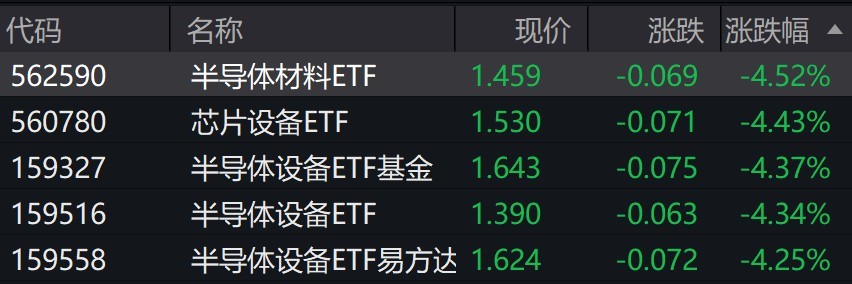
Group 1 - Semiconductor equipment concept stocks declined, with Tuojing Technology falling over 6%, Changchuan Technology down over 5%, and Huahai Qingke and Xinyuan Micro both dropping over 4% [1] - Related semiconductor equipment ETFs also experienced a decline, with an overall drop of over 4% [1] Group 2 - Specific ETF performance included: - Semiconductor Materials ETF at 1.459, down 0.069 or 4.52% - Chip Equipment ETF at 1.530, down 0.071 or 4.43% - Semiconductor Equipment ETF Fund at 1.643, down 0.075 or 4.37% - Semiconductor Equipment ETF at 1.390, down 0.063 or 4.34% - E Fund Semiconductor Equipment ETF at 1.624, down 0.072 or 4.25% [2] Group 3 - Analysts indicate that under the backdrop of the AI wave and domestic substitution, there is a continuous demand for expansion in advanced production lines in China, positioning semiconductor equipment as a cornerstone for wafer foundry expansion and an important link for achieving self-sufficiency in the industry chain, presenting development opportunities for domestic semiconductor equipment manufacturers [2]


国泰海通 · 晨报1103|宏观、海外策略、非银、策略
国泰海通证券研究· 2025-11-02 14:43
Macro Overview - The long-term growth potential of China's economy is significant, with a stable macroeconomic total expected by 2025, but structural differentiation is evident, necessitating policy solutions for weak domestic demand in 2026 [4] - Asset restructuring is crucial, with inflation expectations playing a vital role in wealth management for residents [5] - Global economic and monetary system restructuring is leading to changes in the pricing framework for assets like gold, the US dollar, and US Treasuries [6] Hong Kong Stock Market Strategy - Hong Kong stocks have substantial upward valuation potential, with the overall valuation still considered low despite a rapid recovery in 2025 [11] - The market is expected to attract a significant amount of incremental capital, with over 1.5 trillion yuan anticipated from domestic investors in 2026 [12] - The scarcity of quality assets in the Hong Kong market is a strong supporting factor for upward movement, particularly in sectors like internet, new consumption, and innovative pharmaceuticals [12] - The technology sector is projected to be the main focus for 2026, driven by the AI wave and supportive policies [13] Non-Banking Sector Regulations - The China Securities Regulatory Commission is seeking opinions on new guidelines for performance benchmarks for publicly offered securities investment funds, aiming to address systemic issues in performance comparison and management mechanisms [19][20] - The new regulations will enhance the selection, change, disclosure, and constraint of benchmarks, improving investment transparency and potentially increasing the proportion of index products in the market [21] Asset Overview - Equity markets are outperforming bonds and commodities, with significant gains in Asian markets, particularly Japan and South Korea [25][26] - The bond market shows a "bull steep" characteristic in China, while US Treasuries exhibit a "bear flat" trend due to hawkish signals from the Federal Reserve [27] - Commodity indices have seen declines, with gold and oil leading the downturn, while the US dollar index has risen [28]


3Q25基金持仓分析:科技大时代
CAITONG SECURITIES· 2025-10-30 02:44
Report Title - "Technology in the Big Era - 3Q25 Fund Position Analysis" [2] Report Core Viewpoints - Market performance rebounded in Q3, leading to a turning point in fund issuance. The net value of active funds generally recovered, driving the recovery of fund issuance. Historically, when the proportion of active funds with a net value >1 rises above 80%, fund issuance is expected to accelerate, boosting the performance of heavily - held stocks by funds [3]. - The equity position of active funds reached a historical high. In 3Q25, the stock - holding ratio of active equity - biased funds increased by 1.4 pct to 85.6%, and the equity and convertible bond positions of "fixed - income +" funds changed by +2.5 pct and - 1.0 pct to 10% and 7% respectively [3]. - Funds increased their allocation to technology and cyclical sectors while reducing their allocation to consumption, manufacturing, and high - dividend sectors. In terms of overweight ratios, active funds significantly increased their positions in communication and electronics in the TMT sector, as well as non - ferrous metals and petroleum and petrochemicals in the cyclical sector. They reduced their positions in home appliances and food and beverage in the consumption sector, as well as military and automotive in the manufacturing sector, and banks and transportation in the high - dividend sector [3]. - The TMT position ratio reached a historical high, facing downward pressure. In Q3, the concentration of the top 20 heavily - held A - share stocks by funds increased to 33%, the highest since Q3 2022. Historically, the position ratio of around 30% has been a critical point for active fund clustering. In this technological wave, the TMT position ratio has reached 40%. After the breakdown of previous clustering, the position ratio generally declined to below 20% [4]. - Active funds have strong pricing power in the TMT sector. In terms of the position as a proportion of the industry's free - float market capitalization, active funds currently have relatively higher pricing power in the TMT sector than passive funds and foreign capital, and also have a slight advantage in the manufacturing (machinery and military) sector [4]. - Regarding the adjustment of five types of industry funds: TMT funds increased their positions in CPO and PCB while reducing semiconductor and computer software; consumer funds increased their positions in e - commerce and hotels while reducing chemicals and white goods; new energy funds increased their positions in small metals while reducing vehicle manufacturing and electrical equipment; pharmaceutical funds increased their positions in biopharmaceuticals while reducing chemical drugs; cyclical funds increased their positions in small metals and precious metals while reducing industrial metals and rubber [4]. - Funds continued to increase their positions in Hong Kong - listed internet, semiconductor, and non - banking sectors. Internet platforms such as Alibaba and Tencent, which benefit from the AI wave, semiconductor companies like SMIC and Huahong, and insurance companies in the non - banking sector, which benefit from the improvement of asset quality in a bull market, all received increased allocations from funds [4]. - A selected portfolio of heavily - held stocks by funds was screened for stocks with a CAGR of profit expectations >30% and a profit forecast upward revision of more than 5% since October, which are expected to benefit from the incremental liquidity brought by the recovery of fund issuance [5]. Report Industry Investment Rating - Not provided in the report Summary by Directory Public Offering - Market performance in Q3 was strong, and the net value of active funds generally recovered, driving the recovery of fund issuance. Historically, when the proportion of active funds with a net value >1 rises above 80%, fund issuance is expected to accelerate, boosting the performance of heavily - held stocks by funds [6]. Equity Allocation - In 3Q25, due to the technology and manufacturing market, the equity position of active funds reached a historical high, and "fixed - income +" funds also increased their equity allocation. The stock - holding ratio of active equity - biased funds increased by 1.4 pct to 85.6%, and the equity and convertible bond positions of "fixed - income +" funds changed by +2.5 pct and - 1.0 pct to 10% and 7% respectively [11]. Industry Allocation - In terms of overweight ratios, in Q3, active funds significantly increased their positions in communication (+3.5 pct), electronics (+2.4 pct) in the TMT sector, and non - ferrous metals (+0.6 pct) and petroleum and petrochemicals (+0.5 pct) in the cyclical sector. They reduced their positions in home appliances (-1.6 pct), food and beverage (-1.2 pct) in the consumption sector, as well as automotive (-1.1 pct), military (-1.0 pct) in the manufacturing sector, and banks (-0.5 pct), utilities (-0.4 pct), and transportation (-0.4 pct) in the high - dividend sector [13]. - In terms of sub - sectors, hardware such as CPO and PCB were the main sectors for increased positions. The sectors for reduced positions were mainly the weak - performing consumption, innovative drugs, and urban and rural commercial banks [16]. - In Q3, there was a consensus between north - bound funds and active funds in increasing allocations to technology and cyclical sectors such as electronics, media, non - ferrous metals, and petrochemicals. North - bound funds also significantly increased their positions in new energy. In terms of reduced positions, both significantly reduced their allocations to consumption sectors such as food and beverage and home appliances, as well as high - dividend - related banks, utilities, and transportation [18]. Concentration of Heavily - Held Stocks - In Q3, the concentration of the top 20 heavily - held A - share stocks by funds increased to 33%, the highest since Q3 2022, corresponding to the style where small - cap stocks outperformed large - cap stocks [21]. Sector Concentration - Since 2009, the position ratio of around 30% has been a critical point for previous rounds of active fund clustering. In this technological wave, the TMT position ratio has reached 40%. After the breakdown of previous clustering, except for the relatively slow decline in the position ratio of pharmaceuticals + food and beverage from 2020 in the following three years, the position ratio generally declined to below 20% [25]. Relative Pricing Power - In terms of the position as a proportion of the industry's free - float market capitalization, active funds currently have relatively higher pricing power in the TMT sector than passive funds and foreign capital, and also have a slight advantage in the manufacturing (machinery and military) sector [27]. Industry Funds - TMT funds increased their positions in CPO and PCB while reducing semiconductor and computer software; consumer funds increased their positions in e - commerce and hotels while reducing chemicals and white goods; new energy funds increased their positions in small metals while reducing vehicle manufacturing and electrical equipment; pharmaceutical funds increased their positions in biopharmaceuticals while reducing chemical drugs; cyclical funds increased their positions in small metals and precious metals while reducing industrial metals and rubber [30]. Heavily - Held Stocks - AI hardware - related companies such as Industrial and Commercial Bank of China, Cambricon, Dongshan Precision, and Tianfu Communication entered the top 20 heavily - held stocks by funds, while financial and consumer stocks such as China Merchants Bank, Wuliangye, Haid Group, and Gree Electric Appliance exited the top 20 [33]. A - Share Individual Stock Allocation - Funds increased their positions in stocks such as Tonglian Precision and Xiangyou Pump. The median excess return of the top 20 stocks with increased fund pricing power in Q3 2025 relative to the CSI 300 was 61%, but most of them underperformed in Q4. The median excess return of the top 20 stocks with reduced positions by funds in Q3 was relatively low, only 7% [36][40]. Hong Kong Stock Allocation - In 3Q25, funds continued to increase their positions in Hong Kong - listed internet, semiconductor, and non - banking sectors. Internet platforms such as Alibaba and Tencent, semiconductor companies like SMIC and Huahong, and insurance companies in the non - banking sector all received increased allocations [41]. Selected Portfolio of Heavily - Held Stocks by Funds - Stocks were screened from heavily - held stocks by funds with a CAGR of profit expectations >30% and a profit forecast upward revision of more than 5% since October, which are expected to benefit from the incremental liquidity brought by the recovery of fund issuance [5].
近30万亿财富大洗牌,首富稳坐4连冠,雷军涨出马云!
Sou Hu Cai Jing· 2025-10-29 08:10
Group 1 - The core point of the article highlights the significant changes in the Chinese billionaire rankings, with Zhong Shanshan of Nongfu Spring becoming the richest person in China for the fourth time, with a net worth of 530 billion, a 56% increase, largely due to the doubling of Nongfu Spring's stock price [1][3] - Lei Jun of Xiaomi has seen his wealth surge to 326 billion, a 150% increase, adding 196 billion in one year, propelled by strong performance across multiple business segments, including a 38% year-on-year revenue growth to 227.2 billion and a 70% increase in net profit to 21.5 billion [3][4] - Xiaomi's automotive business has emerged as a significant growth driver, delivering 157,200 vehicles in the first half of the year, generating 21.3 billion in revenue, and achieving a market share of 43.7% in the over 200,000 pure electric sedan market [4][6] Group 2 - The article indicates a shift in wealth dynamics, with six of the top twelve billionaires coming from the internet sector, driven by the AI wave, which has significantly boosted the fortunes of internet giants [6][8] - The new energy sector is also experiencing rapid growth, with notable increases in wealth among leaders like Zeng Yuqun of CATL and Li Shufu of Geely, reflecting a broader trend of wealth accumulation in the automotive industry [6][8] - The article notes a geographical shift in billionaire distribution, with Shanghai, Shenzhen, and Beijing leading in the number of billionaires, indicating a change in economic dynamics and innovation logic within the society [8]


债市延续向好态势,可转债ETF(511380)午后冲高,盘中交投活跃
Sou Hu Cai Jing· 2025-10-29 06:19
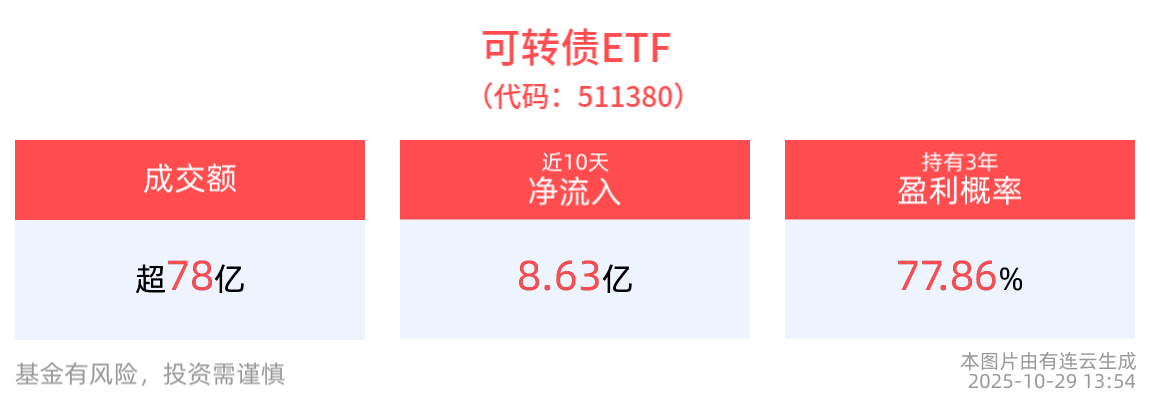
Core Insights - The China Securities Convertible Bond and Exchangeable Bond Index (931078) increased by 0.58% as of October 29, 2025, with the Convertible Bond ETF (511380) rising by 0.55% to a latest price of 13.51 yuan [2] - The recent report from the Central Committee emphasizes the need for proactive macroeconomic policies to stabilize growth, employment, and expectations, while also enhancing risk management in key areas such as real estate and local government debt [2] - The issuance of convertible bonds by banks is viewed as a cost-effective financing method, which can bolster core Tier 1 capital and support business expansion and risk resilience [3] Market Activity - The Convertible Bond ETF recorded a turnover rate of 13.16% with a trading volume of 7.825 billion yuan, indicating active market participation [2] - Over the past week, the Convertible Bond ETF has accumulated a rise of 0.83% [2] - The latest scale of the Convertible Bond ETF reached 59.363 billion yuan, with a net outflow of 638 million yuan recently [3] Investment Opportunities - Despite ongoing market uncertainties, investment opportunities are emerging, particularly in equity assets benefiting from the AI wave and policy support in the technology growth sector [3] - The recent trend shows that in the last 10 trading days, there were net inflows on 6 days, totaling 863 million yuan, with an average daily net inflow of 8.632 million yuan [3] - The Convertible Bond ETF closely tracks the performance of the China Securities Convertible Bond and Exchangeable Bond Index, which is composed of convertible and exchangeable bonds listed on the Shanghai and Shenzhen exchanges [3]
专访中金公司李求索:资本市场有望呈现“稳进”趋势
Nan Fang Du Shi Bao· 2025-10-28 10:30
Core Insights - The "15th Five-Year Plan" is positioned as a critical period for achieving the 2035 long-term goals, serving as a transitional phase between the previous and upcoming plans [3][4] - The capital market is expected to experience opportunities during the "15th Five-Year Plan," characterized by three main aspects: the ongoing revaluation of Chinese assets, the rise of AI trends, and the advantages of Chinese manufacturing [4][5] Group 1: Historical Context and Strategic Importance - The "15th Five-Year Plan" is a key phase for realizing the 2035 vision of achieving basic socialist modernization, bridging the "14th" and "16th" plans [3] - It is also crucial for completing the reform tasks set out in the 20th Central Committee's third plenary session by 2029, which includes over 300 significant reform measures across various sectors [3] Group 2: Capital Market Opportunities - The capital market during the "15th Five-Year Plan" is characterized by three main opportunities: 1. The ongoing revaluation of Chinese assets, which may still be in its early stages due to the restructuring of the international monetary order [4] 2. The AI wave, where China is positioned favorably in global AI competition, leveraging its market size, industrial ecosystem, and policy support [4] 3. The advantages of Chinese manufacturing, which holds nearly 30% of global manufacturing value added and leads in the production of most major industrial products [5] Group 3: Market Trends and Characteristics - The capital market is anticipated to show a "long-term" and "steady" trend during the "15th Five-Year Plan," supported by several factors: 1. Increased government focus on capital market development, which is expected to play a significant role in achieving the 2035 goals [6] 2. The current A-share market is underpinned by solid fundamentals, benefiting from a large market environment and policy incentives [6] 3. Historical data indicates that A-share valuations remain reasonable, suggesting no overvaluation at present [6] Group 4: Historical Market Performance - Since the "15th" plan in 2001, the A-share market has exhibited three notable characteristics: 1. The index has shown more gains than losses, with increasing resilience over time, as evidenced by varying performance across different five-year plans [6][7] 2. Market performance tends to be stronger in the initial and final years of each five-year plan, indicating a correlation with planning expectations and goal achievements [7] 3. Short-term event-driven effects are significant, with positive market performance observed in the lead-up to and following the release of five-year planning documents [7]


石英股份(603688):光伏石英砂龙头,半导体国产替代加快
Shanxi Securities· 2025-10-28 07:04
Investment Rating - The report maintains an investment rating of "Buy-A" for the company [1][7]. Core Insights - The company is a leading producer of high-purity quartz sand, with applications in both photovoltaic and semiconductor sectors. It has a comprehensive product range and a well-established supply chain [1][15]. - The semiconductor industry is experiencing sustained demand driven by the AI wave, with significant potential for domestic substitution. The company is one of the few that has received TEL certification for its semiconductor products, positioning it well to benefit from this trend [2][64]. - The photovoltaic sector is also showing strong growth, with the company maintaining a leading position in the market for quartz crucibles, which are essential for silicon wafer production [3][67]. Summary by Sections Company Overview - Jiangsu Pacific Quartz Co., Ltd. was established in 1992 and listed on the Shanghai Stock Exchange in 2014. The company offers a wide range of products including high-purity quartz sand, quartz tubes, and crucibles, serving various applications in semiconductors, photovoltaics, and optical fibers [1][15][16]. Semiconductor Sector - The semiconductor market is projected to grow significantly, with a forecasted market size of $700.9 billion in 2025, reflecting an 11.2% year-on-year increase. The company is well-positioned to capitalize on the domestic substitution trend due to its certifications and product quality [2][41]. - The domestic semiconductor industry has a high dependency on imports, with a trade deficit of $226.1 billion in 2024, indicating a substantial opportunity for local manufacturers [2][58]. Photovoltaic Sector - The global photovoltaic market is expected to maintain growth, with new installations projected between 466-549 GW in 2025. The company is a key player in the quartz crucible market, which is crucial for the production of silicon wafers [3][67]. - The market for photovoltaic-grade quartz crucibles is anticipated to grow, with a projected CAGR of 21.5% from 2024 to 2029, further driving demand for high-purity quartz sand [3][72]. Financial Forecast and Valuation - The company is expected to see a rebound in net profit from 2025 to 2027, with estimates of 2.2 billion yuan, 5.6 billion yuan, and 9.1 billion yuan respectively. The earnings per share (EPS) for the same period is projected to be 0.41 yuan, 1.03 yuan, and 1.68 yuan [7][8]. - The report highlights the sensitivity of the company's net profit to changes in quartz sand prices, indicating significant potential for profit growth if prices recover [7][88].

全球资金 潮涌何方 机构拆解四季度大类资产配置思路
Shang Hai Zheng Quan Bao· 2025-10-27 20:33
Core Viewpoint - The article discusses the strong performance of various asset classes in the first three quarters of the year and explores investment opportunities for the fourth quarter, emphasizing the importance of a balanced asset allocation strategy amid market uncertainties [1][2]. Group 1: Equity Assets - Multiple institutions express optimism about the performance of equity assets in the fourth quarter, citing factors such as moderate inflation, easing monetary policy, stable corporate earnings, and valuation advantages in certain markets [3]. - The expectation of interest rate cuts by the Federal Reserve is anticipated to benefit emerging market equities, with historical trends indicating that emerging markets typically outperform developed markets during periods of a weakening dollar [3]. - The Hong Kong stock market is expected to see a rebound due to its low valuation and sensitivity to foreign capital flows, while the A-share market is supported by policies aimed at stabilizing earnings and promoting technology and high-end manufacturing sectors [3][4]. Group 2: Gold - Despite recent adjustments in gold prices, the fundamental logic supporting gold's strength remains intact, driven by demand from central banks and investors as a hedge against sovereign debt risks and inflation [5][6]. - Short-term technical pressures may affect gold prices, but the long-term outlook remains positive due to the Fed's easing cycle and ongoing global uncertainties that bolster safe-haven demand [6][7]. - The gold sector is viewed as a strong investment choice due to multiple converging factors, including concerns over global trade policies and a weakening dollar, which enhances gold's investment appeal [6][7]. Group 3: Commodity Focus - Institutions are also paying attention to commodities like aluminum and coal, with low global inventories and increased demand due to economic growth during the inflation cycle [7]. - The upcoming winter heating demand is expected to support coal prices, making it a sector worth monitoring [7]. Group 4: Balanced Strategy - A consensus among institutions suggests adopting a balanced strategy for asset allocation in the fourth quarter, combining stocks, bonds, and commodities to mitigate risks and seize opportunities [8]. - The strategy emphasizes the importance of diversifying across global markets to reduce single-market risks while focusing on structural opportunities in equity markets [8][9]. - The proposed allocation includes a core focus on A-shares, Hong Kong stocks, and gold, with satellite investments in industrial metals like copper and aluminum [9].