美联储降息预期

Search documents
不锈钢:钢价承压低位震荡,但下方想象力有限:镍:累库节奏稍有放缓,宏观与消息短线扰动
Guo Tai Jun An Qi Huo· 2025-11-23 11:22
Report Industry Investment Rating No relevant content provided. Core Viewpoints of the Report - The nickel price is limited in its upward movement due to the long - term logic of hydrometallurgy replacing pyrometallurgy and weak refined nickel demand. However, in the short - term, with marginal improvement in the macro - environment and the resonance of news, there may be a certain degree of price repair. Attention should be paid to the subsequent progress of Indonesian news [1]. - The stainless steel market has a weak fundamental situation, but the downside is also limited. The market is affected by macro - marginal factors and policy uncertainties in Indonesia [2]. Summary by Related Catalogs Nickel and Stainless Steel Fundamentals - **Nickel**: The inventory accumulation of refined nickel has slowed down. The demand for corrosion - resistant alloys is under pressure, and the proportion of using ferronickel to replace nickel plates in the nickel alloy segment has increased. The long - term supply increase expectation of low - cost hydrometallurgy remains. Macro - level, dovish remarks from the Fed have boosted expectations, and there are many uncertainties in Indonesia, which may support the nickel price in the short - term [1]. - **Stainless steel**: The fundamentals are weak, with high upstream inventory, low terminal manufacturing investment growth, and weak post - production cycle consumption. The market is in a seasonally weak period, and the supply - demand relationship has shifted from strong supply and weak demand to weak supply and demand, showing a slight surplus. The cost of ferronickel has limited downward space, and short - selling at low levels is not cost - effective. Attention should be paid to Indonesian policy risks [2]. Inventory Tracking - **Refined nickel**: China's social inventory decreased by 1099 tons to 53144 tons, with warehouse receipt inventory decreasing by 1242 tons to 33785 tons, and spot inventory increasing by 143 tons to 15589 tons. The bonded area inventory remained unchanged at 3770 tons. LME nickel inventory increased by 1860 tons to 253950 tons [3][4]. - **New energy**: On November 14, the inventory days of upstream, downstream, and integrated production lines of SMM nickel sulfate changed by 0, +1, 0 month - on - month to 4, 9, 7 days respectively; the precursor inventory changed by - 0.6 month - on - month to 12.3 days; on November 13, the ternary material inventory changed by - 0.2 month - on - month to 6.9 days [4]. - **Ferronickel - stainless steel**: On October 31, the SMM ferronickel inventory was 30225 tons, with a year - on - month/ month - on - month increase of +3%/+2%. In October, the SMM stainless steel factory inventory was 1.574 million tons, with a year - on - month/ month - on - month increase of +9%/3%. On November 20, 2025, the total social inventory of stainless steel in the Steel Union was 1071733 tons, with a week - on - week increase of 0.11%. Among them, the total inventory of cold - rolled stainless steel was 621623 tons, with a week - on - week decrease of 1.51%, and the total inventory of 300 - series stainless steel was 658798 tons, with a week - on - week decrease of 0.17% [4]. Market News - In September, due to violations of forestry license regulations, the Indonesian forestry working group took over a more than 148 - hectare nickel mining area of PT Weda Bay Nickel, which is expected to affect the monthly nickel ore production by about 600 metal tons [5]. - China has suspended an unofficial subsidy for copper and nickel imported from Russia [6]. - In September, the Indonesian Ministry of Energy and Mineral Resources imposed sanctions on 190 mining companies for failing to provide claim and refund guarantees. The sanctions will be lifted once the companies submit claim plan documents and place claim guarantees for 2025 [6]. - In September, the Indonesian Ministry of Energy and Mineral Resources issued a ministerial order regarding the preparation, submission, and approval procedures of the mining RKAB for the next year. The approval plan is expected to be completed by November 15 this year, and there are transition clauses [6]. - Trump claimed to impose an additional 100% tariff on China and implement export controls on "all key software" starting from November 1 [7]. - The Indonesian government has suspended the issuance of new smelting licenses for certain nickel - related products through the OSS platform [7]. - Due to strengthened safety inspections in Indonesian industrial parks, some nickel hydrometallurgy projects will reduce production loads to clean up tailings slag ponds in December, affecting the output by about 6000 nickel metal tons [7]. - On November 21, the New York Fed President John Williams and Fed Governor Stephen Miran made dovish remarks, prompting investors to increase the probability of a 25 - basis - point interest rate cut in December [7].
【中金外汇 · 周报】美元受益于降息节奏的反复
Sou Hu Cai Jing· 2025-11-23 09:52
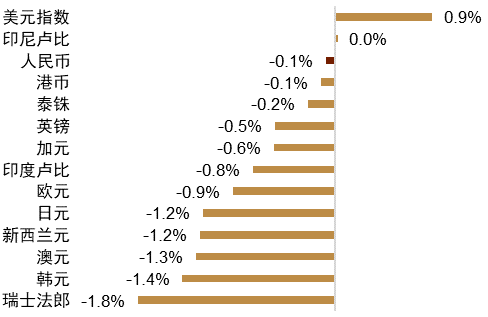
Core Viewpoint - The US dollar has regained strength, surpassing the 100 mark and recovering the 200-day moving average for the first time since early March, supported by various factors including stronger-than-expected non-farm payroll data and hawkish FOMC meeting minutes [1][28]. Group 1: US Dollar Strength - The US government ending the shutdown and the release of September non-farm payroll data exceeding market expectations have weakened the logic for the Federal Reserve to cut rates due to deteriorating employment data [1][25]. - The hawkish tone of the October FOMC meeting minutes has reinforced market expectations that the Fed will not easily cut rates again in December [1][28]. - The weakness of the Japanese yen and British pound has also provided support to the US dollar index [1]. Group 2: Performance of Non-USD Currencies - Non-USD currencies have broadly declined against the strengthening dollar, with the Swiss franc dropping 1.77%, leading the G10 currencies [2]. - The Norwegian krone, Australian dollar, and New Zealand dollar also saw significant declines of 1.59%, 1.27%, and 1.23%, respectively, amid a drop in market risk appetite [2]. - The euro and British pound experienced declines of 0.93% and 0.55%, respectively, influenced by weaker economic data [2][29]. Group 3: Market Focus and Predictions - This week, the market will focus on a series of economic data from the US, particularly PPI inflation and weekly unemployment claims, as well as China's October industrial profits [3][22]. - The market's risk appetite may continue to be volatile, especially after a significant drop in US stocks last week, which could pose a risk to the dollar's further rise [3][36]. - The predicted range for USD/CNY is between 7.09 and 7.14, with expectations for the RMB to maintain a moderately strong trend overall [3][4]. Group 4: RMB Exchange Rate Stability - The RMB showed resilience against the dollar's rise, with only a slight depreciation, while appreciating against a basket of currencies [4][11]. - The CFETS RMB exchange rate index rose by 0.4%, indicating a stable performance despite external pressures from a strong dollar [4][11]. - The RMB's demand is expected to remain balanced, supported by expectations of a moderate appreciation and seasonal factors as the year-end approaches [4][22]. Group 5: UK Economic Outlook - Recent UK economic data has confirmed a weak outlook, raising market expectations for a Bank of England rate cut, with the probability of a cut in December now around 90% [29][33]. - The UK unemployment rate rose to 5%, and retail sales data showed a significant decline, further supporting the case for a rate cut [29][33]. - The upcoming fiscal budget report may also impact the pound, with expectations of increased government borrowing potentially leading to bond market pressures [35].

别被暴跌吓倒!下周或现黄金坑
Sou Hu Cai Jing· 2025-11-23 03:30
Core Viewpoint - The global capital markets experienced a significant sell-off of risk assets, with the A-share market also declining sharply, indicating a shift in investor sentiment towards defensive sectors [1] Market Performance - The Shanghai Composite Index fell by 3.90%, the Shenzhen Component dropped by 5.13%, and the ChiNext Index decreased by 6.15%, all reaching new lows [1] - Over 5,000 stocks declined, with nearly 100 hitting the daily limit down, reflecting extreme market pessimism [1] - Defensive sectors such as shipbuilding, cultural media, and agriculture showed resilience, while previously popular sectors like energy metals, batteries, and photovoltaic equipment faced significant losses [1] Global Market Context - The Hang Seng Index fell by 5.09%, the S&P 500 dropped by 1.95%, and the Nasdaq decreased by 2.74%, influenced by cooling expectations for interest rate cuts from the Federal Reserve and instability in the U.S. AI narrative [1] - Federal Reserve officials began to signal dovish stances, with New York Fed President Williams stating there is still room for rate cuts, potentially alleviating liquidity concerns [1] Technical Analysis - The Shanghai Composite Index has broken below the lower Bollinger Band, indicating significant short-term overselling [2] - Following the panic selling, some institutional funds are starting to position themselves against the trend, increasing the likelihood of a technical and emotional market recovery [2] Key Factors to Watch - Upcoming U.S. economic data, including September retail sales and PPI, could influence market sentiment, especially if they underperform, potentially reinforcing expectations for a December rate cut [3] - International events such as the progress of the Russia-Ukraine peace plan and the UK's autumn budget may also impact market emotions [4] Sector Opportunities - Performance certainty will remain a core theme, with technology sectors like AI applications, robotics, and storage chips showing potential for recovery due to their recent declines and technological advancements [4] - Low-valuation, high-dividend sectors like banks and utilities are suitable for risk-averse investors [4] Investment Strategy - Prioritize high-quality stocks with solid performance and significant pullbacks while avoiding speculative stocks [5] - Continuous monitoring of Federal Reserve policy and global economic data is crucial, as these will be key variables determining market direction [6] Market Signals - A successful market rebound, even if limited, would indicate the market's self-repair mechanism is functioning, suggesting underlying resilience [6] - Conversely, a failure to rebound would signal that market confidence is still fragile and that a trend reversal is not yet imminent [6][7] Observational Approach - Investors should remain vigilant, recognizing that the market may still be searching for a true bottom, requiring patience and careful observation [7] - Quality rebounds should be accompanied by increasing trading volume and orderly rotation of market hotspots, while weak performance may indicate deeper adjustment pressures [8]
特朗普,关税突发!美联储官员最新表态,12月降息概率几乎翻倍
Zheng Quan Shi Bao Wang· 2025-11-23 00:34
Group 1: U.S. Tariff Policy - The Trump administration is preparing a backup plan to restore tariffs amid potential Supreme Court challenges to a key tariff authorization [1][2] - If the court rules against the administration, the U.S. government may have to refund over $88 billion in tariffs already collected [2] - The U.S. has recently adjusted tariffs on Brazilian goods, eliminating a 40% additional tariff on certain products while approximately 22% of exports to the U.S. remain affected [2][3][4] Group 2: Federal Reserve and Interest Rates - Boston Fed President Collins indicated that the probability of a rate cut by the Federal Reserve in December has nearly doubled, with market expectations rising to about 70% [7] - The market reacted positively to dovish comments from New York Fed President Williams, leading to a rebound in U.S. stock indices [7] Group 3: Oil Market Dynamics - International oil prices have been declining, with WTI and Brent crude prices dropping over 3.15% and 2.84% respectively in the past week [11] - Analysts attribute the weak oil market to geopolitical tensions, macroeconomic sentiment, and fundamental oversupply concerns [11][12] - The ongoing conflict between Russia and Ukraine is currently a major support factor for oil prices, but any progress in peace talks could lead to a significant drop in geopolitical risk and a potential return of Russian oil to the market [11][12][13] Group 4: Supply and Demand Outlook - The global oil market is expected to face significant inventory pressure by late 2025 to early 2026, with EIA and IEA projecting substantial stock builds [12] - Recent increases in OPEC+ oil exports have heightened concerns about oversupply, with forecasts indicating a potential surplus of up to 4.09 million barrels per day by 2026 [12][13] - The rising floating storage and in-transit oil volumes are expected to exert further pressure on land-based inventories and oil prices [13]

金价,最新消息!
Sou Hu Cai Jing· 2025-11-22 11:26
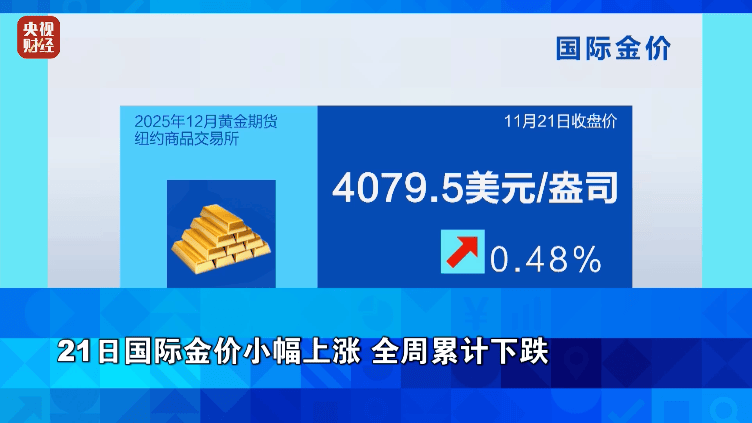
Group 1: Federal Reserve and Market Reactions - The Federal Reserve's monetary policy outlook remains a key concern for the market, with recent hawkish statements from officials causing panic, but New York Fed President Williams indicated that labor market weakness poses a greater threat than inflation, suggesting further rate cuts are possible [1] - Following Williams' dovish comments, market expectations for a 25 basis point rate cut in December rose to over 70%, alleviating investor concerns [1] - The S&P Global data showed that U.S. business activity expanded at the fastest pace in four months in November, with service sector growth accelerating and overall economic outlook improving, leading to gains in major U.S. stock indices [1] Group 2: Company Developments - Eli Lilly became the first pharmaceutical company globally to surpass a market capitalization of $1 trillion, driven by expanded production and strong performance of its weight loss drugs [5] - Goldman Sachs projected that Eli Lilly's oral version of its weight loss drug could be launched in Q1 next year, earlier than expected, which may enhance its market share [5] - Eli Lilly's agreement with the U.S. government to significantly reduce prices for some weight loss drugs is expected to expand its drug coverage and boost sales potential [5] Group 3: European Market Insights - In Europe, the manufacturing PMI for the Eurozone fell to 49.7 in November, indicating a contraction due to weak demand and reduced new orders, particularly in Germany and France [7] - Investor sentiment regarding future economic growth in Europe remains cautious, reflected in mixed performances of major European stock indices [7] Group 4: Commodity Market Trends - International gold prices saw a slight increase due to rising expectations of Federal Reserve rate cuts, although they experienced a weekly decline of 0.36% due to a strong dollar [3] - Oil prices fell on Friday amid concerns over increased supply following U.S. efforts for a peace agreement in Ukraine, with both NY and Brent crude prices showing weekly declines [9]

1121 港股日评:降息预期退潮,港股科技承压-20251122
Changjiang Securities· 2025-11-22 07:41
Core Insights - The Hong Kong stock market experienced a significant decline, with the Hang Seng Index dropping by 2.38% to 25,220.02, and the Hang Seng Tech Index falling by 3.21% to 5,395.49, reflecting a broader market adjustment influenced by tightening liquidity expectations in the U.S. [5][9] - The U.S. non-farm payroll data for September showed mixed results, with an addition of 119,000 jobs, which was above expectations but still at a low level, leading to a decrease in the probability of a Federal Reserve rate cut in December to 33.1% [9][5] - The AI industry chain's pullback in the U.S. has negatively impacted Hong Kong's hard tech sector, particularly the semiconductor sector, which saw significant declines [9][5] Market Performance - On November 21, 2025, the total trading volume in the Hong Kong market reached HKD 285.7 billion, with net inflows from southbound funds amounting to HKD 10.5 million [2][9] - The major indices in the A-share market also experienced declines, with the Shanghai Composite Index down by 2.45% and the CSI 300 down by 2.44% [5][9] - The sector performance showed that all primary sectors under the CITIC Hong Kong Stock Connect Index declined, with steel (-6.39%), non-ferrous metals (-4.39%), and retail (-4.26%) leading the losses [5][9] Industry Outlook - The report suggests a cautious outlook for the Hong Kong stock market, indicating a potential "slow bull" market as it awaits renewed expectations for Federal Reserve rate cuts and clarity in AI long-term narratives [9] - The focus for medium to long-term investments should shift towards sectors driven by new productive forces, including AI and robotics, which are at a critical stage of commercialization [9] - The report highlights four key investment directions: 1) Quality supply creating new demand, 2) Re-evaluation of scarce resources driven by energy transition and geopolitical factors, 3) Recovery from excess capacity in industries like photovoltaics and chemicals, and 4) Benefits to financial markets from increased market activity and low-interest environments [9]
瑞银上调明年国际黄金目标价:最高4900美元!
Yang Zi Wan Bao Wang· 2025-11-22 06:42
Group 1 - UBS raised its mid-2026 gold price target from $4,200 to $4,500 per ounce, influenced by expectations of Federal Reserve rate cuts, ongoing geopolitical risks, fiscal concerns, and strong demand from central banks and ETF investors [1][2] - The firm also increased its upside target for gold to $4,900 per ounce due to potential spikes in political and financial risks, while maintaining a downside target of $3,700 per ounce [1] - Analysts expect strong demand for exchange-traded funds (ETFs) in 2026, but caution that a hawkish stance from the Federal Reserve and the risk of central banks selling gold remain significant challenges [1] Group 2 - Gold ETF inflows reached 222 tons, and demand for gold bars and coins exceeded 300 tons for the fourth consecutive quarter, indicating an increase in investor appetite [2] - UBS analysts believe that jewelry demand is not as weak as previously feared and recommend investors to buy on dips, suggesting a moderate single-digit percentage allocation to gold in investment portfolios [2] - UBS's global wealth management strategists emphasize that gold remains a crucial component of resilient investment strategies [2]
超5000只个股下跌!A股总市值一天蒸发逾3万亿元,发生了什么?
Sou Hu Cai Jing· 2025-11-21 23:33
Core Viewpoint - The A-share market experienced a significant decline on November 21, 2025, with major indices dropping sharply due to external factors such as the reduced probability of a Federal Reserve rate cut and internal market adjustments following previous gains [2][7]. Market Performance - On November 21, the Shanghai Composite Index fell by 2.45% to 3834.89 points, the Shenzhen Component dropped by 3.41% to 12538.07 points, and the ChiNext Index decreased by 4.02% to 2920.08 points, marking the largest single-day declines since April 8, 2023, for the Shanghai and Shenzhen indices [3][4]. - The total market capitalization of A-shares decreased by approximately 3.04 trillion yuan, bringing the total to around 103 trillion yuan [6]. Sector Performance - Most sectors saw declines, with the advertising, digital media, and fisheries sectors showing gains of 1.82%, 1.65%, and 1.55% respectively, while energy metals, steel raw materials, and coke sectors experienced significant losses of 9.16%, 7.96%, and 6.92% respectively [3][4]. - Only two sectors, cultural media and shipbuilding, saw net inflows of capital, while the semiconductor, electronic components, and communication equipment sectors faced the largest outflows [4]. External Factors - The decline in the A-share market is attributed to external pressures, including the Federal Reserve's cooling rate cut expectations and rising yields in the Japanese bond market, which heightened concerns over global liquidity tightening [7][8]. - Recent U.S. labor data indicated stronger-than-expected job growth but also revealed a rise in unemployment, leading to a decreased likelihood of a December rate cut by the Federal Reserve [7]. Market Outlook - Analysts suggest that the market may continue to experience a "weight protection + structural theme" oscillation pattern, with low-valuation financial stocks like insurance and banks offering defensive value [8]. - The market is expected to remain in a "slow bull" phase, with valuation corrections being a primary reason for the current downturn, while fundamental drivers are anticipated to gain importance as the earnings season approaches [8].

流动性担忧叠加科技股波动 亚太股市遭遇“黑色星期五”
Shang Hai Zheng Quan Bao· 2025-11-21 18:43
Market Overview - The Asia-Pacific stock market experienced a significant decline on November 21, with the Korean Composite Index dropping by 3.79% and major indices like the Shanghai Composite, Hong Kong Hang Seng, and Nikkei 225 all falling over 2% [3][4] - Major tech stocks faced substantial losses, including SoftBank Group down over 10%, SK Hynix down over 8%, and Semiconductor Manufacturing International Corporation (SMIC) down over 6% in H-shares and over 3% in A-shares [3][4] Macro Factors - The primary macro factor for the recent adjustment in the Asia-Pacific stock market is the uncertainty surrounding the Federal Reserve's interest rate decisions, particularly following conflicting employment data released by the U.S. Labor Department [4][5] - The employment report indicated a significant increase in non-farm payrolls, with 119,000 jobs added in September, far exceeding the expected 50,000, while the unemployment rate rose to 4.4%, the highest since 2021 [4] AI Sector Concerns - The ongoing debate regarding the "AI bubble" has contributed to the decline in high-valued tech stocks, with major companies like Nvidia, Apple, and Microsoft experiencing notable drops [5][6] - Despite Nvidia's strong quarterly performance, its stock price fell, leading to a broader sell-off in tech stocks across Asia, particularly affecting companies in the supply chain [5][6] Investment Outlook - Long-term prospects for Chinese assets remain positive, driven by structural opportunities in overseas expansion and technological innovation [6][7] - Barclays Research has expressed optimism about Chinese stocks, predicting strong performance through 2025, with the Hong Kong market being one of the best-performing globally this year [6][7] - UBS forecasts a favorable year for the Chinese stock market, supported by factors such as internet, hardware technology, and brokerage sectors, alongside resilience in trade amidst uncertainties [7]

A股市场下跌原因找到了,高盛给出9大理由,前两次均为历史大底
Sou Hu Cai Jing· 2025-11-21 16:31
Core Viewpoint - The recent market crash has raised concerns among investors, with Goldman Sachs providing nine reasons for the capital storm, suggesting that similar panic events in the past have marked historical bottoms [1][4]. Market Performance - On November 21, 2025, the A-share market experienced its largest single-day drop since April 7, with over 2,500 companies declining more than 3% [4]. - The Nasdaq index fell over 5%, with major tech stocks, including Nvidia, suffering significant losses [4]. Investor Sentiment - The sell-off was driven by a fragile emotional foundation among investors, exacerbated by worries over domestic policies and geopolitical tensions, leading to a negative market sentiment that spread from offshore to onshore markets [4][11]. - Despite the downturn, there is a perception among some investors that this could represent a rare buying opportunity [3]. Comparison with Global Markets - A-shares exhibit valuation advantages compared to global markets, with many companies trading below book value and offering dividend yields exceeding 4% [7]. - The decline in the U.S. market was more severe, with concerns over AI bubbles and the Federal Reserve's interest rate decisions adding to market uncertainty [7]. Historical Context - Historical parallels are drawn with past market crashes, such as those in April 2020 and April 2025, which were triggered by various global events and led to significant market corrections [9][12]. - The current market conditions share similarities with previous "diamond bottoms," characterized by prolonged declines, low price-to-earnings ratios, and widespread pessimism [12]. Foreign Investment Trends - Despite the negative market atmosphere, foreign capital, represented by northbound funds and QFII, continues to show strong interest in A-shares, with net inflows reaching 161.6 billion yuan from January to July 2018 [14]. - The sectors most affected by the recent downturn include consumer electronics, photovoltaics, lithium batteries, and AI applications, while defensive assets like rare earths, agriculture, and pharmaceuticals have performed well [14]. Investment Strategy - In the current market environment, professional investors are focusing on fundamentally strong companies with sustainable growth potential, emphasizing the importance of patience in identifying undervalued assets [14][15].