绿色转型

Search documents
上半年全国海洋生产总值5.1万亿元,海洋经济稳中向好
Xin Jing Bao· 2025-08-01 10:03
Core Insights - The marine economy in China showed resilience and positive growth in the first half of the year, with a national marine GDP reaching 5.1 trillion yuan, a year-on-year increase of 5.8% [1] - Traditional marine industries, particularly shipbuilding, demonstrated improved production efficiency, with the completion of sea vessels increasing by 4.7% year-on-year [1] - Emerging marine industries maintained a leading position globally, with new orders, delivered orders, and hand-held orders in the marine engineering equipment sector accounting for 64.6%, 43.3%, and 62.6% of the international market share, respectively [1] - The overall business performance of marine-related enterprises remained stable, with a higher proportion of companies reporting year-on-year growth in revenue, profit, and R&D expenditure compared to the first quarter [1] - Despite complex international conditions, marine foreign trade continued to grow, with total import and export volume increasing by 1.1% year-on-year, surpassing the first quarter's growth of 1.0 percentage points [1] - High-end, intelligent, and green marine products showed competitive advantages, contributing significantly to export growth, with ship and wind turbine exports increasing by 20.0% and 13.7% year-on-year, respectively [1] Industry Support and Future Outlook - The growth of the marine economy was supported by macro policies, the deepening application of digital technology, and accelerated green transformation, creating a strong synergy for continued growth [2] - The Ministry of Natural Resources plans to further enhance technological innovation, optimize industrial layout, and stimulate market vitality to achieve qualitative and quantitative improvements in the marine economy, supporting the goal of building a strong marine nation [2]
国泰海通|宏观:“五年规划”的前世今生——“十五五规划”系列研究之一
国泰海通证券研究· 2025-08-01 09:44
Core Viewpoint - The evolution of the five-year plan reflects a flexible and diverse set of goals focusing on innovation, livelihood, and safety, with an emphasis on optimizing industries and transitioning to green production capabilities [1][5]. Group 1: Planning Framework - The five-year plan follows a fixed cycle that includes seven steps: preliminary research, investigation and compilation, suggestions and implementation, drafting, review and approval, mid-term evaluation, and summary evaluation [2]. - The structure of the five-year plan can be divided into three main parts: overall goals, sector-specific discussions, and implementation mechanisms [3][4]. Group 2: Key Features of Recent Five-Year Plans - The main objectives of the five-year plans have become more flexible, with GDP growth targets shifting from fixed values to range targets. The proportion of targets reflecting economic growth has decreased from 33% in the "Tenth Five-Year Plan" to 20% in the "Fourteenth Five-Year Plan," while social comprehensive goals have increased from 67% to 80% [5]. - Industry policy focuses on dynamic adjustments between manufacturing and service sectors, with an emphasis on enhancing manufacturing competitiveness and the rapid development of service industries driven by consumer demand and supportive policies [6]. - Major engineering projects are increasingly concentrated in the areas of livelihood, ecology, and infrastructure, with a notable shift in regional focus towards western provinces such as Sichuan, Tibet, and Xinjiang [7].


滨化股份筹划启动H股上市 双资本平台赋能绿色化工龙头跃迁
Zhong Guo Jin Rong Xin Xi Wang· 2025-08-01 08:09
Core Viewpoint - Shandong chemical leader Binhua Co., Ltd. plans to issue H-shares and list on the Hong Kong Stock Exchange, marking a strategic move to establish an "A+H" dual capital platform and enhance its global presence and competitiveness [1][5]. Industry Transformation - The global chemical industry is undergoing significant changes, with supply-demand mismatches, trade tensions, and geopolitical risks putting pressure on profits. However, long-term trends such as "green transformation," "domestic substitution," and "high-end industrialization" are creating strategic opportunities for structural shifts [1]. - The expansion of the new energy industry chain under the "dual carbon" strategy is generating new market opportunities within the chemical sector, making Binhua's timing for the Hong Kong listing particularly strategic [1]. Growth Drivers - Binhua Co., Ltd. reported strong growth in its Q1 2025 financial results, achieving revenue of 3.782 billion yuan, a significant year-on-year increase of 94.14%, primarily due to the production ramp-up of its carbon three and four projects. The net profit attributable to shareholders reached 95.9991 million yuan, reflecting a year-on-year growth of 225.75% [1]. - The company's net cash flow from operating activities surged by 8924.95% to 984 million yuan, indicating a marked improvement in cash flow management [1]. Technological Advancements - Continuous technological breakthroughs are laying the foundation for sustainable development. Binhua's newly developed processes for producing epoxy chloropropane and innovations in water resource utilization and energy-saving technologies have been recognized by industry associations [2]. - The successful production of qualified 6N-grade electronic-grade chlorine and the performance testing of a new alkaline water electrolysis hydrogen production system highlight the company's commitment to advancing in high-tech sectors [2]. Capital Strategy - The upcoming Hong Kong listing is expected to leverage international capital to accelerate Binhua's high-end and green industry layout, particularly in high-end chemical new materials and electronic chemicals [3]. Strategic Planning - Binhua has proposed the "Beikun Plan," which aims to establish a new green energy center in the northern coastal region of Binzhou, integrating renewable energy projects with biomass technology [4]. - The plan includes the development of six core industrial clusters, focusing on high-end new materials, deep processing of light hydrocarbons, electronic chemicals, and more, to promote cluster development in the Binzhou chemical industry [4]. - A strategic technology innovation system will guide industrial development, incorporating various initiatives to foster high-tech projects and support the creation of a zero-carbon industrial park [4].

国家发展改革委:将确定首批国家级零碳园区建设名单 在政策先行先试等方面给予积极支持
Xin Hua Cai Jing· 2025-08-01 07:04
新华财经北京8月1日电 在8月1日举行的国家发展改革委新闻发布会上,国家发展改革委政研室主任蒋 毅表示,零碳园区建设不是戴帽子、挂牌子,是一项创新性强、挑战性高的系统性工程、长期性工作; 不是要打造"政策洼地",而是要建设"绿色转型高地"。 "每一项指标都有明确、严格的要求,不是随随便便就能达到的。"蒋毅表示,"地方、园区、企业要坚 持从自身实际出发,根据自身资源禀赋、产业特点、发展阶段,科学确定零碳园区建设的路径和方式, 确保技术方案可操作、工程项目能落地、创新举措能实施、要素资金有保障,一定要避免盲目决策、贪 大求全、大干快上的误区。" 在蒋毅看来,零碳园区建设具有五方面意义:一是加快能源绿色转型。综合采用绿电直连直供、需求侧 管理、科学配置储能等调节性资源、利用清洁低碳热能资源等方式,为提高新能源消纳比例探索新路 径。二是引导产业深度脱碳。探索以绿色能源制造绿色产品的"以绿制绿"模式,支持节能降碳改造和用 能设备更新,鼓励企业建设极致能效工厂、零碳工厂。三是促进区域协调发展。引导高载能产业有序向 资源可支撑、能源有保障、环境有容量的园区转移集聚,推动区域间形成合理分工和良性循环。四是适 应绿色贸易规则。 ...
兖矿新疆煤化工:技术升级铺就绿色转型路
Zhong Guo Hua Gong Bao· 2025-08-01 01:56
新疆煤化工依托山东能源集团国家级科研平台,实现关键环节绿色突破。一是应用自主知识产权的多喷 嘴水煤浆加压气化技术(国家863成果),碳转化效率达99%,残渣含碳量低于3%。二是引进丹麦托普 索WSA湿法制酸装置,年回收硫化氢制取硫酸1.5万吨,实现有害气体零外排。三是通过DCS系统实时 优化工艺参数,甲醇合成工序能耗较设计值降低8%,年节约标煤1.2万吨。 在中央控制室大屏上,一组数据印证着绿色转型成效: 资源转化——每年105万吨原料煤转化为30万吨 甲醇、52万吨尿素及6万吨三聚氰胺,煤炭价值提升3.2倍; 排放控制——较投产初期实现单位产品能耗 降12%,碳排放强度优于行业均值15%; 固废利用——气化渣除按规定销售给制砖企业外,大部分规范 回填,危废合规处置率100%。 站在新起点,新疆煤化工正推进深度绿色实践,计划2025年实施包装车间粉尘全封闭回收,推动尿素生 产"近零排放";深入推进区域协同,联合周边企业共建危废循环利用网络,打造精细化工绿色集群。 "绿色制造是系统工程,我们从工艺源头设计清洁生产链条,让每吨煤的环保价值与经济价值同步释 放。"公司环保总监指出。目前,该公司正将绿色工厂经验向兖矿 ...
创新国际赴港上市:双碳+产能红线紧逼!豪赌绿电、出海,募资40亿能否撕开铝业困局?
Jin Rong Jie· 2025-08-01 01:54
7月31日,创新国际实业集团有限公司(以下简称"创新国际")向港交所更新上市申请,拟募资拓展海 外产能及绿色能源项目。这家深耕铝产业链上游的龙头企业,以84%的氧化铝自给率和88%的电力自给 率构筑成本护城河,却在关联交易占比超59.8%、铝价波动加剧的行业变局下面临关键考验。 一体化布局与成本控制:铝业巨头的核心竞争力 内蒙古霍林郭勒市的电解铝生产基地,是创新国际核心竞争力的缩影。根据CRU报告,该基地2024年 产量位列华北第四、全国第十二,支撑公司电解铝现金成本控制能力跻身国内前5%。通过"能源-氧化 铝精炼-电解铝冶炼"垂直整合,公司实现氧化铝自给率84%、电力自给率88%,显著高于行业平均水 平。 地理布局进一步强化成本优势。山东滨州生产基地临近铝土矿进口港口,运输成本较内陆同行低约 15%;内蒙古基地则受益于0.28元/度的工业电价,较东部沿海地区低40%。2023年启动的400兆瓦风电 和110兆瓦光伏项目,预计2025年并网后可将绿电占比提升至35%,推动吨铝碳排放降低18%。这种"火 电保供+绿电降本"的能源结构,使其在工信部4500万吨电解铝产能红线政策下占据先发优势。 技术迭代与合规生产 ...
严重缺人!人才缺口近百万,入行年薪可达25万
Zhong Guo Ji Jin Bao· 2025-08-01 01:39
Core Insights - The demand for "green collar" talent in the "dual carbon" sector is approaching one million, while current practitioners number only around 100,000, indicating a significant talent gap [2][4][5]. Group 1: Definition and Scope of "Green Collar" Jobs - "Green collar" jobs are defined as those with characteristics related to environmental protection, low carbon, and recycling, as identified in the 2015 and 2022 editions of the "Occupational Classification Dictionary of the People's Republic of China" [3]. - The 2022 edition identified 134 green occupations across various fields, including energy conservation, environmental protection, clean production, and green services [3]. Group 2: Talent Demand and Salary Insights - The income for "green collar" jobs varies by region, experience, and industry, with entry-level positions earning between 100,000 to 250,000 yuan annually, while senior positions command higher salaries [5]. - Deloitte China predicts that proactive green transformation could create 38 million jobs by 2050, primarily in low-carbon industries [5]. Group 3: Opportunities for Young Professionals - The rise of "green collar" jobs is attributed to national strategies in renewable energy, green manufacturing, and environmental technology, creating new employment opportunities [7]. - Young professionals are increasingly drawn to "green collar" careers due to a strong interest in environmental sustainability and favorable career prospects, despite initial lower salaries [9]. Group 4: Need for Composite Talent Development - The demand for specialized talent in the "dual carbon" sector extends across various industries, requiring skills in new energy technologies, green materials, and understanding of ESG frameworks [11]. - The introduction of new academic programs, such as "Carbon Neutrality Science and Engineering," aims to cultivate composite professionals capable of bridging technical and sustainability domains [11]. Group 5: Case Study of a New Profession - The role of energy storage station operators exemplifies the emerging "green collar" jobs, involving both on-site maintenance and online monitoring of energy systems [14]. - Industry experts emphasize the need for improved training and certification systems to support the healthy development of energy storage operator roles [14].
全球电力告急:数据中心喊渴,中国1.2万亿截了条“电龙”
Xin Lang Cai Jing· 2025-07-31 10:23
Group 1 - The core argument of the article is that the rise of AI is fundamentally an "electricity revolution," with significant implications for global energy demand and supply [1][5] - AI models, such as OpenAI's GPT-7, consume massive amounts of electricity, with one training session requiring 360 million kilowatt-hours, equivalent to the annual electricity consumption of 300,000 households [6][10] - A report from Goldman Sachs predicts that global electricity demand will increase by 2.5% annually before 2030, with data centers alone accounting for 1% of this increase, equivalent to the electricity consumption of an entire medium-sized country each year [6][10] Group 2 - The U.S. faces a shortage of 510,000 power workers to meet new electricity demands, while Europe is short 250,000, highlighting a significant labor gap in the energy sector [6][7] - In Europe, one-third of electrical engineers are over 50 years old, leading to a potential crisis as many retire without sufficient younger workers to replace them [7][8] - The labor shortage in the energy sector is hindering the green transition in the U.S. and Europe, as they struggle to find skilled workers to build and maintain energy infrastructure [7][8] Group 3 - China is investing 1.2 trillion yuan in the Yarlung Tsangpo River hydropower station, which will generate 300 billion kilowatt-hours annually, significantly boosting its energy capacity [8][10] - The Yarlung Tsangpo project is expected to provide three times the annual electricity output of the Three Gorges Dam, positioning China as a key player in the global energy landscape [8][10] - The construction of the hydropower station utilizes advanced technology, including AI and remote-controlled machinery, reducing the reliance on traditional labor [9][11] Group 4 - The Yarlung Tsangpo hydropower station is part of China's broader energy strategy to provide stable and low-cost clean energy to support the global AI industry [10][11] - China's electricity prices are significantly lower than those in the U.S. and Europe, making it an attractive location for data centers and AI companies [10][11] - The project is designed with ecological considerations in mind, employing environmentally friendly construction methods and ensuring minimal impact on local ecosystems [11][12] Group 5 - The article emphasizes that the competition in the AI era is fundamentally about who can provide sufficient electricity to power AI technologies [12][13] - As the Yarlung Tsangpo project progresses, it is expected to solidify China's energy advantage in the AI sector, potentially leading to a dependency of Western data centers on Chinese electricity [12][13] - The investment in the hydropower station is seen as a strategic move to secure China's position in the future digital economy, enabling faster and more stable growth in AI capabilities [12][13]

国际宏观资讯双周报-20250731
Zhong Cheng Xin Guo Ji· 2025-07-31 08:44
Economic Insights - The Bank of Korea lowered the benchmark interest rate by 25 basis points to 2.5%, the lowest since August 2022, amid a significant downgrade of GDP growth forecast from 1.5% to 0.8% for 2025[10] - Canada's GDP grew by 2.2% in Q1 2025, exceeding market expectations and driven by strong exports, particularly in the mining and financial sectors[14] - Mexico's central bank drastically cut its GDP growth forecast for 2025 to 0.1%, down from 0.6%, citing domestic economic weakness and uncertainties from U.S. trade policies[15] Financial Developments - South Africa's budget update revealed a projected GDP growth of only 1.4% for 2025, down from a previous estimate of 1.8%, with debt-to-GDP ratio expected to peak at 77.4%[26] - Saudi Arabia issued $16 billion in Islamic bonds, with its holdings of U.S. Treasury securities rising to $131.6 billion as of March 2025[28] - Egypt's central bank cut interest rates by 100 basis points, indicating a shift to a more accommodative monetary policy as inflation pressures ease[21] Political and Social Context - Italy's Prime Minister Meloni reached a preliminary agreement with the EU to reduce the fiscal deficit below 3% of GDP by 2027, focusing on public spending cuts and tax compliance[31] - The Philippines' midterm election results showed President Marcos' coalition winning 6 out of 12 contested Senate seats, impacting future political dynamics[37] - Turkey's President Erdogan announced a "Family Decade" initiative to address declining birth rates, emphasizing traditional family values[53]
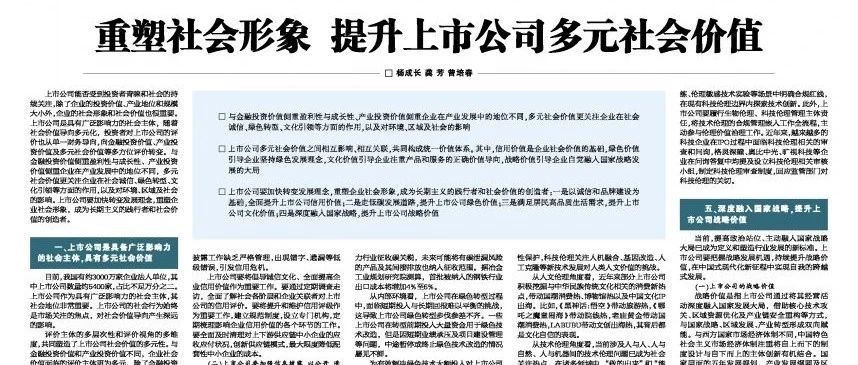
重塑社会形象 提升上市公司多元社会价值
申万宏源研究· 2025-07-31 07:49
Core Viewpoint - The article emphasizes the importance of multi-dimensional social value for listed companies, highlighting the need for companies to reshape their social image and become long-term value creators by focusing on credit, green, cultural, and strategic values [1][2][3]. Group 1: Multi-Dimensional Social Value - Listed companies play a significant role as influential social entities, with their social behavior being a focal point of market attention [2]. - The evaluation of social value is multi-faceted, involving various stakeholders such as financial investors, employees, consumers, and non-profit organizations, each with different perspectives [2][3]. - The social value of listed companies is interconnected, forming a unified value system where credit value serves as the foundation [4]. Group 2: Enhancing Credit Value - Credit value reflects a company's ability and willingness to fulfill commitments, impacting its social trust capital [5]. - Companies should prioritize integrity and brand building to enhance credit value, addressing shortcomings in credit management and information disclosure [6][8]. - High-quality information disclosure is crucial for improving credit value, with companies encouraged to adopt transparent practices and actively communicate their values [8][9]. Group 3: Green Value Development - Green value is defined as a company's ability to transform ecological responsibilities into sustainable competitiveness through green technology innovation [10]. - The relationship between green ecological value and market performance is significant, with compliance to environmental standards becoming a new market entry barrier [11]. - Companies should integrate green technology investments into their strategic planning to balance short-term performance with long-term sustainability [12][13]. Group 4: Cultural Value Enhancement - Cultural value encompasses a company's ability to guide social cultural development and meet residents' quality of life needs [15][16]. - Companies face challenges in aligning their products and services with consumer demands for high-quality living, often lacking in cultural value management [17][18]. - To enhance cultural value, companies should focus on innovative offerings that resonate with consumer aspirations and cultural identity [19][20]. Group 5: Strategic Value Integration - Strategic value refers to a company's alignment with national development goals, leveraging core technologies and regional resources [21][22]. - Companies must actively integrate their strategies with national priorities to uncover new opportunities and expand their development space [23][24]. - Strategic resources associated with national policies can provide significant support for companies, enabling them to pursue new business avenues [25].