
债市

Search documents
流动性周报:债市行情升温能否持续?-20251103
China Post Securities· 2025-11-03 10:46
Report Industry Investment Rating No relevant content provided. Core View of the Report - The bond market at the end of the year can be more optimistic. For the short - end, there is high configuration and trading value, and inter - bank certificates of deposit rates may decline unexpectedly at the end of the year. For the long - end, with the expansion of the term spread, there is room for repair, and the warming of trading sentiment may drive the long - end to re - price monetary easing, manifested as a limited compression of the term spread [3][5][19]. Summary According to the Directory 1. Can the Upward Trend of the Bond Market Continue? - **View Review**: The bond market in the fourth quarter may move in a volatile manner. The 30 - year minus 10 - year and 10 - year minus 1 - year treasury bond spreads have reflected the repair of risk preference. The liquidity, capital situation, and short - end interest rate valuations are reasonable, and the current bond market has allocation value. Supply pressure is about to ease, there may be an opportunity for monetary easing, and redemption pressure will persist. In a stable and loose capital environment, inter - bank certificates of deposit are in a high - configuration and high - trading value range and may decline unexpectedly at the end of the year [3][11]. - **Unexpected Bond Market Performance in Late October**: The repair of the bond market in the last week of October exceeded expectations. Some investors were surprised that the bond market remained stable after the broader market index stabilized at 4,000 points, and it seems that the buying power of trading accounts is continuously returning [3][11]. - **Central Bank Bond - Buying Restart**: It should be understood from the perspective of "continuation". The scale of net purchases may not exceed last year, and the increase in liquidity and buying power it provides may be limited. It should be understood more from the perspective of expectation repair and signaling. It can be regarded as a turning point for the re - warming of monetary easing expectations, which is a projection of trading sentiment. As the bond market trading sentiment is being repaired and the capital situation remains loose, the trading sentiment can be projected onto the expectation of monetary easing again [3][12][13]. - **Fading Negative Factors in the Bond Market**: The negative factors in the bond market at the end of the year and the beginning of the new year are gradually fading. The expectation of the pulling effect of the broad fiscal policy has been digested. Although the new policy - based financial instruments may have a greater pulling effect on investment demand than before, the bond market's expectation trading may be close to full. The impact of the local government bond scale and the public - offering fee rate new regulations may not be completely exhausted, but there is a basis for the repair of bond market sentiment [4][17][19]. 2. Risk Warning Not included as required.
债市升温,4-5y信用配置情绪较好:——信用周报20251103-20251103
Huachuang Securities· 2025-11-03 07:33
1. Report Industry Investment Rating - No information provided in the content 2. Core Views of the Report - This week, credit bond yields declined significantly, and spreads showed a divergent trend, with 4 - 5y varieties outperforming. Although the SSE Composite Index breaking through 4000 points had an impact on the bond market, the central bank's announcement of restarting treasury bond trading and the unexpected decline in the October manufacturing PMI led to a relatively strong performance in the bond market. The improvement in institutional sentiment towards credit bond allocation drove the relatively strong performance of 4 - 5y credit varieties, with a large narrowing in spreads, while most 1 - 2y varieties and medium - term notes over 5y widened passively [1][7]. - Key policies and hot events included the release of the "Administrative Measures for Asset Management Trusts (Draft for Comment)" by the Financial Regulatory Administration, Vanke receiving a loan of up to 2.2 billion yuan from its major shareholder Shenzhen Metro Group, Vanke's Q3 2025 report showing a decline in operating income and a net loss, and the central bank's report on the financial work situation indicating a significant reduction in the number of financing platforms and the scale of operating financial debts [1][2][10]. 3. Summaries According to the Table of Contents 3.1 Credit Bond Market Review: Most Yields Declined, 4 - 5y Varieties Performed Better - Credit bond yields declined significantly this week, and spreads showed a divergent trend, with 4 - 5y varieties outperforming. The central bank's announcement of restarting treasury bond trading and the unexpected decline in the October manufacturing PMI led to a relatively strong performance in the bond market. The improvement in institutional sentiment towards credit bond allocation drove the relatively strong performance of 4 - 5y credit varieties, with a large narrowing in spreads, while most 1 - 2y varieties and medium - term notes over 5y widened passively [1][7]. 3.2 Key Policies and Hot Events: Vanke Received Another Loan from Shenzhen Metro Group, and the "Administrative Measures for Asset Management Trusts (Draft for Comment)" was Released - On October 31, the Financial Regulatory Administration released the "Administrative Measures for Asset Management Trusts (Draft for Comment)" to strengthen supervision, prevent risks, and standardize the development of the trust industry [10]. - On October 30, Vanke announced that its major shareholder Shenzhen Metro Group would provide a loan of up to 2.2 billion yuan to repay the principal and interest of its publicly - issued bonds. As of the announcement date, Shenzhen Metro Group had provided a cumulative loan of 26.93 billion yuan (excluding this time) [2][10]. - On October 30, Vanke released its Q3 2025 report. In the first three quarters, the company's total operating income was 161.388 billion yuan, a year - on - year decrease of 26.61%, and the net profit attributable to the parent company was a loss of 28.016 billion yuan, a year - on - year decrease of 56.14%. Although Vanke's self - repayment ability was weak, it had received support from its major shareholder and financial institutions [2][11]. - On October 28, the central bank released the State Council's report on the financial work situation, stating that as of the end of September 2025, the number of national financing platforms and the scale of operating financial debts had decreased by 71% and 62% respectively compared to the end of March 2023, and risks had been significantly mitigated. The central bank emphasized continuing to support the debt - resolution work of financing platforms and their market - oriented transformation [2][12]. 3.3 Secondary Market: Credit Bond Yields Generally Declined, and Credit Spreads Showed a Divergent Trend - Yields of medium - and short - term notes generally declined by 2 - 13BP, with spreads of 4 - 5y varieties narrowing by 4 - 8BP, and spreads of most other maturities widening by 0 - 4BP [14]. - For urban investment bonds, yields of various varieties generally declined by 4 - 11BP, with 4 - 5y varieties performing better. Credit spreads showed a divergent trend, with spreads of most varieties narrowing by 1 - 6BP [14]. - For real estate bonds, except for the 1y and 3y AAA varieties, yields of other varieties generally declined by 3 - 12BP. Spreads of most varieties generally narrowed by 0 - 8BP [15]. - For cyclical bonds, yields of coal bonds generally declined by 2 - 12BP, and spreads of most varieties narrowed by 0 - 9BP. Yields of steel bonds generally declined by 3 - 12BP, and spreads of most varieties narrowed by 0 - 8BP [15]. - For financial bonds, yields of bank secondary capital bonds and perpetual bonds of various maturities declined by 5 - 12BP, and spreads of most varieties narrowed by 1 - 8BP. Yields of securities firm sub - bonds generally declined by 1 - 9BP, and spreads of most varieties generally narrowed by 0 - 3BP. Yields of insurance sub - bonds generally declined by 5 - 11BP, and spreads of most varieties generally narrowed by 1 - 4BP [15]. 3.4 Primary Market: Net Financing of Credit Bonds and Urban Investment Bonds Declined Month - on - Month - This week, the issuance scale of credit bonds was 224.8 billion yuan, a month - on - month decrease of 246.7 billion yuan, and the net financing was - 12.6 billion yuan, a month - on - month decrease of 148.5 billion yuan. The issuance scale of urban investment bonds was 105.6 billion yuan, a decrease of 5.83 billion yuan from last week, and the net financing was - 36.6 billion yuan, a decrease of - 4.96 billion yuan from last week [4]. 3.5 Trading Liquidity: Trading Activity in the Inter - bank Market Decreased, and Trading Activity in the Exchange Market Increased - This week, the trading activity of credit bonds in the inter - bank market decreased, and the trading volume decreased from 586 billion yuan last week to 580.7 billion yuan. The trading activity in the exchange market increased, and the trading volume increased from 381.7 billion yuan last week to 435.8 billion yuan [4]. 3.6 Rating Adjustment: One Entity's Rating was Upgraded, and No Entity's Rating was Downgraded - This week, the rating of one entity was upgraded, and no entity's rating was downgraded [4].

债市:10月金融数据预测,债市继续进攻
2025-11-03 02:35
Summary of Key Points from Conference Call Records Industry Overview - **Debt Market**: The focus is on the Chinese debt market, with predictions for financial data in October indicating a continued aggressive stance in the debt market [1][2]. Core Insights and Arguments - **Weak Credit Demand**: Anticipated new loans in October are expected to be negative, around 300 billion, a significant year-on-year decrease of 200 billion. This reflects insufficient corporate financing demand and local government debt control, posing challenges to economic recovery [1][2]. - **M1 Growth Pressure**: M1 growth is projected to decline month-on-month in October, primarily due to seasonal bank wealth management impacts and a low base from the previous year. A significant drop in M1 growth is expected in Q4 as the year-on-year base normalizes, indicating weakened corporate vitality [1][4]. - **Social Financing Growth Slowdown**: The expected social financing increment for October is 980 billion, a year-on-year decrease mainly from credit and net financing of government bonds. By year-end, social financing growth is predicted to fall to around 8.0% [1][5]. - **Real Estate Market Risks**: The real estate market continues to decline, with average housing prices dropping by 50%, potentially triggering financial risks. National banks are generally pessimistic about the economy due to poor performance across various sectors [1][6]. - **Optimism in Debt Market**: Non-bank institutions have shifted to a more optimistic view of the debt market, bolstered by central bank purchases of government bonds, leading to a belief that bond yields have reached a temporary bottom, with a bullish outlook for Q4 [1][8]. - **Banking Sector Dynamics**: The decline in bank funding costs has significantly enhanced their motivation to purchase local bonds. Major banks view local bonds as high cost-performance investments and are actively increasing their government bond investments [3][11]. Additional Important Insights - **Policy Tools Impact**: The injection of 500 billion in policy tools has only partially alleviated local government fiscal pressures, with limited effects on overall credit demand and infrastructure investment growth [1][7]. - **Future Economic Outlook**: The economic outlook for 2026 suggests increasing downward pressure, exacerbated by a real estate crisis and declining consumer subsidies, leading to lower consumption growth and excess inventory [1][10]. - **Long-term Interest Rate Trends**: The long-term downward trend in interest rates is expected to continue, with potential for the 10-year government bond yield to challenge 1.6% if the central bank lowers rates in December [1][13][17]. - **Market Reactions to Regulatory Changes**: New guidelines for public fund performance benchmarks may significantly impact the stock market, leading to a more cautious approach in fund management and potentially benefiting underweighted sectors [1][16][18]. Conclusion - The overall sentiment in the debt market is bullish for the upcoming months, driven by economic pressures, declining bank funding costs, and ongoing central bank policies. Investors are encouraged to increase their positions in government bonds and extend durations to capitalize on favorable market conditions [1][14][19][20].
10月PMI点评:基本面对债市的定价权再次确认
Changjiang Securities· 2025-11-02 23:30
1. Report Industry Investment Rating No information provided in the given content. 2. Core Viewpoints of the Report - In October 2025, the decline of manufacturing PMI, weaker than the seasonal level and with weakening supply and demand, may indicate certain downward pressure on the Q4 economy [2][7]. - Both domestic and external demands declined, and price indicators did not continue the improvement trend of last month. The differentiated structure of "strong raw material prices and weak finished - product prices" may restrict the repair of corporate profits [2][7]. - The business climate of large enterprises fell below the boom - bust line, and the business climates of high - tech manufacturing and equipment manufacturing industries significantly declined [2][7]. - The business climate of the non - manufacturing industry is mainly driven by holiday service consumption, and the overall expansion strength is still weak [2][7]. - The trading logic of the bond market in Q4 focuses on the weakening economic fundamentals and the expectation of monetary easing, and a repair market may be welcomed. It is expected that the yield of the active 10 - year treasury bond (tax - exempt) may decline to 1.65% - 1.7%, and the yield of the taxable bond may decline to 1.7% - 1.75% [2][7]. 3. Summary by Relevant Catalogs 3.1 Event Description - In October 2025, the manufacturing PMI was 49.0%, a decrease of 0.8 pct from the previous month, lower than the Wind consensus forecast of 50.0%. The non - manufacturing business activity index slightly increased by 0.1 pct to 50.1%, slightly higher than the boom - bust line and lower than the Wind consensus forecast of 50.3%. Among them, the service industry business activity index was 50.2%, an increase of 0.1 pct, and the construction industry business activity index was 49.1%, a decrease of 0.2 pct [5]. 3.2 Event Comment - **Manufacturing PMI and economic pressure**: The manufacturing PMI in October 2025 fell back to a nearly two - year low. The production index and new order index decreased by 2.2 pct and 0.9 pct respectively to 49.7% and 48.8%. The procurement volume index decreased significantly by 2.6 pct to 49.0%, and the difference between the "finished - product inventory - on - hand orders" index widened by 0.6 pct to 3.6 pct. The weak pattern of production and demand was partly due to the pre - release of some demand before the National Day holiday and partly reflected the lack of endogenous momentum, indicating certain downward pressure on the Q4 economy [7]. - **Demand and price situation**: In October, external demand did not continue its resilience, and the new export order index significantly declined by 1.9 pct to 45.9%. The new order index for domestic demand also turned from rising to falling. The main raw material purchase price index and the ex - factory price index both decreased by 0.7 pct, recording 52.5% and 47.5% respectively. The difference between them remained at 5.0 pct, and the main raw material purchase price index was still in the expansion range. The "strong raw material prices and weak finished - product prices" structure may restrict the repair of corporate profits [7]. - **Enterprise and industry changes**: Among enterprises, the PMIs of large and small enterprises both fell by 1.1 pct to 49.9% and 47.1% respectively, and the PMI of medium - sized enterprises slightly fell by 0.1 pct to 48.7%. In terms of industries, the PMIs of high - tech manufacturing and equipment manufacturing industries were 50.5% and 50.2% respectively, a decline of 1.1 pct and 1.7 pct from the previous month. The consumer goods industry remained in the expansion range, slightly falling by 0.5 pct to 50.1%, while the PMI of the basic raw material industry further dropped to 47.3%. The overall market expectation was optimistic, with the production and business activity expectation index at 52.8%, and the expectation indexes of industries such as non - ferrous metals and transportation equipment rising to the high - level boom range above 60% [7]. - **Non - manufacturing industry situation**: In October, the non - manufacturing PMI slightly increased by 0.1 pct to 50.1%, and the service industry PMI rose to 50.2%. The on - hand order index fell by 0.8 pct while the new order index remained flat, indicating that the holiday effect was the main driver. The business activity indexes of industries such as transportation, accommodation, and culture and entertainment were all in the high - level boom range above 60%, but industries such as real estate continued to be sluggish. The construction industry business activity index turned from rising to falling, decreasing by 0.2 pct to 49.1%, possibly dragged down by the slowdown of holiday construction and the decline of post - holiday real estate sales [7]. - **Bond market outlook**: Currently, the endogenous momentum for the repair of production and demand may be limited. On the day when the PMI data was released, the yield of the 10 - year treasury bond active bond decreased by 0.95 BP. The economic fundamentals still face a pattern of weak supply and demand, the pressure on enterprises for passive inventory replenishment continues, and the ex - factory - raw material price gap still restricts the repair of corporate profits. Although 500 billion yuan of new policy - based financial instruments have been put in place and local governments have an additional 200 billion yuan of special bond quotas, the sustainability of the recovery of real estate sales and the transmission effect of policy funds on infrastructure investment still need to be observed. The trading logic of the bond market in Q4 focuses on the weakening economic fundamentals and the expectation of monetary easing, and a repair market may be welcomed. It is expected that the yield of the active 10 - year treasury bond (tax - exempt) may decline to 1.65% - 1.7%, and the yield of the taxable bond may decline to 1.7% - 1.75% [7].
11月债市,破局之时
HUAXI Securities· 2025-11-02 08:31
Report Industry Investment Rating No information provided in the given content. Core Viewpoints of the Report - In November, the bond market is expected to break through and start a downward trend, with a higher probability of yield decline. If the market restarts the expectation of interest rate cuts, the long - term interest rate is expected to challenge the low level before the bond market adjustment in July. The 10 - year treasury bond yield may fall to 1.70%, and the 30 - year treasury bond yield may drop to the range of 2.00 - 2.05%. [7][61] - The fundamental data in October may be weak. With the prior implementation of fiscal and quasi - fiscal policies in the fourth quarter, interest rate cuts may become a more flexible incremental stimulus tool, and the bond market may restart the trading of the expectation of "looser monetary policy". [2][30] - The potential negative factors in the bond market in November, such as government bond supply and bond fund redemption fee regulations, may have a lower - than - expected impact due to regulatory and market precautions. [3][34] - Institutional behavior in November may affect the market through two main lines. The short - and long - end assets may be repriced, and the profit - taking power of the allocation disk may slow down the decline of interest rates but is less likely to reverse the upward trend. [6][45] Summary According to the Table of Contents 1. October Bond Market: Calm After the Storm - In October, the long - term interest rate continued the trading logic of September and achieved a "step - down" due to the decline in risk appetite caused by the US tariff pressure. The 10 - year treasury bonds generally showed a "head - and - shoulders top" pattern, indicating that the interest rate may have basically completed the topping process. [1] - The bond market pricing in October was mainly based on three main lines: when the central bank would buy bonds, the evolution of Sino - US relations, and the new regulations on bond fund redemption fees. The market could be divided into three stages. [13] - In terms of various bond market varieties in October, interest - rate bonds recovered, and credit bonds were stronger than interest - rate bonds. The yields of most bonds declined. [17][18] 2. Macro - Narrative Vacuum Period: Rising Expectations of Interest Rate Cuts - In November, before the Politburo meeting and the Central Economic Work Conference in December, the market will enter a macro - narrative vacuum period. Whether the macro - economic data in October can boost the expectation of interest rate cuts will be the key to bond market pricing. [22] - The manufacturing PMI in October was lower than expected, with significant drag from production and new order sub - items, indicating a possible economic slowdown. [22] - The end - of - month bill interest rates approaching zero in October suggest that credit demand may have returned to a low point. [23][24] - High - frequency price data indicates that the year - on - year decline of PPI in October may widen again. [29] 3. Government Bond Supply and Bond Fund Redemption Fee Regulations: Apparent Negative Factors - The potential negative factors in the bond market in November are the significant increase in government bond net supply compared to October and the uncertainty of the official implementation of the new regulations on public bond fund redemption fees. However, the actual impact may be lower than expected due to regulatory and market precautions. [3][34] - The slow issuance of local government bonds in October is likely to be accelerated in November and December. It is estimated that the net supply of government bonds in November and December will be 1.23 trillion and 0.81 trillion yuan respectively. The large - scale supply in November may prompt the central bank to strengthen liquidity support, and the capital market may remain stable. [3][35] - If the new regulations on bond fund redemption fees are strictly implemented as in the solicitation draft, the bond market may experience a short - term shock at the time of implementation, especially credit - type bond funds may be more affected. [5][40] 4. Institutional Behavior: Returning to a Neutral Variable - In November, institutional behavior may affect the market through two main lines. The short - and long - end assets may be repriced. After the central bank announced the resumption of treasury bond trading operations, the market's willingness to price short - term varieties increased, and the long - term interest rate may decline as the negative factors in the bond market are exhausted and institutional investors pursue year - end performance. [6][45] - The profit - taking power of the allocation disk may slow down the decline of interest rates but is less likely to reverse the upward trend. Banks' self - operated institutions may prefer to take profits during the bond market's upward period. [51] 5. Bond Market Breakthrough: Starting a Downward Trend - Currently, the bond market has two characteristics: low duration and limited short - selling power. The risk of trading long - term bonds is relatively controllable. [55][58] - It is predicted that the bond market yield in November is more likely to decline. The bond market strategy in November can consider increasing duration on rallies, and priority can be given to ultra - long treasury bonds or policy - financial bonds with sufficient spread protection. Tax - inclusive bonds may perform better. [7][61]
国债衍生品周报-20251102
Dong Ya Qi Huo· 2025-11-02 01:49
Report Summary 1. Report Industry Investment Rating No relevant content provided. 2. Core View of the Report - The short - term market is mainly volatile. Traders should pay attention to the impact of the capital market and equity market fluctuations on the bond market [2]. 3. Summary by Related Catalogs 3.1 Market Influencing Factors - **L利多因素**: The central bank increased the volume of MLF to maintain abundant liquidity, and the loose capital market supported the bond market sentiment. The basic consensus reached in the Sino - US economic and trade consultations led to a phased increase in market risk appetite [2]. - **利空因素**: The strengthening of the equity market suppressed the bond market sentiment, with a significant stock - bond seesaw effect. The yield of 10 - year treasury bonds increased, and the adjustment of spot bonds dragged down the performance of futures [2]. 3.2 Market Data - **国债到期收益率**: Data on 2Y, 5Y, 10Y, 30Y, and 7Y treasury bond yields from April 2024 to August 2025 are presented [3]. - **资金利率**: Data on deposit - type institutional pledged repurchase weighted interest rates (1 - day and 7 - day) and 7 - day reverse repurchase rates from December 2023 to June 2025 are shown [3]. - **国债期限利差**: Data on the term spreads of 7Y - 2Y and 30Y - 7Y from April 2024 to August 2025 are provided [4][5]. - **国债期货持仓**: Data on the positions of 2 - year, 5 - year, 10 - year, and 30 - year treasury bond futures from December 2015 to December 2023 are given [8]. - **国债期货成交**: Data on the trading volumes of 2 - year, 5 - year, 10 - year, and 30 - year treasury bond futures from April 2024 to August 2025 are presented [9]. - **国债期货基差**: Data on the basis of the current - quarter contracts of 2 - year, 5 - year, 10 - year, and 30 - year treasury bond futures are provided, with different time ranges for each [10][11][12][14]. - **国债期货跨期价差**: Data on the current - quarter minus next - quarter spreads of 2 - year, 5 - year, 10 - year, and 30 - year treasury bond futures are given, with different time ranges for each [18][20]. - **跨品种价差**: Data on the TS*4 - T and T*3 - TL cross - variety spreads are provided, with different time ranges for each [21][22].
债市波动下如何布局?民生理财:中短期内债市胜率偏低
2 1 Shi Ji Jing Ji Bao Dao· 2025-10-31 10:37
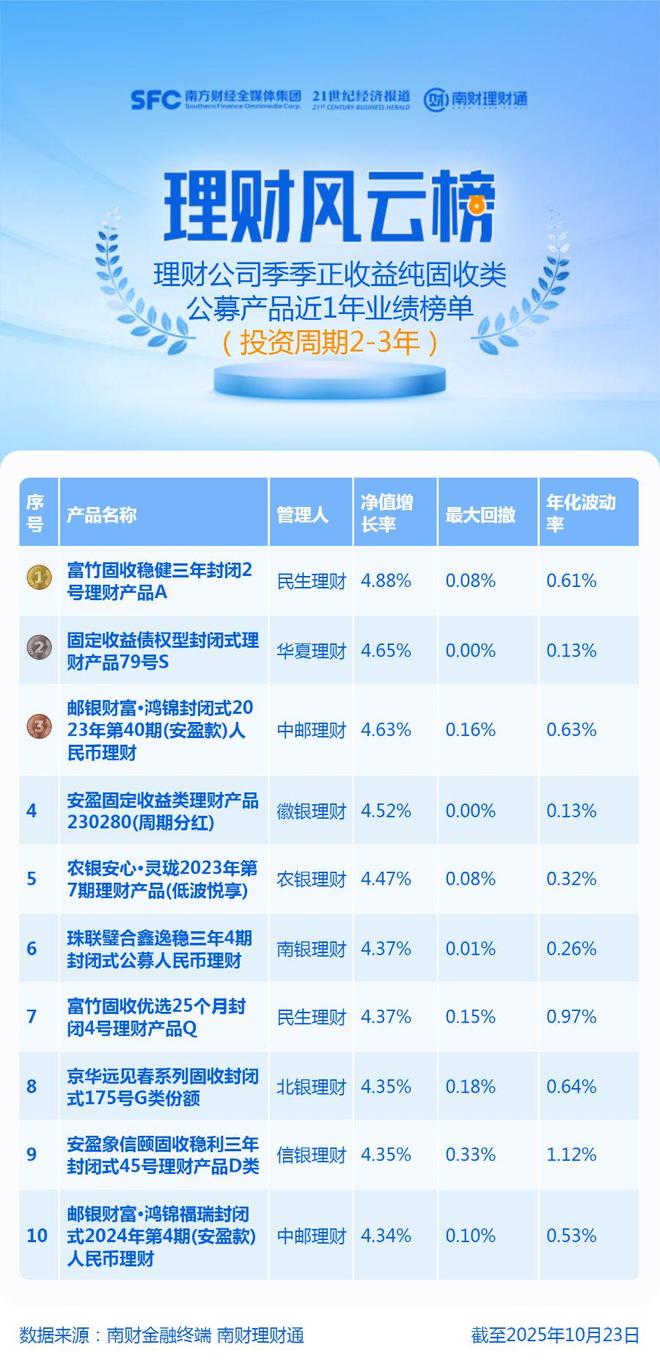
Overall Performance - As of October 23, 2025, there are 982 public pure fixed-income products with a duration of 2-3 years, of which 694 have complete net value disclosures. The average net value growth rate over the past year is 3.29%, with an average maximum drawdown of 0.16% [5] - Among these products, 615 achieved positive returns each quarter, representing 88.6% of the total [5] - The top three products by net value growth rate are: Minsheng Wealth's "Fuzhu Fixed Income Stable Three-Year Closed No. 2 Product A" at 4.88%, Huaxia Wealth's "Fixed Income Debt Closed Product No. 79S" at 4.65%, and Zhongyou Wealth's "Zhongyou Wealth Hongjin Closed 2023 No. 40 (Anying Fund) RMB Financial Product" at 4.63% [5] Highlighted Product Analysis - Minsheng Wealth's "Fuzhu Fixed Income Stable Three-Year Closed No. 2 Product A" primarily invests in medium to high-grade credit bonds, achieving a net value growth rate of 6.985% since inception. As of the 2025 semi-annual report, the bond holding ratio is 91.69%, with the top ten holdings being credit bond assets, accounting for 41.94% [6] - Minsheng Wealth attributes the performance to the continuous strength of the equity market and the impact of new public fund sales regulations, leading to a decline in bond yields, particularly in long-end trading varieties. The outlook suggests that the equity market's expectations and institutional behaviors will negatively impact the bond market, indicating a lower probability of success in the short to medium term [6]

债市韧性持续显现,30年国债ETF博时(511130)震荡上行,近5日“吸金”合计超6亿元
Sou Hu Cai Jing· 2025-10-31 05:40
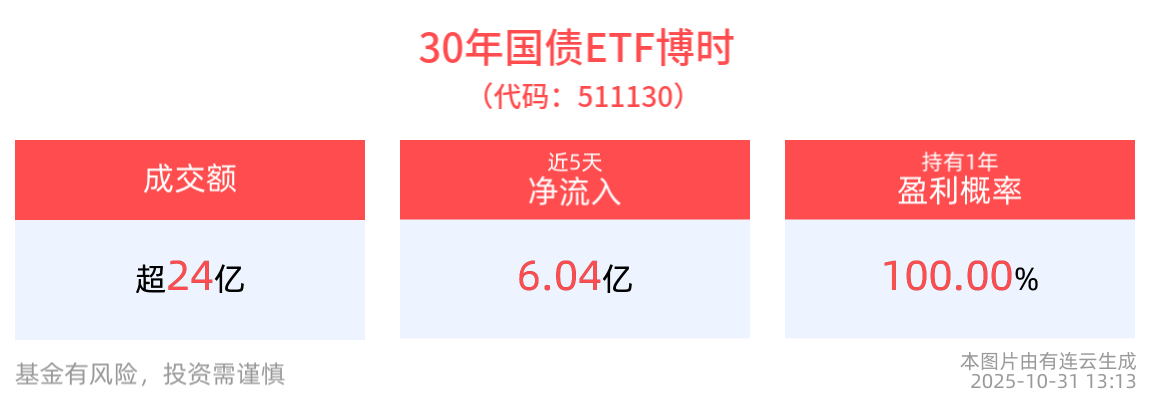
Core Insights - The 30-year government bond ETF from Bosera has seen a price increase of 0.30% as of October 31, 2025, with a recent price of 107.83 yuan, and a cumulative increase of 0.60% over the past week [2] - The liquidity of the ETF is robust, with a turnover rate of 13.25% and a trading volume of 2.433 billion yuan, indicating active market participation [2] - The People's Bank of China (PBOC) conducted a 7-day reverse repo operation of 355.1 billion yuan at a stable interest rate of 1.40%, contributing to a slight decline in yields for major government bonds [2] - The sentiment in the bond market has improved due to factors such as PBOC's bond purchases, the need for low interest rates for economic recovery, and positive developments in US-China negotiations [2] Market Analysis - Analysts suggest that the PBOC's resumption of open market operations is a response to the diminishing impact of earlier factors that led to a pause, and it is necessary for liquidity management and government bond issuance [3] - Southwest Securities notes that despite challenges in the third quarter, the bond market has shown resilience, with long-term funds from banks, wealth management, and insurance continuing to increase their allocations [3] - The latest scale of the 30-year government bond ETF from Bosera is 18.264 billion yuan, with a net inflow of 195 million yuan recently, indicating strong demand [3] - Over the past five trading days, there have been net inflows on four occasions, totaling 604 million yuan, with an average daily net inflow of 121 million yuan [3]
每日债市速递 | 超五成债基三季度被净赎回
Wind万得· 2025-10-30 22:37
Group 1: Open Market Operations - The central bank conducted a 7-day reverse repurchase operation of 342.6 billion yuan at a fixed rate of 1.40% on October 30, with a net injection of 130.1 billion yuan for the day after accounting for 212.5 billion yuan in reverse repos maturing [1]. Group 2: Funding Conditions - The end of the tax period has led to continued net injections by the central bank, resulting in a further easing of the interbank funding market. The overnight repo rate for deposit-taking institutions fell over 9 basis points to around 1.31%, with ample supply in the market [3]. - The latest overnight financing rate in the U.S. stands at 4.31% [3]. Group 3: Interbank Certificates of Deposit - The latest transaction rate for one-year interbank certificates of deposit among major banks is at 1.64%, showing a slight decrease from the previous day [7]. Group 4: Bond Market Overview - Major interest rate bonds in the interbank market have seen yields decline, with the 30-year main contract rising by 0.19% and the 10-year main contract increasing by 0.05% [13]. Group 5: International Relations and Economic Cooperation - Chinese President Xi Jinping and U.S. President Donald Trump discussed economic and trade issues, emphasizing the importance of cooperation and the need to avoid a cycle of retaliation. Both sides aim to finalize agreements to enhance economic ties [14]. - The U.S. will cancel certain tariffs on Chinese goods, while China will adjust its countermeasures accordingly, indicating a potential thaw in trade relations [15]. Group 6: Financial Policy Developments - The Ministry of Finance and other departments issued a notice to improve duty-free shop policies to boost consumption, effective from November 1, 2025 [15]. - The National Financial Regulatory Administration announced the expansion of pilot programs for pension financial products nationwide, with increased fundraising limits for financial institutions [16].

债市专题研究:科技股牛市对债市影响的海外经验
ZHESHANG SECURITIES· 2025-10-30 05:16
Report Industry Investment Rating - The report does not provide an industry investment rating. Core Viewpoints - Referring to the experience of Japan and South Korea during their technology transformation phases, the technology bull market did not significantly impact the bond market. Bond investors need not overly worry about the ongoing technology bull market in the equity market. The linkage between stock and bond markets is more of a short - term factor, and long - term bond market pricing should still consider fundamental factors [1][3][31]. Summary According to the Table of Contents 1. Overseas Experience of the Impact of the Technology Stock Bull Market on the Bond Market Japan: From "Trade - Oriented" to "Technology - Oriented" - After World War II, Japan implemented a "trade - oriented" economic strategy, achieving relatively high economic growth from 1956 - 1973. In the 1970s, due to the loss of labor dividends and the oil crisis, Japan shifted towards a technology - oriented economy [1][10]. - The government introduced a series of policies to support high - tech industries. The VLSI plan promoted the development of the semiconductor industry, leading to a technology stock bull market. From 1970 - 1985, the Nikkei 225 index rose from about 2300 to about 13000, and the information and communication industry index reached 31.75 in 1985, compared to 1 in January 1970 [13][14]. - From 1975 - 1985, the Japanese bond market was highly volatile, mainly due to the two oil crises in 1973 and 1980. The bond yield changed with inflation and policy interest rates, and the stock - bond seesaw effect was not significant. After 1980, there was a period of stock - bond double - bull [18]. South Korea: Comprehensive Promotion of Technology Transformation - South Korea's economic transformation was similar to Japan's, gradually shifting from labor - intensive to capital - intensive and then to technology - intensive. In 1986, it proposed a technology - oriented strategy and launched a series of plans to support high - tech industries [2][23]. - After 1986, the South Korean stock market entered two accelerated growth periods. In the first half of 1997, the stock market rebounded, led by the electrical and electronic equipment industry, while the national bond yield remained stable or declined, showing a simultaneous strengthening of stock and bond markets [2][26]. Comparison with China - China is currently in an important economic transformation stage, with the economic growth engine shifting from traditional industries to emerging industries, and the role of consumption in driving domestic demand increasing. China has formed a technology - led equity market bullish atmosphere [3][29]. - Similar to Japan and South Korea, the linkage between the stock and bond markets in China may be limited. The stock - bond seesaw effect in the third quarter was likely due to short - term factors, and the long - term bond market pricing depends on fundamental and policy factors [3][30].
