
贸易协议

Search documents
KCMTrade分析师Tim汇评 | 美联储降息与市场反应:鲍威尔的声明引发波动
Sou Hu Cai Jing· 2025-10-30 06:25
Group 1 - The Federal Reserve's FOMC meeting was a key event this week, with a 25 basis point rate cut as expected, but the main focus was on Chairman Jerome Powell's comments regarding potential actions in December [1] - Powell's remarks dampened market expectations for another rate cut in December, leading to increased pessimism among investors regarding the likelihood of further cuts by year-end [1] - The strengthening of the US dollar and rising US Treasury yields were beneficiaries of the Fed's hawkish stance, with the dollar index (DXY) climbing back above 99 [1] Group 2 - The rebound in oil prices from last week's lows was influenced by US sanctions on Russian oil companies, raising concerns about the impact on crude imports from China and India [4] - Despite the recovery, speculation about OPEC+ potentially announcing further production increases in December limited the upside for oil prices [4] Group 3 - Over 83% of S&P 500 companies have reported earnings exceeding expectations during the ongoing Q3 earnings season, with a particular focus on technology giants expected to deliver robust earnings to support high valuations [6] Group 4 - The Bank of Japan and the European Central Bank are expected to maintain interest rates unchanged in their upcoming policy announcements, with the Japanese yen under pressure due to anticipated economic stimulus measures following the recent elections [7] - Japan's core CPI rose to 2.9%, above the 2% inflation target, which may lead the Bank of Japan to consider further rate hikes by year-end [7]

铜价下跌 此前受贸易协议希望提振而创下纪录高位
Sou Hu Cai Jing· 2025-10-30 02:49
Core Viewpoint - Copper prices have declined in early Asian trading, retreating from record highs due to market concerns over supply disruptions [1] Group 1: Market Trends - LME three-month copper contracts fell by 1.0% to $11,071.00 per ton [1] - The market is closely analyzing the Federal Reserve's latest interest rate decision, which typically influences metal prices positively [1] Group 2: Demand and Supply Factors - Optimism regarding a potential trade agreement has been a key factor driving recent copper price increases [1] - Positive demand outlook and supply issues have been impacting price trends, although there are concerns that these disruptions may undermine confidence in the expected outcomes of developing projects [1]
美总统到访,韩国送了一顶金冠
Huan Qiu Shi Bao· 2025-10-29 23:37
Group 1: Trade Agreement Outcomes - The unexpected trade agreement reached during the summit includes a total investment plan of $350 billion from South Korea to the U.S., with $200 billion in cash investments and $150 billion allocated for shipbuilding cooperation under the "Make American Shipbuilding Great Again" initiative [3][4] - The agreement stipulates a reduction in automotive tariffs from 25% to 15%, aligning with the rates negotiated by Japan and the U.S. Other categories such as pharmaceuticals and wooden products will receive most-favored-nation treatment, while certain materials will be subject to zero tariffs [3][4] - Semiconductor tariffs will be set at a level not lower than that of Taiwan to ensure the competitiveness of South Korean companies [3][4] Group 2: Defense and Security Cooperation - The summit resulted in a new consensus on defense and security, with South Korea planning to enhance its defense capabilities through increased defense budgets and the development of its defense industry [4] - South Korea aims to initiate a nuclear-powered submarine project to improve maritime deterrence and strategic mobility, which was acknowledged by President Trump, who agreed to establish follow-up consultation mechanisms [4] - The strategic cooperation will focus on nuclear submarine propulsion systems, shipbuilding industries, and defense equipment [4] Group 3: Diplomatic Context and Reactions - The summit was marked by a high level of hospitality, with South Korea welcoming President Trump with a 21-gun salute and a special gold tie presented to him by President Yoon Suk-yeol, symbolizing the "golden future" of the Korea-U.S. alliance [5][6] - Despite the celebratory atmosphere, there were protests nearby, indicating some domestic dissent regarding the summit and its outcomes [6] - The timing of North Korea's missile test was interpreted by experts as a strategic move, coinciding with the summit, while also leaving room for future dialogue despite rejecting Trump's meeting proposal [7][8]
血亏!金价遭“闷杀”,亚洲股市歇火,贸易预期成元凶?
Sou Hu Cai Jing· 2025-10-29 23:11
Group 1: Gold Market - The price of spot gold dropped by 2.7% to $4002.29 per ounce, reaching a three-week low, while December futures fell by 2.9% to $4019.70 per ounce [3] - Prior to this decline, gold prices had surged from $3800 to $4400 per ounce in the first three weeks of October, attracting many investors [3] - The drop in gold prices is linked to easing trade tensions, which reduced demand for safe-haven assets, as noted by High Ridge Futures' metal trading head [3] Group 2: Asian Stock Markets - Asian stock markets experienced a downturn, with the MSCI Asia-Pacific Index (excluding Japan) falling by 0.1% and the Nikkei Index declining by 0.2% after a previous 2.5% rise [5] - The South Korean Composite Stock Price Index dropped by 1.4% despite positive third-quarter economic growth data [5] - The gold sector in A-shares was also affected, with Shandong Gold's stock price falling by 3.2% on October 28, indicating increased selling pressure [5] Group 3: Federal Reserve and Interest Rates - The upcoming Federal Reserve interest rate decision is highly anticipated, with over 97% of the market expecting a 0.25 percentage point cut, and some advocating for a more aggressive 50 basis point reduction [7] - The yield on 10-year U.S. Treasury bonds remained stable at around 3.98% prior to the decision [7] Group 4: Oil and Currency Markets - The oil market saw a slight decline in prices due to OPEC+ production increase news [8] - The currency market remained stable, with the dollar index consolidating and the euro slightly rising to 1.1659 against the dollar [8] Group 5: Market Outlook - Despite recent market volatility, experts remain optimistic about gold's long-term potential, predicting it could reach $5000 per ounce [10] - Upcoming earnings reports from major technology companies may provide new momentum for the stock market [10]

特朗普称贸易协议“几乎敲定”,韩国确认对美分期投资2000亿美元现金
Guan Cha Zhe Wang· 2025-10-29 15:54
Core Points - The trade agreement between the US and South Korea, which had faced delays due to disagreements over a $350 billion investment plan, is nearing completion following a meeting between President Trump and President Yoon Suk-yeol at the APEC summit [1][3][5] Group 1: Investment Details - South Korea plans to invest $200 billion in cash and $150 billion in shipbuilding cooperation as part of the $350 billion investment in the US [3][4] - The investment will be structured through a Special Purpose Company (SPC) to offset losses from one project with profits from another [3][4] - The South Korean government has implemented multiple safeguards to limit financial risks and protect the foreign exchange market, ensuring that only commercially viable projects receive investment [3][4] Group 2: Tariff Adjustments - The US will reduce tariffs on South Korean automobiles from 25% to 15%, while certain items like pharmaceuticals will receive most-favored-nation treatment and zero tariffs will apply to specific natural resources [4][5] - The agreement will align South Korea's semiconductor tariffs with those of Taiwan, but no additional openings in the agricultural market have been made [4][5] Group 3: Market Reactions and Public Sentiment - Following the announcement of the nearing agreement, the South Korean won appreciated by 0.9% against the US dollar, reflecting reduced concerns over the trade deal [5][6] - Public sentiment in South Korea is largely negative towards the US's investment demands, with 80.1% of respondents in a poll considering the $350 billion requirement unfair [6][8]
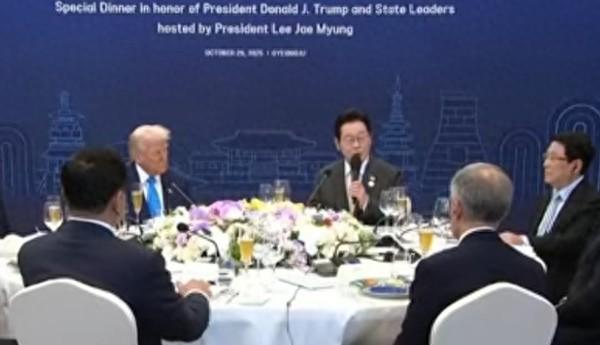
韩美就关税具体内容达成协议 汽车关税将降至15%
Zhong Guo Ji Jin Bao· 2025-10-29 12:30
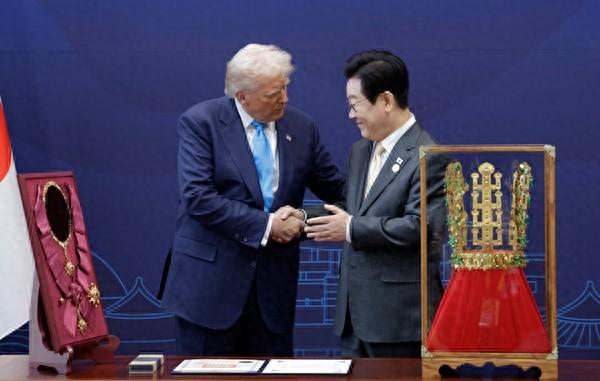
Core Points - The US and South Korea have reached an agreement on tariffs, with auto tariffs set to decrease to 15% from the previous 25% [2][5] - South Korea will invest $350 billion in the US, with $200 billion paid in installments and $150 billion allocated for shipbuilding [2][3] - A special purpose company will be established for US investment projects, focusing on commercially viable initiatives [2][6] Tariff Agreement - The US will maintain a 15% tariff on South Korean goods, while auto tariffs will be reduced to 15% [2] - The agreement aims to improve the trade environment for South Korean companies [2] Investment Details - South Korea's investment will be phased, rather than a one-time payment, with profits shared 50:50 before recovering initial investments [2][3] - The maximum annual funding provided to the US by South Korea is set at $20 billion [2] Bilateral Cooperation - The leaders of both countries expressed a commitment to expand economic cooperation centered around the shipbuilding industry [6] - South Korea aims to support US manufacturing revitalization through increased investments and imports [6] Defense and Security - Discussions included the importance of defense industrial cooperation, with South Korea requesting nuclear submarine fuel supplies [6] - The agreement is expected to alleviate some defense responsibilities for the US military in the region [6] Diplomatic Relations - South Korean President Lee Jae-myung awarded US President Trump the highest honor, the Order of Mugunghwa, highlighting the close relationship between the two leaders [7]
突发!关税大消息!
Zhong Guo Ji Jin Bao· 2025-10-29 12:05
Group 1 - The core agreement between South Korea and the United States involves a reduction of automotive tariffs to 15%, down from the previous 25% [2] - The investment plan includes a total of $350 billion, with $200 billion to be paid in installments and $150 billion allocated for shipbuilding [2] - South Korea will set an annual funding limit of $20 billion for investments in the U.S., with profits shared on a 50:50 basis before recovering initial investments [2] Group 2 - The meeting between South Korean President Lee Jae-myung and U.S. President Trump emphasized expanding economic cooperation centered around the shipbuilding industry [6] - Trump acknowledged the importance of the shipbuilding sector and expressed confidence in the U.S. returning to a leading position in global shipbuilding [6] - Lee requested the supply of nuclear submarine fuel from the U.S., clarifying that South Korea does not intend to build submarines equipped with nuclear weapons [6][7]
突发!关税大消息!
中国基金报· 2025-10-29 11:51
Core Points - The core agreement between South Korea and the United States involves a reduction of automobile tariffs to 15% and a commitment from South Korea to invest $350 billion in the U.S. over time [3][5][6]. Group 1: Tariff Agreement - South Korea and the U.S. have reached an agreement where the automobile tariff will be reduced to 15%, down from the previous 25% [5][6]. - The U.S. will continue to impose a 15% tariff on South Korean goods overall [5]. Group 2: Investment Commitments - South Korea will invest $350 billion in the U.S., with $200 billion to be paid in installments and $150 billion allocated for shipbuilding [5][6]. - The investment will be phased rather than a one-time payment, and profits will be shared equally (50:50) before the initial investment is recouped [5][6]. Group 3: Bilateral Cooperation - The leaders of South Korea and the U.S. expressed a commitment to expand economic cooperation centered around the shipbuilding industry [11]. - Discussions included the importance of national security and the potential for the U.S. to supply nuclear submarine fuel to South Korea, which would allow South Korea to build conventional submarines [12]. Group 4: Diplomatic Relations - The meeting between South Korean President Lee Jae-myung and U.S. President Trump was described as very successful, with both leaders emphasizing the strengthening of the U.S.-South Korea alliance [9][11]. - President Trump was awarded South Korea's highest honor, the Order of Mugunghwa, highlighting the close relationship between the two leaders [12].

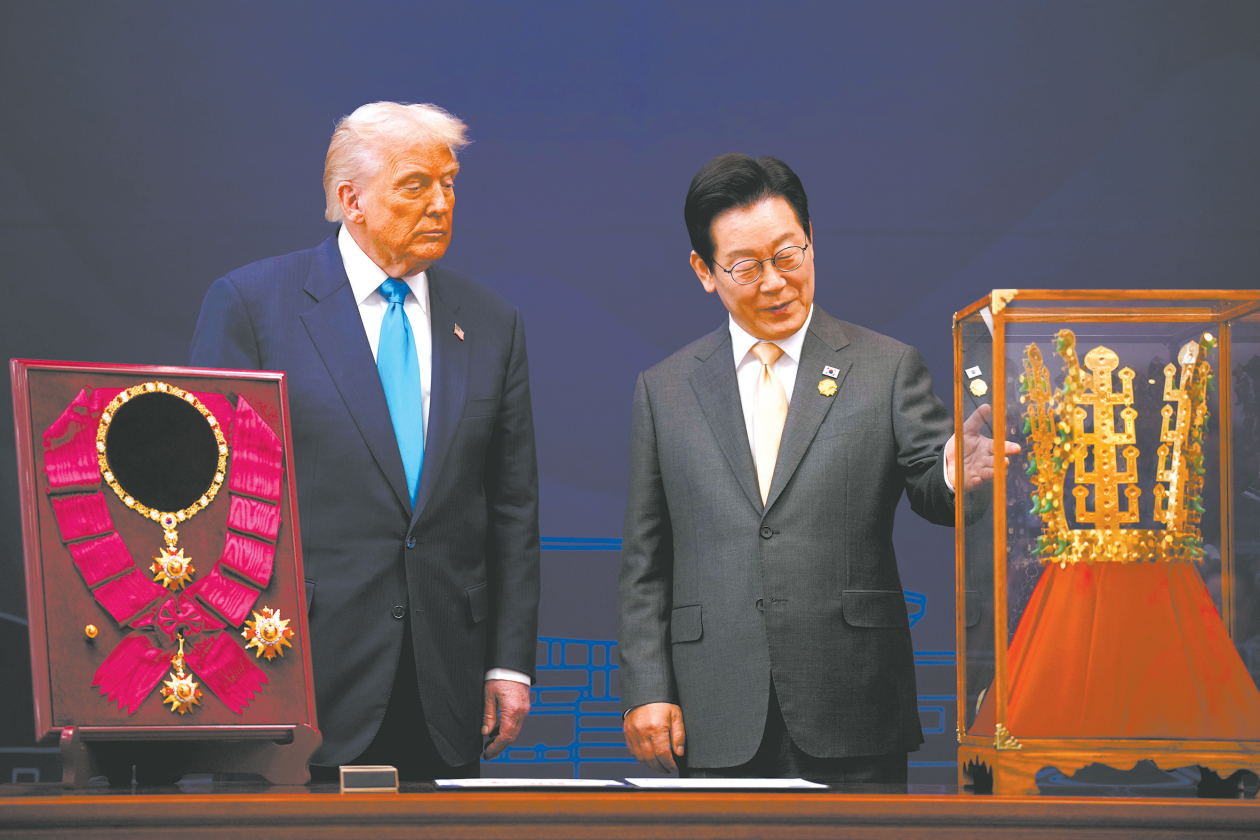
抵韩第一天获赠“金王冠”、无穷花大勋章,特朗普:我现在就想戴上
Guan Cha Zhe Wang· 2025-10-29 11:39
Core Points - The meeting between U.S. President Trump and South Korean President Lee Jae-myung aimed to ease trade and defense tensions between the two countries, highlighted by the presentation of significant gifts [1][3] - Trump became the first U.S. president to receive South Korea's highest honor, the "Mugunghwa Grand Order," recognizing his role as a "peace builder" on the Korean Peninsula [1][3] - The gifts included a replica of the "Golden Crown of Silla," symbolizing leadership and the historical pursuit of peace on the Korean Peninsula [3][4] Group 1: Diplomatic Relations - South Korea's efforts to impress Trump included a lavish welcome and gifts, reflecting a desire to secure concessions in ongoing tariff negotiations [5] - The U.S. and South Korea are currently at an impasse regarding a $350 billion investment plan, with disagreements over investment methods and responsibilities [5] - Trump's visit to South Korea follows his previous stops in Japan and Malaysia, indicating a strategic approach to strengthen alliances in the region [4] Group 2: North Korea Relations - Speculation surrounds the possibility of Trump meeting North Korean leader Kim Jong-un during his visit, although North Korea has shown little interest in such a meeting [6] - Trump's comments suggest a willingness to ease sanctions on North Korea in exchange for negotiations, despite North Korea's firm stance on retaining its nuclear capabilities [6] - Recent missile tests by North Korea have raised concerns, but Trump downplayed the significance of these actions during his visit [6] Group 3: Domestic Reactions - Protests against Trump's visit occurred in South Korea, with local groups criticizing his approach to the U.S.-South Korea alliance [6] - South Korean officials are concerned about potential demands from Trump regarding increased military spending and defense responsibilities [5][6] - Lee Jae-myung indicated that discussions on visa regulations and worker treatment are ongoing, highlighting the complexities of U.S.-South Korea relations [7]
韩美敲定贸易协议:韩国承诺3500亿美元对美投资,换取汽车15%关税、半导体产业关税优待
Hua Er Jie Jian Wen· 2025-10-29 11:19
Core Points - The US and South Korea have reached an agreement on specific terms of a trade deal, including a commitment from South Korea to invest $350 billion in the US [1][2] - The investment plan consists of $200 billion in cash investments, with an annual cap of $20 billion, and an additional $150 billion allocated for shipbuilding projects [2] - The agreement maintains a 15% tariff on automotive parts and ensures that semiconductor tariffs will not disadvantage South Korea [1][2][3] Investment Commitments - South Korea's $350 billion investment will be executed in two phases, with $200 billion as cash investments and $150 billion for shipbuilding [2] - The investment commitments are expected to be finalized by January 2029 [2] - This investment strategy mirrors a previous agreement between the US and Japan, indicating a consistent approach by the Trump administration towards major Asian economies [2] Tariff Arrangements - The US will maintain a 15% overall tariff level, with both countries agreeing on the same tariff rate for automotive parts [1][3] - South Korea has secured the most-favored-nation status for pharmaceutical tariffs, which is a significant advantage [3] - In the agricultural sector, South Korea successfully resisted demands for further market opening, particularly concerning rice and beef [2]