顺周期

Search documents
市场分析:半导体电池领涨,A股震荡上行
Zhongyuan Securities· 2025-11-13 09:11
Market Overview - On November 13, the A-share market opened lower but rose throughout the day, with the Shanghai Composite Index facing resistance around 4025 points[2] - The Shanghai Composite Index closed at 4029.50 points, up 0.73%, while the Shenzhen Component Index rose 1.78% to 13476.52 points[7] - Total trading volume for both markets reached 20,658 billion yuan, above the median of the past three years[3] Sector Performance - Key sectors showing strong performance included batteries, energy metals, chemical products, and semiconductors, while sectors like railroads, banks, and power showed weaker performance[3] - Over 70% of stocks in the two markets experienced gains, with energy metals and batteries leading the rise[7] Valuation Metrics - The average price-to-earnings (P/E) ratios for the Shanghai Composite and ChiNext indices are 16.40 times and 49.22 times, respectively, above the median levels of the past three years, indicating a suitable environment for medium to long-term investments[3] - The market is at a significant transition point, with the Shanghai Composite Index likely to consolidate around the 4000-point mark[3] Investment Strategy - Investors are advised to adopt a balanced allocation strategy focusing on "cyclical + technology growth" to capture structural opportunities[3] - Short-term recommendations include monitoring investment opportunities in batteries, energy metals, chemical products, and semiconductors[3] Risk Factors - Potential risks include unexpected overseas economic downturns, domestic policy changes, and macroeconomic disturbances that could impact the recovery process[4]
猛料!大消费主题全面喷发,A股近巅峰,风格将变?
Sou Hu Cai Jing· 2025-11-11 18:11
Group 1 - The A-share market is experiencing a divergence, with the main index rising by 0.53% while the ChiNext index fell by 0.92%, indicating a split in market sentiment driven by domestic positive news and international negative pressures [1] - The Producer Price Index (PPI) has shown signs of recovery, with a significant narrowing of the decline since August and a positive turn in October, signaling a rebound in industrial activity [1][4] - The surge in prices of key materials such as lithium hexafluorophosphate (up 140%) and polysilicon (up 80%) reflects a broader recovery in corporate profitability, exemplified by Tianqi Lithium's turnaround from losses to profits [1][4] Group 2 - The recovery in PPI is translating into a rise in the Consumer Price Index (CPI), which increased by 0.2% year-on-year in October, indicating a positive cycle where manufacturing profits lead to higher employee incomes and increased consumer spending [4] - The stock market is witnessing a rally in cyclical sectors, particularly in upstream resource stocks and consumer sectors such as liquor, tourism, and dairy, which are benefiting from the recovery in end-consumer demand [4] Group 3 - The ChiNext index is struggling due to concerns over high valuations in the artificial intelligence sector, with warnings from institutions about potential bubbles in tech stocks [6] - Despite the short-term pullback in AI stocks, the long-term growth narrative remains intact, as indicated by recent government policies aimed at fostering AI development [6] - The current market dynamics suggest a preference for more certain cyclical themes over speculative tech investments, leading to a divergence in performance between the main board and the ChiNext [6] Group 4 - The strong performance of the A-share market is not unfounded, as it reflects anticipations of economic recovery in the fourth quarter, despite a slight slowdown in GDP growth in the third quarter [8] - Investors face a dilemma between chasing the currently hot consumer sectors or positioning themselves in the adjusting tech stocks, highlighting the ongoing uncertainty in market trends [8]



市场分析:银行光伏行业领涨,A股小幅震荡
Zhongyuan Securities· 2025-11-11 09:17
Market Overview - On November 11, the A-share market experienced a slight fluctuation, with the Shanghai Composite Index finding support around 3991 points[2] - The Shanghai Composite Index closed at 4002.76 points, down 0.39%, while the Shenzhen Component Index fell 1.03% to 13289.01 points[7] - Total trading volume for both markets was 20,141 billion yuan, slightly lower than the previous trading day[7] Sector Performance - Strong performers included banking, photovoltaic equipment, non-metallic materials, and food and beverage sectors[3] - Weak performers were in insurance, aerospace, energy metals, and electronic components sectors[3] - Over 50% of stocks in the two markets saw gains, with photovoltaic equipment and food and beverage sectors leading the increases[7] Valuation Metrics - The average price-to-earnings (P/E) ratios for the Shanghai Composite and ChiNext indices were 16.37 times and 49.92 times, respectively, above the median levels of the past three years[3] - The current market is at a significant transition point, with the Shanghai Composite Index likely to consolidate around the 4000-point mark[3] Investment Strategy - Investors are advised to adopt a balanced allocation strategy focusing on "cyclical + technology growth" to capture structural opportunities[3] - Short-term market expectations lean towards steady upward fluctuations, with recommendations to maintain reasonable positions and avoid chasing highs or lows[3] Risk Factors - Potential risks include unexpected overseas economic downturns, domestic policy changes, and macroeconomic disturbances[4]

A股开盘速递 | A股三大股指集体高开 沪指涨0.13% 存储芯片等板块涨幅居前
智通财经网· 2025-11-11 01:36
Core Viewpoint - The A-share market is experiencing a collective rise, with significant gains in sectors such as storage chips, CPO, gold, and electricity, indicating positive market sentiment and sector performance [1] Group 1: Market Analysis - The three major A-share indices opened higher, with the Shanghai Composite Index up by 0.13% and the ChiNext Index up by 0.58%, reflecting a bullish market trend [1] - Institutional investors suggest increasing positions in chemical, non-ferrous, and new energy sectors, as these areas are expected to benefit from the ongoing AI narrative and improving return on equity (ROE) trends [2] - The current market volatility is attributed to changes in the underlying structure of incremental capital, with a shift towards stable absolute return funds reducing the effectiveness of traditional aggressive timing strategies [2] Group 2: Sector Recommendations - According to research, cyclical sectors such as non-ferrous metals, steel, and building materials are recommended for investment, driven by expectations of a strong cyclical year ahead [3] - The analysis indicates that the price increase in commodities is linked to historical patterns of PPI rises during significant political events in China and the U.S., suggesting a favorable environment for these sectors [3] - Emphasis is placed on the recovery opportunities in cyclical sectors like steel, chemicals, and building materials, alongside a focus on low-position technology growth areas such as AI software applications and military technology [4] Group 3: Future Outlook - The resource sector is anticipated to emerge as a new main investment direction following the technology sector, with a focus on key resources and military applications [5] - The A-share market is expected to maintain a bullish trend into 2026, although with a potential slowdown in growth rates, prompting investors to prioritize fundamental improvements and sector performance [5]
跨越拐点的顺周期航空,新变化新看点
2025-11-11 01:01
Summary of Airline Industry Conference Call Industry Overview - The airline industry is experiencing a recovery in fundamentals, outperforming other cyclical consumer sectors, with continuous profit improvement in the first three quarters of the year, and an expectation of profitability for the entire year due to declining oil prices and increased passenger load factors [1][3][5]. Key Factors Influencing Profitability - Key factors affecting airline profitability include ticket prices, passenger load factors, and oil prices. A 1% increase in passenger load factor has a more significant impact on overall industry profitability than a 1% increase in ticket prices [1][5]. - The decline in Brent crude oil prices has contributed to lower fuel costs, aiding profitability [1][5]. Future Expectations - Despite a challenging macro environment, the airline industry has achieved profitability, indicating substantial future growth potential. Ticket prices are expected to rise in 2026, further driving profit growth [1][6]. - The current macro environment shows that travelers are price-sensitive, leading to cautious pricing strategies. The turning point in supply and demand is expected to manifest more in passenger load factors rather than ticket price increases in 2025, with a higher likelihood of price increases in 2026 [1][7]. Supply and Demand Dynamics - Since 2019, the fleet size of airlines has expanded by over 20%. Currently, demand growth exceeds supply growth, which may eventually reflect in ticket prices [1][8]. - The recovery of international flights to 85% capacity has become a significant growth factor, with airlines reallocating more capacity to international markets, resulting in tighter domestic supply [3][9]. Ticket Price Trends - In 2025, ticket prices showed strong performance during the off-peak season, while peak season prices were weaker compared to previous years. This trend indicates a gradual recovery in business travel demand [11]. - The correlation between domestic ticket prices and commercial real estate metrics in major cities suggests that business travel activity significantly influences ticket pricing [11]. Historical Performance and Future Outlook - Historically, airline stocks have performed well in the fourth quarter, with 14 out of the last 20 years showing increases, often driven by macroeconomic expectations or specific policy changes [12]. - The fundamentals of airline stocks are gradually becoming clearer, with a significant increase in operational scale, indicating a more optimistic profitability outlook for the next two to three years [13][16]. Investment Strategy - For investment, airlines with relatively low valuations and lagging performance, such as China Southern Airlines and Spring Airlines, are recommended. For those seeking cyclical elasticity, Air China and China Eastern Airlines are preferred due to their significant marginal improvements and greater profit elasticity [18]. Conclusion - The airline industry is positioned for growth, with improving fundamentals, a favorable supply-demand dynamic, and potential for increased ticket prices in the near future. Investors are encouraged to consider cyclical stocks within this sector as they may offer substantial returns in the upcoming quarters [1][6][17].
公司固态变压器(SST)项目启动,多年数据中心深耕经验打开未来成长空间!
摩尔投研精选· 2025-11-10 10:41
Macro Strategy Insights - Recent price increases in commodities are driven by a rush to capitalize on the anticipated cyclical recovery in 2024, with potential synchronization between China and the U.S. [1] - Historically, years ending in 6 or 1 tend to see rising Producer Price Index (PPI) due to significant political events, while U.S. industrial metal prices typically bottom out in presidential election years and peak in midterm election years [1][2] Industry Tracking - The demand for lithium iron phosphate (LiFePO4) is improving, leading to price increases in various phosphate chemical products. Since 2024, phosphate rock prices have remained high, and the supply of phosphate rock may not meet expectations due to increased mining barriers and processing difficulties [3] - As of November 6, the average market price for yellow phosphorus reached 22,486 RMB/ton, up 527 RMB/ton from the previous week, reflecting a 2.34% increase [3] - The phosphate chemical market is supported by strong downstream demand, with companies actively seeking new suppliers to ensure stable supply amid tight market conditions [3] - The operational stability of phosphate chemical companies is bolstered by optimized product structures and sufficient operating cash flow, enhancing their capacity for cash dividends [3]

中金:恒指明年“基准”目标28,000至29,000点
智通财经网· 2025-11-10 06:52
Core Viewpoint - The Hong Kong stock market has undergone significant changes over the past year, with the Hang Seng Index (HSI) currently valued at 11.4 times earnings, which is above the average since 2015, indicating that it is not considered "cheap" [1] Group 1: Market Valuation and Expectations - The current market valuation is heavily reliant on earnings recovery rather than further expansion of valuation multiples or risk premiums [1] - Under a baseline scenario, if the weighted risk-free rate decreases from 3.4% to 3.1%, and if the technology and internet sectors see a return to their low risk premiums, the valuation upside could be around 5-7% [1] - In an optimistic scenario, if policies stimulate price recovery, there could be over 15% upside in valuations if other sectors also see a drop in risk premiums [1] Group 2: Profit Growth Projections - Under baseline assumptions, the projected profit growth for Hong Kong stocks is 3% for 2026, with non-financial sectors expected to grow by 6-7% and financial sectors projected to have zero growth [2] - The expected index levels for the HSI are between 28,000 to 29,000 points under baseline conditions, with optimistic and pessimistic scenarios projecting 31,000 and 21,000 points respectively [2] Group 3: Investment Strategy Recommendations - The company suggests maintaining a focus on dividend-paying assets to navigate the weak overall credit cycle, indicating a need for continued monetary easing [2] - In a weak credit expansion environment, the company recommends focusing on sectors that can still expand credit, particularly in AI technology, emerging industries, and those linked to U.S. demand [2] - Specific sectors recommended for overweight positions include AI software and hardware, new energy, chemicals, home furnishings, and innovative pharmaceuticals, while underweight positions are suggested for real estate, food retail, and personal household goods [3]
转债周度专题:下修空间继续缩窄-20251110
Tianfeng Securities· 2025-11-10 06:12
Group 1 - The willingness to adjust convertible bonds is decreasing, with only 10% of proposed adjustments in October compared to 21% in September, indicating a shrinking adjustment space [1][13][19] - The proportion of convertible bonds with a price in the (0,80] range has decreased from 40.7% at the beginning of the year to 20.0%, reflecting a continuous reduction in potential adjustment space [1][19] - The market is seeing a shift from adjustment strategies to focusing on the underlying stocks, with an emphasis on opportunities related to undervalued stocks in the context of optimistic market expectations [2][22] Group 2 - The convertible bond market has shown positive performance, with the China Securities Convertible Bond Index rising by 0.86% this week, alongside an increase in average daily trading volume to 685.26 billion [3][31] - A total of 17 industries saw gains, with the retail, coal, and steel sectors leading the market, while the computer, media, and electronics sectors experienced declines [3][30][38] - The weighted average conversion value of the market has increased to 104.67 yuan, with a corresponding decrease in the premium rate to 37.68% [4][48] Group 3 - The supply of convertible bonds is tightening, with two new bonds issued this week and several announcements regarding potential adjustments and redemptions [5][24] - The market is advised to focus on convertible bonds nearing their adjustment periods, considering factors such as remaining term and financial pressure to identify potential adjustment candidates [1][19][24] - The report highlights the importance of monitoring structural opportunities in sectors like technology, consumer goods, and cyclical industries, particularly in the context of economic recovery [2][22][24]
帮主郑重:创业板跌超2%!A股早盘分化,午后这么干不慌
Sou Hu Cai Jing· 2025-11-10 04:31
Core Viewpoint - The market is experiencing a divergence, with the ChiNext index dropping over 2% primarily due to a pullback in computing hardware stocks, while cyclical sectors like chemicals and consumer goods are gaining strength, indicating a shift in market dynamics [3] Group 1: Market Analysis - The decline in the ChiNext index is attributed to profit-taking in computing hardware stocks, which had previously seen significant gains [3] - Despite the drop in certain sectors, over 2,900 stocks in the market are still in the green, and trading volume has increased, suggesting that the market retains vitality and is merely adjusting its rhythm [3] - The long-term logic for computing stocks remains intact, but short-term volatility should be managed [3] Group 2: Investment Strategy - Investors holding computing stocks should maintain their positions as long as key support levels are not breached, avoiding panic selling [3] - For those looking to enter the market, it is advisable to wait for a suitable pullback before gradually accumulating positions [3] - In cyclical sectors, such as chemicals and dairy, investors should avoid chasing high prices and instead look for opportunities after corrections, while managing their positions carefully [3]


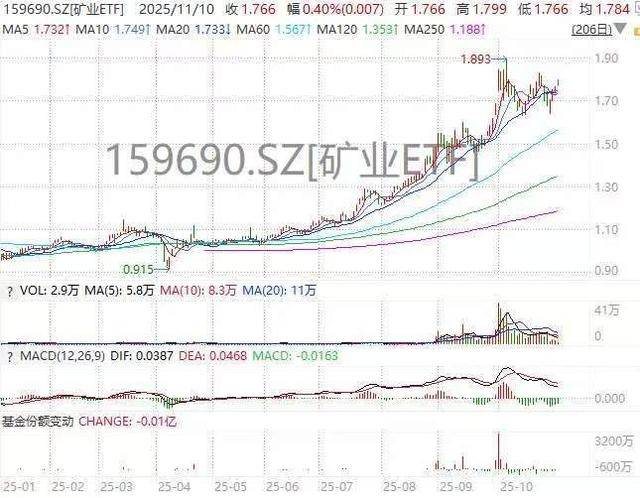
矿业ETF(159690)盘中飙涨2.27%,华钰矿业、湖南黄金、盛新锂能领衔
Sou Hu Cai Jing· 2025-11-10 03:16
Group 1 - The resource sector is showing strong performance, with the mining ETF (159690) rising by 2.27% during trading, led by companies such as Huayu Mining, Hunan Gold, and Shengxin Lithium Energy [1] - The current strength of the sector is supported by solid supply and demand fundamentals, with supply constraints due to declining ore grades and insufficient capital expenditure, alongside geopolitical factors increasing supply uncertainty [3] - The rapid development of the new energy industry is driving demand for strategic metals like lithium and cobalt, while a manufacturing recovery is boosting demand for minor metals [3] Group 2 - Multiple institutions are optimistic about the resource sector, with Citic Securities recommending an increase in positions in cyclical industries, citing a favorable risk-reward ratio [4] - According to招商证券, 2026 will see a cyclical resonance between China and the US, making non-ferrous metals a key focus for investment [4] - The mining ETF (159690) is highlighted as an effective investment tool, covering various strategic resources and demonstrating significant price elasticity during rises in non-ferrous metal prices, often outperforming the underlying commodities [4]