资产配置

Search documents
每周大类资产配置图表精粹-20250812
Huachuang Securities· 2025-08-12 05:51
Group 1: Monetary Policy and Economic Indicators - The Federal Reserve's financial pulse growth index (FCI-G Index) for 1-year dropped to -0.4, the lowest since July last year, indicating strong monetary policy support for corporate output and employment[4] - The 3-year FCI-G Index fell to -0.7, the lowest since April 2022, suggesting that the necessity for rate cuts this fall is not as pressing as last year[4] - As of August 8, the S&P 500 index EPS growth reached 10%, significantly exceeding the expected 4%, reflecting robust U.S. economic growth[7] Group 2: Market Positioning and Speculation - Broad dollar speculative net positions shifted from short to long, with net long positions reaching 31,000 contracts, the highest since April this year[7] - The speculative net short positions in S&P 500 mini contracts decreased to 119,000, a two-month low, after a significant increase in July[10] - The overall credit standards of U.S. commercial banks marginally eased, with the percentage of banks tightening credit for large enterprises dropping from 18.5% to 9.5%[15] Group 3: European Economic Conditions - The European Central Bank has cut rates three times this year, yet broad credit and bank lending in the Eurozone have not expanded significantly, with M3 growth dropping to 3.3%, the lowest since September last year[13] - The Eurozone's non-financial corporate credit growth fell to 2.3%, indicating a need for further ECB rate cuts[13] Group 4: Risk Premium and Investment Returns - The equity risk premium (ERP) for the CSI 300 index is at 5.1%, one standard deviation above the 16-year average, suggesting potential for valuation uplift[17] - The forward arbitrage return for China's 10-year government bonds is 19 basis points, 49 basis points higher than December 2016 levels, indicating attractive returns[21] - The total return ratio of domestic stocks to bonds is 25.1, above the 16-year average, enhancing the appeal of equity assets over fixed income[29]
年轻人该如何做好股票投资
Di Yi Cai Jing· 2025-08-12 04:59
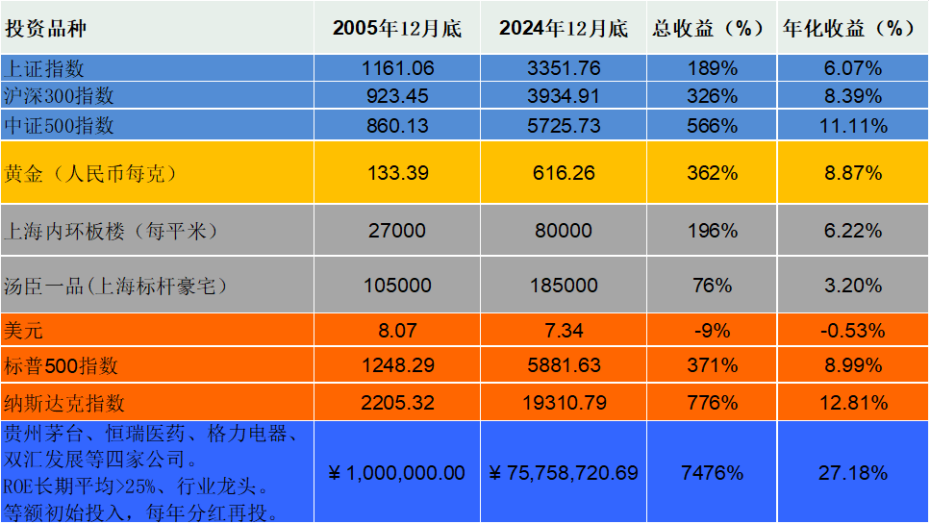
Core Insights - The article emphasizes the importance of selecting good companies, waiting for reasonable prices, and maintaining long-term investments in the stock market [1][9] Investment Returns - Over the past decade, investments in A-shares yielded nearly five times returns, averaging an annualized return of 16%, which is below the target of tenfold returns set ten years ago [1][2] - A 10% annualized return is significantly more beneficial compared to the current bank interest rates of around 2% [2] Investment Approach - The article advocates for a serious approach to stock investment, highlighting that stocks represent ownership in companies rather than mere trading instruments [3][4] - It suggests that understanding financial statements and key performance indicators (KPIs) is crucial for evaluating companies [7] Long-term Investment Strategy - The long-term performance of various investment assets shows that stocks, particularly those of leading companies, provide substantial returns, with some companies achieving an annualized return of 27.18% [6][7] - The article encourages young investors to set clear investment goals and adopt a diversified asset allocation strategy to mitigate risks [8][9] Recommended Investment Practices - Young investors are advised to start with index funds and gradually explore sector-specific ETFs to benefit from different industry growths [9] - The importance of global investment opportunities is highlighted, suggesting that young investors should not limit themselves to domestic markets [9]





国泰海通晨报-20250812
Haitong Securities· 2025-08-12 02:17
Group 1: Strategy and Market Outlook - The report maintains a tactical overweight view on A-shares and US stocks for August, driven by improving risk appetite and favorable macroeconomic conditions [4][5][20] - The strategic asset allocation (SAA) plan is set with a target allocation of 45% equities, 45% bonds, and 10% commodities, with a maximum deviation of 10% [4][19] - The tactical asset allocation (TAA) plan forecasts a 2025 annualized return of 55%, with a Sharpe ratio of 1.65, suggesting strong performance in equity assets [5][20] Group 2: Construction Industry Insights - Historical reviews of three central Xinjiang work conferences indicate significant price elasticity for construction companies in the Xinjiang region, with notable stock price increases following these events [7][9] - Xinjiang's fixed asset investment grew by 16.2% in the first five months of 2025, with industrial investment increasing by 22.8%, particularly in wind and solar energy projects [8] - The establishment of the New Tibet Railway Company with a registered capital of 95 billion yuan is expected to boost infrastructure projects in Xinjiang, with a total investment plan of 3.47 trillion yuan for 500 key projects [9][10] Group 3: Aerospace Industry Developments - The report highlights a critical shortage in China's rocket launch capacity, which is a bottleneck for low Earth orbit satellite deployment [11][13] - The acceleration of low Earth orbit satellite networks is emphasized, with a target of deploying approximately 23,000 satellites by 2030, necessitating significant improvements in rocket launch capabilities [13][14] - The development of reusable rockets and liquid fuel technologies is identified as essential for enhancing launch capacity and reducing costs [14]
避险需求升温 “购金潮”席卷全球央行
Jing Ji Wang· 2025-08-12 02:03
Group 1 - Brazil's gold exports surged by 60% year-on-year in the first half of 2025, driven by increased attractiveness of gold as a value reserve due to U.S. tariff policies [1] - The mining trade surplus in Brazil reached $16.01 billion, accounting for 53% of the national trade surplus, with mineral exports totaling $20.1 billion and imports at $4.1 billion [1] - Gold is recognized as a strategic mineral by multiple countries, highlighting its importance in Brazil's key mineral policy formulation [1] Group 2 - The spot price of gold in London has increased by 3.31% since August, with December futures reaching a record high of $3,534.1 per ounce on August 8 [2] - The share of gold in global foreign exchange reserves has been gradually increasing, with the IMF reporting that the dollar's share has declined to 57.4% as of Q1 this year [2] - Central banks' gold purchases, while slowing in Q2 2025, remain significantly higher than the average from 2010 to 2021, indicating sustained demand amid geopolitical tensions and economic uncertainty [2] Group 3 - Gold investment is viewed as a reliable long-term store of value, effectively hedging against inflation risks [3] - Historical data shows that while gold prices may fluctuate in the short term, the long-term trend is upward, ensuring the preservation of asset value [3] - The increase in official gold reserves globally reflects a long-term asset allocation strategy to safeguard national wealth [3]
申万宏源“研选”说——除了股债,我还能通过产品买什么其他资产?
申万宏源证券上海北京西路营业部· 2025-08-12 02:00
Core Viewpoint - The article emphasizes the importance of diversifying investment portfolios beyond stocks and bonds by considering commodity ETFs, which can provide opportunities to mitigate risks and capture investment potential in various commodities related to daily life [1]. Group 1: What is Commodity ETF? - Commodity ETFs are funds that track the price movements of commodities such as gold, copper, and soybeans, allowing investors to gain exposure without directly buying physical assets [3]. Group 2: Reasons to Consider Commodity ETFs - Commodity ETFs offer convenience compared to physical assets, with lower entry barriers, simpler operations, and flexible trading options [4]. - They help in risk diversification as commodity price movements may not correlate with stocks and bonds, potentially reducing overall portfolio volatility [4]. - They provide access to investment opportunities in long-term trends, such as global energy transitions, which may not be fully captured by traditional stock and bond investments [4]. Group 3: Types of Commodity ETFs - Gold ETFs can serve as a hedge against stock market volatility and inflation, allowing investors to benefit from gold price increases without holding physical gold [6]. - Agricultural commodities like wheat and corn, as well as economic crops like soybeans and cotton, exhibit high volatility but have low correlation with stocks and bonds over the long term, making them suitable for differentiated portfolio allocation [7]. Group 4: Considerations for Investing in Commodity ETFs - Commodity assets may experience greater short-term volatility compared to stocks and bonds, necessitating a strong understanding of the supply and demand dynamics and influencing factors of different commodities [10][11]. - Commodity investments are non-yielding assets, meaning they do not generate interest or dividends; returns primarily come from price changes [11]. Group 5: Conclusion - Overall, commodity ETFs can enrich investment choices beyond stocks and bonds, with categories like gold, non-ferrous metals, energy, and agricultural products each offering unique characteristics that can enhance portfolio diversification [12].


国泰海通:8月维持对A股与美股的战术性超配观点
Zhi Tong Cai Jing· 2025-08-11 22:35
Group 1 - The core viewpoint is that the tactical overweight stance on A-shares and US stocks is maintained, driven by improving market risk appetite and favorable macroeconomic conditions [1][2] - The current low interest rate environment necessitates higher demands for asset allocation research, with a long-term trend of institutional capital entering the market supported by diverse investment tools [2] - The strategic asset allocation (SAA) plan has a year-to-date annualized return of 9.1% and a Sharpe ratio of 1.57, with a target allocation of 45% equities, 45% bonds, and 10% commodities [2] Group 2 - The improvement in risk appetite is identified as a key factor influencing current tactical asset allocation, with multiple factors expected to support strong performance in equity assets [3] - The tactical asset allocation (TAA) plan projects an annualized return of 55% by 2025, with a high Sharpe ratio of 1.65 from backtesting [3] - The August allocation recommendation suggests 55% in equities, 40% in bonds, and 5% in commodities, with a positive outlook on A-shares and Hong Kong stocks, and a cautious stance on government bonds due to market pressures [3]

中原信托成功举办“中蕴经纬·原观澜变”投资策略报告会
Sou Hu Cai Jing· 2025-08-11 15:24
Core Insights - The "Zhongyun Jingwei·Yuan Guanlan Bian" investment strategy report conference was held in Zhengzhou, attracting over a hundred clients to discuss market opportunities [1] - The event emphasized the importance of professional investment strategies and forward-looking perspectives in wealth management amid a complex economic environment [3] Macroeconomic Analysis - Dr. Deng Shubin, Chief Economist of Zhongyuan Securities, provided an in-depth analysis of the macroeconomic outlook for the second half of the year, highlighting significant growth in service consumption and the resilience of the Chinese economy despite structural issues and external risks [4] - The central government aims to "expand residents' property income" as a key path to boost consumption, with the value of stock asset allocation becoming increasingly prominent in the current recovery environment [4] Market Insights - Mr. Zhang Liang, General Manager of Shenzhen Zhongou Ruibo, noted a significant positive shift in domestic policies, indicating the end of the bear market and the beginning of a bull market, with a focus on sectors such as technology, innovative pharmaceuticals, and gold for growth opportunities [6] - The current economic resilience, coupled with increased external uncertainties, suggests that the bond market is entering a period of fluctuation, where bonds should be viewed as a "core allocation" to balance investment portfolio volatility [9] Wealth Management Solutions - The "He Account" one-stop wealth management service was introduced by Mr. Wang Ningqi, emphasizing the solution to multi-account configuration challenges and the benefits of asset isolation and targeted inheritance through trust legal structures [10] - The conference showcased Zhongyuan Trust's commitment to providing professional and forward-looking market insights and asset allocation strategies, reinforcing its dedication to client-centric wealth management [12]

国泰海通|策略:风险偏好改善支撑全球权益配置价值
国泰海通证券研究· 2025-08-11 14:15
Core Viewpoint - The article maintains a tactical overweight view on A-shares and US stocks for August, driven by improving market risk appetite and expectations of economic growth [1][2]. Group 1: Market Conditions - Recent improvements in market risk appetite have led to risk assets significantly outperforming safe-haven assets, with equities outperforming commodities and bonds [1]. - The expectation of continued economic growth and government support for capital markets is leading to a highly optimistic outlook for A-shares [1]. - The US stock market is viewed positively due to a reduced probability of recession and increasing chances of interest rate cuts [1]. Group 2: Asset Allocation Strategy - The current low-interest-rate environment necessitates higher demands for asset allocation research, with a long-term trend of increased institutional investment in capital markets [1]. - A strategic asset allocation (SAA) plan has been constructed based on macro factors, achieving an annualized return of 9.1% and a Sharpe ratio of 1.57 as of the end of July [1]. - The proposed strategic benchmark allocation is set at 45% for equities, 45% for bonds, and 10% for commodities, with a deviation limit of 10% [1]. Group 3: Tactical Asset Allocation (TAA) - The improvement in risk appetite is identified as a core factor influencing the current tactical asset allocation, with multiple factors expected to support continued strong performance in equity assets [2]. - The TAA plan projects an annualized return of 55% by 2025, with a high Sharpe ratio of 1.65 based on full sample backtesting [2]. Group 4: Specific Allocation Recommendations - For August, the recommended allocation is 55% in equities, 40% in bonds, and 5% in commodities [3]. - A positive outlook is maintained for A-shares and Hong Kong stocks due to stable economic growth expectations and government support [3]. - Caution is advised regarding government bonds due to pressures from market risk appetite and capital redemption [3]. - The outlook for commodities, particularly oil, remains cautious due to supply and demand pressures [3].

国泰海通 · 晨报0812|策略、建筑工程、航空航天
国泰海通证券研究· 2025-08-11 14:15
Group 1: Market Strategy and Asset Allocation - The core viewpoint emphasizes an improvement in risk appetite supporting global equity allocation value, with a tactical overweight on A-shares and US stocks as of August [3] - The current low interest rate environment necessitates higher demands for asset allocation research, with a strategic asset allocation (SAA) plan yielding an annualized return of 9.1% and a Sharpe ratio of 1.57 as of the end of July [3] - The proposed strategic benchmark allocation is set at 45% for equities, 45% for bonds, and 10% for commodities, with a deviation limit of 10% [3] Group 2: Tactical Asset Allocation Insights - The enhancement of risk appetite is identified as a key factor influencing current tactical asset allocation, with expectations of continued strong performance in equity assets supported by various factors including technological breakthroughs and government support for capital markets [4] - The tactical asset allocation (TAA) plan anticipates a 55% weight in equities, 40% in bonds, and 5% in commodities, reflecting optimism for A-shares and Hong Kong stocks, as well as marginal optimism for US and Japanese stocks [4] - Caution is advised regarding government bonds due to market risk appetite adjustments and redemption pressures, while commodity prices, particularly oil, may face dual pressures from supply and demand [4] Group 3: Infrastructure Opportunities in Xinjiang - Historical reviews of three central work conferences on Xinjiang indicate significant stock price increases for key construction companies following these meetings, with notable gains such as 45.6% for Beixin Road and Bridge after the first conference [10] - Fixed asset investment in Xinjiang increased by 16.2% in the first five months of the year, with industrial investment rising by 22.8%, particularly in wind and solar energy projects [11] - The establishment of the Xinjiang Tibet Railway Company with a registered capital of 950 billion yuan highlights ongoing infrastructure investment, with plans for 500 key projects totaling 3.47 trillion yuan by 2025 [12] Group 4: Coal Chemical Industry Development - The coal chemical sector in Xinjiang is projected to experience a construction peak, with planned projects exceeding 800 billion yuan, driven by policy support [13] - Companies like China Chemical and Donghua Technology are positioned to capitalize on traditional coal chemical market opportunities, with significant new orders reported [13] Group 5: Aerospace and Satellite Deployment - The acceleration of low Earth orbit (LEO) satellite deployment is identified as a critical area, with a projected need for 2.3 million satellites by 2030, necessitating enhanced rocket launch capabilities [18] - Current rocket launch capacity is insufficient to meet the demand for satellite deployment, with an annual requirement of 1,500-2,000 tons compared to the current capacity of approximately 200 tons [19] - Reusable rocket technology is highlighted as a key factor in reducing launch costs, with liquid fuel rockets becoming the mainstream choice for new generation reusable rockets [20]

与其想着在牛市发财,不如先避免成为牛市的受害者
雪球· 2025-08-11 13:01
Core Viewpoint - The current market situation suggests a potential bull market, but many investors may not be adequately prepared for it [2][8]. Group 1: Historical Experiences - In the 2014-2015 bull market, the company engaged in numerous trades but struggled to keep up with the market, resulting in minimal gains [4][5]. - During the 2019-2020 bull market, the company focused on broad index products, achieving annual returns of over 30%, which were considered relatively low at the time [6]. Group 2: Investment Strategies - The company emphasizes the importance of responding to market conditions rather than attempting to predict them, suggesting that most investors should adopt a more reactive approach [9][10]. - Two key strategies for responding to a bull market include: 1. Investing a significant portion of funds in equity markets when market positions are not high, and being willing to increase investments during market pullbacks [11]. 2. Accepting average market returns rather than seeking quick profits, which may involve diversifying investments across broad indices to mitigate risks [11][12]. Group 3: Market Dynamics - The current market index levels may not accurately reflect the underlying sector performances, as value stocks have contributed significantly to index gains, while other sectors may still have room for growth [11]. - The company suggests that the best approach for ordinary investors is to increase equity allocations during market lows and focus on responding to market changes rather than making predictions [16].